
40 percent of all students drop out of college—with over 20,000 degree programs in Germany, this isn’t a sign of a lack of opportunities, but rather an indication of poor choices. “Finding the right career is a matter of analyzing your own abilities and, above all, a matter of self-confidence”—that’s the view of the 15-member team at the young company “Mein Mutiger Weg.” It visits schools to show how things could work out—and what young people should do.

Over 20,000 degree programs, over 320 vocational training programs. Would you like a little more? Probably not. Most young people study business administration. The field promises security, much like law, or meets a need, like psychology. Together with medicine, computer science, mechanical engineering, and economics, these are the “top choices.” In the worst-case scenario, young people are pushed into certain careers by those around them. A bigger problem, however, is the fear of making mistakes, according to what was said that morning at the Steinmühle. Career guidance for 11th graders, who often don’t yet know where their journey will take them after graduation.


Identifying Your Own Strengths

High school graduation—what’s next? It’s a question that’s always been around. But navigating the maze of options, identifying one’s own strengths, and choosing the right path seems harder than ever. Brothers Pascal and Frederic Keller have launched a startup to improve the situation for young people: “…we’ve been there ourselves.” Now the two brothers from the Palatinate are touring the entire country with their team to tell high school students how career guidance can be effective. Their mission: “Mein Mutiger Weg” (My Courageous Path).

Using a workbook and an engaging presentation that puts them on the same level as the students and speaks their language, Pascal and Frederic Keller guide the students through the morning with numerous real-life examples. A list of professions—in no particular order—gives them a glimpse of the wide range of possibilities.

The young people on the organizing team—all under 30 themselves—admit: “Some people already know what they want to be by the eighth grade.” If that’s not the case, the goal is to identify one’s own strengths. “Why not ask classmates and friends who know you well what you’re good at?” is one suggestion.


Gaining Experience Through Internships

Internships can also be a great way to identify your own strengths. There are as many as 53,000 open internship positions in Germany. If you find one that interests you, it’s time to start applying—another step, another hurdle. What does the hiring manager want to hear?

When asked about their strengths during job interviews, many applicants gave standard answers. “I’m reliable,” “I’m creative”—these kinds of responses hardly impress anyone anymore. Instead, it’s about sharing what you’ve already accomplished on your own, what you’ve actually done—even outside of school—even if it’s unusual. “Have the confidence to talk about what you’re capable of.” A story, an example. That’s how hiring managers can see which direction you’re headed. Your career choice is a success when you can apply your strengths as often as possible in your day-to-day work—when you can make a reality of what’s important to you in life.”


Digital Help

Along the way, participants can also take advantage of digital resources for career guidance. These include simulated job interviews and help navigating the maze of available opportunities. The organizing team invites followers to check out its Instagram channel @meinmutigerweg and also recommends the platforms www.traumjob-campus.de and www.berufenet.arbeitsagentur.de.

The Federal Employment Agency’s career counseling service was specifically recommended by the “Mutmacher-Crew” as one of several key components. For students at Steinmühle, Annerose Glöckner is the designated career counselor at the Federal Employment Agency in Marburg. She was also present at the Steinmühle event; among other things, she can help students find internships and offers individual counseling for students in the E-phase. Contact: annerose.gloeckner@arbeitsagentur.de. The contact person for career guidance at Steinmühle is Dr. Claudia Röder.
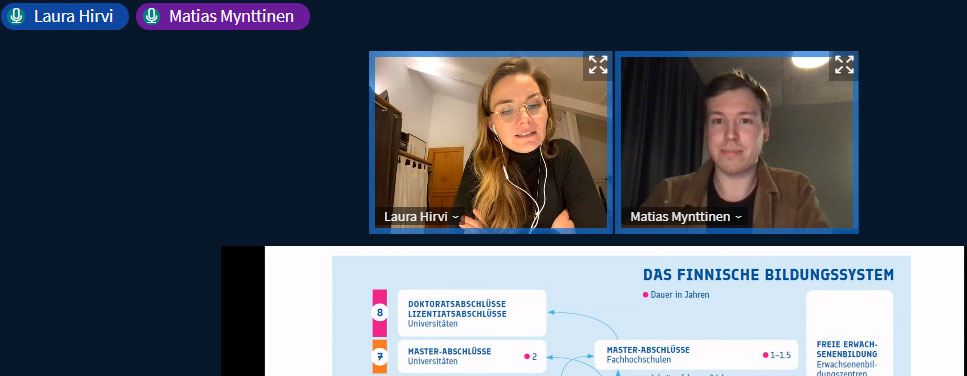
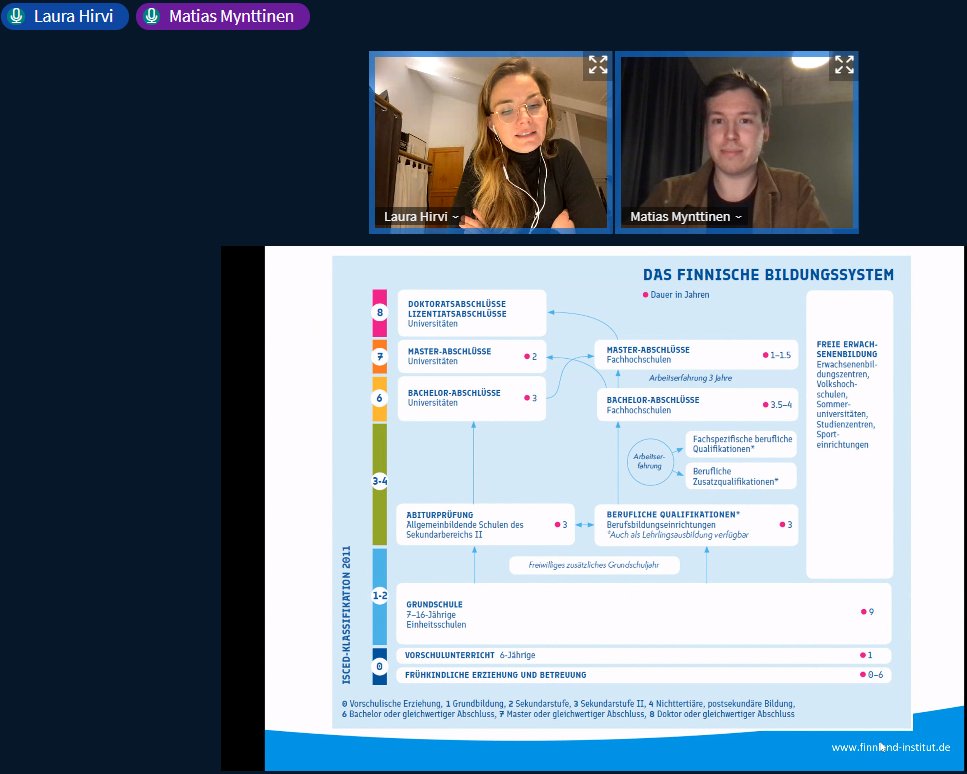
The Finnish education system is considered a model for Europe. Furthermore, the latest “World Happiness Report” recently revealed that the happiest people in the world live in Finland. After all, the report analyzed data from 156 countries!

So what is the Finnish education system all about, given that it sets the course for the lives of young people in Finland? Using Big Blue Button, the Steinmühlen teachers recently attended a presentation by Dr. Laura Hirvi. The director of the Finland Institute in Berlin spoke about the Finnish education system.


Home learning is possible

There are fundamental differences between the Finnish and German school systems: For example, there is no compulsory education. But anyone who thinks this means students aren’t learning is sorely mistaken: “The Finns,” says Dr. Laura Hirvi, “actually learn throughout their lives.” In Finland, the obligation to learn can also be fulfilled at home. Anyone who wishes to do so can apply for home schooling. The acquisition of knowledge actually begins even before school. The country, with its 5.5 million people, already invests heavily in its preschools, which also teach through play.


Comprehensive School Through Age 16

The comprehensive school system for all students between the ages of 7 and 16 is based on a different concept than the one in this country. The goal is to spare young people from having to make early decisions, which is believed to promote equal opportunity. However, this does not prevent students from competing for high Abitur scores. “It is,” says Dr. Laura Hirvi, “a major competition in the upper secondary school.” Meanwhile, digital high school graduation exams are standard in Finland. A 10-week summer break allows for a long respite from the curriculum.

And what about the people in the school community? Dr. Laura Hirvi reports that teachers enjoy a fairly high status. They are held in high regard, their working hours are usually clearly defined, and many are civil servants. However, there is no evidence that students are subject to strict rules. On the contrary, they are encouraged to make their own decisions. And in fact, children in Finland often become independent at an earlier age.

However, there is at least one rule that is simply “set in stone”: From 8 a.m. to 4 p.m., all students are provided for, and the shared meal is part of the curriculum. That’s just the way it is. And it cannot be changed by any other decision, such as one made by the parents.

Dr. Laura Hirvi’s presentation took place as part of an Erasmus project on the individualization of learning and development processes, in which Steinmühle is participating together with the teacher training college and the Europaschule Gladenbach.

Images of bombed-out houses, scenes of war, dust, rubble, and ash: The images of Iraq shown on the news are authentic, but they don’t tell the whole story. This country—which is actually rich yet plagued by extreme poverty—has other facets as well. Selfies, hookah, bike races, pool, and excessive drinking under one of Baghdad’s Tigris bridges, where young men gather at night. At night, “at a bearable 35 degrees,” as Vincent Haiges says. People’s lives take place outdoors.

The former student at the Steinmühle boarding school lived in Iraq for two years—first in the north, then in the capital. He also visits other crisis-stricken areas—to touch on sensitive issues, to contribute to global transparency, and to get to know other perspectives. To provide a more complete picture, offer explanations, and share knowledge.


“Freedom comes with responsibility”

After graduating from high school, Haiges went on his first trip; at age 21, he arrived in Morocco. “Tell me about Germany,” he can still hear Mustafa say today. That was the moment Haiges began to become aware of global inequality. But what was he to do with that realization? he asked himself.

He realized that freedom comes with responsibility. Vincent Haiges began his studies in Vienna and London, focusing on conflict studies and international law.

He graduated from the university with a master’s degree in political science. His drive to seek out the world’s hotspots, capture the events through photography, and present them has remained undiminished.

This works well through images, and his documentaries resonate with audiences. A high-profile group of clients in the media sector is interested in what Vincent Haiges brings back to the safety of Central Europe: *Der Spiegel*, Deutsche Welle, *Die Zeit*, and the Goethe-Institut. But foreign publications are also interested: from Japan, Switzerland, and even Al Jazeera. Vincent Haiges also documents events in crisis zones for the UN.


“They were wearing masks— not because of COVID-19″

When the reporter talks about excessive drinking under the Tigris Bridge, he does not intend to downplay the violence and terror in the country. His visit to a maximum-security prison in Mosul, northern Iraq, remains his worst memory. According to Haiges, photos were able to capture what was happening there. “You could see people wearing masks.” “…But not because of COVID-19, but because of the smell of corpses.”

Over time, these experiences have instilled a certain humility in the reporter. Not everyone is cut out to be a crisis reporter, even if they can write or take photographs. It takes the ability to connect with people, a clear willingness to adapt, and a genuine desire to be one of them—at least temporarily. Vincent Haiges learned Arabic and always works with a female colleague who conducts on-site interviews with women—due to the social role of Iraqi women. In their presence, a foreign man is taboo, let alone as an interview subject. Nevertheless, bringing in a local producer and translator—a so-called “fixer”—is a necessity. It’s a system—albeit a manageable one—that must be organized and made to function.


“Let’s not get too at once”

During the lecture at the Steinmühle, Haiges is asked if he ever burns out. He finds peace during necessary breaks at his apartment in Berlin-Kreuzberg—a place whose very name instills respect in many people from the provinces. Some ways to maintain strength and energy are time-honored but still effective, says Haiges: taking breaks, not trying to do too much at once, eating well and sleeping well, and exercising.

His invisible adversary: post-traumatic stress disorder.

Vincent Haiges, born in 1988, still remembers rowing coach Martin Strohmenger as the head of his boarding house. Memories linger on both sides, though their priorities are certainly different today. While the Steinmühlen community began the new year quietly amid the ongoing lockdown, Haiges was preparing for his next mission in January. This time, it was in Europe—Bosnia, near the Croatian border.

He was asked if he would be ready again so soon, and his answer was clear: “Believe in what you’re doing. It’s the most important factor in resilience.”

(Vincent Haiges gave the presentation in December to 13th-grade students, in compliance with pandemic-related regulations. The event was organized by Bernd Hülsbeck, a teacher of politics, economics, and history at Steinmühle.)