In March, the COVID-19 pandemic brought massive disruptions to our personal, academic, and social lives and required great sacrifices from all of us. As the Easter break approached, the boarding school was therefore committed to offering the children a restful and carefree vacation and, in doing so, providing some relief to their parents. And so, the boarding school students were given the opportunity to spend the entire Easter break on the Steinmühle grounds—under the constant supervision of the on-site educational team, safe and secure with no contact with the outside world, enjoying a wide range of recreational activities on the spacious campus, homeschooling, and special projects.


Take some time to focus on your personal interests

In addition to the daily recreational activities and support with homework while working from home, the opening of special project rooms was primarily intended to allow students to pursue personal interests that often take a back seat during the regular school year, or to broaden their horizons beyond the classroom.

The students interested in technology took their first steps in programming by working with the Arduino microcontroller and taking online courses on artificial intelligence offered by the University of Helsinki. This is a skill that is already in high demand today, but will be particularly sought after in future societies.


Learn a Foreign Language or Become an Office Pro

There were also extensive opportunities for anyone who wanted to develop their practical everyday skills. The program included learning another foreign language, as well as professional training in all Office applications and improving touch-typing skills. Our high school graduates in particular—who, despite all the challenges, had taken their written exams in a nearly heroic manner before the break and most of whom will be heading to college—showed great interest and dedication in these programs.

All athletes had the opportunity to train for the German Sports Badge, hone their basketball skills under the guidance of a basketball player, earn their C-level fitness trainer certification, or take a closer look at currently very popular fitness apps to assess their user-friendliness.

Anyone who wanted to hit the dance floor was in the right place in the boarding school’s mirror hall. Under the guidance of Timo, one of our 12th graders, students learned the rhythms of disco fox and cha-cha-cha, as well as the elegance of the tango, so they can cut a fine figure on any dance floor in the future.


My Own Creations on the Sewing Machine

Creative talents should also be given the freedom to flourish. In a hand-lettering class, the young people were able to practice their calligraphic skills and learn “the art of beautiful writing.” With Easter just around the corner, it was the perfect opportunity to send greeting cards and Easter wishes.


Upcycling projects—the processing and reuse of waste materials—have been very popular for years, especially when it comes to creating new furniture from old pallets. So, some students at the Westfalenhaus “armed” themselves with pencils, hammers, and paintbrushes to enhance the garden for the coming summer with a garden lounge, where future students will also be able to enjoy Marburg’s sunny days.


In addition, thanks to the active support of Corinna, one of our housekeepers, the boys and girls were able to showcase their talent at the sewing machine. Old clothes were transformed into new, original creations, and by sewing face masks, they rose to the challenge of the current situation.


Easter Break at Steinmühle: Perhaps the most enjoyable way to comply with stay-at-home orders…

Unlike project-based learning in grades 5–9, where students typically work on three projects per semester, grade 10 features two major semester-long projects. In the first semester, each group chose a topic related to environmental sustainability, which consisted of a research phase, a project, and a presentation on the topic and project they had selected. In this context, we—Calvin, Clemens, Felix, Jan, Lukas, and Simon—from class 10b focused on CO2 emissions.

Since trees have the ability to sequester CO2, they are indispensable for protecting the climate. Upon closer examination, it quickly becomes clear that this ability not only ensures sustainability over many years but also continuously counteracts CO2 pollution. So, in order to take action ourselves against this CO2 pollution and to improve the local ecosystem in a sustainable way, we have decided to plant trees and create our own orchard meadow.

Since the school still needed to implement a compensatory measure for the new middle school building, our idea fit very well with the school administration’s plans. As a result, a suitable meadow area was quickly made available to us for planting, specifically behind the middle school building. Following a corresponding application by the school, the Giessen Regional Council provided 1,156 euros to cover the material costs for the orchard meadow—on the condition that the school take responsibility for maintaining the trees.


A home for thousands of animals and plants

An orchard meadow is beneficial not only because of the environmental benefits provided by the trees. It is an unfertilized meadow where fruit trees grow; it also serves as a habitat for over 5,000 animal species and more than 3,000 plant species. For example, the red-backed shrike, which needs both open space and trees, can settle here. And the orchard meadow is also an ideal habitat for the nightingale, the chiffchaff, the yellowhammer, and otherwise endangered bat and insect species.

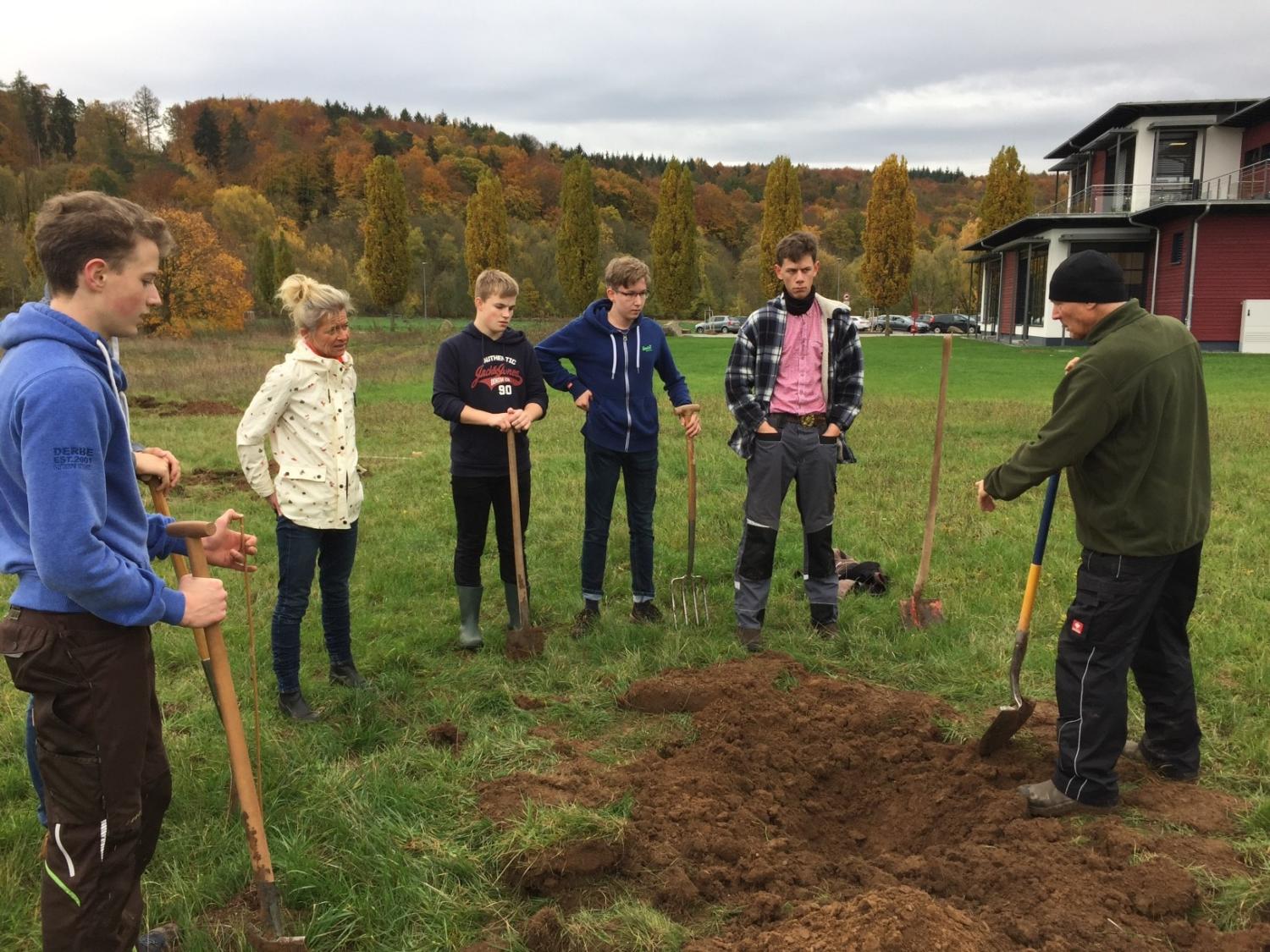
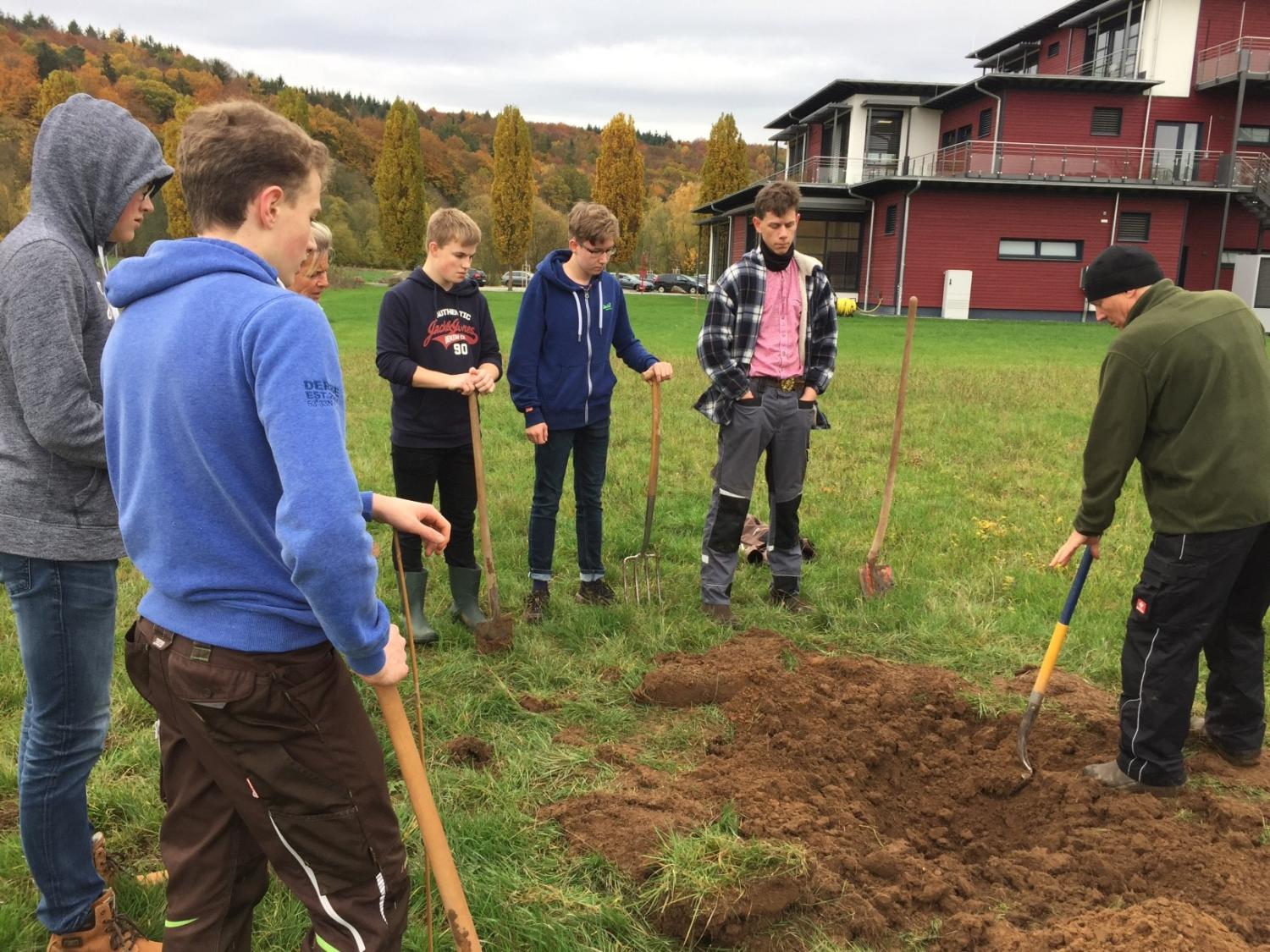
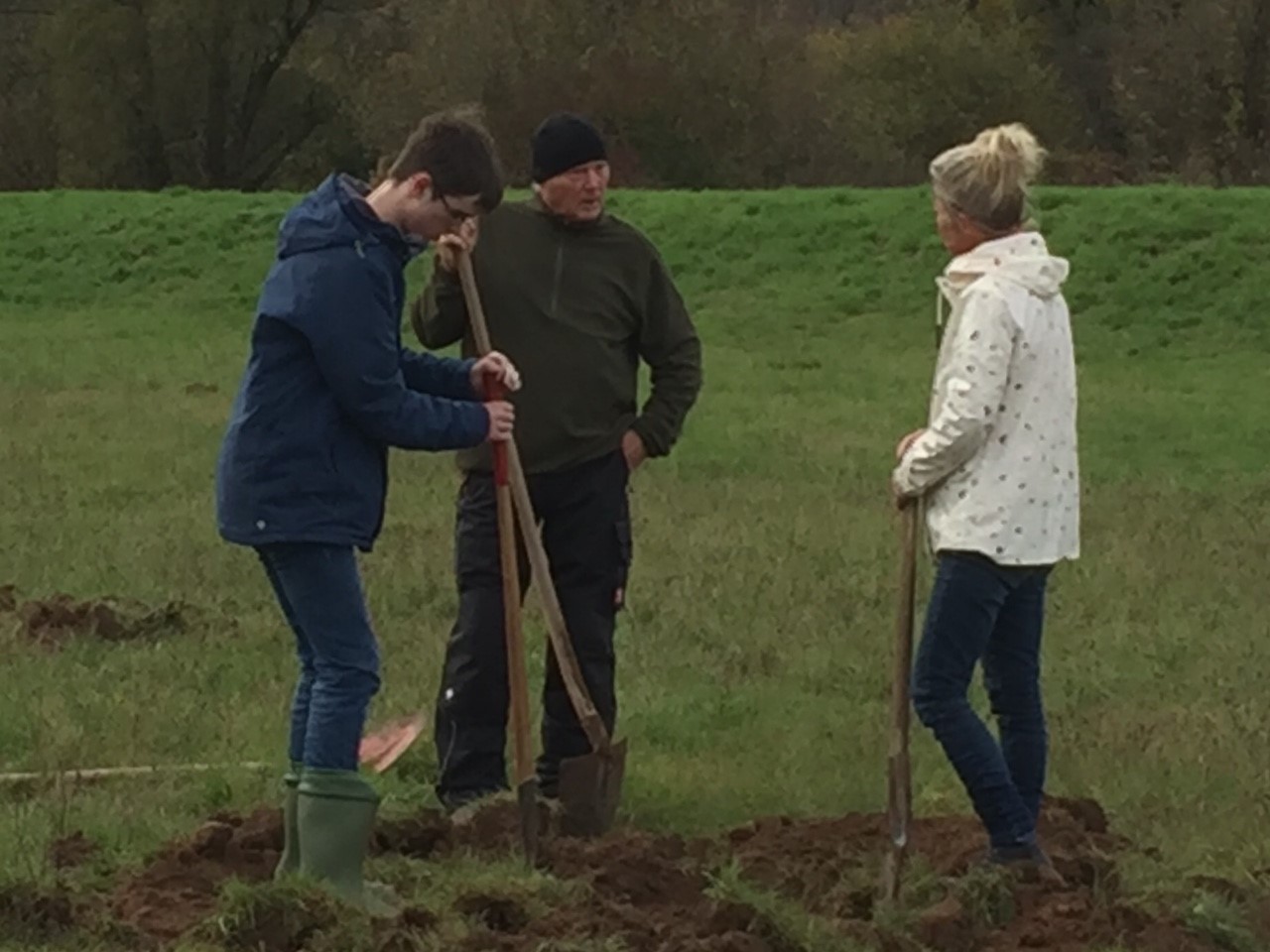
Now we had to decide where to place the trees on the selected area. To do this, we first staked out the meadow and marked the tree locations with sticks. We decided to arrange the trees in triangles. This made sense because the trees had to be spaced a certain distance apart, which was easy to achieve with a triangular pattern. A few days later, the trees arrived at the school. Since they still had bare roots at that point, we had to dig them in temporarily. Then the day of planting arrived. We received help from an expert on orchard meadows, Mr. Moll; Steinmühlen teacher Carmen Bastian; the landscape gardener; and Mr. Schäfer, a teacher at the boarding school.


How to Plant Trees

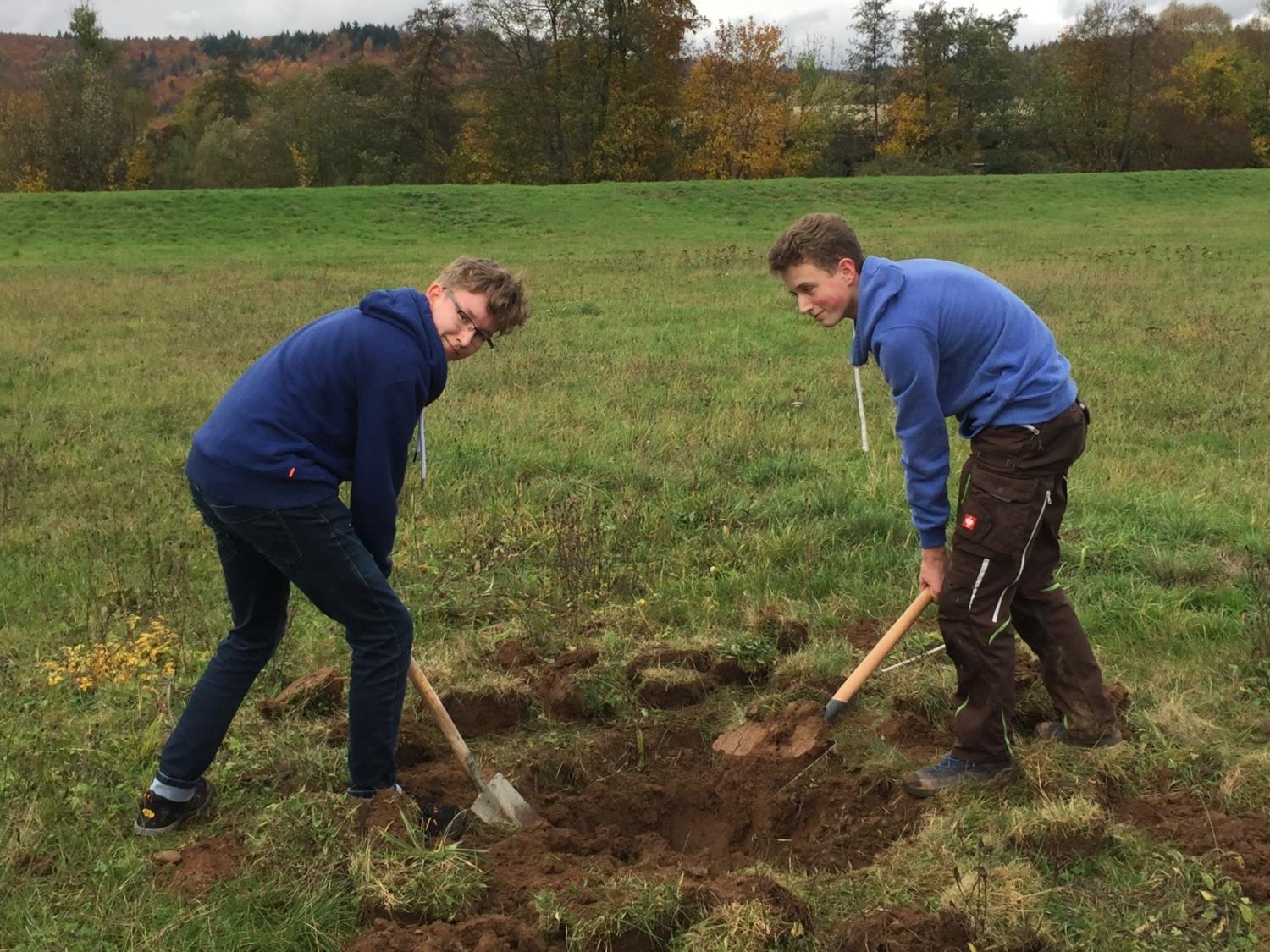
First, holes were dug for the trees, and in the center of each of these holes, another, deeper hole was dug. Next, a wooden stake was hammered into the ground at the edge of each hole. Finally, a wire was placed in the deep hole to protect the tree. Next, the tree, along with its root ball, was placed into the hole and the whole thing was covered with soil. Finally, we tied the tree to the stake with a thick string. This provides the tree with support during the initial period. We used this method for all 15 trees. We made good progress, and even though it started to rain after a while, that didn’t dampen our motivation.

For environmental reasons, we planted not just one type of tree, but three different fruit varieties: mainly apple trees, but also a few plum and pear trees. We also decided not to arrange the trees randomly, but to group them by fruit variety. So the two plums and the two damsons are on the left side, while the apple trees are in the center and on the right.

Clemens Gerhardt (Class 10b)

For the third time, Steinmühle gave a graduating class the opportunity to assess their own abilities through the geva test before they were finally placed in advanced courses. The test requires students to work through a test booklet containing various tasks within four hours. A limited amount of time is allotted for each task. Once the results are evaluated, they reveal the students’ aptitudes and interests and suggest which careers might be suitable for them in the future. This is particularly helpful for students who do not yet have a specific career path in mind. “Our partnership with the geva Institute is a key component of our career guidance activities,” explained Dr. Claudia Röder, who also serves as the coordinator for school-based internships.

Three and a half days to work together to bring to life the music we want to play—for many years now, this has been the foundation of both ensembles’ annual programs, which are then premiered at Bands on Stage: Songs ranging from John Lennon to ’50s rhythm ’n’ blues, ’80s movie pop, jazz-funk, and Real Book standards in 2020. Both ensembles have grown significantly this year thanks to younger musicians—in particular, female vocalists, flutists, a violinist, and a young euphonium player. The more experienced older members are still there as well, ensuring that both the band and the jazz ensemble maintain their vibrant outlook for years to come: How it’s done is passed on playfully, directly from musician to musician, through collaboration among students in grades 6 through 12. What is explained can be experienced immediately through mutual listening and playing. Ideas for just about everything come from the group. And the wonderful retreat on the edge of the Wolfshausen forest is a fantastic and welcoming place for this—once again this year: “Imagine… it’s easy if you try.”

(Frank Wemme)

In search of its own “Oscar” for the Hessian Children’s and Youth Theater Week (KUSS Festival), partner schools of the Hessian State Theater were asked to submit design ideas. The idea submitted by Steinmühlen student Kiara Cordes (Class 12e) was the most compelling: an artist modeled from clay on his way to the stage. The trophy was created during special sessions over the holidays with the support of teacher Ines Vielhaben and will now be recreated each year and presented to the new KUSS winner. Photos: Katja Peters

KUSS Festival Trophy, Kiara Cordes, Steinmühle. Photo: Katja Peters

KUSS Festival Trophy, Kiara Cordes, Steinmühle. Photo: Katja Peters

Steinmühle School has cleared another hurdle on its path to becoming a Health-Promoting School and has earned the “Movement and Perception” partial certificate. As a result, the school now holds two of the at least four partial certificates required to earn the overall certificate. Both partial and overall certification are issued by the Hessian Ministry of Education and Cultural Affairs.

All certification stages require a high degree of organization and commitment in the respective area. After the first partial certificate focused on the topic of “Nutrition and Consumption,” the focus shifted to school activities related to physical activity and awareness. “The certification process was initiated by forming a steering committee,” reports school athletic director Michael Neirich, who coordinated the overall process and also provided professional development on the topic. “It worked to Steinmühle’s advantage that many of these elements were already part of our everyday school life,” says Neirich in retrospect. “We were in a pretty good position right from the start.”

Nevertheless, it was necessary to collect basic data, compile conceptual information, and prepare documentation on the work. This included conference minutes, project descriptions, press reports, and professional development events. The assessment was based on a self-evaluation and an external evaluation by the certification group of the State School Authority—including a meeting with the school administration, an on-site tour, and classroom observations.

In addition to Michael Neirich, the main contributors to the development of the “School Promoting Physical Activity and Perception” sub-certificate were Manuela Schmidt (steering committee chair), Moritz Zöckler (documentation), Nicole Hohm and Heike Rabben-Martin (addiction prevention), Carmen Bastian (Environmental Office), and Bernd Holly, representing the school administration. Angela Heinemann

They were the “front-line workers” who helped earn the certificate, which was presented by School District Director Heike Grosser (right). From left: Moritz Zöckler, Manuela Schmidt, Michael Neirich.

Idyllic natural surroundings at the Steinmühle boarding school and nature camp in Marburg, Hesse, for students with behavioral challenges and gifted students

Even during the COVID-19 crisis, Steinmühle Boarding School remains a safe and reliable home for every boarding student. In compliance with the currently applicable general hygiene regulations, all residents have the opportunity to move about freely on the spacious boarding school grounds. This ensures that students can spend time close to nature in the fresh air and engage in individual physical activities.

To ensure the safety of all students and teaching staff, students are currently not permitted to leave the Steinmühle campus.

Since the state of Hesse suspended compulsory schooling, all students at Steinmühle have been participating in homeschooling. Steinmühle immediately implemented the necessary technical measures to facilitate this. The teachers provide as much support as possible to boarding students during homeschooling whenever questions arise regarding their assignments.