Strengthen the Community

Joint Start for the Class Teams

On Mondays, the individual classes start the week together. With the support of their homeroom teacher, the students discuss various topics for the coming days. It is an opportunity for everyone to voice their concerns—a practice that Steinmühle considers important for approaching the upcoming lessons as clearly and unburdened as possible.

Special occasions, such as birthdays, are given a moment of recognition before the lesson content is introduced.

To facilitate this straightforward and supportive communication between students and their homeroom teachers, the teams of teaching staff are deliberately kept small. Through team meetings and informal interactions, prompt communication among teachers regarding students—especially when there are specific concerns—is well-established and common practice.

Class Council & Mediation Program

Spending School Days Together in Harmony

To strengthen class cohesion, the class council is a regular part of the week. Here, issues raised by the group are discussed, ideally under the guidance of the class representatives. Class matters such as maintaining order, addressing everyday school concerns, or planning celebrations and group activities also have their place in these meetings. Typically, the need for conflict resolution processes is greater in 5th grade than later in 6th grade. Accordingly, the “Social Learning and Mediation” project takes place as part of the 5th-grade project-based learning curriculum. Over the course of three weeks, each class learns in a playful and intensive way—through a variety of self-awareness activities—that conflicts are normal, why this is the case, and what options exist to limit, resolve, or mitigate them—and how liberating such a culture of interaction can be.

In the 11th-grade classes, which have been reorganized based on students’ interests, the project days—which include a field trip—serve to bring the students together once again later on.

Community at the Steinmühle

Student-Parent-Teacher Conference Days

Instead of discussing students during parent-teacher conferences, parents, teachers, and students at Steinmühle come together for a student-parent-teacher conference.
With the parents present, the student receives feedback from the teacher. This allows any differing perspectives to be clarified together. If there isn’t enough time during the meeting, a new appointment is scheduled on the spot.

Evaluation and Feedback Procedures

The format of parent-teacher conferences—which bring together students, parents, and teachers—is viewed positively across the board by students, parents, and teachers. This was the finding of an evaluation. Surveys and feedback processes are an essential part of quality management at Steinmühle, helping to make school processes visible and measurable.

Cooperative Learning Methods

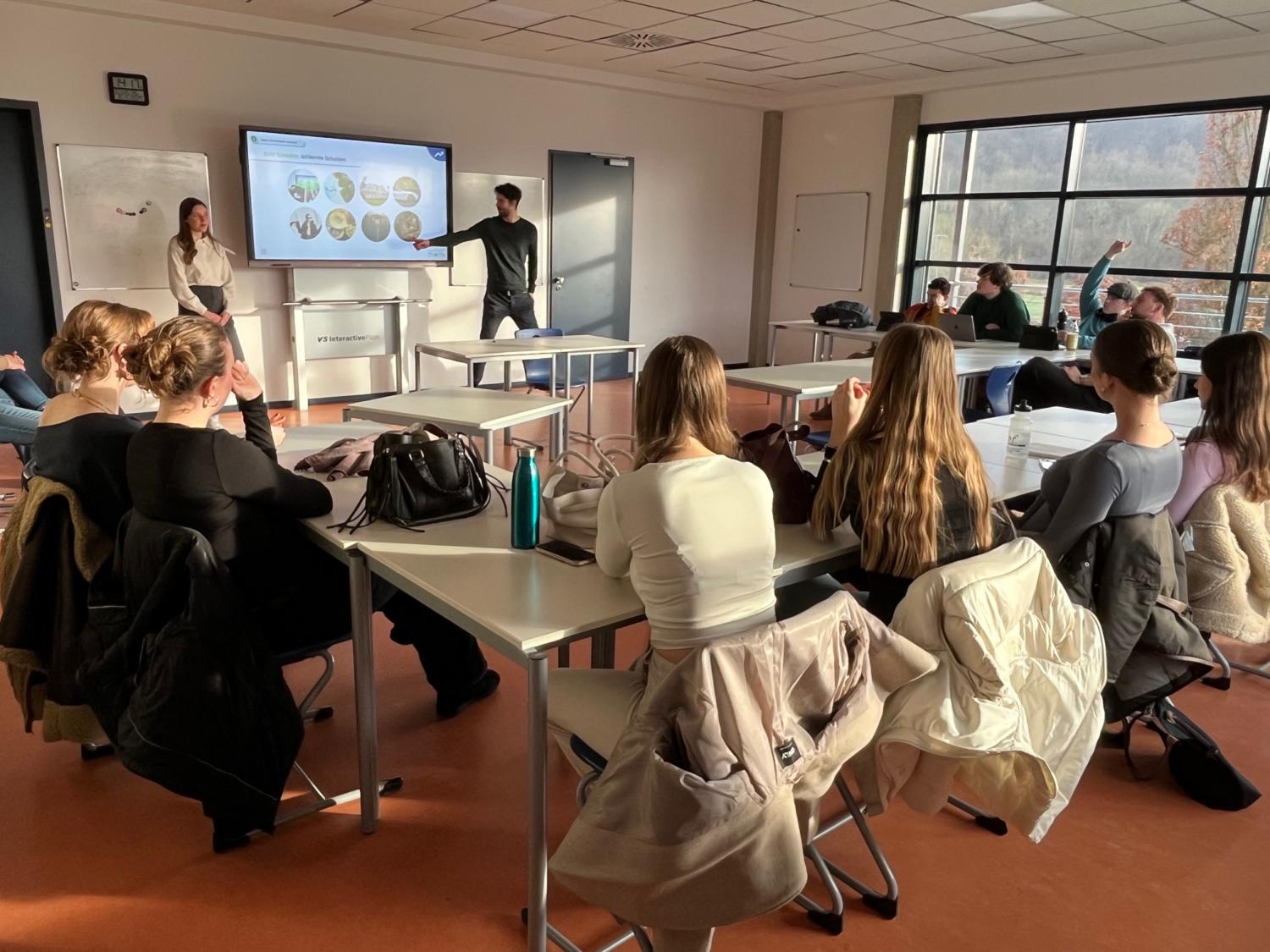
When students explain things to one another, the learning often proves to be more lasting than when adults do so. The Hattie study, among others, highlighted this as an effective element of school learning. As part of internal teacher training programs and through participation in a Europe-wide training program on the topic, Steinmühle has consistently worked to strengthen this area, with the goal of making smart facilitation methods that promote cooperative learning part of the teachers’ standard repertoire and, consequently, an integral part of everyday classroom practice at Steinmühle.
Important ideas also frequently come from the Marburg Teacher Training Seminar, which is responsible for training student teachers. We maintain close ties with it as a training school.

Examples of this:

• Analyzing a topic using the “Think-Pair-Share” method—first on your own, then with a partner, and finally as a group

• a so-called “group puzzle,” in which experts—once they have established themselves as such through a division of labor—explain things to one another

• the form of a placemat that encourages written dialogue among four participants

Engaging forms of collaboration have long been an important element of teaching at Steinmühle, and this approach has been further strengthened in recent years, particularly through numerous well-developed project-based learning initiatives in grades 5 through 10.

Cooperative Learning Methods

When students explain things to one another, the learning often proves to be more lasting than when adults do so. The Hattie study, among others, highlighted this as an effective element of school learning. As part of internal teacher training programs and through participation in a Europe-wide training program on the topic, Steinmühle has consistently worked to strengthen this area, with the goal of making smart facilitation methods that promote cooperative learning part of the teachers’ standard repertoire and, consequently, an integral part of everyday classroom practice at Steinmühle.
Important ideas also frequently come from the Marburg Teacher Training Seminar, which is responsible for training student teachers. We maintain close ties with it as a training school.

Examples of this:

• Analyzing a topic using the “Think-Pair-Share” method—first on your own, then with a partner, and finally as a group

• a so-called “group puzzle,” in which experts—once they have established themselves as such through a division of labor—explain things to one another

• the form of a placemat that encourages written dialogue among four participants

Engaging forms of collaboration have long been an important element of teaching at Steinmühle, and this approach has been further strengthened in recent years, particularly through numerous well-developed project-based learning initiatives in grades 5 through 10.

Trips and Exchange Programs

All field trips are listed well in advance in the annual calendar, and their organization and content are discussed at parent-teacher conferences.

5th Grade

Experiential Education Days in Wolfshausen with the BSJ (two days/one overnight stay)

6th Grade

6 Days in Scharbeutz

7th Grade

At the start of the school year: 3-day rowing camp (sports and adventure project)

8th Grade

6-day ski or snowboard course in Mayrhofen (Austria)

9th Grade

5-day language trips based on the choice of a second foreign language

Grades 8 through 10

Numerous volunteer exchange opportunities around the world through the Round Square network and with partner schools in Uruguay and Tanzania

High School

In high school, field trips are aligned with the school’s academic focus. The trips are prepared for and reviewed in class and take place either at the end of the Q2 semester or at the beginning of Q3.