For Steinmühle, this is arguably the greatest honor it has ever received: As of Wednesday evening, our school is one of 81 “Smart Schools” nationwide—out of a total of about 40,000 schools in Germany. The announcement of this year’s twenty winners was made at the digital Bitkom Education Conference by Minister of State and Commissioner for Digitalization Dorothee Bär, who joined the event live from the Federal Chancellery. The politician, who also serves as chair of the jury, announced the names of the “award-winning flagship schools that demonstrate how digitization works.” The minister went into even greater detail: “These schools aren’t just continuing digitally what was already being done in the analog world. Rather, they’re providing additional services and doing much, much more.”
In fact, that sums up the application process quite well. Dirk Konnertz, executive director of the Steinmühle School Board Association, took the initiative and ultimately compiled the comprehensive application materials together with Principal Bernd Holly. The goal here was to demonstrate that visions for the future of our education system have already become part of everyday school life. It was about showing how digital skills are taught and how new learning scenarios are being implemented. Dirk Konnertz: “We had to explain how technology works at our school and what it accomplishes, but also how our teaching staff and students tackle these challenges—each in their own way. In addition to all these descriptions, we naturally also had to demonstrate credibly how these processes unfold, that we offer professional development, and that we are constantly evolving. We clearly benefited from the fact that we’re well-positioned in terms of our public image and that we document everything very well on our website, in the yearbook, and in the Steinmühlen magazines.” Dirk Konnertz saw particularly good prospects for the competition because the school’s self-developed app had successfully established itself as a digital tool in everyday school life: “I’m in touch almost daily with our programmer, Aaron Stein, who has continued to reliably develop the StoneApp even a year after graduating from Steinmühle. He therefore played a major role in winning this award,” emphasizes the managing director.
The only winning school in Hesse
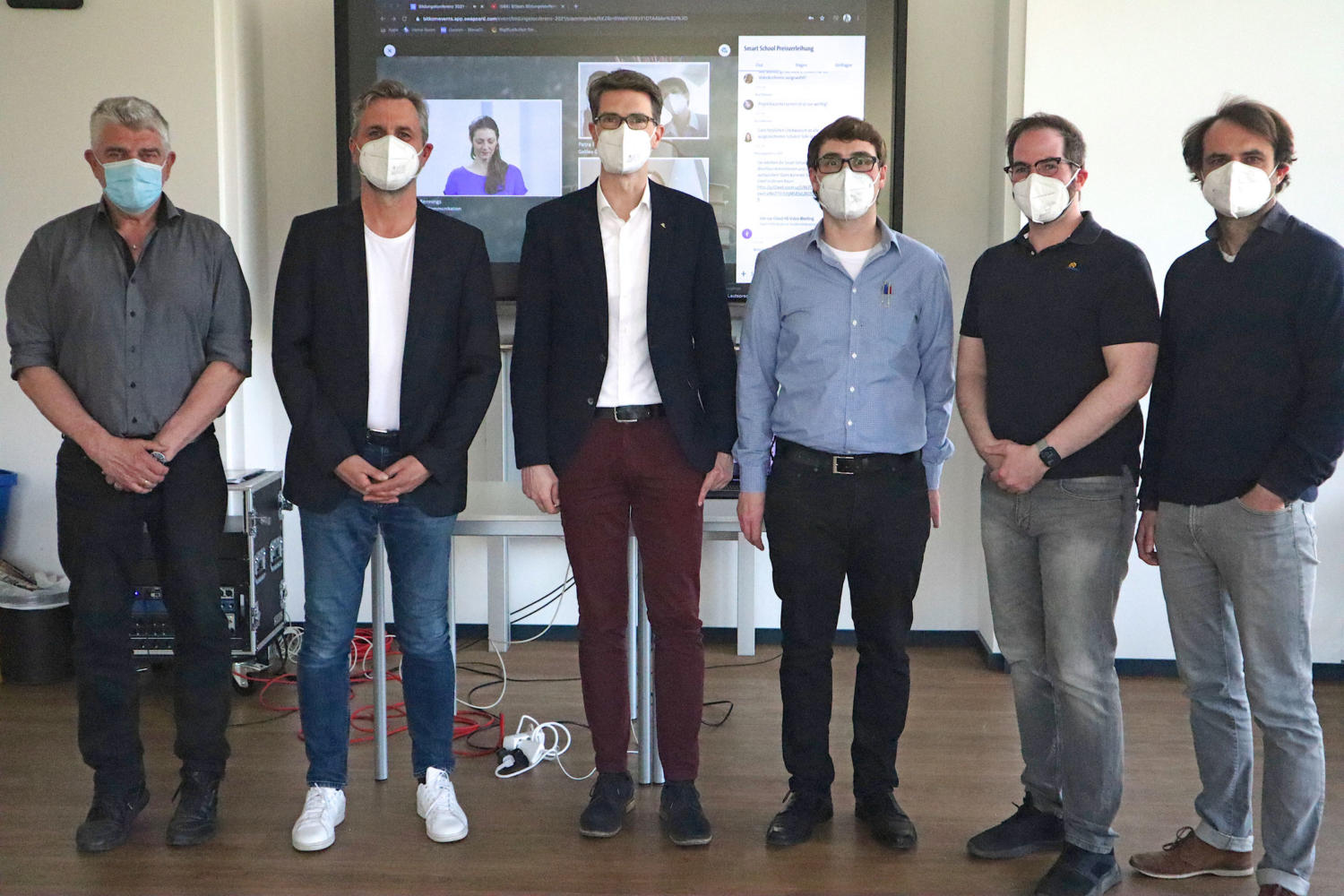
“It makes you very proud,” said Principal Björn Gemmer, delighted with Steinmühle’s achievement as the only school in Hesse to win among all types of schools. Fellow principal Bernd Holly and Fabian Küster from Steinmühle’s IT department then explained to the live audience what best practices look like at Steinmühle—especially during the pandemic, but not only then. Of course, they mentioned the school’s own StoneApp, but they also highlighted the dedicated teachers across all grade levels, “…without whom we could never have won this award.” Steinmühle has been proud of its digitalization coordinator, Malte Klimczak, not just since winning this award. Whenever support and advice are needed, he has always been there. “Always available”—Till Buurman is also always on call when it comes to IT. After all, when the technology glitches, online conferences, learning tools, and the like simply don’t work.
“The expert jury clearly recognized that we have already arrived in the digital future and that there are no gaps in our system,” the participants concluded at the end of the day, pleased with this prestigious award.
Jury Members and Partners
The digitization of the Steinmühle was evaluated as part of the competition by the following jury members:
Dorothee Bär (Jury Chair, Office of the Federal Chancellor), Prof. Silke Bartsch (Didactics of Vocational Education, TU Berlin), Prof. Ira Diethelm (Didactics of Computer Science, University of Oldenburg), Dr. Julia Freudenberg (Managing Director, Hacker School), Julia Kleeberger (Managing Director and CEO, Junge Tüftler), Stefanie Kreusel (Member of the Supervisory Board, Senior Vice President, Customer & Public Relations, Group Representative for Digital Education and Schools at Deutsche Telekom Business Solutions GmbH), Thomas Oks (Head of Instructional Design at Oskar-Schindler-Gesamtschule in Hildesheim), Micha Pallesche (Principal, Ernst-Reuter-Schule, Karlsruhe; Smart School), Dario Schramm (Secretary General, Federal Student Conference), Lena Spak (Co-founder, Scobees), Catharina van Delden (Treasurer, Founder, and Managing Director
innosabi GmbH), Marja-Liisa Völlers (Member of the Bundestag and Vice Chair of the Enquete Commission on “Vocational Education and Training in the Digital World”), Madeleine Wolf (co-founder and CEO of Vision You).
The competition’s partners are dell.com and telekom.de; excitingedu.de serves as the media partner.