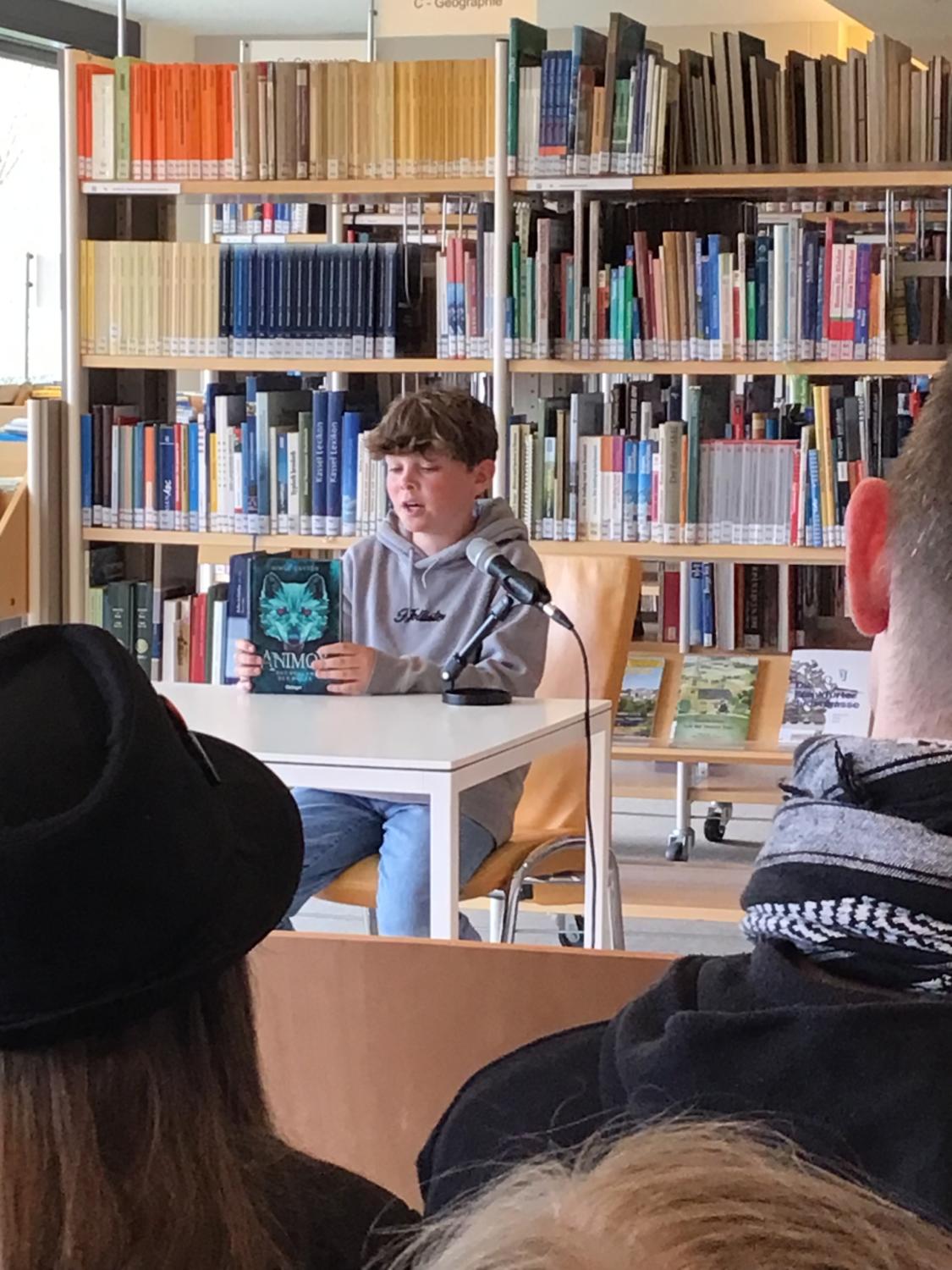
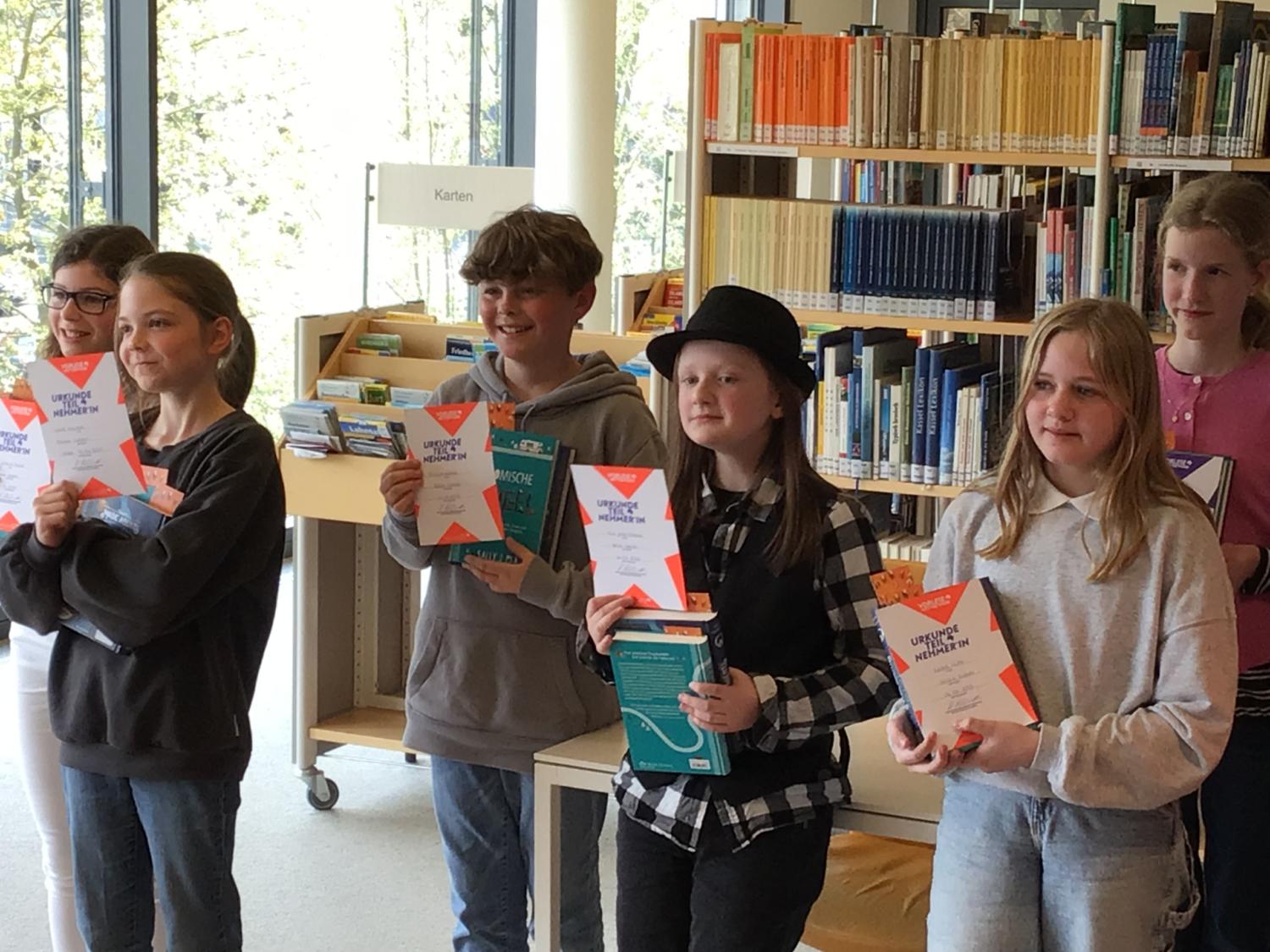
On the very first Monday after the Easter break, the winners of the city and county rounds had to take the stage as readers in the next round of the district competition at the Giessen City Library. Philian from Class 6c once again delivered a compelling performance.
Once again, he skillfully evoked the moods of the texts—both the prepared ones and the unfamiliar ones—and, with the latter, he once more demonstrated his quick grasp of the given moments. Overall, he was very skilled at drawing the audience into the story. However, he was not alone in this regard during this round. Nine talented young readers demonstrated remarkable reading skills, a fact the jury highlighted in their brief remarks. The selection was, inevitably, not an easy one for the jury. The fact that Philian did not advance to the next round—along with six other strong young readers—was something we had to accept, as is customary in competitions. All in all, it was an admirable “reading journey,” and we were delighted to accompany him on it. Hats off to him!

“Older folks will remember”…a cliché that’s hard to avoid at this point: At the age of twelve, David Bennent—born in 1966 and the son of a Swiss acting family—played Oskar Matzerath in the film adaptation of Günter Grass’s *The Tin Drum*. A successful film that filled movie theaters starting in 1979 and was known for its ideal cast under director Volker Schlöndorff. In that film, Bennent, in his childlike role, protested against the adult world of the late 1920s in Danzig. Today, Bennent is an ambassador for the international children’s aid organization “terre des hommes”; in that capacity, he came to Marburg for a reading—and then to the Steinmühle.

An experienced actor, socially conscious and attuned to the perspectives of young people—the DS 11 class taught by Steinmühlen teacher Ines Vielhaben could hardly have asked for a better instructor for a short workshop. The arrangement with the prominent guest came about through the art and DS teacher’s connection to Gisela Glatzl, one of the active members of terre des hommes Marburg. “We’d prefer it if no one were watching,” Bennent explained, expressing his wish to have no observers in the room during the workshop. Afterward, the wonderful actor—who, though only 1.55 meters tall—answered all kinds of questions.

Bennent personally has very little experience with school. “My parents were against it,” says the Swiss native, adding that his mother homeschooled him and his sister. The goal was to encourage free thinking and self-reflection. Exams and anxiety were to be kept at bay.

By no means did “focusing on oneself” result in a person with egocentric traits. On the contrary, Bennent has long been concerned about the plight of children. The actor has been closely associated with terre des hommes for about 20 years, and he has served as an ambassador for the children’s charity since 2019. “What lies ahead? We have to take responsibility,” he asserts.


“Every single person can make a difference”

David Bennent focuses particularly on the textile industry. “We pay such a low price for many items—and that’s not right.” The actor denounces the situation in countries such as Bangladesh and India, where children are forced to work under terrible conditions. If everyone just gave a little thought to where textiles come from and was willing to adjust their buying habits slightly, that would already be a big step forward.

Bennent wants to dispel the misconception that individuals can’t make a difference. He cited the example of a major food and beverage corporation that, after its drinking water policy became public, saw a 20 percent decline in sales over the course of three years in some parts of the world. Bennent commented: “The cumulative effect of our behavior certainly has an impact. You can see that here.”

Bennent appealed to the students: “Each and every one of you is important.” And they were so impressed by his remarks that they took several selfies with the actor, who now lives in Berlin. Whether a guest at the Steinmühle is interesting to young people apparently has nothing to do with their age. And, as we learned, neither does their awareness of social issues.

The Steinmühlen rower’s goal is to qualify for the Olympics

That’s quite an achievement: With a five-second lead, Steinmühlen rower Marc Weber and his partner Jonas Gelsen from the Nassovia Höchst Rowing Club clearly and confidently held off their opponents at the mid- and large-boat trials on the regatta course in Hamburg-Allermöhe. They had already won two out of two races on Saturday, so they didn’t even have to compete on Sunday. “With this victory in the qualifying round, the team has qualified for the European Championships in four weeks and will aim to secure an Olympic berth at the World Championships,” explained coach Martin Strohmenger.

“We were both a little nervous before the competition,” says Marc Weber. “After reviewing our ergometer results and our performance at the German Small Boat Championships in Brandenburg two weeks ago, we wanted to see where we stood,” he explains. “We managed to take a clear lead in the first race and also take the lead in the second race. If we do well at the European Championships as well—which I hope we will—then we can secure our spot and get the ‘go-ahead’ to qualify for the Olympics at the World Championships.”


“The support from Steinmühle helps me keep my head clear”

Marc Weber, for whom the weekend in Hamburg had been sunny—and not just in terms of the weather—said: “I’m very happy. We’re making great strides right now; we’re on the right track and moving very fast.” The athlete extended a big thank you to Steinmühle and to everyone there who supported him without making a big deal out of it. Weber: “I feel very well taken care of; my mind is clear. The Rudern und Sport Steinmühle club, along with the Steinmühle School and Boarding School, deserve a great deal of credit for helping us achieve significant success across Germany.”

High praise for their new recruit, Marc Weber—U23 World Champion in the single sculls (2019) and 2019 Athlete of the Year in Hesse—was in turn

Steinmühlen management, school administration, and the board of the Rudern und Sport Steinmühle association. “We would be delighted if this journey continues on an international level. We will continue to support this effort.”


We have reason to celebrate! The Steinmühle has won the Hopp Foundation’s school award—worth €2,500—for its commitment to STEM education as part of the “Jugend forscht” state competition.

The Hopp Foundation is committed to promoting young talent in STEM subjects and has been a key supporter of “Jugend Forscht” for many years. Since last year, the award has honored schools that are particularly committed to fostering talented students interested in science and technology, thereby making an important contribution to strengthening science and technology in Germany.
This generously endowed award is—in addition to being a recognition of achievement—of course also a welcome opportunity to significantly expand Steinmühle’s science equipment.
A prerequisite for participating in the competition was a detailed application letter in which a project by Steinmühle plus STEM students played a significant role.


Plus-MINT Project in cooperation with Philipps University of Marburg

In collaboration with the University of Marburg, a project idea was developed to study the Lahn River in the area of the restoration site at the Gisselberg Span. Dr. Christoph Reudenbach from the Department of Geoinformatics is actively supporting the plus-MINT students with his expertise. The idea is to develop an autonomous, sensor-equipped boat to minimize the need to enter the sensitive ecosystem in the Gisselberg span renaturation area. This platform is designed to semi-automatically measure water quality in the Lahn River and collect water samples.
The project is a great opportunity for the students to learn how to build complex devices and program them independently for research purposes, as well as to deepen their knowledge in the fields of robotics, programming, and environmental sciences.


Strong Commitment to Environmental Education

In recent years, students at Steinmühle have submitted numerous projects to “Jugend forscht” and have often achieved great success. This year, they won two second-place finishes and one first-place finish at the regional competitions; one project even won the state award for the best interdisciplinary project in Hesse.
In his laudatory speech, Mr. Oliver Karplak, the state competition director for “Jugend forscht,” specifically highlighted Steinmühle’s strong commitment to environmental education and environmental projects in recent years. This helps raise students’ awareness of environmental issues and encourages them to act in an environmentally conscious manner.


A big thank you

Steinmühle is very proud that its work in the STEM fields has been recognized with this award, and we would like to once again extend our heartfelt thanks to everyone involved. The Hopp Prize is a wonderful recognition of this work and an incentive for the future to continue raising our students’ awareness of the importance of STEM subjects and environmental issues, and to offer them opportunities to actively engage in building a sustainable future.

We did it! We—Maya Fischer, Marlene Wagner, and Anna-Lena Griesler—are proud to have come through two exciting days of competition.

On Friday at 8 a.m., it was time for us to say, “Off to Kassel!” Together with our advisor, Ms. Töhl, we set off from the Steinmühle. Upon arriving at the University of Kassel, we were warmly welcomed and immediately began setting up our booth. After a brief welcome by the competition director, Eva Kretzer, and our host, Prof. Axel Bangert, we had our first discussion with the jury, followed by a photo session. It wasn’t easy to satisfy the photographer, but the result is impressive (see below). The friendly jury seemed very interested and asked us some exciting questions about our topic, “Adhesives from Nature.” The second jury team, in particular, delved even deeper into the chemistry of adhesives.
Everyone enjoyed the lunch that followed, and we had some fun conversations—for example, about the different colors of glass bottles.
After the lunch break, we had some time to check out the other projects and play games like Jenga or Mogelmotte. Once that time was up, we speculated about what would happen in the next workshop. We were wrong in assuming it would be a drumming workshop. The juggling workshop (so we were completely off the mark) gave us plenty of opportunities to get to know the other participants better. Finally, we had pizza, after which we all headed back to the youth hostel satisfied and stuffed our bellies with candy.

Day 2—Once we arrived back at the university, we set up our booth again and, after another round of discussions, immediately headed into our lunch break. After lunch, the general public was also able to marvel at the various projects and ask questions about the individual topics. The awards ceremony, hosted by science journalist Sascha Ott, was a lot of fun for everyone, and we all had a good laugh, especially during the experiments. Just before things got serious for all the students, Steinmühle received a surprise: the Hopp Foundation’s School Prize (2,500 euros). When it was the Chemistry Department’s turn—third in line—we “only” received the Special Prize for Materials and Substances. Shortly before the end, after the technicians had received their prizes, four special prizes were awarded, and we were among the recipients: We were honored with the state prize for the best interdisciplinary project.
After the closing coffee and cake, we drove back to Steinmühle—tired, exhausted, and happy. For all of us, the two days were a very varied and exciting experience.

Anna-Lena Griesler (6c)