The 2022 high school graduates were not always a homogeneous group. With their diverse personalities, they each had their own minds, their attitudes varied, and tolerance was required on all sides. Principal Björn Gemmer also emphasized this in his speech at the graduation ceremony in the festival tent, while at the same time announcing another fact: This group of young people achieved the best Steinmühlen high school graduation results to date.

“Nevertheless”? Or “therefore”? Was this a matter of causality or coincidence? The only thing that’s certain is that diversity among young characters isn’t really anything out of the ordinary. Even the children’s book author Andreas Steinhöfel, whom Gemmer quoted, presented such examples as a clear reality in his work *Rico, Oskar, and the Deep Shadows*, while the principal “didn’t want to look at anyone” and just smiled. In any case, Steinhöfel’s recommendation is to take children and adolescents seriously. Who, if not Steinmühle, offers the ideal setting for this? It has made it its mission to both enable the personal development of each individual and to achieve goals in everyday school life. Quite clearly, this is working out excellently.

Principal Bernd Holly introduced these contributions—which recounted the events and anecdotes that took place over the years during this eventful period—from the perspectives of teachers and students. But he did not do so without thanking everyone involved who, in a symbolic sense, keeps Steinmühle running: parents, students, the teaching staff, the non-teaching staff, and the boarding school.

There was an outpouring of emotion at the farewell celebration, which also spread among the guests who filled the festival tent on the Steinmühlen grounds. Following the successful high school graduation ceremony last summer, Steinmühlen Managing Director Dirk Konnertz had no trouble deciding to hold the prom on the school’s own grounds again, together with the students’ families.

The graduating seniors took a moment to look back on their first day of school on August 20, 2013, and smiled at the flyer from back then, which had been created especially for their “big day.” The young people extended their greetings and thanks to all the teachers, the administrative staff, in the dining hall and cafeteria, the cleaning team led by Erika Thiel, and especially to the teachers who had made their experiences unforgettable by organizing ski and rowing trips as well as the trip to Schuby.

Resource scarcity, global warming, the climate crisis, and more: The Future is Now—the future has already begun! That’s why Ines Vielhaben, an art teacher at Steinmühle, is leading a new student group dedicated to activities that could slow this trend or highlight alternative ways for each of us to act. What’s actually happening? How can we take countermeasures? And how can this topic be addressed at Steinmühle across the various subject departments? Ines Vielhaben presented the project to the faculty meeting this past spring, outlining these questions along with the goals and responsibilities of the new club. The plan is to address the topic ideally through smaller lesson units or larger projects. Those present spontaneously contributed ideas and expressed their willingness to participate. Annett Miller expressed a desire to integrate a project using the iPad, particularly with regard to the necessary resources. Lisa Braun offered the assistance of the Geography department, which already had a wealth of materials on the subject.

“We hope to see even more interest from students, parents, and faculty, and we hope that over the summer break, some of them will decide to join our club,” says Ines Vielhaben, who is happy to serve as the contact person (ines.vielhaben@steinmuehle.net). As part of her advanced art class, high school senior Talea Funk designed a logo for the club to help people quickly recognize its posts and activities.

Will women’s soccer finally gain more recognition thanks to this year’s European Championship and the German team’s strong debut? At Steinmühle, at any rate, they’re already a step ahead on this front. There was a huge success here—and everyone is celebrating it! After winning the district and regional competitions, the Steinmühle girls in Competition Class IV (born in 2010 and 2011) took a surprising but well-deserved third place at the state competition in Grünberg (as we reported). — Bronze, then, at the Hesse finals of “Youth Trains for the Olympics”!

In addition to the girls, whose skill and total dedication contributed to this success, one man also played a key role: Lothar Potthoff. He is the athletic director of MSG Marburg/Weimar; he accompanied the Steinmühlen girls to all their competitions and prepared them exceptionally well for this tournament. He was supported by Carlotta Weber from 6th grade and Julian Arnold from the MSG coaching staff. “This is a huge success! Of course, the girls wanted to go to Berlin for the national finals. But after some initial disappointment, the joy of finishing in third place now prevails,” the coach summed up. His team was ultimately on the verge of reaching the final when, in the semifinals, they were unfortunately defeated in a penalty shootout by the eventual champions from Gymnasium Oberursel.

“Next year, we’ll be competing in Competition Class III with this team and we’ll see how we do,” says Lothar Potthoff, already looking forward to the upcoming competitions. He is a coach through and through and has previously coached a school team at Steinmühle—“the ones who are graduating this year.”

He began his career in soccer at an early age, starting out in his native Sauerland and then continuing in Marburg’s Waldtal and with the veterans’ team in Niederweimar. In 1988, he began working with youth.

The trend of more and more girls playing soccer has developed over the years. Female players brought their friends along, and the association promoted soccer for women. Due to a lack of all-girls teams, female players often play on boys’ teams. This is possible up through the B-Youth division.

“There are very strong women’s teams in the United Kingdom, France, and Spain that play in front of crowds of 80,000 to 90,000 spectators.” Lothar Potthoff criticizes the DFB’s policies, under which “old white men have long belittled women’s soccer with little respect.”

The former principal of the Ebsdorfergrund Comprehensive School in Heskem can neither understand nor condone this. He sees how much fun the girls in their Steinmühlen jerseys have playing soccer and is glad that there are always opportunities to practice locally. For him, life as a soccer coach five days a week has become an integral part of his life; it helps him unwind: “When I’m on the field, everything else fades away.” Social connections are important to him.

But the retired history and politics teacher cares deeply about other things as well, which he sees being put into practice through his work as a soccer coach: “Team sports counteract the trend toward individualism, foster a sense of community, and encourage the assumption of responsibility. You help your opponent back up, and you’re there when extra hands are needed. After all, you can’t carry a goal all by yourself.”

Whenever there’s an opportunity to engage with politicians, the high school students at Steinmühle are eager to participate. They value the chance to discuss current issues, hear different perspectives, and ask questions about topics that are on their minds. This was also the case during the visit by State Parliament Representative Nina Eisenhard. The 32-year-old has been a member of the Hessian State Parliament since 2019 and serves as the higher education policy spokesperson for the Green Party’s state parliamentary caucus.

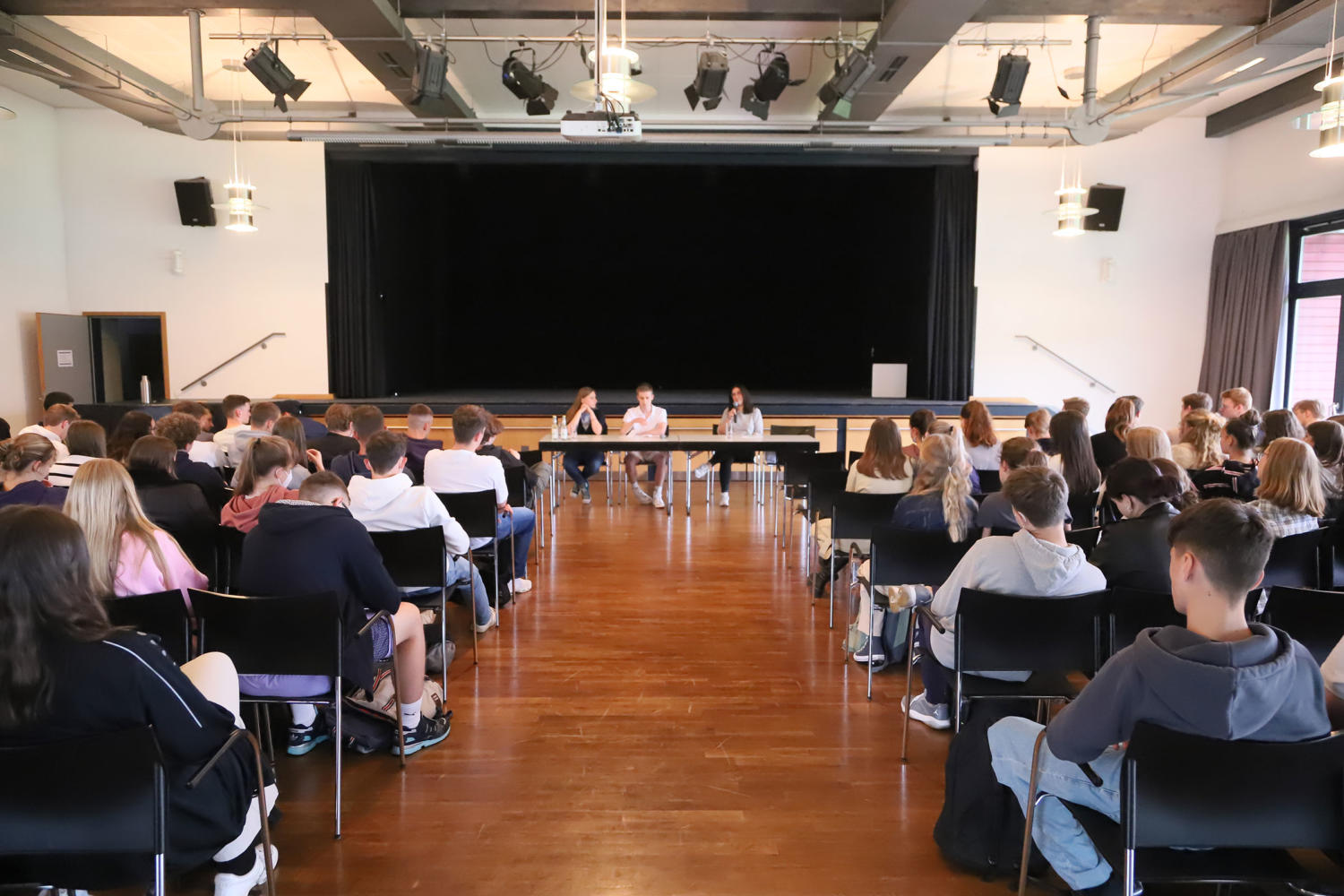
The visit, organized by Erno Menzel and Bernd Hülsbeck with the support of their colleagues in the Politics and Economics department, had been prepared in class. Participants included the 12th-grade class and the future 11th-grade Politics and Economics honors class. However, some questions also arose spontaneously, partly prompted by the conflict in Ukraine. The discussion centered on defense spending, the question of how the Green Party, as a coalition partner, could possibly support certain decisions in substance, and the fact that digitization is progressing so terribly slowly, especially in higher education.

Despite her young age, Nina Eisenhardt was able to draw on her own personal experience. She didn’t go straight from the classroom to a seat in parliament. The politician spoke about her experience as a self-employed entrepreneur running a web development company. “This has significantly improved my understanding of these issues,” she said. According to Nina Eisenhardt, the slow pace of digitization in the education sector isn’t due to a lack of available hardware: “That’s already in place.” Rather, there is a lack of staff for maintenance and long-term oversight. “It’s simply a matter of jobs.”

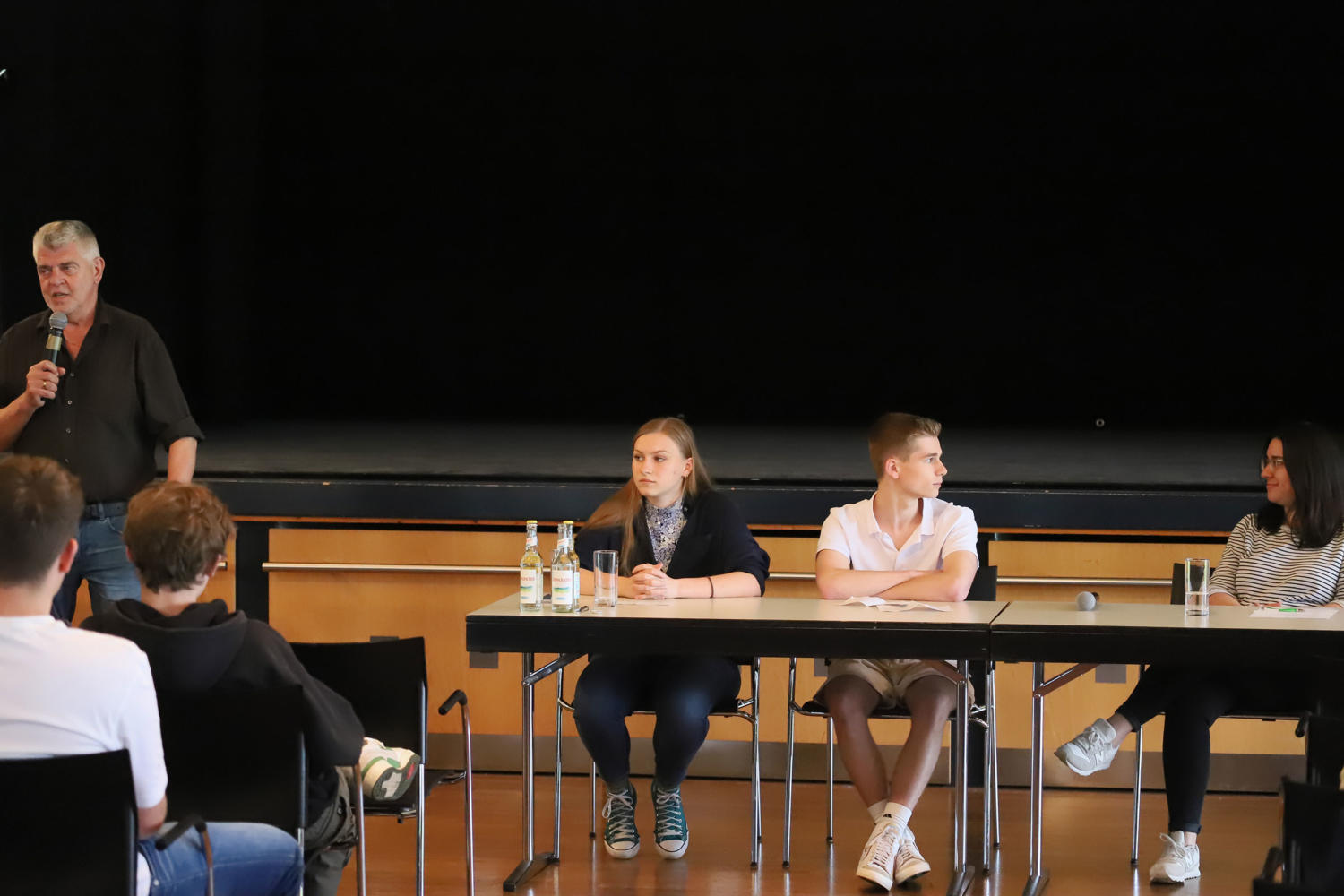
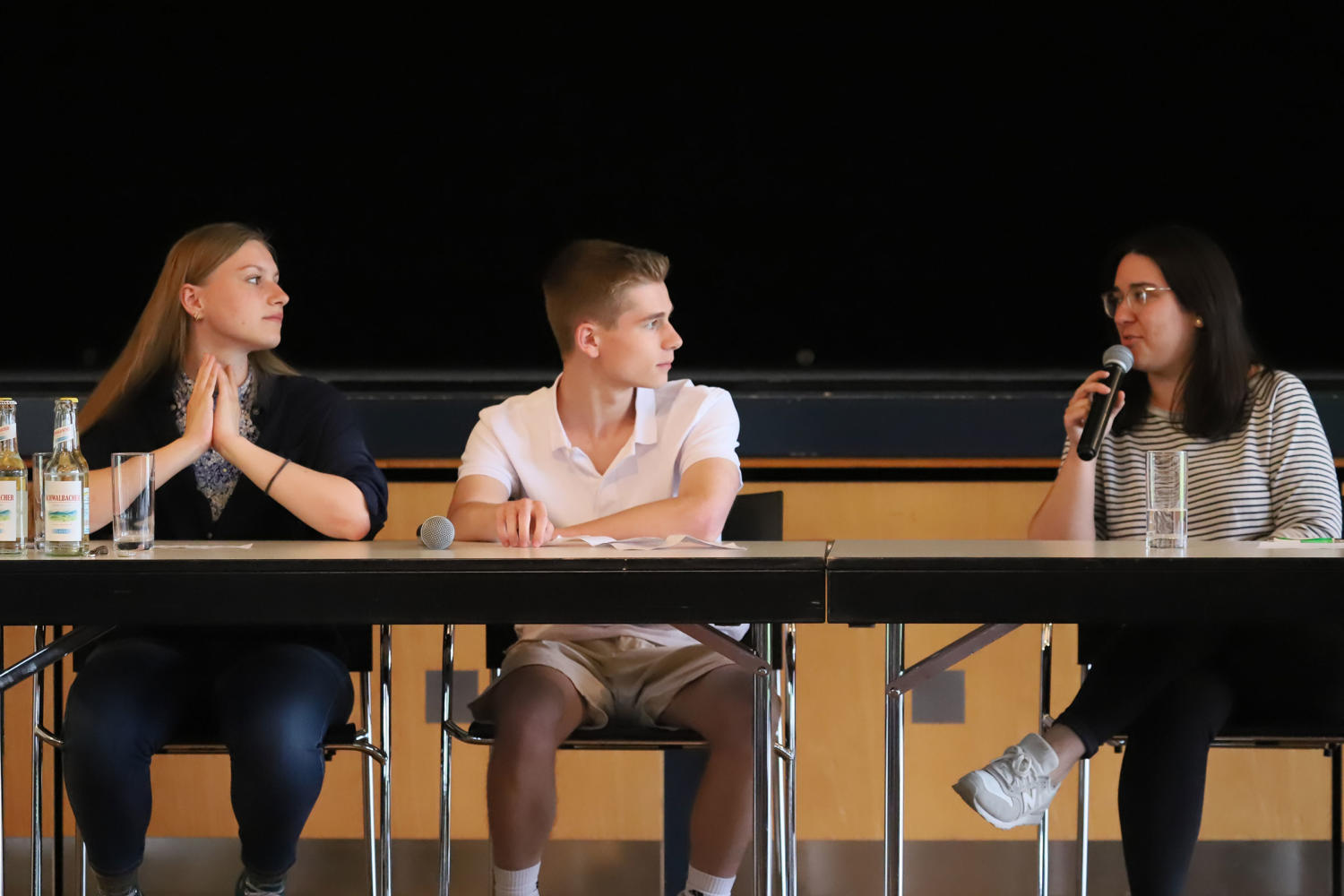
The students, led by the moderator team of Tilmann Molzberger and Mara Mensing, asked whether she found the decisions being made within the coalition unsatisfactory in terms of their substance. The member of parliament described the coalition compromises as side effects of a “temporary alliance of convenience.” She noted that if one wants to be part of the process and play a fundamental role in shaping it, there will inevitably be decisions that run counter to one’s personal views.

The questioners—all of whom were men—were also interested in the visitor’s views on a possible lowering of the voting age.

According to Nina Eisenhardt, voting is a right that requires no qualifications. You don’t have to explain why you want to vote. There is no reason to deny the right to vote to those under 18. The representative continued: “I’m in favor of lowering the voting age to 14. From that age on, you can work, earn a salary, and are required to pay taxes.” Nina Eisenhardt concluded: “Voting starting at age 14—that would be a huge opportunity.”

The speeches have been given, and the farewell celebration has taken place. The class of 21/22 was bid farewell the weekend before last amid much joy, but also many tears.

At the traditional boarding school brunch held before the official graduation dance, a total of 16 graduating students were personally honored. Among other awards, Oscars were presented for “the greatest transformation” and for the “superhero” of the boarding school class. Each graduate received a personalized speech from the teaching staff.

Great Speeches for Great Personalities

These very special moments between the teaching staff and the students they mentor always stir up a lot of emotion. Parents, family members, and friends of the graduates were once again deeply moved by these encounters this year. “I’ve rarely heard so many fitting and beautiful words spoken about my daughter at the same time,” said one mother, visibly moved. “Choosing the Steinmühle back then was simply the best decision we could have made.”

Both boarding school director Anke Muszynski and the teachers heard this phrase repeatedly that morning. And by that morning at the latest, one thing becomes clear to all graduating students: Steinmühle is more than just a time spent in school. You remain a Steinmühle student forever. A Temporary Farewell—The Next Fall Festival Is Coming

“We’ll definitely see each other again!” That’s what the teachers and graduates promised each other. We want to thank you for the time we spent together at boarding school and wish you all the best for your future. Dear graduates, we’ll see you again at the Fall Festival!


In June, nearly 50 students and teachers took advantage of the holidays and, as is tradition, traveled to the beautiful Valais region. From the Augustinushütte in Randa, the hiking group set out on their treks into the high-alpine regions.

Group start across the suspension bridge on Europaweg

As they do every year, everyone set out together from the cabin. Their first destination was the cross above Randa, which has become a second home for many of the long-time participants.

Anyone who wanted more after that could walk across the Charles Kuonen suspension bridge, which spans nearly 500 meters at a height of 85 meters. “I’m afraid of heights, but I can do this!” student Jan muttered before crossing. Just like last year, Jan managed to overcome his fear thanks to the group’s calm and encouragement, and successfully completed the crossing.

For those who still hadn’t had enough, it was possible to extend their hike on the very first day to a total of 900 meters of elevation gain, hiking directly to the Europahütte at 2,265 meters and returning to the hut via the Europaweg.

“We’ll do everything together!”

The entire trip was centered on a strong sense of community. Every day, the students were offered three different hikes: manageable hikes for beginners, and more challenging hikes for intermediate and experienced hikers, led by the experienced instructors from the Steinmühle boarding school. The goal was not to complete the hike in the fastest time, but rather for everyone to reach their set destination together as a group.

Educator Nils Schwandt, who has been traveling to the Valais for about 30 years himself and organizes the trip anew every year, never fails to express his enthusiasm: “Randa is simply an incredibly beautiful spot. And I’m happy when we can pass on this fascination with nature and hiking to the young students.”

Meals were prepared and eaten together as well. In the rustic parlor, with its old wooden floorboards, tables, and benches, everyone refueled before and after the hikes. A special highlight: the evening dishwashing party. Washing dishes with joy—a unique experience that you’ll probably only find in this form in Randa.

The joy of reaching the summit and cooling off in the lake: Valais has it all for the people of Steinmühle

Top athletic performances, fantastic views, and relaxing together: Everything was possible for the students during the Swiss hiking week. Whether it was the 1,100-meter ascent to the summit of the Wannihorn or the view of the Matterhorn from over 3,000 meters above sea level, whether it was letting off steam at Lake Schalisee after the climb over the Rötiboden, or relaxing together by the cool waters at Jungen. The tunnel tour was a hit once again, with the hike along the water pipes and the visit to the Gletschertor. Slipped into the day off

Athletes know it: You’ve got to take a day off. The tour group spent theirs at the Briggerbad thermal springs. Those who still had enough energy let loose on the slide: Who can slide the fastest? Who can swing the highest? But anyone who wanted to could lean back and relax deeply in the grotto with a salt scrub and a sauna. “I just lay there all day,” reported student Viviana that evening, visibly refreshed. “That felt so good. Now I’ll be able to go hiking again tomorrow, fully recharged!” “Let’s do it again next year!”

That was probably the phrase the six educators heard most often that week. After five days of hiking, the group returned to the Steinmühle grounds. Although they were visibly exhausted from the hikes, their enthusiasm and the memories of their time together far outweighed the physical exertion. Randa 2023—hopefully we’ll see you again!


After a two-year hiatus due to the pandemic, the Marburg Night Marathon finally took place again on July 1. Steinmühle was represented by nine relay teams, meaning it had more runners at the starting line than any other school, club, or company.

All nine relay teams completed the 42.195 km at varying speeds, depending on their goals, level of training, and physical condition. The individual runners’ times varied greatly in some cases, because the organizers, Patric Hahn and Björn Gemmer, weren’t focused on putting together teams that were as homogeneous as possible, but rather on experiencing a sense of community.

The fastest relay team, with a time of 3h 18min, was the 12th-grade math track: Students Nico Bolz, Paul Martin, and Jan Audretsch, along with their teacher Björn Gemmer, finished 15th out of 119. The other relay teams and their results are shown in the photos.

Nico Bolz, Alina Klähn, and Ian Wudtke, as the lead runners for their respective relay teams, continued running after the baton handoff and completed a half marathon. Nico finished in 208th place out of 645 after 1 hour and 49 minutes, while Alina and Ian finished just over 5 minutes later in 299th and 300th place, respectively.

Eleventh-grader Maxim Dyck even crossed the finish line as a “marathon finisher” in 80th place out of 101 after 4 hours and 32 minutes, while M-PH teacher René Schulenberg finished 18 minutes later in 89th place. Both were greeted and celebrated at the finish line to loud applause from the Steinmühlen community.

But it wasn’t just the athletic achievements that made the evening at the relay handoff and in the university stadium so special. It was the shared experience that the 37 runners had together. Students, boarding school teachers, faculty members, and one of the two principals were at the starting line, cheering on everyone wearing a Steinmühle shirt, being cheered on themselves, comparing their times, celebrated each other’s successes, and spent a joyful evening together in good company. Once again, it was clear: Steinmühle is a supportive community.


A huge success for Steinmühle: After winning the district and regional competitions, the Steinmühle girls in Competition Class IV (born in 2010 and 2011) took third place—a surprise but well-deserved result—at the state competition in Grünberg.

Lothar Potthoff, the athletic director of MSG Marburg/Weimar, accompanied the girls to all their competitions and prepared them exceptionally well for this tournament. He was assisted by Carlotta Weber from 6th grade. “This is a huge success! Of course, the girls wanted to go to Berlin for the national finals. But after some initial disappointment, the joy of finishing in third place now prevails,” the coach summed up. His team was ultimately on the verge of reaching the final when, in the semifinals, they were unfortunately defeated in a penalty shootout by the eventual champions from Gymnasium Oberursel.

In the group stage, they recorded two wins (4–0 against Gerhard-Hauptmann-Schule Wiesbaden and 1–0 against Rabanus-Maurus-Schule Fulda) as well as a decisive loss to the favored team from Carl-von-Weinberg-Schule Frankfurt (0–7). After missing out on a spot in the final in a penalty shootout against Oberursel, the team was able to muster all its strength once again in the third-place match: The Steinmühlen girls defeated the Eltville High School 3–2, securing the bronze medal in the Hesse championship. Huge congratulations on this extraordinary achievement! “Next year, we’ll compete in Competition Class III with this team and see what we can accomplish,” says Lothar Potthoff, already looking forward to the upcoming competitions.

Playing for Steinmühle were Juli Grosse, Hannah Harbrecht, Sophia Lo Lacono, Ceysu Sevinc, Ella Steiner, Antonia Tapia Gehring, Mira Vienken, Marlene Wagner, and Samri Wulf.