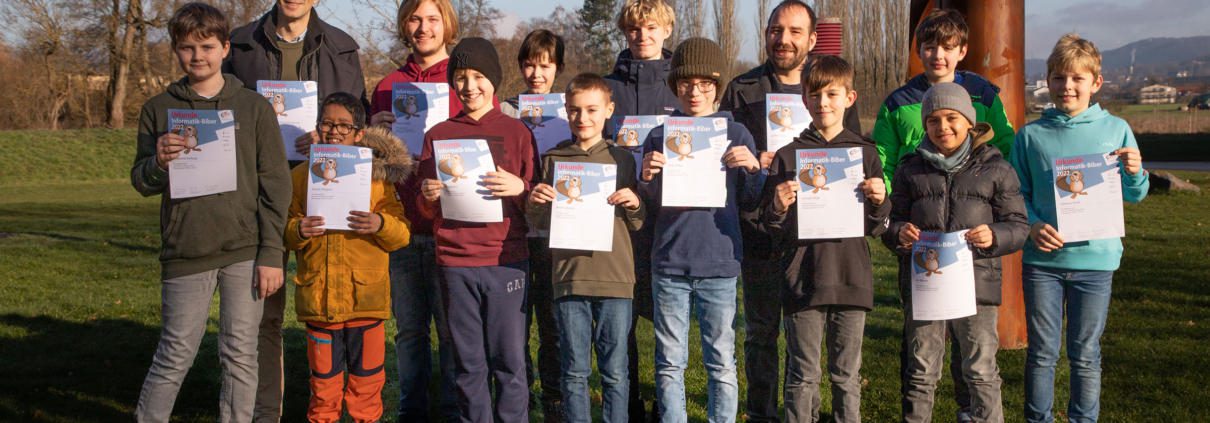
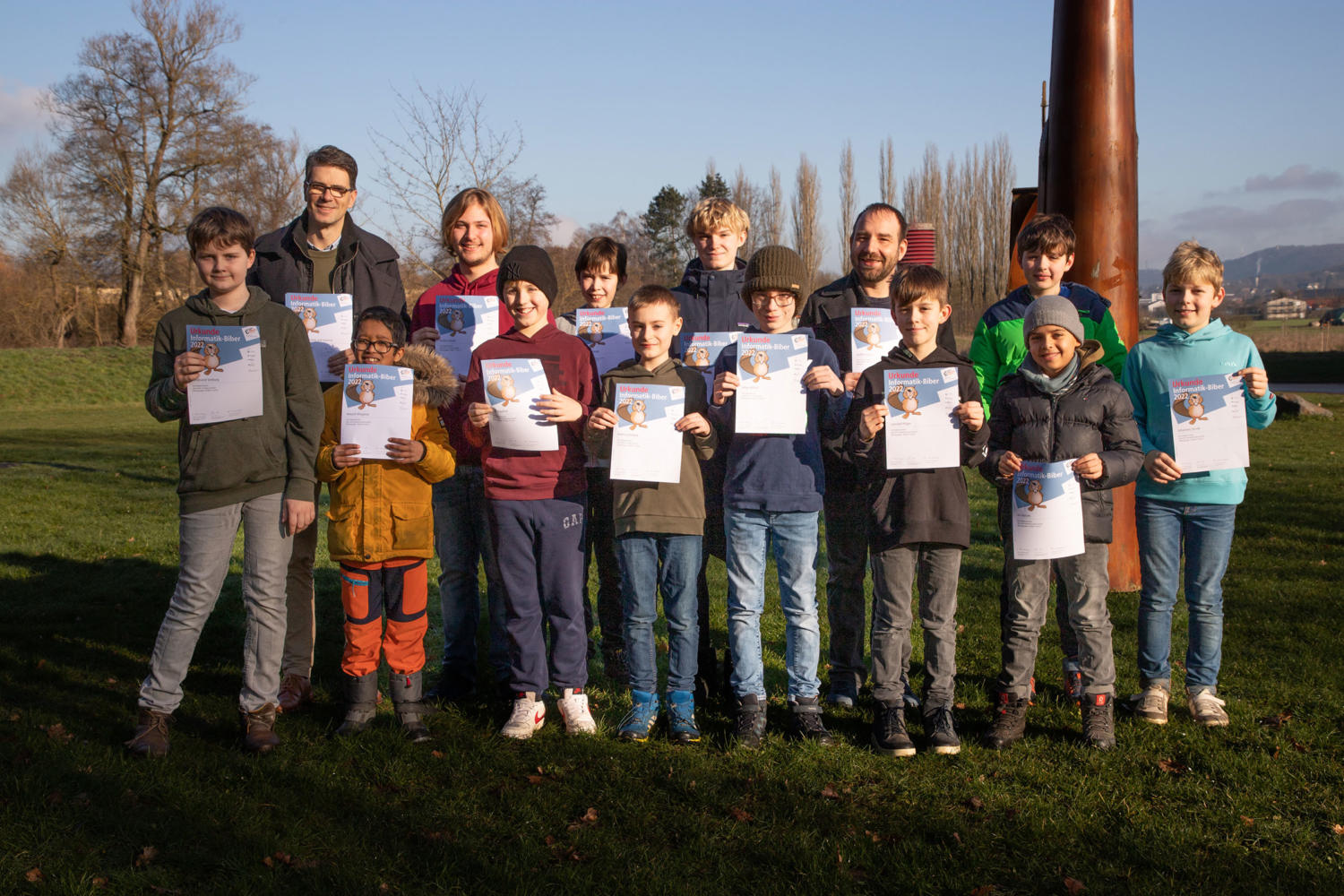
Steinmühle School participated in the nationwide “Informatik Biber” competition with 15 students from grades 5 through 13. The Informatik Biber is an annual computer science competition for students held in November, featuring brainteasers that explore concepts in computer science. The questions are answered online using a multiple-choice format.

The students at Steinmühle not only participated in this national competition, but also performed well. In addition to five certificates of recognition, they won eight third-place prizes. Anton Schmenk and Julian Alshut (front center) each even won a second-place prize.

Principal Björn Gemmer and Steffen Ullwer, head of Department III, congratulated the students on these great results and posed for the photographer alongside them. In the photo (back row, from left): Björn Gemmer (principal), Velten Schulz (13d), Leonard Schmidt (5b), Max Preidel (10b), Steffen Ullwer (Head of Department III), Leonard Hilger (5i). Front row, from left: Ferdinand Verburg (5i), Akaash Bhagwat (5i), Carl Höpfner (5a), Anton Schmenk (5b), Julian Alshut (5c), Leonard Hilger (5i), Ari Araam (5i), Johannes Stroth (5i). Missing from the photo are Paula Hartmann (10c), Mats Böhmer (10c), and Julius Lehnig (5b).

The Informatik-Biber is one of the student competitions recommended by the Conference of Ministers of Education.
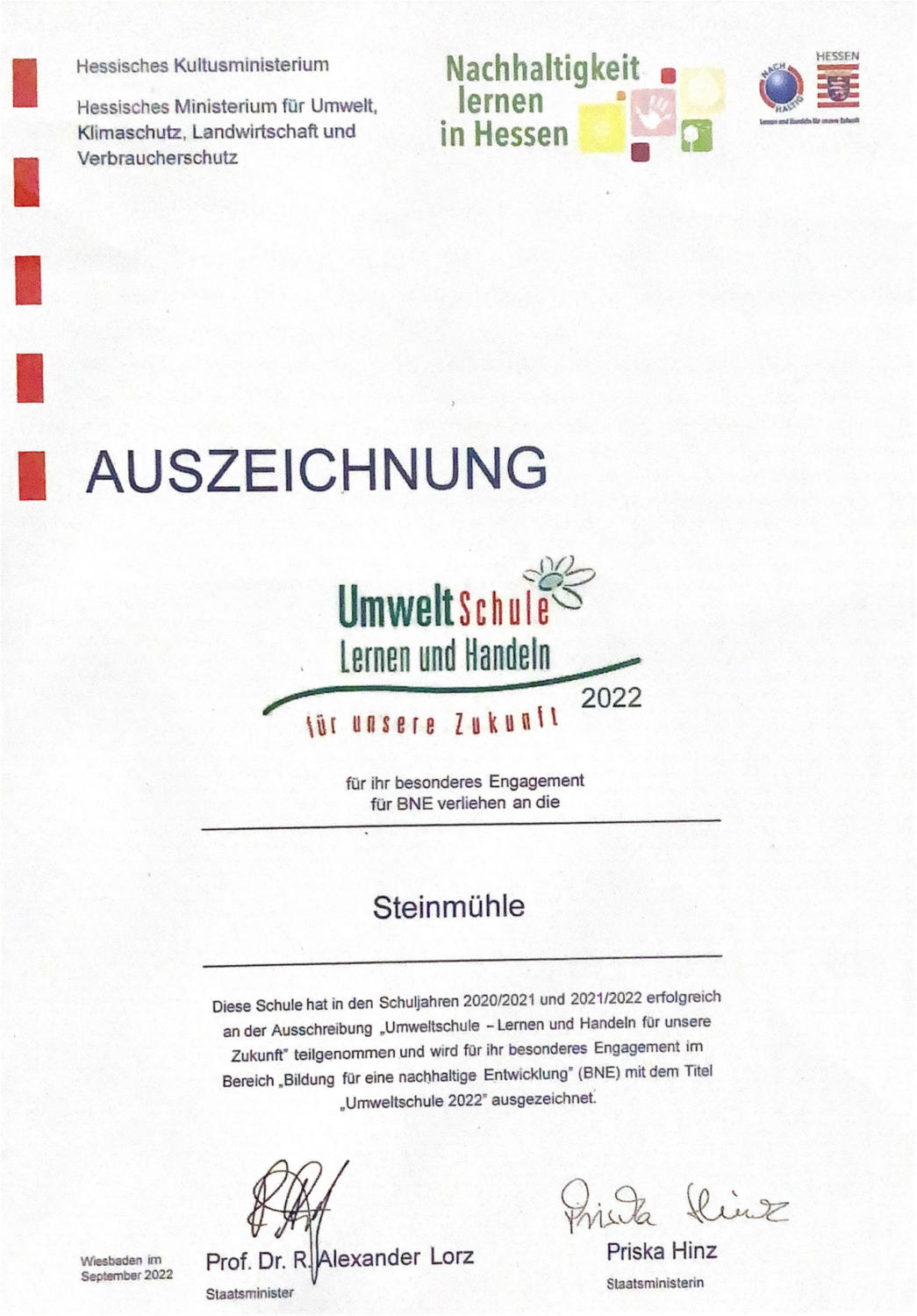
Steinmühle began 2023 as a recertified “Hessian Environmental School.” The award was presented jointly by the Ministry of the Environment and the Ministry of Education “for a school’s exceptional commitment to environmental education and education for sustainable development.”

During a festive ceremony, Angelika Schichtel from the Ministry of the Environment, Climate Protection, Agriculture, and Consumer Protection and Silke Bell (State Coordinator for Hessian Environmental Schools and Specialist Advisor on Education for Sustainable Development at the Hessian Ministry of Education and Cultural Affairs) presented the award to Steinmühle. This was reported by Carmen Bastian, the environmental officer at Steinmühle.

“Eco-School”—What Is This Award For?

The “Environmental School—Learning and Acting for Our Future” award recognizes a school’s exceptional commitment to environmental and ecological education. With this award, the two ministries honor improvements in the quality of instruction and school life in line with Education for Sustainable Development (ESD).

The fact that this is precisely the direction in which Steinmühle is currently focusing its efforts made the application for recertification a perfect fit.

In Action Area I—the sustainable redesign of the school grounds—measures related to nature conservation and the promotion of biodiversity were highlighted. These included the maintenance and expansion of the orchard meadow—we have already reported on this several times in our Steinmühlen media.

AG School for Earth as the “supreme discipline”

In Action Area II—the implementation of the concept “Education for Sustainable Development in Everyday School Life”—the application highlighted the founding of the “School for Earth” working group, led by Steinmühlen teacher Ines Vielhaben. This impressed the certifying officials, who, upon presenting the certificate, described this activity as a “pioneering flagship initiative” and wished the school much success in its continued implementation. In its yearbook, the school once again explicitly highlighted the spirit of optimism at Steinmühle and noted that the work of the “School for Earth” student group had led to a clear mandate to focus even more explicitly on ecology and sustainability. The focus is on the prioritized areas of nutrition, heating energy, electricity, waste management/cleaning, and mobility.

In this context, Steinmühle will be launching several additional initiatives in the near future. There are already numerous projects that have been implemented in the areas mentioned. The school garden, a water dispenser, the mobile chicken coop, sustainable building technology, energy-efficient renovations, solar and hydroelectric power, and participation in the “Schulradeln” competition are just a few examples.

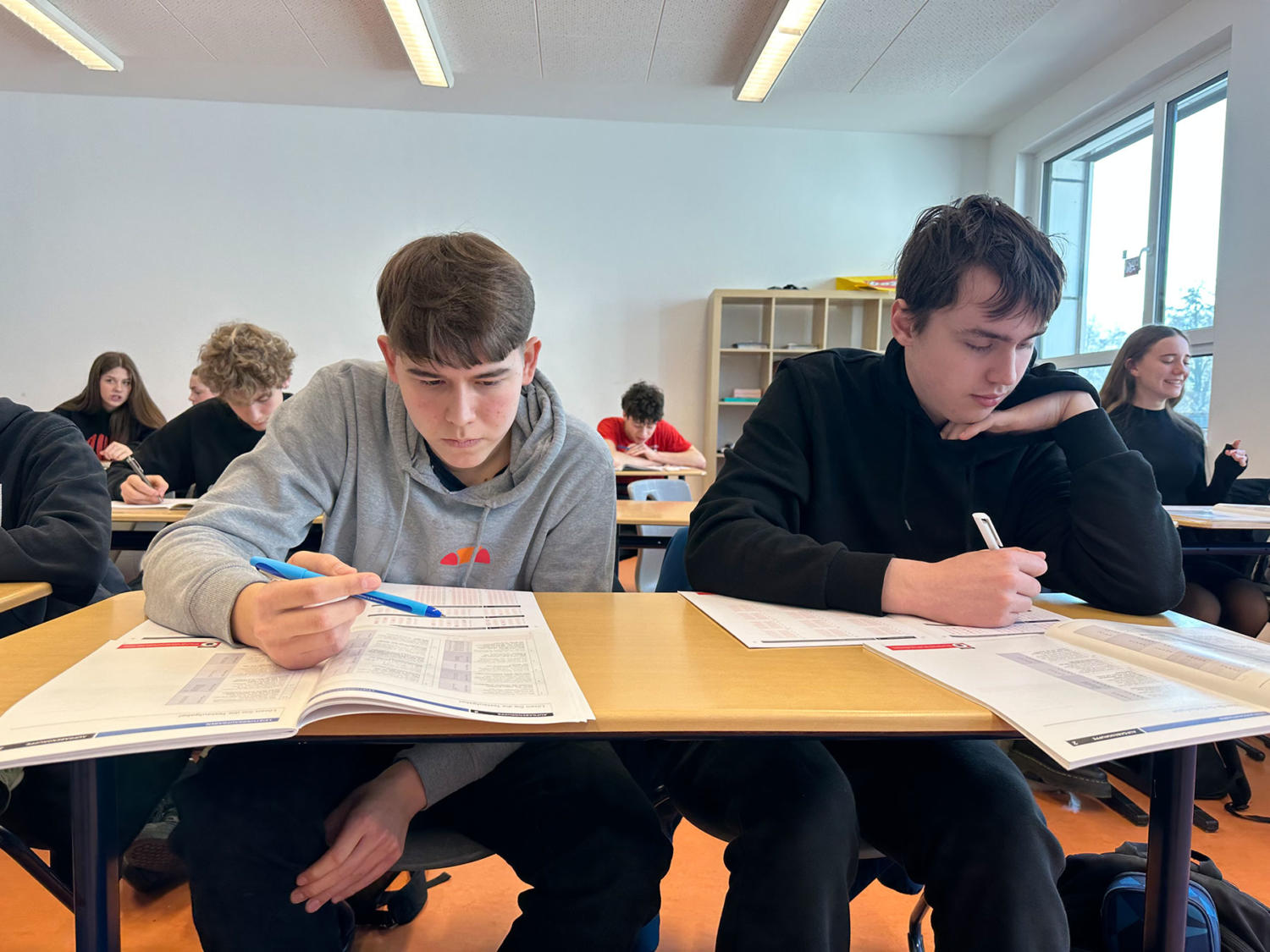
Once again this year, Steinmühle gave 11th-grade students the opportunity to assess their own abilities and interests through the geva test before they finalize their selection of advanced courses. The task was to work through a test booklet containing various exercises within a limited time. Many students are still unsure about the direction their future career “journey” will take. They are struggling with their choice of advanced courses and have absolutely no idea which college major to pursue or which vocational training program to complete later on.

Once the results are analyzed, the geva test essentially provides students with answers to the following questions:

  • What are my greatest interests, key skills, and achievements?
  • Where is there potential, and where are the starting points for my personal development?
  • Am I assessing my performance accurately? In which areas do I overestimate myself, and in which do I underestimate myself?
  • How do I stand out from my peers with a similar educational background?
  • Which degree programs or vocational training programs are the best fit?
  • What career development opportunities are available?

“Our partnership with the geva Institute is an important part of our career guidance efforts,” explained Dr. Claudia Röder, who is responsible for academic and career guidance at Steinmühle and coordinates the school’s internships.

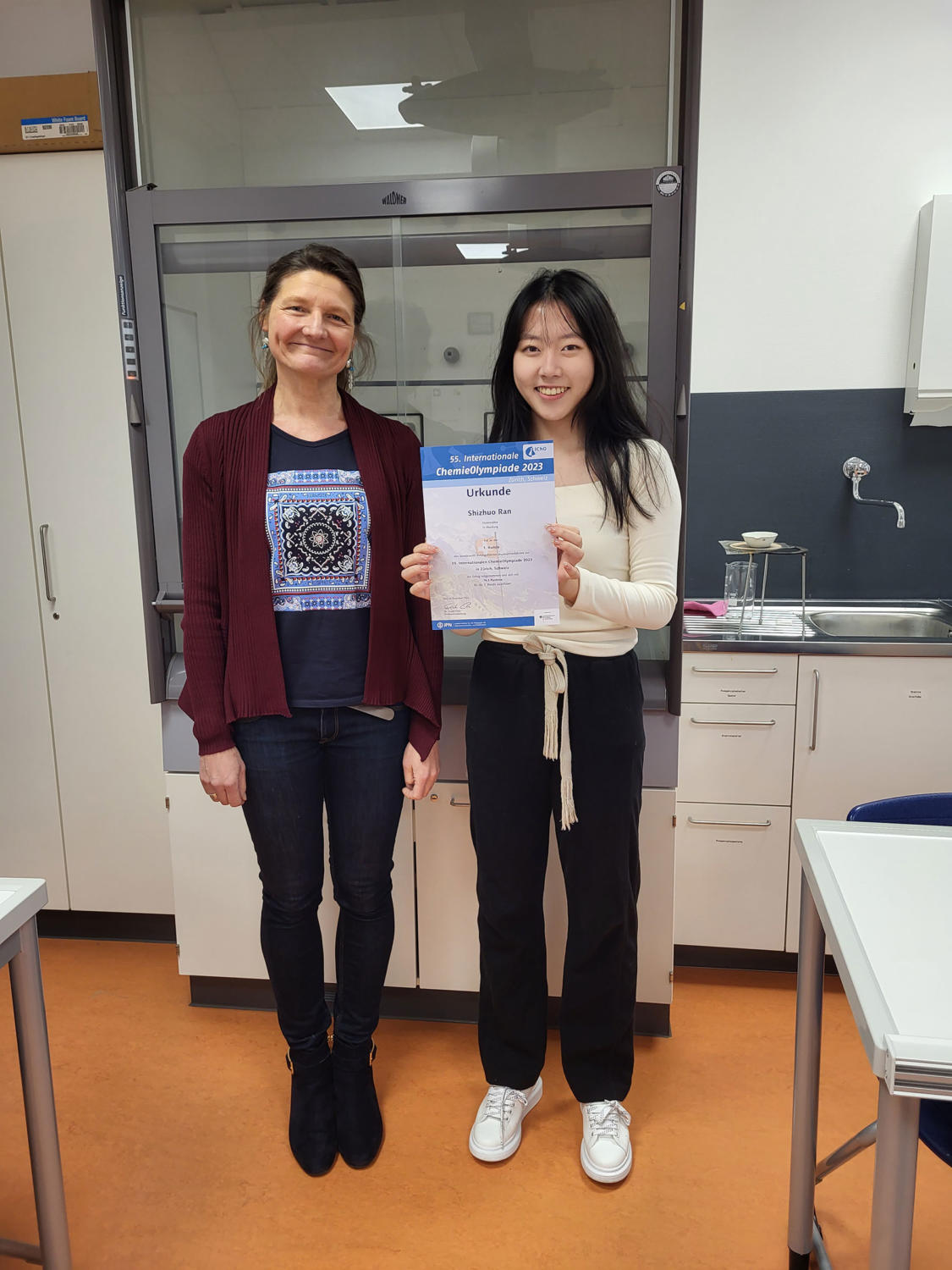
Shizhuo Ran, a 13th-grade student at Steinmühle, successfully participated in the first round of the selection process for the 55th International Chemistry Olympiad (IChO), which is taking place in Zurich this year. The IChO team at the Leibniz Institute for Science and Mathematics Education in Kiel announced the news. The entire Steinmühle community congratulates her on this achievement, which earned both the participant and her supervising teacher, Sirii Wienbeck (photo), a certificate each. The Chemistry Olympiad covers nearly the entire spectrum of chemistry, including inorganic chemistry, organic chemistry, physical chemistry, analytical chemistry, biochemistry, and spectroscopy. Many of the topics covered are at the university level.

In January, Class 8c from Steinmühle High School visited the Marburg District Court on Universitätsstraße as part of the “Youth and Crime” project, accompanied by their teacher, Dr. Claudia Röder. Students Greta Steiner and Evelyne Hildermann wrote the following about the visit:

We wanted to pursue criminal charges. After passing through security, the hearing began at 9:30. The courtroom was a small room divided into two sections: one section was for spectators, and the other section housed the prosecutor, the judge, a court clerk who was taking the minutes, and the defendant.

When the trial was about to begin, no defendant appeared, and the judge feared she would have to send for him. The prosecutor wanted to make sure once more that no one was actually there, and as he did so, he ran into the defendant in the hallway.

The defendant appeared in court without a lawyer and chose to represent himself. In the trial in question, the defendant was accused of assaulting his wife and an acquaintance at a house party attended by about 10 people in total, and of later resisting law enforcement officers.

The defendant denied the sequence of events and said that he had never become violent. However, since five witnesses described him as violent, he was found guilty. He was sentenced to seven months in prison, suspended for three years, and a fine of 600 euros, which he is allowed to pay in installments.

The witness, who failed to appear without a valid excuse, was fined 150 euros or sentenced to three days in jail.

Everyone was clearly shaken by the fact that actions we young people had actually considered “not that bad” had led to a prison sentence.

We all followed the trial with bated breath and found the outcome gripping. At the same time, we realized that, due to his language difficulties, the defendant hadn’t understood everything the prosecutor or the judge had said. For example, he was unfamiliar with the term “probation,” so he reacted with horror to the verdict.

All in all, it was a great morning, and it was cool to get a taste of “normal life” for a change.

By the age of 12, reading has long since become a part of everyday life. At the same time, reading well and understanding well remain an ongoing and ever-changing challenge—one that lasts a lifetime. This also applies to reading aloud well, where we can often notice how language has the power to enchant us. Readers can thus become enchanters! Around 20 children from classes 6a, 6b, and 6c embraced this magic at the end of 2022 and took part in the nationwide reading competition for sixth graders. The event was organized by the German Publishers and Booksellers Association.


Philian Merle represents Steinmühle at the city level

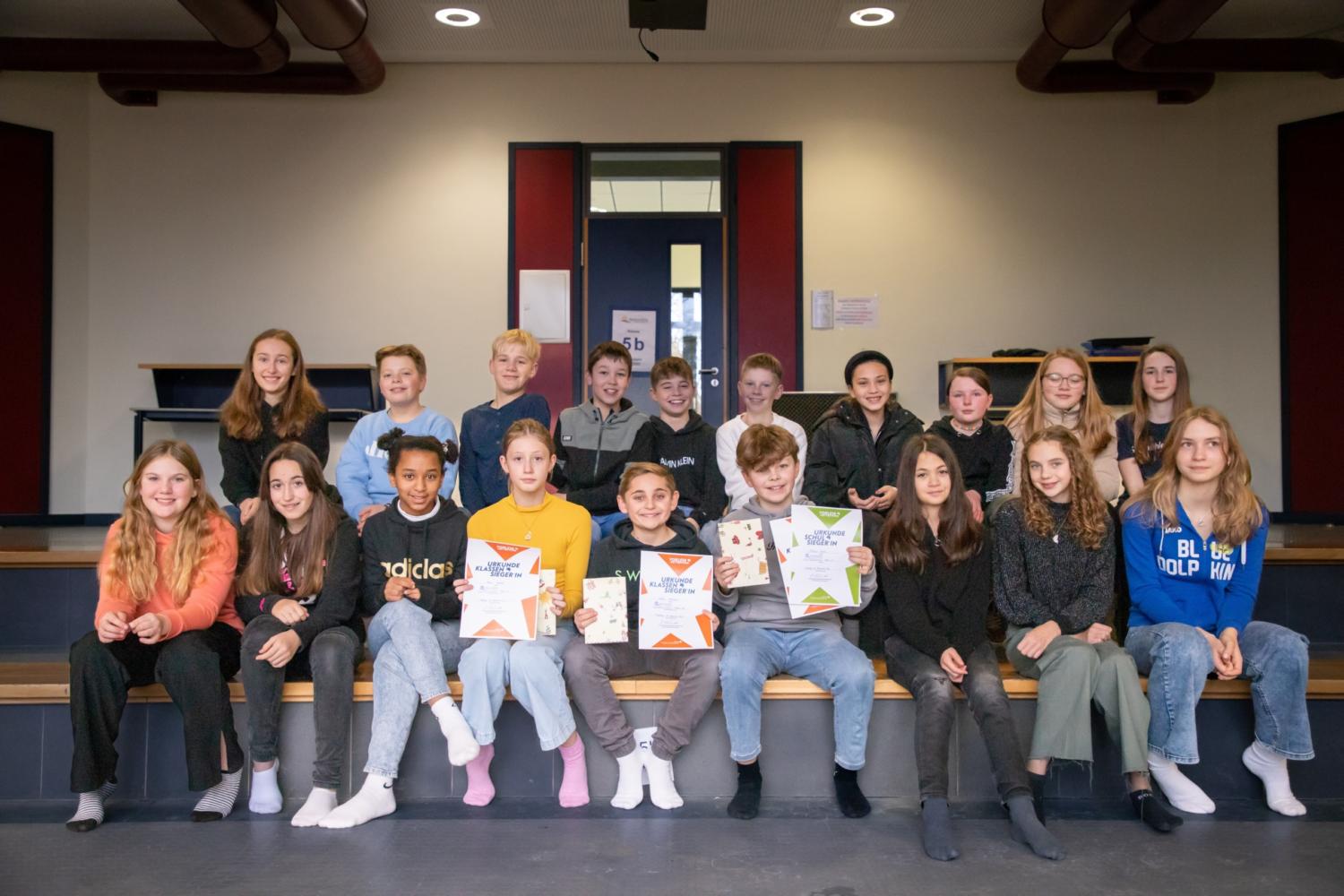
All the girls and boys gave compelling and moving readings, which were met with applause and admiration from their classmates in the audience as well as from the “juries,” consisting of teachers and, in some cases, fellow students. Only one person advances to the next round in this competition, whether it’s during the class reading or in the second round, which took place in early December and involved reading in front of all classmates in the grade. As the “school winner,” according to Frank Wemme, head of the lower secondary school, Philian Merle will “represent” Steinmühle in the next round at the city level in 2023. He was selected by the teachers’ jury in December—which was no easy decision, given the high quality of reading by all three “class winners,” including Aenna Arnold and Matteo Dörbecker.The school extends its heartfelt thanks to all the brave readers for taking part. Their participation is what made it possible for Steinmühle to compete in the first place.

Our photo shows the participants in the 6th-grade reading contest: (top row, from left) Antonia Mahnken, Fabian Preis, Till Kretschmann, Ben Borawski, Ben Templer, Arthur Böning (Class 6c), Sara Strempel, Lotte Schröder (Grade 6b), Anna-Lena Griesler (Grade 6c), Helena Taschner (Grade 6b). Bottom row, from left: Janna Gosejacob, Julia Hedoch (Grade 6c), Samri Wulf, Aenna Arnold (Grade 6a), Matteo Dörbecker (Grade 6b), Philian Merle, Ceysu Sevinc, Maja Böttcher (Grade 6c), Fenja Schlegel (Grade 6b).

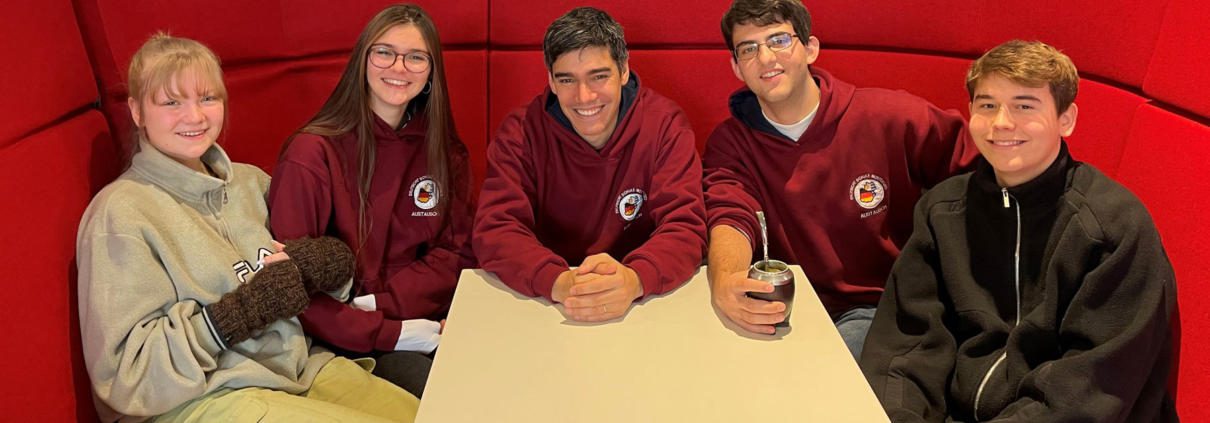
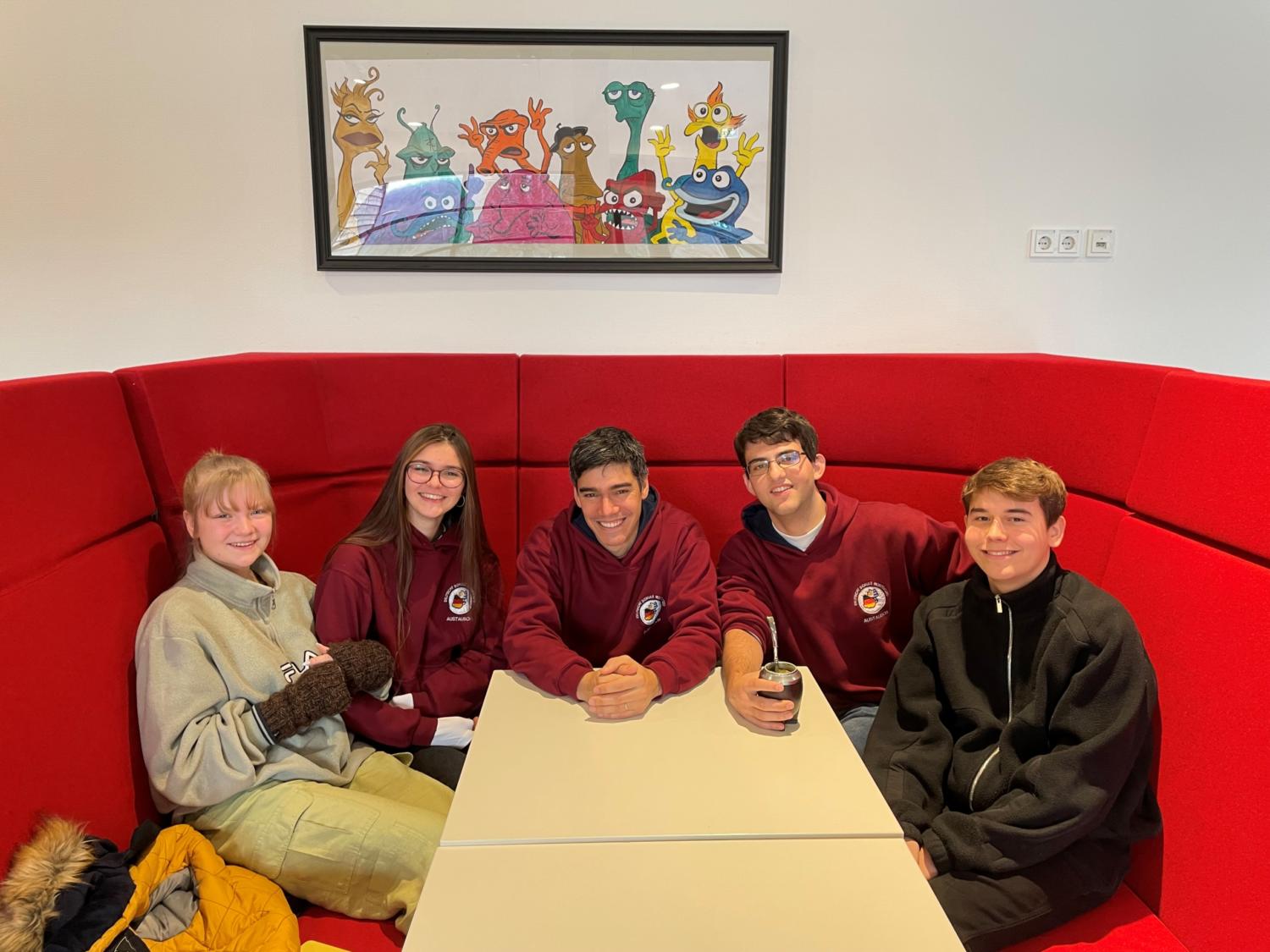
They miss their mate tea a little, and dinner is always “pretty early”—but everything else is absolutely perfect for Giulianna and Bruno from the German School in Montevideo. Together with their teacher Riobaldo, they are guests at Steinmühle for a total of six weeks. The stay is part of the Uruguay exchange, a project organized by Steinmühle Spanish teacher María Ramos. Following exchanges in 2019 and 2020, this is the third exchange between students from Uruguay’s capital and Steinmühle. In turn, 11th-grade Spanish students have the opportunity to experience everyday school life in Montevideo. For Lilli and Ben-Luis, there are only a few weeks left until they set off on their return visit to South America and experience daily life at the partner school. 1,300 students attend that school; it is the oldest German school in Latin America.

Bruno began learning German in Montevideo when he was in kindergarten, and added English in elementary school. He enjoys learning languages. His classmate Giulianna’s interest in the German language stemmed from her German uncle and a visit her father made to Germany, “which he enjoyed.” Ben-Luis, a student at Steinmühlen, also has family reasons for wanting to improve his Spanish: “I have relatives in Spain.” Lilli, Giulianna’s exchange partner from Marburg, wants to travel a lot when she grows up and is looking forward to improving her Spanish where it’s spoken.

Of course, the young people had already done a bit of research on their respective host countries before their trip. When asked about the environmental problems of our time, they collectively conclude that there is still room for improvement on both sides: Montevideo, with its population of just under 1.5 million, meets 90 percent of its energy needs through wind and hydroelectric power, but does not practice waste separation. — Just one example of this.

Exchanges offer the best opportunities to improve language skills and learn a lot from one another. The young people all agree: “It’s a great program. We recommend it.” Our photo shows (from left) Lilli, Giulinanna, teacher Riobaldo, Bruno, and Ben-Luis.