


Technical Equipment, the School’s Own StoneApp
Smart School Award
Steinmühle is currently equipped with fiber-optic internet and Wi-Fi throughout the school grounds. There is a multitouch display in every room. In grades 5–13, iPad-based instruction is conducted based on the BYOD (Bring Your Own Device) concept. A dedicated server infrastructure ensures the provision of a secure school cloud.
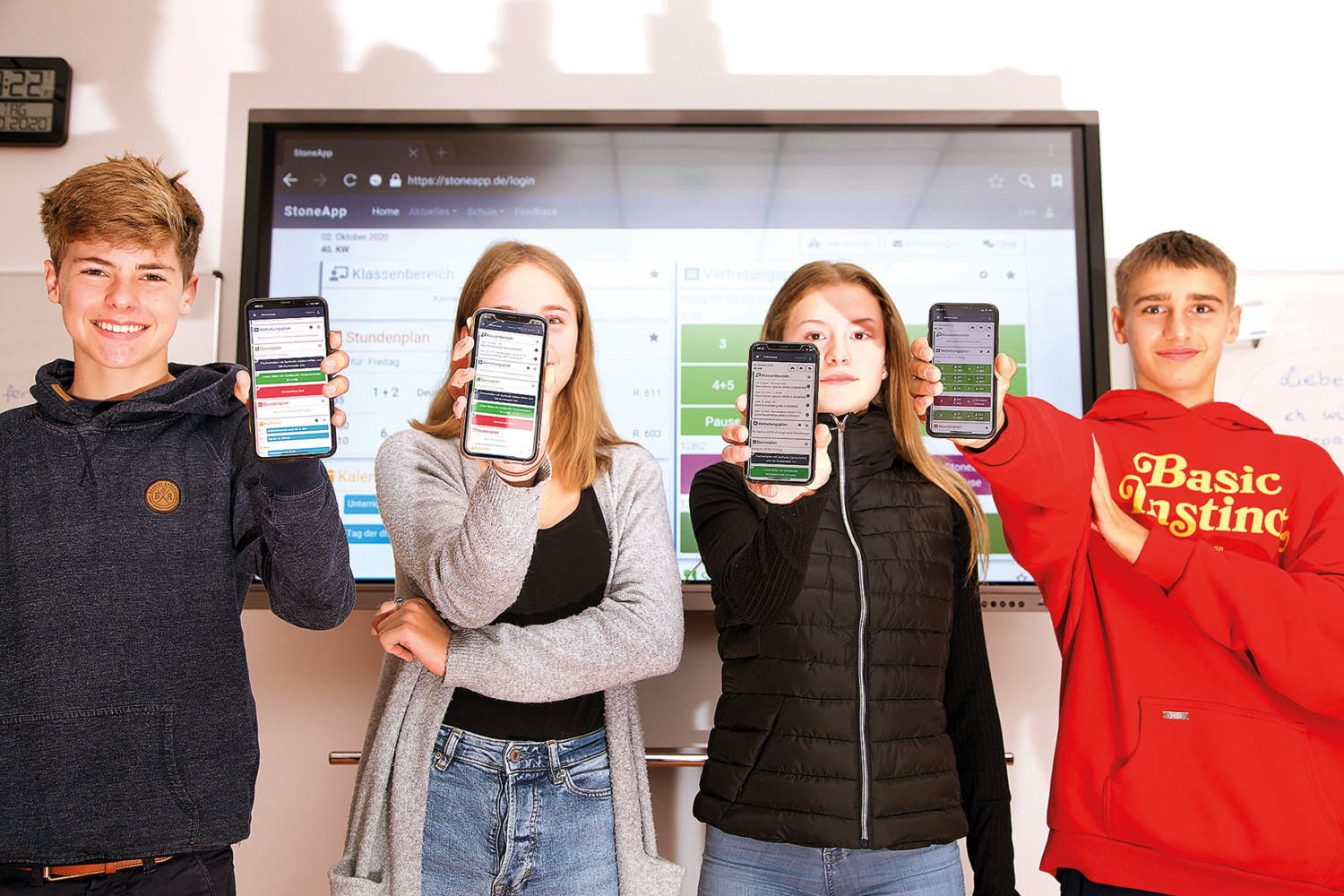
In the spring of 2021, Steinmühle was named a “Smart School” by the digital association bitkom for a unique feature at the school: its own school management app. It supports daily school life by facilitating communication between parents, teachers, and students—whether it involves, for example, reporting absences due to illness, submitting assignments, or accessing digital infrastructure such as the cloud.
Digital Government and AI
The school portal is used for school administration and serves as a digital class register. To better support digital learning, Telli AI is being used, and Moodle is currently being tested.
Steinmühle has its own AI server. Two high-performance NVIDIA graphics cards power state-of-the-art open-source language models—including GPT-OSS-120b, Gemma 3, and Mistral 7b. The OpenWebUI interface makes it intuitive for teachers and students to use. The hardware is deliberately designed to be scalable, ensuring that growing usage numbers will not cause bottlenecks.
The applications currently being tested include a parent assistant with information about Steinmühle, a resource assistant for the religion department, exam assistants for teachers, and other experimental projects. Everything runs on Steinmühle’s infrastructure—no data leaves the school, and full GDPR compliance is ensured.
Digital Life at the Steinmühle
iPad-Based Instruction
The goal of learning through new technologies is the systematic, pedagogically sound, and sustainable use of digital tools. This enables personalized learning.
Educational videos enhance the visualization of learning content through dynamic elements. Inquiry-based learning—such as collecting and analyzing one’s own data—can be emphasized more, as can the easy sharing of work results, which in turn fosters greater collaboration and feedback among learners. Expanding media literacy—for example, by creating videos and blogs—and, not least, fostering a love of learning through playful elements (gamification) are key goals of using digital media.
Starting in the second half of 5th grade, digital media will be gradually introduced into the classroom.
The devices remain at school. At the same time, instruction will remain hybrid: In addition to digital work, emphasis will continue to be placed on writing, reading, and keeping notebooks on paper to ensure a balanced use of media.
The school is responsible for the central procurement and technical management of the iPads. The school operates under the “Bring Your Own Device” model. Everyone uses the same device. Starting in 9th grade, students may take the devices home for personal use.
Full details can be found in Steinmühle’s Media Education Concept:







Cellphone-Free School
Since 2025, following discussions within the school community, Steinmühle has been implementing a cell phone-free school policy. A digital code of conduct was developed by a working group consisting of parents, teachers, and student representatives.
The goal is to establish uniform rules regarding digital devices. Students in grades 5–10 are not permitted to use them on school grounds. Lockers are available for their personal devices. The primary goal—which also involves older students setting an example for younger ones—is the principle of “invisibility.” This is intended to ensure the safety of younger students, promote social interaction, and reduce screen time.
Cellphone-Free School
Since 2025, following discussions within the school community, Steinmühle has been implementing a cell phone-free school policy. A digital code of conduct was developed by a working group consisting of parents, teachers, and student representatives.
The goal is to establish uniform rules regarding digital devices. Students in grades 5–10 are not permitted to use them on school grounds. Lockers are available for their personal devices. The primary goal—which also involves older students setting an example for younger ones—is the principle of “invisibility.” This is intended to ensure the safety of younger students, promote social interaction, and reduce screen time.
Our "Digitale Steinmühle" Expert Team





Sie haben Fragen zur Schule?
Schulleitung & Geschäftsführung
Björn Gemmer & Dirk Konnertz
Telefon: 06421 408-20
Sie haben Fragen zum Internat?
Internatsleitung & Geschäftsführung
Anke Muszynski & Dirk Konnertz
Telefon: 06421 408-0
Sie haben Fragen zur Schule?
Schulleitung & Geschäftsführung
Björn Gemmer & Dirk Konnertz
Telefon: 06421 408-20
Sie haben Fragen zum Internat?
Internatsleitung & Geschäftsführung
Anke Muszynski & Dirk Konnertz
Telefon: 06421 408-0
- NEWSLETTER
- VERÖFFENTLICHUNGEN
- ARBEITEN AN DER STEINMÜHLE
- SOMMERCAMPS
- IMPRESSUM
- DATENSCHUTZ
- KONTAKT