Principal Björn Gemmer recently presented certificates to students in the WU Computer Science program. They had participated in the Youth Computer Science Competition for eighth- and ninth-graders. Daniel Carle from class 8c even made it to the third round of the competition. Special congratulations to him! The other students received a certificate of recognition or an award for their participation in the second round. Posing for the photographer (from left) were Parsa Vahhabzadeh, Emil Graf, Dominik Koerth, Mika Koch, Maxim Kokaryev, Mio Bender, Daniel Carle, and subject teacher Nicole Scholtes. Jakob Tober is missing from the photo.
The students prepared for the competition as part of the WU Computer Science course and with the help of the learning platform, reports Nicole Scholtes. On the competition platform http://jwinf.de offers numerous practice problems at various difficulty levels, as well as past competition problems.

The Youth Computer Science Competition is a computer science competition for students with little or no programming experience. In the first and second rounds, participants can complete the tasks online. In the third round, they must complete more challenging tasks at home. The competition is open to all students in grades 5 through 13.

The first round began in February, and the students worked on the second round in class right after the Easter break. The third round, for which Daniel Carle has qualified, begins in September. “Students who are interested are welcome to contact me if they’d like to participate next year,” encourages Nicole Scholtes. To participate, you need a teacher account. More information can be found on the website https://bwinf.de/jugendwettbewerb/.

On March 16, the annual Kangaroo Math Competition took place. This is a multiple-choice competition in which students have 75 minutes to correctly answer as many questions as possible across three difficulty levels. Correct answers are worth 3–5 points depending on the difficulty, but points are also deducted for incorrect answers. “So our students have to be very strategic in how they approach the test,” reports Julia Bernzen on behalf of the math department.
Once again, students from Steinmühle Elementary School and High School voluntarily participated in the Kangaroo Competition; this year, even more than last year—a total of 119 students in grades 3 through 9. Everyone receives a prize at the end of this competition, though grand prizes (1st–3rd place) are also awarded, as well as prizes for the “biggest kangaroo jump” (the longest streak of correct answers).The math department is particularly proud of the fantastic results, and once again, many of the main prize winners are from Steinmühle. Here are the names of our math whizzes, along with the prizes they won:

– Nika Jablonski from Class 4 for the longest kangaroo hop in the elementary school
– Johanna Fuchs, 5a, 3rd place
– Charlotte Hanefeld, 5a, 3rd prize
– Sophia Schlösser, 5a, 3rd prize
– Julian Alshut, 5c, 3rd prize
– Leonard Hilger, 5i, 3rd prize
– Johannes Stroth, 5i, 3rd prize
– Jana Nowakowski, 5i, 3rd Prize
– Anna-Lena Grießler, 6th grade, 1st Prize and the school’s longest Kangaroo jump
– Sophie Menzler, 6th grade, 2nd Prize
– Philian Merle, 6th grade, 2nd prize
– Orlando Geisel, 9c, 1st prize

The following people posed for the photographer:

Front row, from left to right: Charlotte Hanefeld, Sophia Schlösser, Johanna Fuchs, Jana Nowakowski, Nika Jablonski.

Middle row, from left to right: Anna-Lena Grießler, Philian Merle, Sophie Menzler, Leonard Hilger, Johannes Stroth, Julian Alshut.

Orlando Geisel was absent from the photo shoot.

(Back row, from left to right) Maximilian Moll, representing the Mathematics Student Council, and Björn Gemmer, representing the school administration, congratulated the students on their achievements.

We have reason to celebrate! The Steinmühle has won the Hopp Foundation’s school award—worth €2,500—for its commitment to STEM education as part of the “Jugend forscht” state competition.

The Hopp Foundation is committed to promoting young talent in STEM subjects and has been a key supporter of “Jugend Forscht” for many years. Since last year, the award has honored schools that are particularly committed to fostering talented students interested in science and technology, thereby making an important contribution to strengthening science and technology in Germany.
This generously endowed award is—in addition to being a recognition of achievement—of course also a welcome opportunity to significantly expand Steinmühle’s science equipment.
A prerequisite for participating in the competition was a detailed application letter in which a project by Steinmühle plus STEM students played a significant role.


Plus-MINT Project in cooperation with Philipps University of Marburg

In collaboration with the University of Marburg, a project idea was developed to study the Lahn River in the area of the restoration site at the Gisselberg Span. Dr. Christoph Reudenbach from the Department of Geoinformatics is actively supporting the plus-MINT students with his expertise. The idea is to develop an autonomous, sensor-equipped boat to minimize the need to enter the sensitive ecosystem in the Gisselberg span renaturation area. This platform is designed to semi-automatically measure water quality in the Lahn River and collect water samples.
The project is a great opportunity for the students to learn how to build complex devices and program them independently for research purposes, as well as to deepen their knowledge in the fields of robotics, programming, and environmental sciences.


Strong Commitment to Environmental Education

In recent years, students at Steinmühle have submitted numerous projects to “Jugend forscht” and have often achieved great success. This year, they won two second-place finishes and one first-place finish at the regional competitions; one project even won the state award for the best interdisciplinary project in Hesse.
In his laudatory speech, Mr. Oliver Karplak, the state competition director for “Jugend forscht,” specifically highlighted Steinmühle’s strong commitment to environmental education and environmental projects in recent years. This helps raise students’ awareness of environmental issues and encourages them to act in an environmentally conscious manner.


A big thank you

Steinmühle is very proud that its work in the STEM fields has been recognized with this award, and we would like to once again extend our heartfelt thanks to everyone involved. The Hopp Prize is a wonderful recognition of this work and an incentive for the future to continue raising our students’ awareness of the importance of STEM subjects and environmental issues, and to offer them opportunities to actively engage in building a sustainable future.

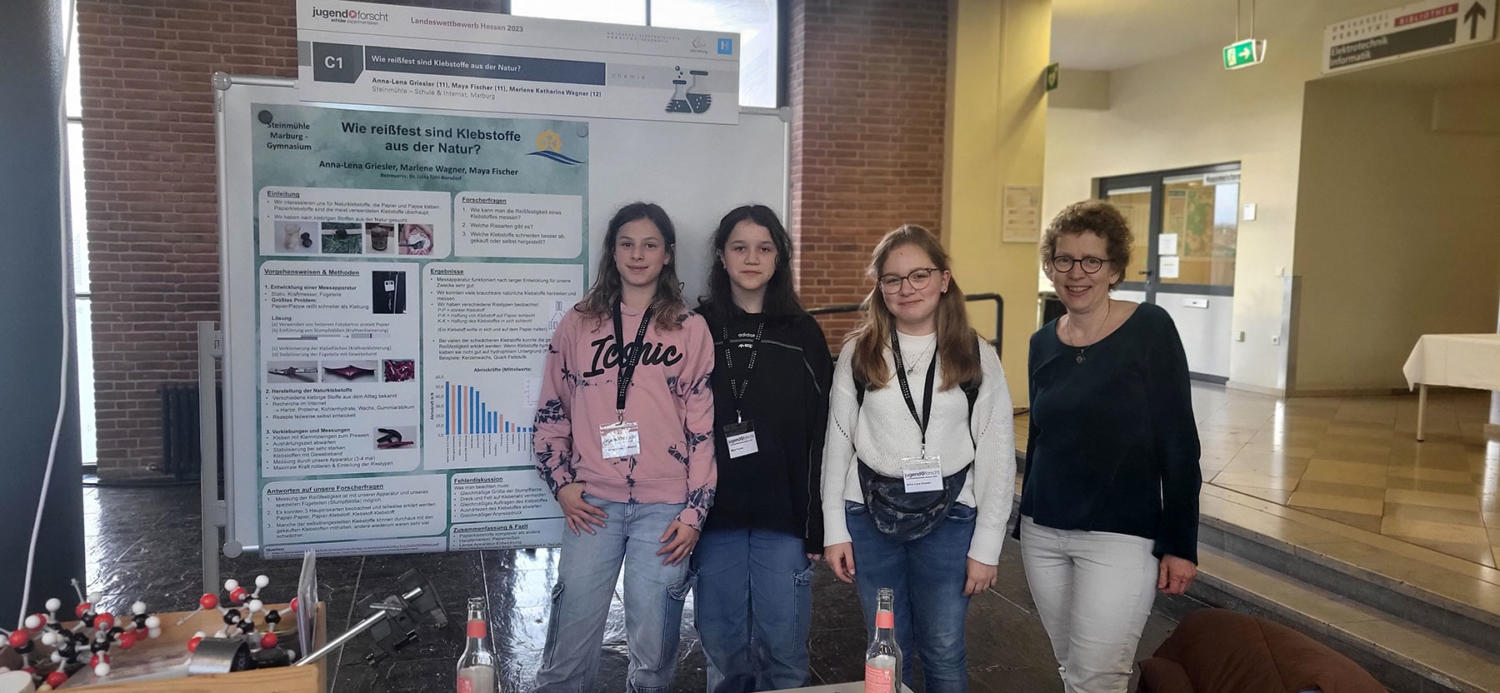
We did it! We—Maya Fischer, Marlene Wagner, and Anna-Lena Griesler—are proud to have come through two exciting days of competition.

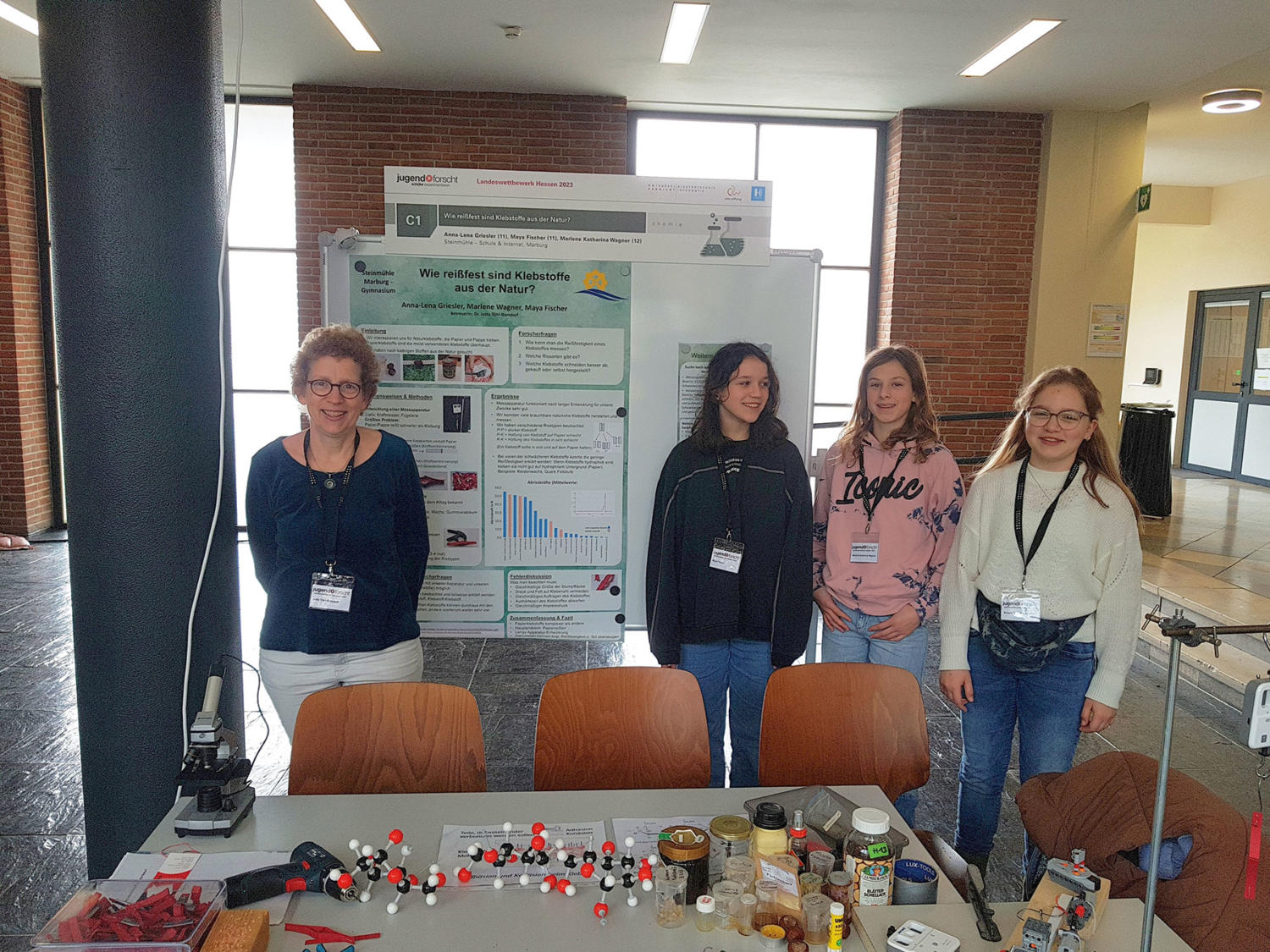
On Friday at 8 a.m., it was time for us to say, “Off to Kassel!” Together with our advisor, Ms. Töhl, we set off from the Steinmühle. Upon arriving at the University of Kassel, we were warmly welcomed and immediately began setting up our booth. After a brief welcome by the competition director, Eva Kretzer, and our host, Prof. Axel Bangert, we had our first discussion with the jury, followed by a photo session. It wasn’t easy to satisfy the photographer, but the result is impressive (see below). The friendly jury seemed very interested and asked us some exciting questions about our topic, “Adhesives from Nature.” The second jury team, in particular, delved even deeper into the chemistry of adhesives.
Everyone enjoyed the lunch that followed, and we had some fun conversations—for example, about the different colors of glass bottles.
After the lunch break, we had some time to check out the other projects and play games like Jenga or Mogelmotte. Once that time was up, we speculated about what would happen in the next workshop. We were wrong in assuming it would be a drumming workshop. The juggling workshop (so we were completely off the mark) gave us plenty of opportunities to get to know the other participants better. Finally, we had pizza, after which we all headed back to the youth hostel satisfied and stuffed our bellies with candy.

Day 2—Once we arrived back at the university, we set up our booth again and, after another round of discussions, immediately headed into our lunch break. After lunch, the general public was also able to marvel at the various projects and ask questions about the individual topics. The awards ceremony, hosted by science journalist Sascha Ott, was a lot of fun for everyone, and we all had a good laugh, especially during the experiments. Just before things got serious for all the students, Steinmühle received a surprise: the Hopp Foundation’s School Prize (2,500 euros). When it was the Chemistry Department’s turn—third in line—we “only” received the Special Prize for Materials and Substances. Shortly before the end, after the technicians had received their prizes, four special prizes were awarded, and we were among the recipients: We were honored with the state prize for the best interdisciplinary project.
After the closing coffee and cake, we drove back to Steinmühle—tired, exhausted, and happy. For all of us, the two days were a very varied and exciting experience.

Anna-Lena Griesler (6c)

A great success for our very young researchers from 6th grade: By winning the regional competition in Gießen, they qualified for the state competition and were able to travel to Kassel for two days with their advisor, Dr. Jutta Töhl-Borsdorf, to present their research project there. And they won there, too.
, Anna-Lena Griesler (11), Maya Fischer (11), and Marlene Wagner (12) focused on making adhesives from natural sources (as we reported), and this involved a lot of chemistry. But since the three didn’t stop at just making the adhesives—they also built a device to test their tensile strength—engineering played a major role in this project as well. Their force measurements using digital force sensors ultimately fell within the realm of physics as well.
This multifaceted approach—that is, its interdisciplinary nature—impressed the jury. The continuous refinement of the experimental apparatus and the depth of understanding with which they analyzed the underlying processes impressed the judges. In addition, they were praised for their confidence during the presentation and, in particular, for their strong team spirit.

The depth of content is something that is also close to the heart of “Jugend forscht” advisor Dr. Jutta Töhl-Borsdorf. “The three of them had to explain the different adhesive properties of the various materials on the paper. Since paper is made of cellulose, that’s more of a topic from 12th-grade chemistry class. Natural adhesives are also rather complex molecules. But you can ‘break it down’ into simpler terms.” During the jury deliberations, the team was able to impress with their expertise and technical terms such as hydrophilic and hydrophobic, hydrogen bonding, and cohesion and adhesion failures.

It was also great to see the students interacting with students from other schools. One team, for example, had been working on an adhesive made from mistletoe berries. A sample was quickly provided and measured by the girls. However, this adhesive turned out not to be suitable for everyday use just yet.
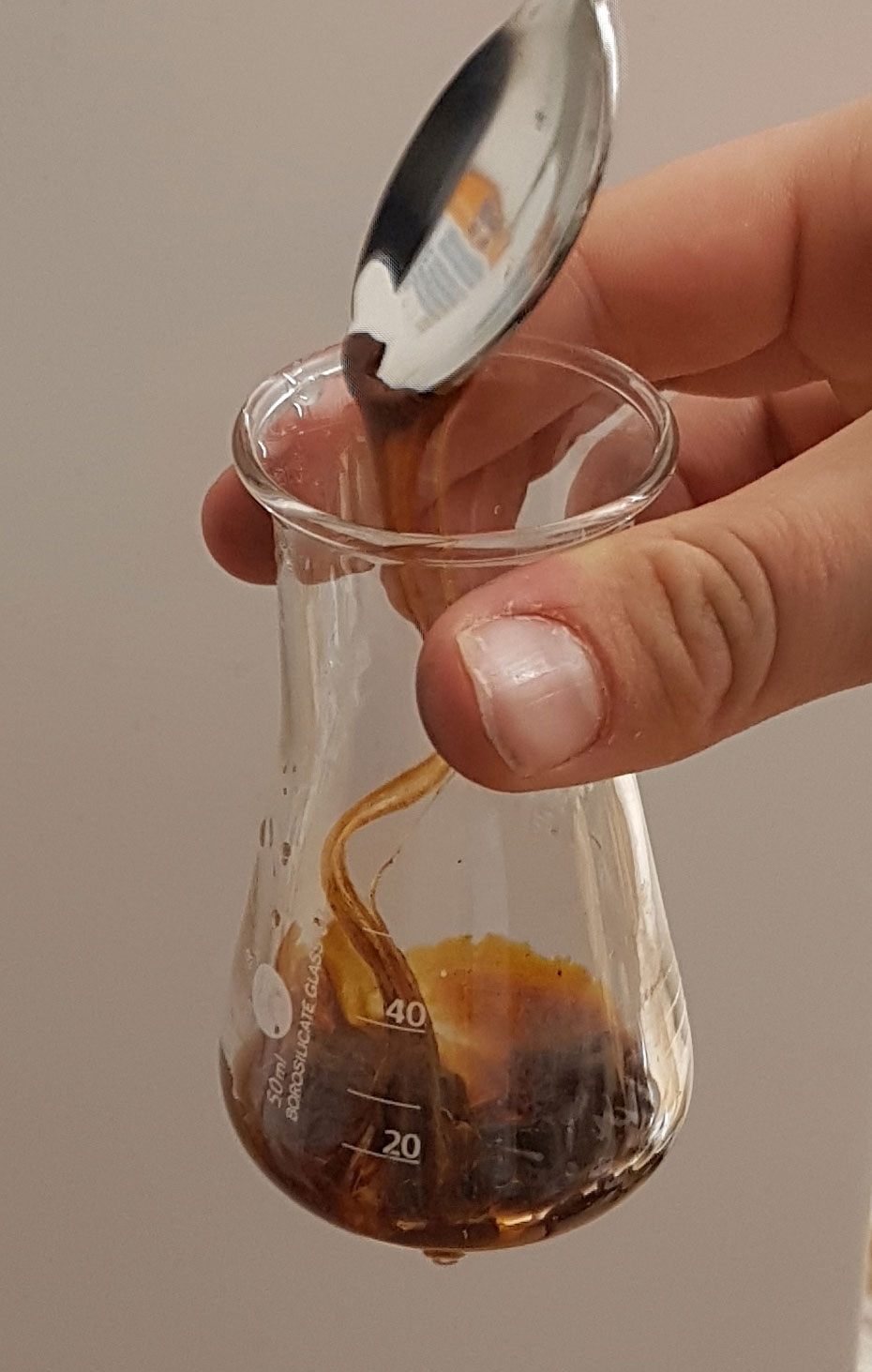
The team’s best adhesive consists of starch, sugar, and a little vinegar, which breaks down the starch molecules into shorter chains.
Last but not least, the Steinmühlen team also took home the special “Materials and Substances” prize from the Institute of Materials Science at the University of Kassel. In total, this meant prize money of 300 € for the three young researchers, though Anna-Lena noted: “The money isn’t really important at all. Spending those two days with like-minded people was the best part.”

We are very proud of you. Congratulations!
Click here for the University of Kassel’s press release

On March 7, the Central Hesse Student Research Center kicked off its activities at Steinmühle School in Marburg with an experiment and information day, which was also attended by numerous students from Steinmühle. Steinmühle Principal Björn Gemmer was delighted to welcome 90 students from all over Central Hesse.

“How do I come up with a research question, and how can I develop it further?” was the central theme of the day, which the students explored in six very different workshops. Some students investigated the behavior of woodlice, while others examined how much radioactivity the human body absorbs. Another workshop used real measurement data to study the motion of entire galaxies, while the chemistry workshop focused on the question of optimal combustion. The math workshop was dedicated to calculating the area of polygons, and the energy workshop focused on the efficient use of natural resources.

In addition to the six workshops, there was an extensive supporting program. At the “Market of Opportunities,” students presented their current projects from the “Jugend forscht” competition, the German Young Physicists’ Tournament, and the First Lego League. Mr. Burk, the regional director of “Jugend forscht,” informed participants about what to consider when conducting their own research projects and answered questions from the audience.
In addition to the technical content, the students naturally also had time to exchange ideas and get to know one another. The organizers were impressed by the students’ high level of motivation and the positive atmosphere. So it was ultimately no surprise that the final feedback was consistently positive. Many participants said they plan to start their own research projects in the near future.
Let’s hope that many students from Steinmühle are among them.

If you’re also interested in STEM or are thinking about starting a research project, check out the website of the Central Hesse Student Research Center.


For more information about the SFM’s programs, visit https://sfz-mittelhessen.de

This year, our “Jugend Forscht” teams had to compete at two different locations.

What is the condition of the soil in our area?
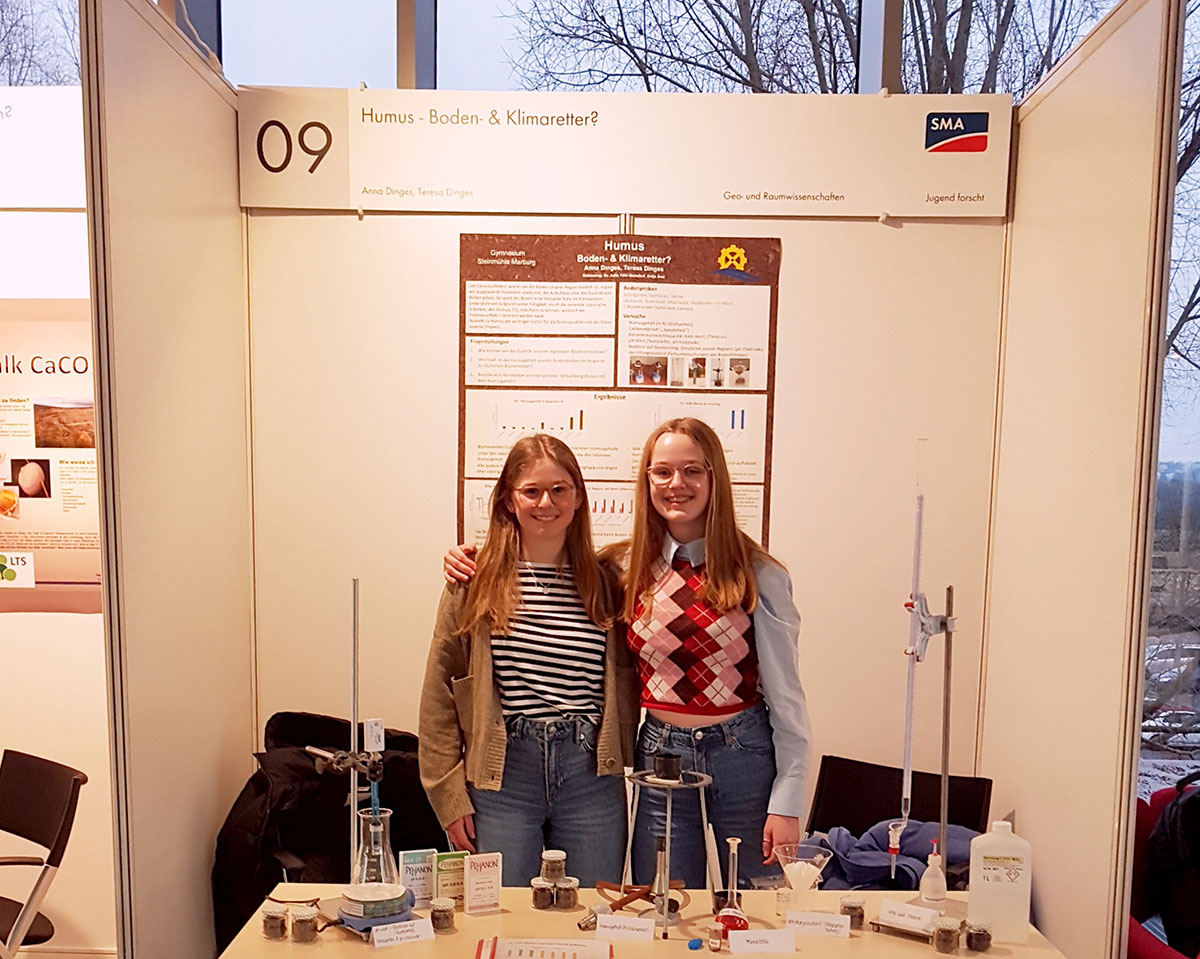
Sisters Anna Dinges (12th grade) and Teresa Dinges (9th grade) traveled to Kassel on Saturday, February 11, with their project “Humus: Savior of the Soil and Climate?” on Saturday, February 11, along with their advisors Antje Seel and Dr. Jutta Töhl-Borsdorf. The North Hesse regional competition was held at SMA in Kassel-Niestetal.

Soils play a major role in the climate system because humus is capableof storing large amounts ofCO2 . Anna and Teresa wondered about the condition of the soils in the areas where they live and go to school. In addition to measuring humus content, pH, and KAK values (a measure of soil fertility), they also investigated how soils react to acid rain. They compared the measurements from the soil samples they collected with those from commercially available potting soils and found that the latter actually had higher humus and KAK values. However, a coniferous forest soil also performed impressively overall. The jury particularly praised the outstanding laboratory work, which was conducted at a high level and with great precision, the rigorous scientific approach, and the in-depth examination of sustainability issues at the local level.

With their project, they won second place in the “Geosciences and Spatial Sciences” category and a special prize consisting of a one-year subscription to the science magazine “natur.”

Rainwater and Natural Adhesives
On
Friday, February 24, a large group set out for the University of Giessen to present their projects at the competition in Central Hesse. Anna-Lena Griesler, Maya Fischer, Marlene Wagner, Nico Farwig, Justus Pöschl, and Robin Richter—all from the 6th-grade GuFi lab groups—took on the challenge in the “Students Experiment” category.
The Steinmühlen bus was fully occupied with the six children, their supervisor Dr. Jutta Töhl-Borsdorf, STEM teacher Dr. Patrick Szabo, and participation assistant Steven Müller.
They set off at 7:45 a.m., and the morning was well filled with jury interviews and interesting lab tours. In the afternoon, the presentation booths were open to the general public. Many parents, grandparents, and friends took the opportunity to have the young researchers explain their projects to them. By around 5:00 p.m., everyone was tired but full of new impressions as they returned to the Steinmühle.
This year’s awards ceremony took place online on Saturday afternoon. To mark the occasion, all the students gathered at the Steinmühle for pizza. And finally, there was something to celebrate.

The group of three boys who asked themselves, “Is rainwater valuable?” won over the jury, taking second place in the “Geosciences and Spatial Sciences” category and a special prize of a one-year subscription to the magazine Geolino.
Justus, Nico, and Robin analyzed rainwater for various components, developed a water hardness test using soapy water, and found that cress grows better with rainwater than with tap water. The jury praised their clear methodology, the neat presentation of the measurement results, the visualization of the cress growth, and their broad knowledge.

Anna-Lena, Maya, and Marlene securedfirst place in the chemistry category—and with it, a spot in the state competition at the University of Kassel—with their project “How Tear-Resistant Are Natural Adhesives?” They made many adhesives themselves—for example, from food—and tested other natural substances, such as spruce resin, shellac, and snail slime, for their adhesive properties. The team also succeeded in developing a device to measure the adhesive strength of the substances on paper.
The jury was particularly impressed by how these very young students continuously refined and adapted their experimental setup. They paid close attention to accuracy and critically evaluated their approach in each phase of the experiment. Their strong problem-solving skills were evident.
The team also won the plusMint Special Prize for interdisciplinary projects.

If you’re interested in starting your own research project, just stop by the “Open Lab” at the Steinmühle—it’s open every Tuesday and Friday starting at 2 p.m. (Room 127).

Steinmühle School participated in the nationwide “Informatik Biber” competition with 15 students from grades 5 through 13. The Informatik Biber is an annual computer science competition for students held in November, featuring brainteasers that explore concepts in computer science. The questions are answered online using a multiple-choice format.

The students at Steinmühle not only participated in this national competition, but also performed well. In addition to five certificates of recognition, they won eight third-place prizes. Anton Schmenk and Julian Alshut (front center) each even won a second-place prize.

Principal Björn Gemmer and Steffen Ullwer, head of Department III, congratulated the students on these great results and posed for the photographer alongside them. In the photo (back row, from left): Björn Gemmer (principal), Velten Schulz (13d), Leonard Schmidt (5b), Max Preidel (10b), Steffen Ullwer (Head of Department III), Leonard Hilger (5i). Front row, from left: Ferdinand Verburg (5i), Akaash Bhagwat (5i), Carl Höpfner (5a), Anton Schmenk (5b), Julian Alshut (5c), Leonard Hilger (5i), Ari Araam (5i), Johannes Stroth (5i). Missing from the photo are Paula Hartmann (10c), Mats Böhmer (10c), and Julius Lehnig (5b).

The Informatik-Biber is one of the student competitions recommended by the Conference of Ministers of Education.

Shizhuo Ran, a 13th-grade student at Steinmühle, successfully participated in the first round of the selection process for the 55th International Chemistry Olympiad (IChO), which is taking place in Zurich this year. The IChO team at the Leibniz Institute for Science and Mathematics Education in Kiel announced the news. The entire Steinmühle community congratulates her on this achievement, which earned both the participant and her supervising teacher, Sirii Wienbeck (photo), a certificate each. The Chemistry Olympiad covers nearly the entire spectrum of chemistry, including inorganic chemistry, organic chemistry, physical chemistry, analytical chemistry, biochemistry, and spectroscopy. Many of the topics covered are at the university level.

From January 16–19, the Math Camp took place in Marburg as part of the plus-MINT talent development program. Steinmühle, as the host and organizer, offered the 20 students from the plus-MINT boarding schools Birklehof, Louisenlund, Schulpforte, and St. Afra a very varied program.

Workshops in the Department of Mathematics and Computer Science at Philipps University of Marburg

During her workshop at the University of Marburg, Prof. Dr. Agricola discussed the “mathematics of voting.”

The workshop led by Prof. Dr. Oliver Goertsche at the University of Marburg focused on geometry, topology, and spherical triangles. According to Prof. Dr. Goertsche, this material is covered in the fourth semester of the mathematics program and proved quite challenging for the participants of the plus-MINT Camp.

“The workshop was impressive; I’m a big fan of theoretical mathematics, and the content really challenged me,” says Luis, who has been a plus-MINT student at Steinmühle since the summer of 2022.

“I felt the same way—the lectures by the university professors really got my brain working. It’s motivating, and I really enjoy pushing myself to my limits,” agrees Fabian, a student at Steinmühlen.

Dr. Karl-Heinz Muth and Steinmühlen student Clara Steiner offered a completely different perspective on mathematics with their presentation titled “Entertainment Math: You Didn’t See That Coming!”

Field Trip to the Mathematikum in Giessen

During their field trip to the Mathematikum in neighboring Giessen, the students got hands-on. The Mathematikum is the world’s first interactive mathematics museum. About 200 exhibits offer visitors a new perspective on mathematics and invite them to participate. “The Mathematikum was actually closed for renovations, but it made an exception for the plus-MINT students and opened exclusively for us,” says Björn Gemmer, principal of Steinmühle School.

“We were able to try out all the stations; some were very easy, while others were really challenging. You couldn’t tell just by looking at them beforehand, and we were sometimes surprised by the complexity of exhibits that seemed simple at first glance,” Fabian says.

Participation in the “Bolyai” International Mathematics Team Competition

“The ability to work together is a core value in our lives”—this is the motto of the “Bolyai” math team competition, in which the plus-MINT students participated as part of the math camp at Steinmühle. The challenge was to work as a team to solve challenging math problems within a set time limit.

The students from Louisenlund and Schulpforte secured a spot in the top 10 thanks to their team effort.

Mathematical City Scavenger Hunt Through Marburg’s Upper Town

Marburg offers visitors several impressive sights: St. Elizabeth’s Church, the Old University, the Landgrave’s Castle, and the Old Town—known in Marburg as the “Oberstadt”—located below it.

The plus-MINT students got to know the Upper Town, with its picturesque alleys, colorful half-timbered houses, and hidden squares, during a math-themed city scavenger hunt. Together, they completed various tasks and immersed themselves in Marburg’s fascinating history.

We wrapped up the evening with a group dinner and a get-together in the tea room

The three-course candlelit dinner and the get-together provided a lovely conclusion to our time together and gave us yet another opportunity to catch up. “It was really nice to see the other plus-MINT students again and talk about our experiences at the boarding schools,” says Clara, a student from Steinmühle.

“We felt very comfortable and welcome at the Steinmühle, and interacting with the other plus-MINT students was very inspiring,” say Johanna and Paula from St. Afra.

“Yes, I completely agree, and spending the night in the gym added a touch of adventure to the whole thing! I’m already looking forward to the next plus-MINT Camp and can’t wait to see where we’ll get to go,” says Aaron from St. Afra.

PlusMINT – What’s Next? Selection Days at Birklehof in Early April 2023

It’s that time of year again in April, and the new plus-MINT candidates will have the opportunity to showcase their talents during the selection days at the Birklehof.

“We deliberately take plenty of time to get to know the students. We conduct research, experiment, and build things together. Afterward, the selection committee decides whether to admit them to the program,” explains Sven Meier, plus-MINT project manager.

In addition to interest and aptitude, the evaluation criteria include extracurricular involvement in STEM fields, personality and social skills, as well as a willingness to actively participate in the plus-MINT program.

For more information, visit: www.plus-mint.de

Steinmühle is already looking forward to welcoming the new plus-MINT students—and, of course, to the next plus-MINT camp!