

Environmental Sustainability Project: Class 10b Planted an Orchard Meadow
Unlike project-based learning in grades 5–9, where students typically work on three projects per semester, grade 10 features two major semester-long projects. In the first semester, each group chose a topic related to environmental sustainability, which consisted of a research phase, a project, and a presentation on the topic and project they had selected. In this context, we—Calvin, Clemens, Felix, Jan, Lukas, and Simon—from class 10b focused on CO2 emissions.
Since trees have the ability to sequester CO2, they are indispensable for protecting the climate. Upon closer examination, it quickly becomes clear that this ability not only ensures sustainability over many years but also continuously counteracts CO2 pollution. So, in order to take action ourselves against this CO2 pollution and to improve the local ecosystem in a sustainable way, we have decided to plant trees and create our own orchard meadow.
Since the school still needed to implement a compensatory measure for the new middle school building, our idea fit very well with the school administration’s plans. As a result, a suitable meadow area was quickly made available to us for planting, specifically behind the middle school building. Following a corresponding application by the school, the Giessen Regional Council provided 1,156 euros to cover the material costs for the orchard meadow—on the condition that the school take responsibility for maintaining the trees.
A home for thousands of animals and plants
An orchard meadow is beneficial not only because of the environmental benefits provided by the trees. It is an unfertilized meadow where fruit trees grow; it also serves as a habitat for over 5,000 animal species and more than 3,000 plant species. For example, the red-backed shrike, which needs both open space and trees, can settle here. And the orchard meadow is also an ideal habitat for the nightingale, the chiffchaff, the yellowhammer, and otherwise endangered bat and insect species.
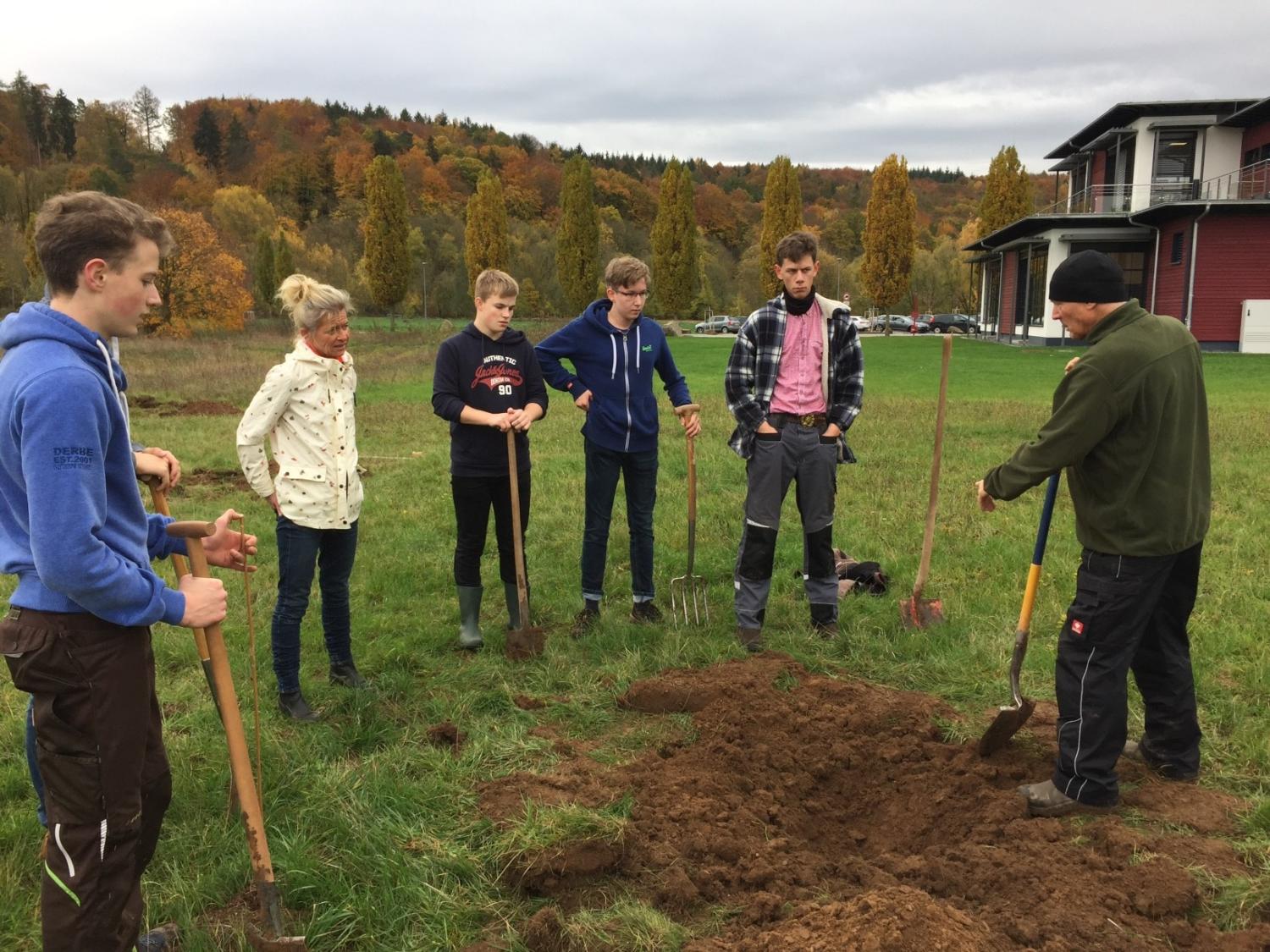
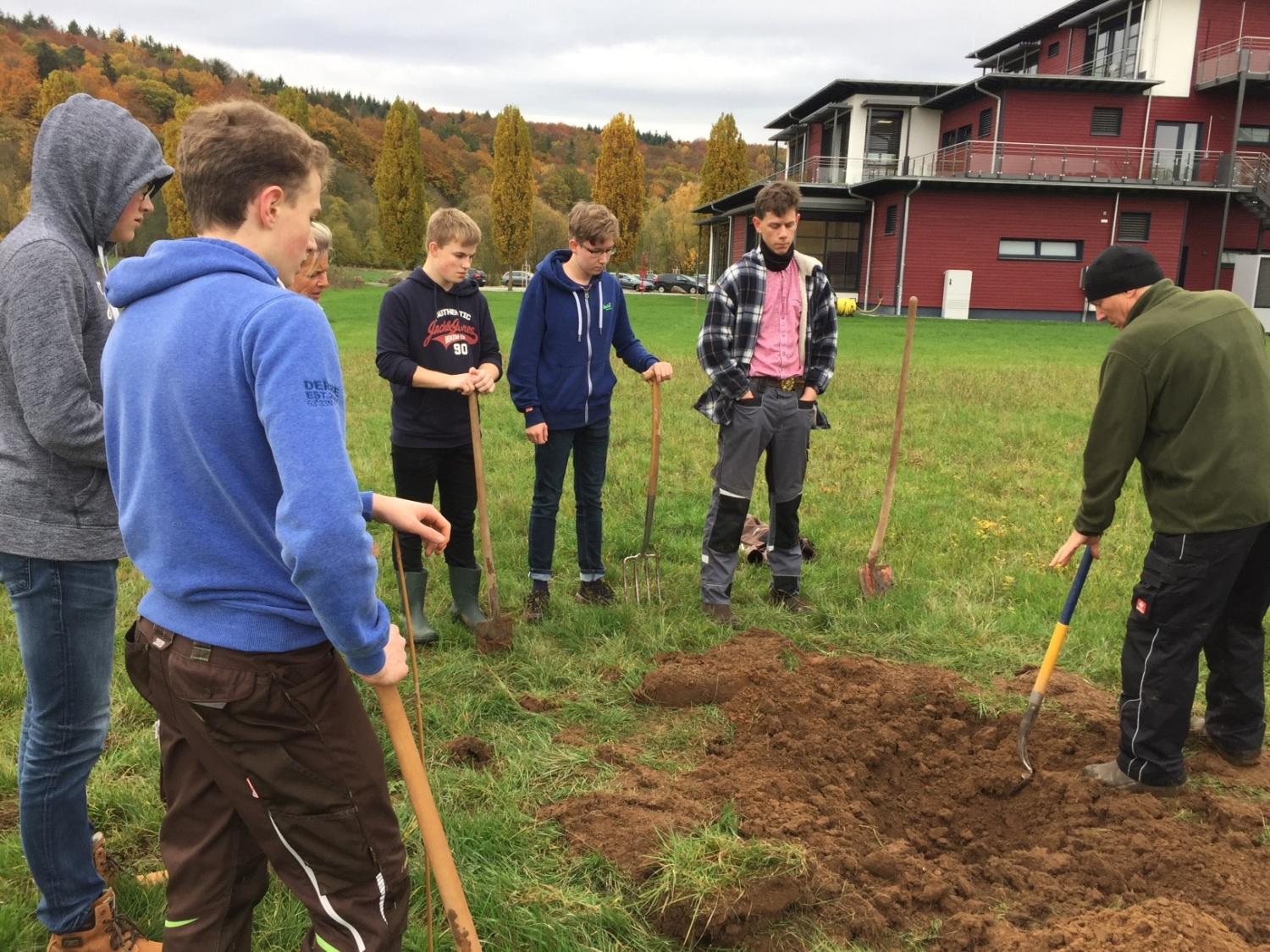
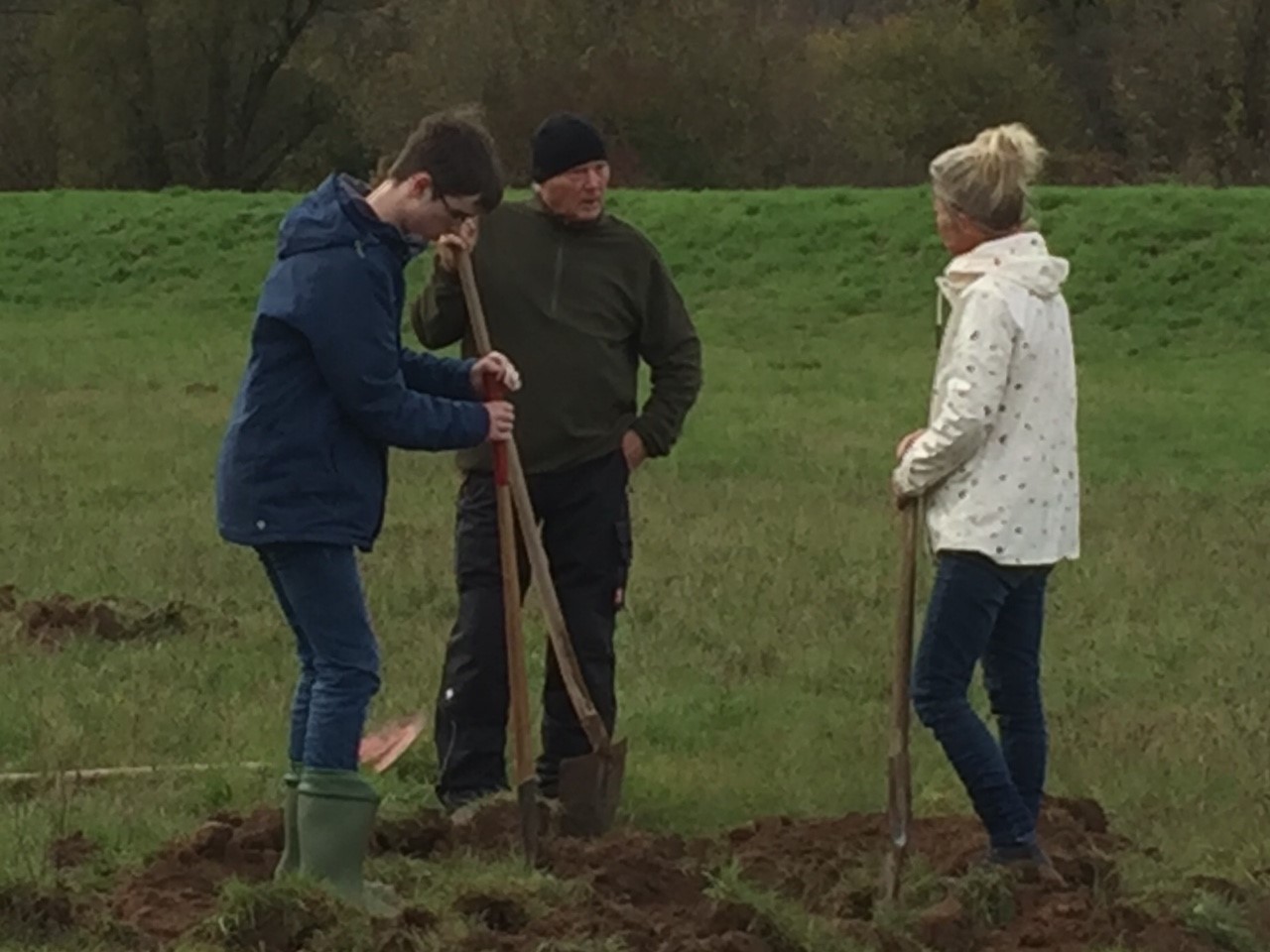
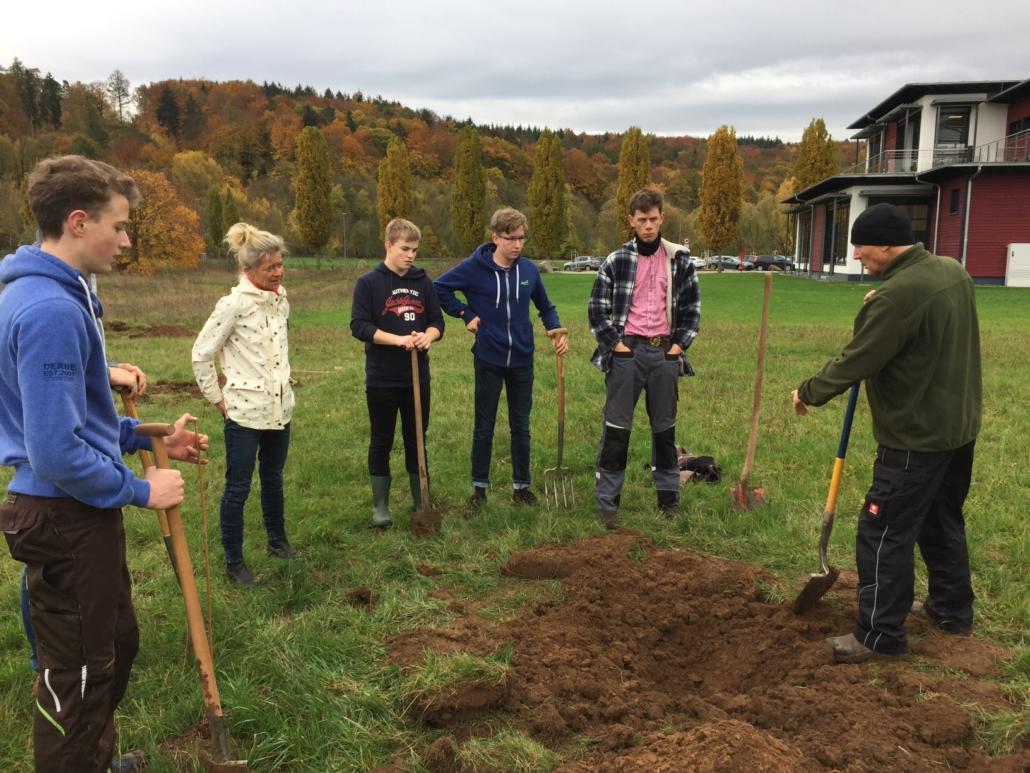
Now we had to decide where to place the trees on the selected area. To do this, we first staked out the meadow and marked the tree locations with sticks. We decided to arrange the trees in triangles. This made sense because the trees had to be spaced a certain distance apart, which was easy to achieve with a triangular pattern. A few days later, the trees arrived at the school. Since they still had bare roots at that point, we had to dig them in temporarily. Then the day of planting arrived. We received help from an expert on orchard meadows, Mr. Moll; Steinmühlen teacher Carmen Bastian; the landscape gardener; and Mr. Schäfer, a teacher at the boarding school.
How to Plant Trees
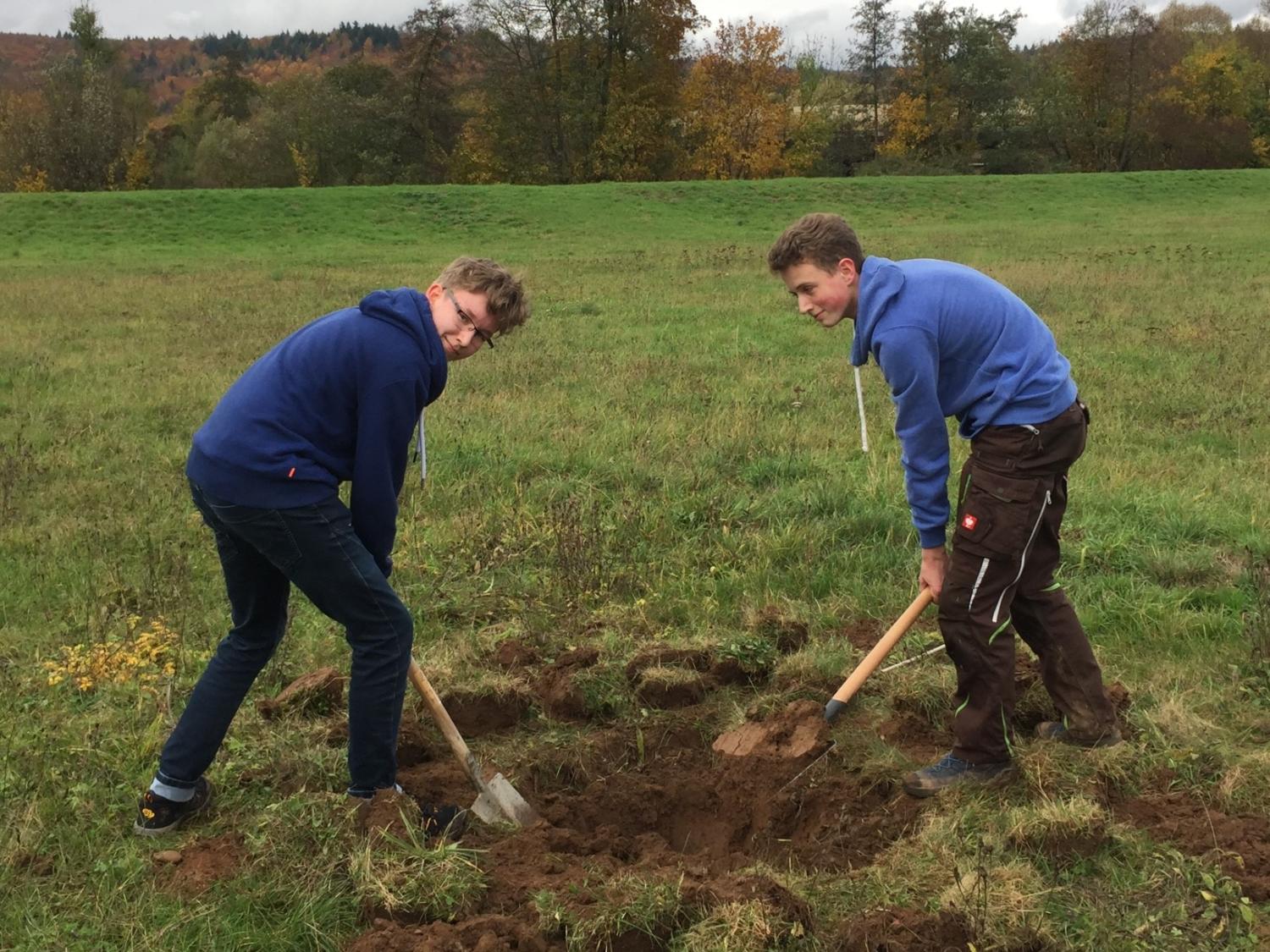
First, holes were dug for the trees, and in the center of each of these holes, another, deeper hole was dug. Next, a wooden stake was hammered into the ground at the edge of each hole. Finally, a wire was placed in the deep hole to protect the tree. Next, the tree, along with its root ball, was placed into the hole and the whole thing was covered with soil. Finally, we tied the tree to the stake with a thick string. This provides the tree with support during the initial period. We used this method for all 15 trees. We made good progress, and even though it started to rain after a while, that didn’t dampen our motivation.
For environmental reasons, we planted not just one type of tree, but three different fruit varieties: mainly apple trees, but also a few plum and pear trees. We also decided not to arrange the trees randomly, but to group them by fruit variety. So the two plums and the two damsons are on the left side, while the apple trees are in the center and on the right.
Clemens Gerhardt (Class 10b)