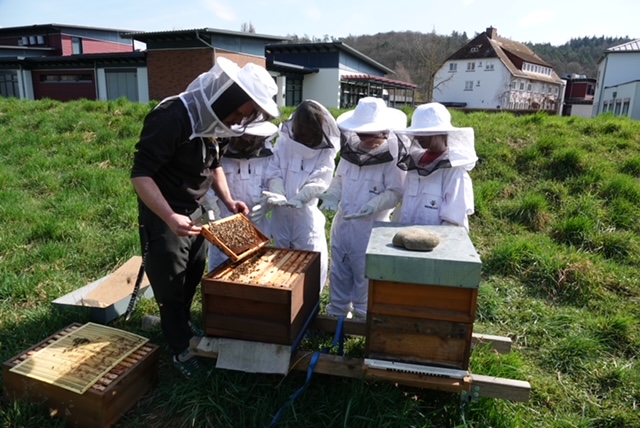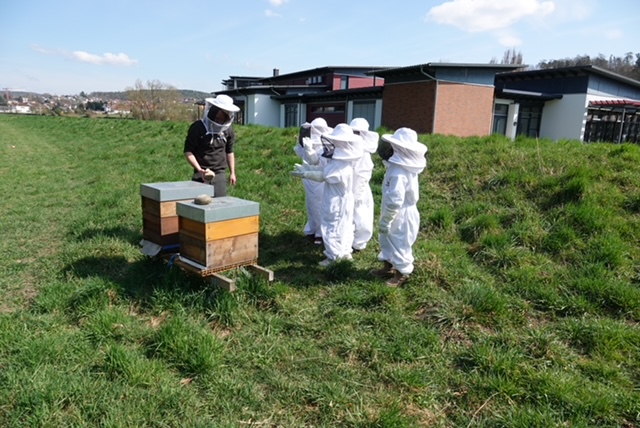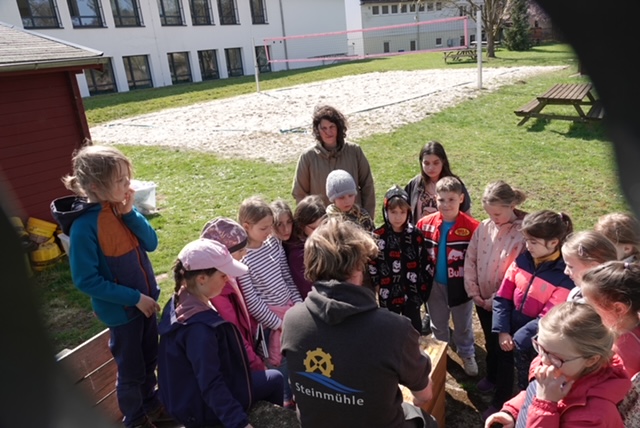
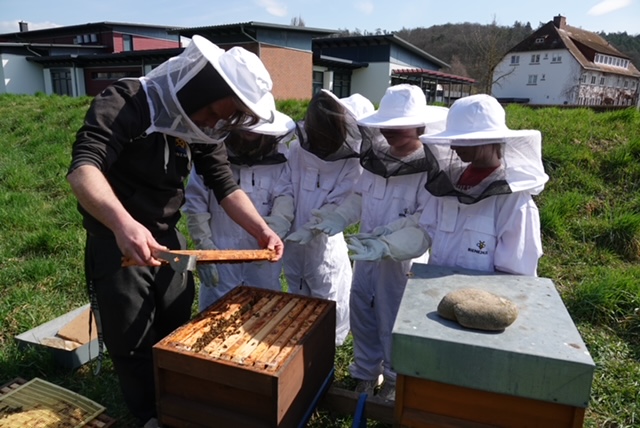
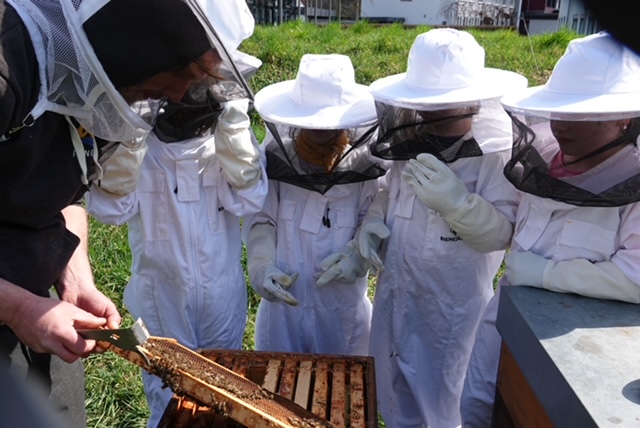
The fact that the Steinmühle also has bees and offers its own honey was already on display at last fall’s festival. As part of a collaborative project, elementary school students from the Erich Kästner School in Cappel were able to explore the topic in even greater depth. Equipped with beekeeping suits, the girls and boys not only learned details about the bees’ proverbial industriousness but were also able to see for themselves the results of their hard work.

Dr. Sven Freibert teaches math and biology at Steinmühle. With the help of his colleague Niklas Berthold from the Steinmühle bee team, he aimed to introduce the children from the neighboring school to the buzzing little colony on the Steinmühle grounds. Bee expert Dr. Sven Freibert found the students to be very well-informed: “We started by talking a bit about the ecology and life of bees. Since the children had just covered the topic of ‘bees’ in class, we were able to move right into hands-on activities.”


About Worker Bees, Drones, and Queen Cells


We started off with a “dry” specimen—that is, a beehive. “Using it as a model, we discussed the structure—the movable floor with the entrance, the honey chamber, the brood chamber, and the lid—and learned about their individual functions, including the technical terms.”

To get a closer look, five children at a time were then allowed to put on the beekeeping suits—what an exciting experience! Dr. Sven Freibert: “We then took this group over to the ‘inhabited’ hives and observed the bees’ lives up close. We saw worker bees, drones, queen cells with their surrounding area, and honeycombs filled with honey.” Fortunately, according to the Steinmühlen teacher, no child was stung during these observations.


“It was a wonderful day”


The group reported at the end that a honey tasting had actually been planned afterward, but unfortunately could not take place due to time constraints. Maybe there will be a next time? Anna Zwickenpflug, a teacher at the Erich Kästner School, noticed that her students were very enthusiastic about the visit to the Steinmühle and raved, “It was a wonderful day with the bees.”
 

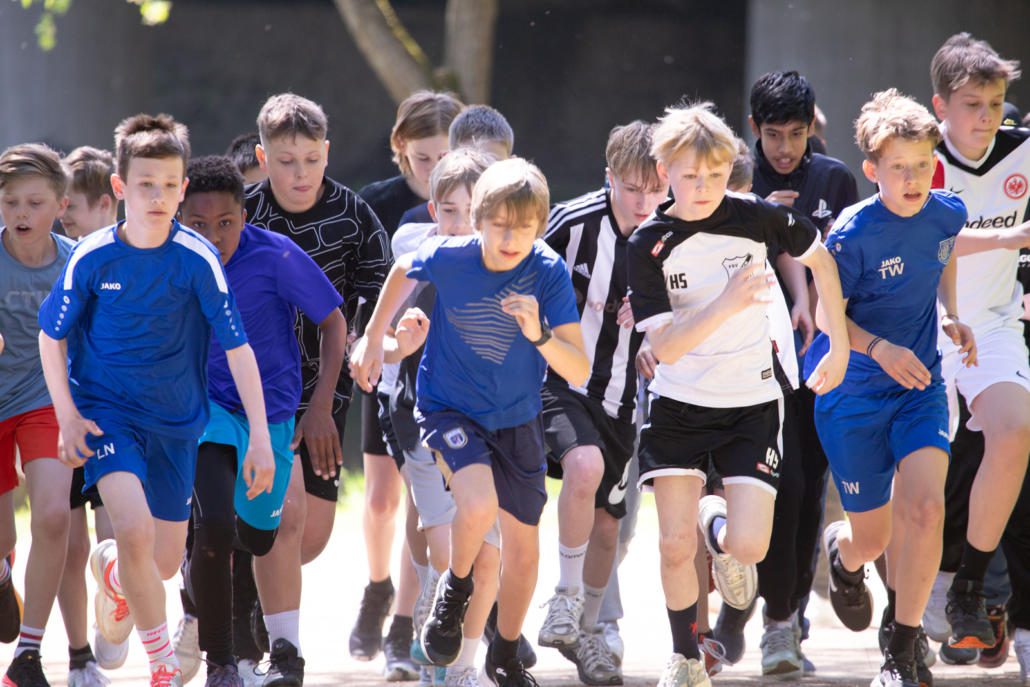
The weather was perfect, and so were the other conditions: Marcel Kalb, the school’s physical education director, and his team of teachers were greeted at the traditional spring run for grades 5 and 6 at the Steinmühle School & Boarding School by cheerful students who, with a healthy dose of ambition, ran the same course as generations before them.

“All in all, it was another very exciting event with lots of positive energy and plenty of sportsmanship,” said Marcel Kalb happily. “It’s truly gratifying to see how a sporting challenge can motivate a young community and drive them to achieve their best!”


Oliver, Caroline, Abraham, and Anouk were the fastest in their age group

Oliver Mand and Caroline Hecker (both in 5c) were the fastest in the 5th-grade division. Abraham Sow and Anouk Sedlmayr (both in 6a) posted the best time in the 6th-grade division.

The fastest relay teams were from classes 5a and 6b.


The results in detail:

5th Grade Boys – 1st Oliver Mand, 5c (4:39m), 2nd Samuel Pacho, 5a (4:46m), 3. Kai Gundlach, 5b (4:53m)
Grade 5 Girls – 1. Caroline Hecker, 5c (5:18m), 2. Marlene Jerrentrup, 5b (5:28m), 3. Dana Gorr, 5a (5:53m)
Grade 5 Relay – 1. 5a (3:47m), 2. 5b (3:51m), 3. 5c (4:01m), 4. 5i (4:03m)

6th Grade Boys – 1st Abraham Sow, 6a (4:40m), 2nd Philipp Leont, 6b (4:49m), 3. Leo Niederhöfer, 6c (5:00m)
Grade 6 Girls – 1. Anouk Sedlmayr, 6a (5:19m), 2. Alea Stübner, 6i (5:24m), 3. Clara Koch, 6c (5:29m)
Grade 6 Relay – 1. 6b (3:44m), 2. 6a (3:46m), 3. 6i (3:49m), 4. 6c (3:50m)


It’s almost that time again: For the second time, we’ll be awarding our school’s own StoneMINT certificate to this year’s high school graduates! With this certificate, we recognize outstanding achievements and dedication in the fields of mathematics, computer science, natural sciences, and technology (MINT) throughout their entire school career.


What is the StoneMINT certificate?

The StoneMINT Certificate recognizes outstanding achievements and exceptional dedication in STEM fields at the secondary school levels I and II. The award may be granted with the distinction “with very good results” or “with honors.”


What are the requirements?

To receive the STEM certificate, the following criteria must be met:

Scientific Work: Participation and placements in “Schüler experimentieren” or “Jugend forscht,” or in science or math Olympiads.

Academic proficiency: Enrollment in advanced STEM courses with a grade point average of at least “good” or “very good.”

Additional STEM activities: Participation in other STEM activities (e.g., competitions, workshops, plusMINT camps, internships, special academic achievements, etc.).

The exact criteria for awarding the certificate are listed in the sample certificate. There you will find detailed information about the requirements in each area.


All services are documented

Since some students far exceed the requirements, the complete individual STEM portfolio is printed on the certificate. This ensures that all achievements and activities are comprehensively documented and recognized—even those that go beyond the minimum requirements.

Even if you’re still in middle school or elementary school, you can start collecting now!


Questions?

If you have any questions about the StoneMINT certificate, our STEM coordinator, Dr. Jutta
Töhl-Borsdorf, will be happy to assist you (jutta.toehl@steinmuehle.net).


Our sample certificate: