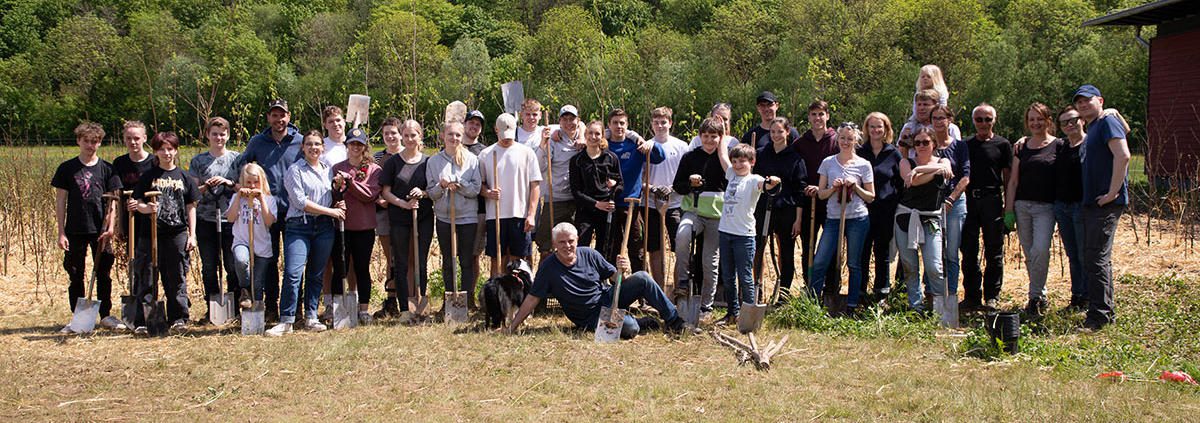
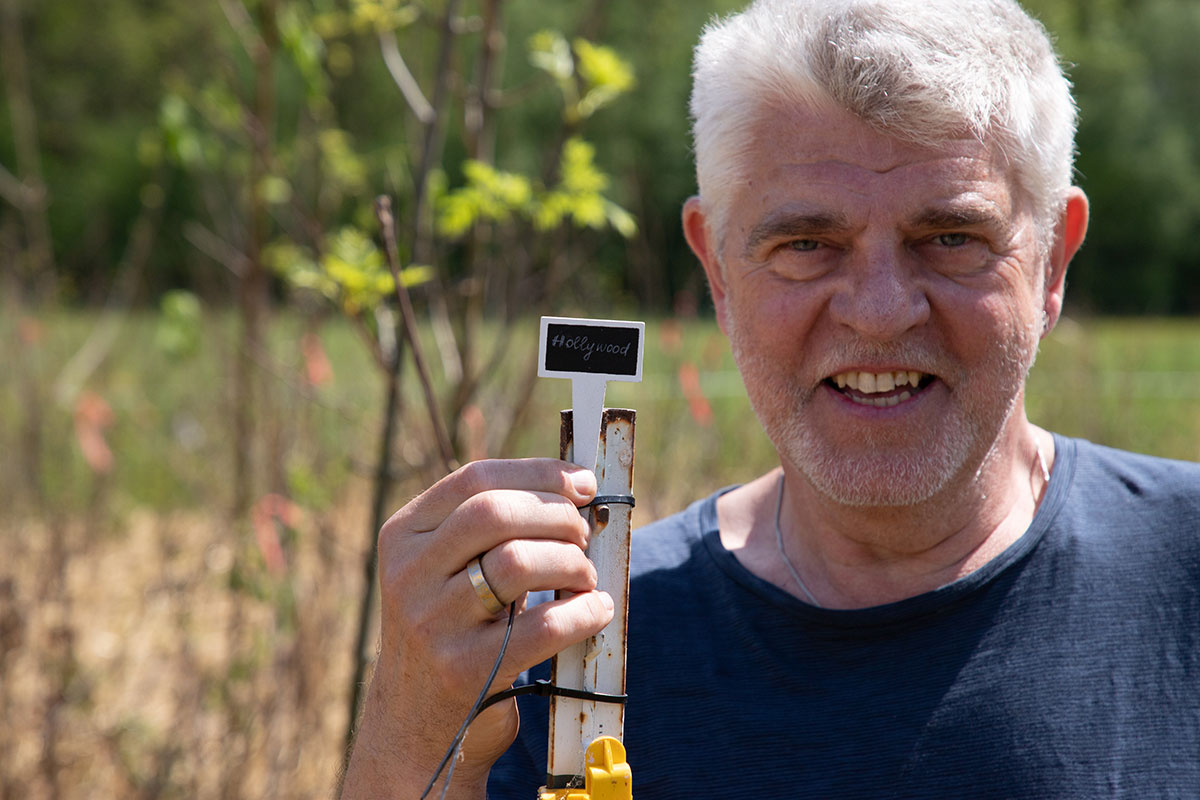
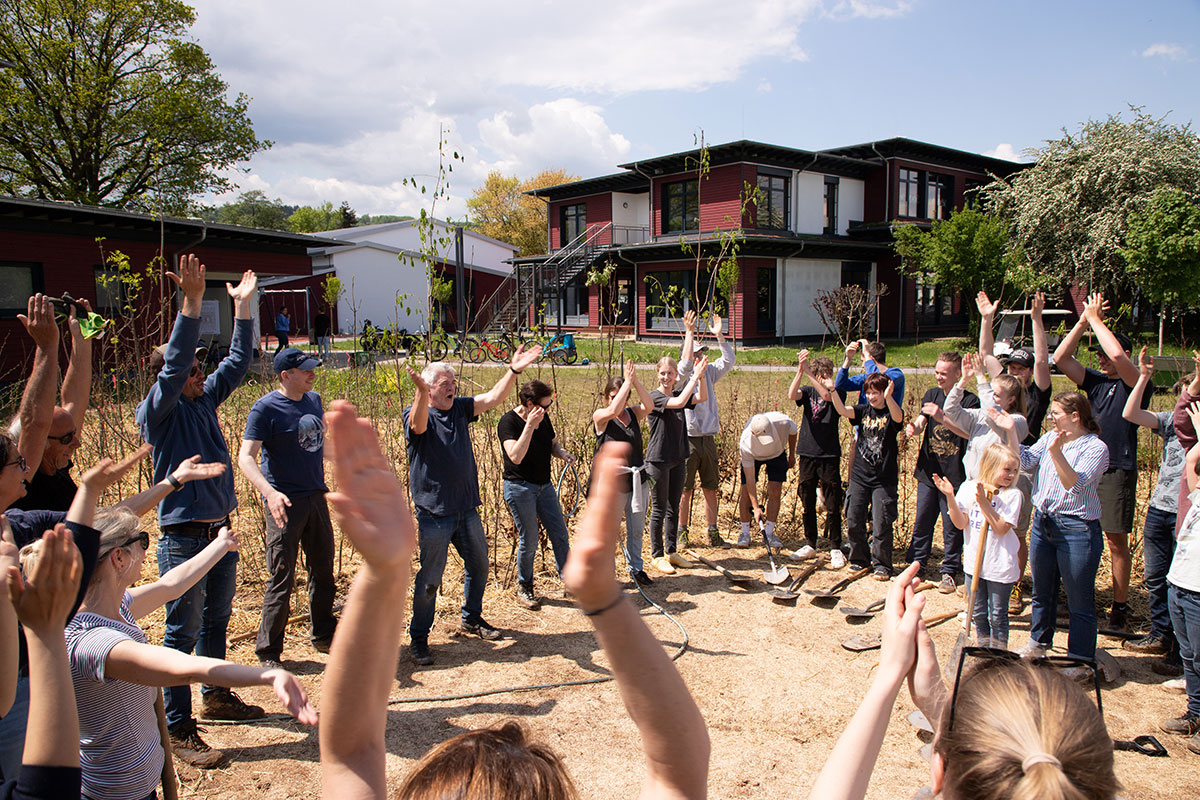
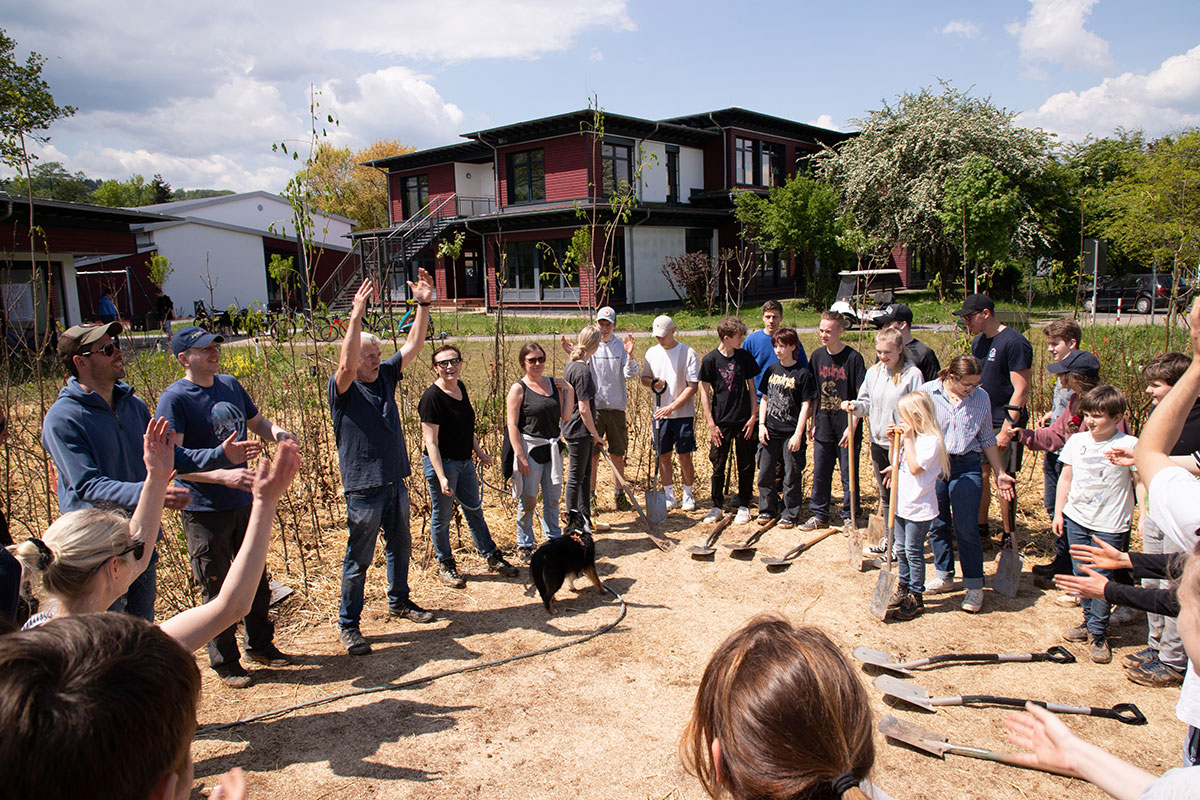
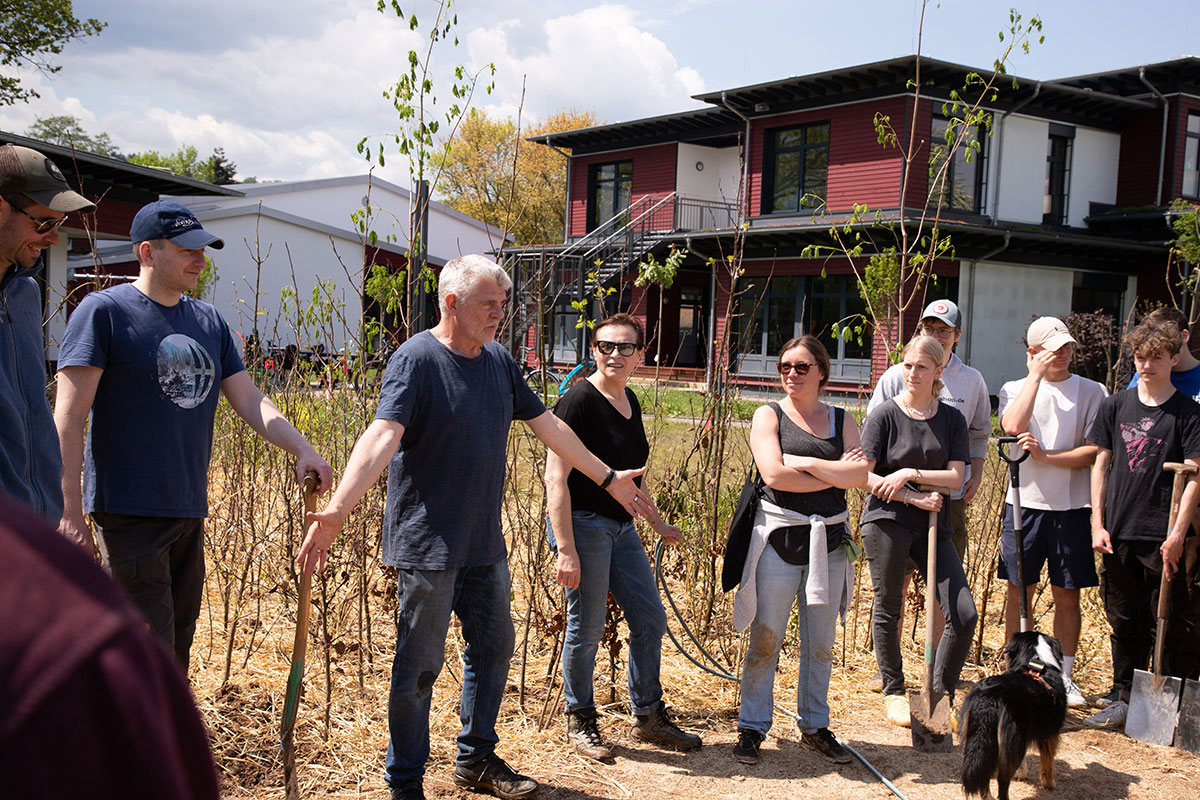
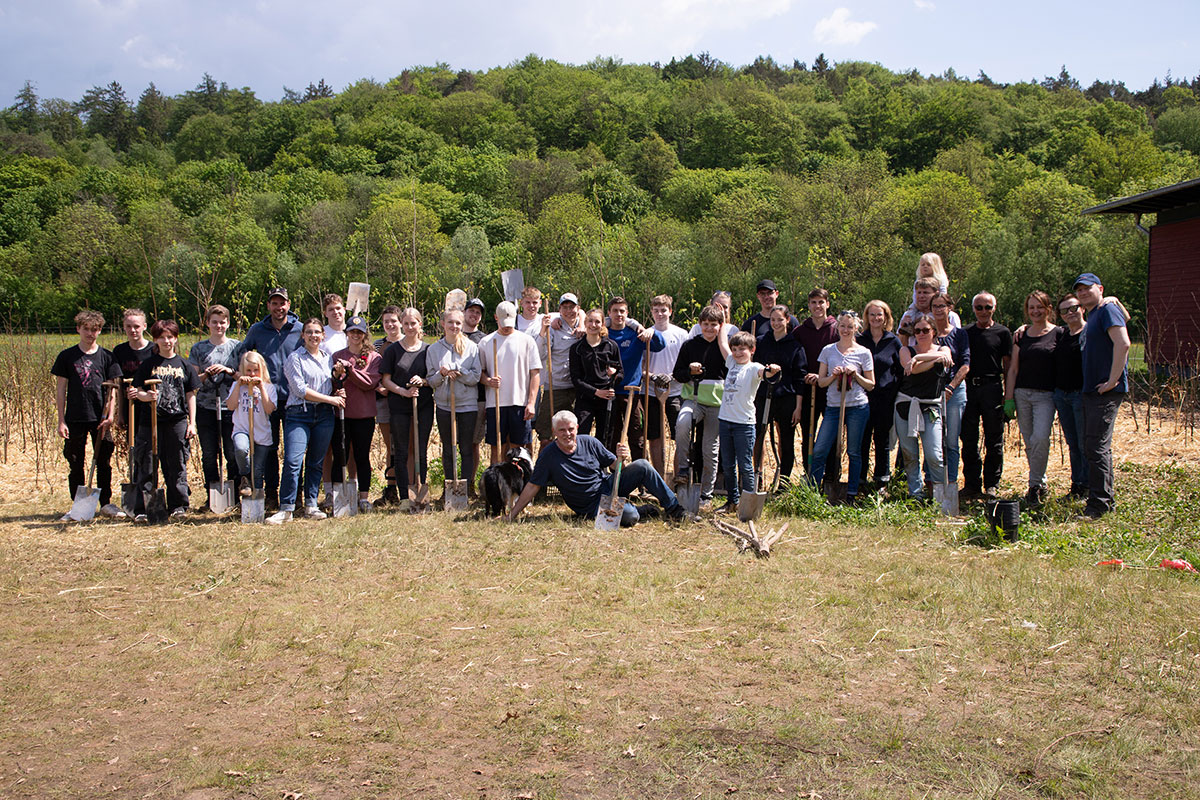
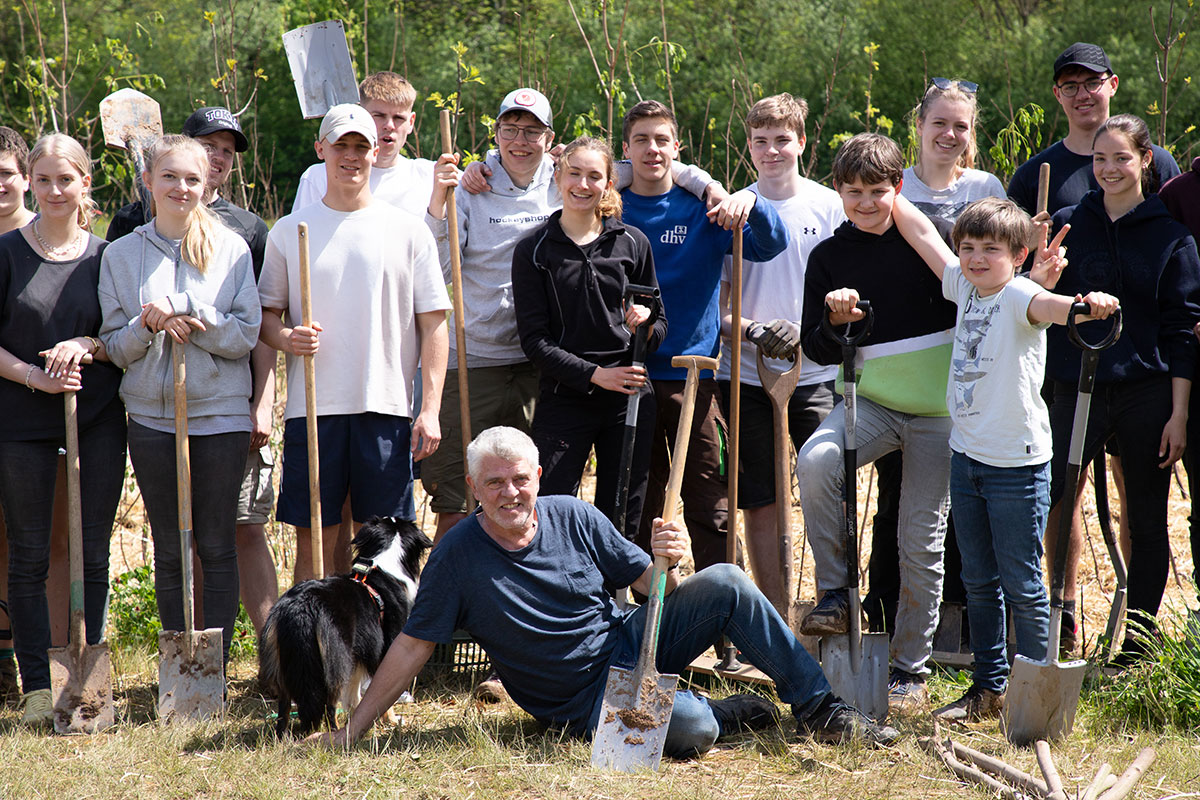
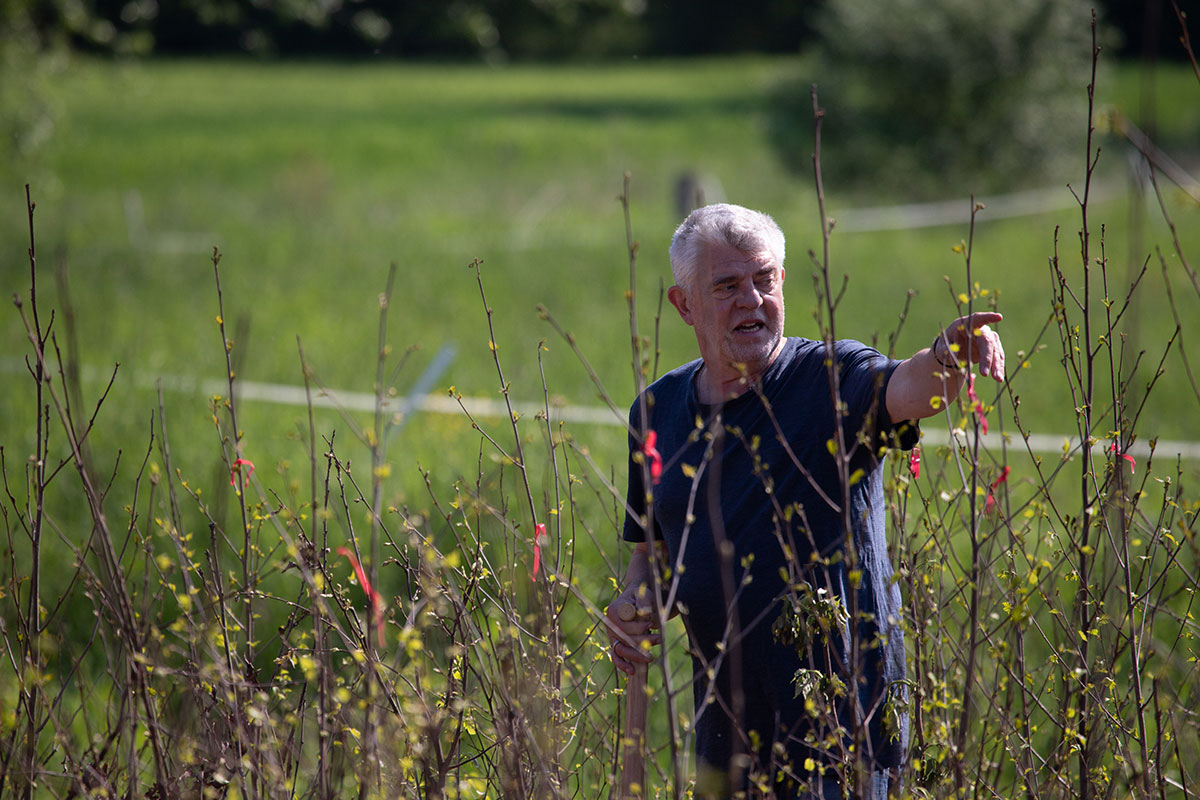
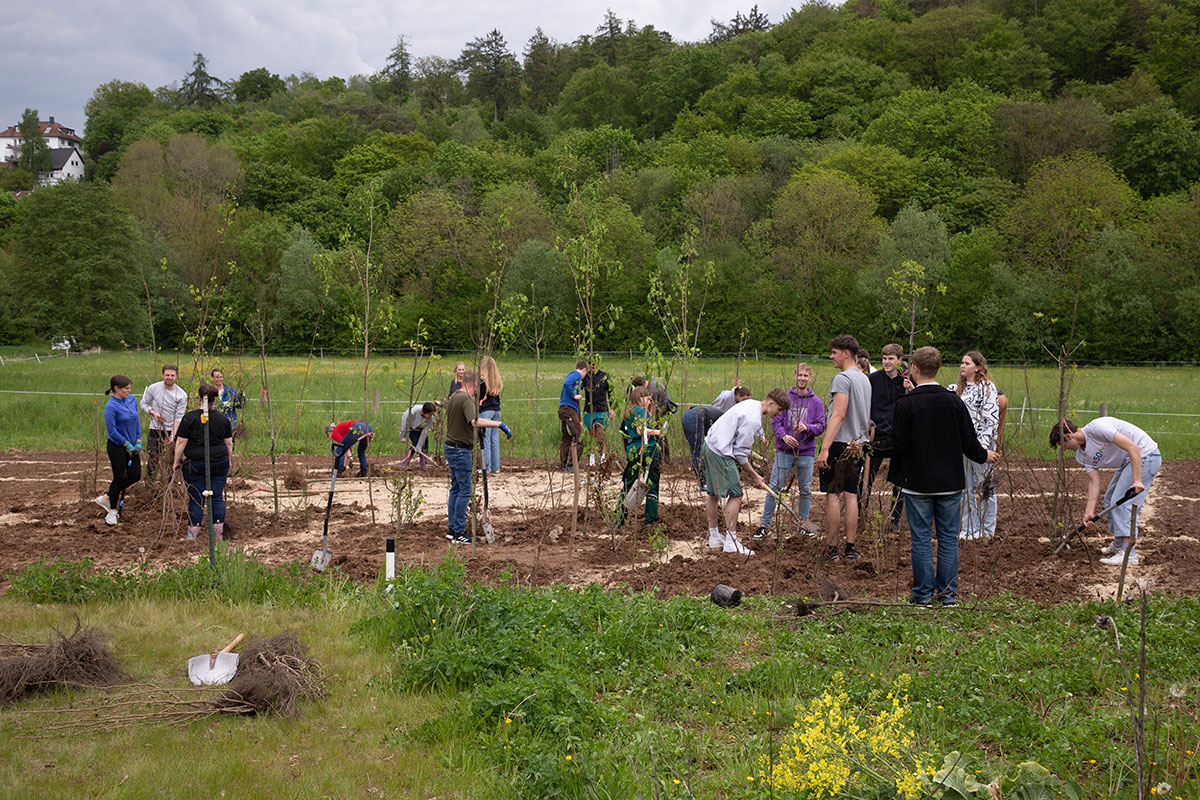
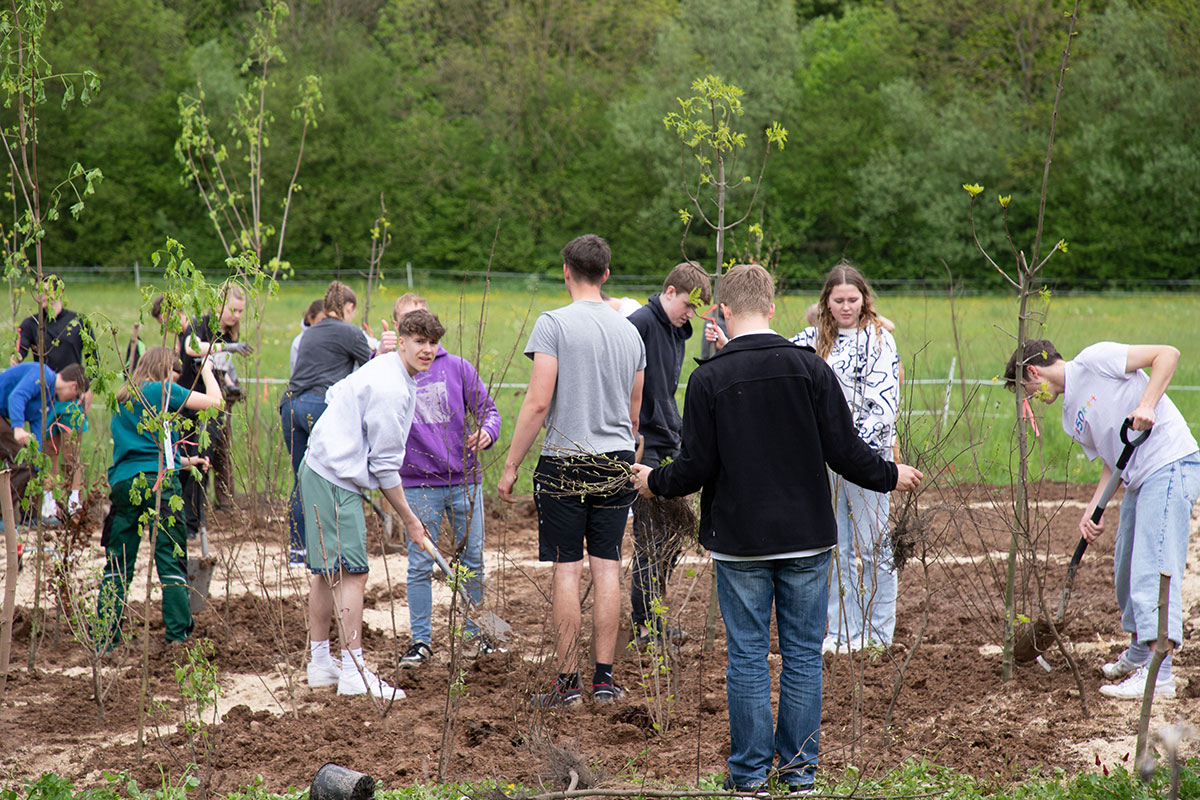
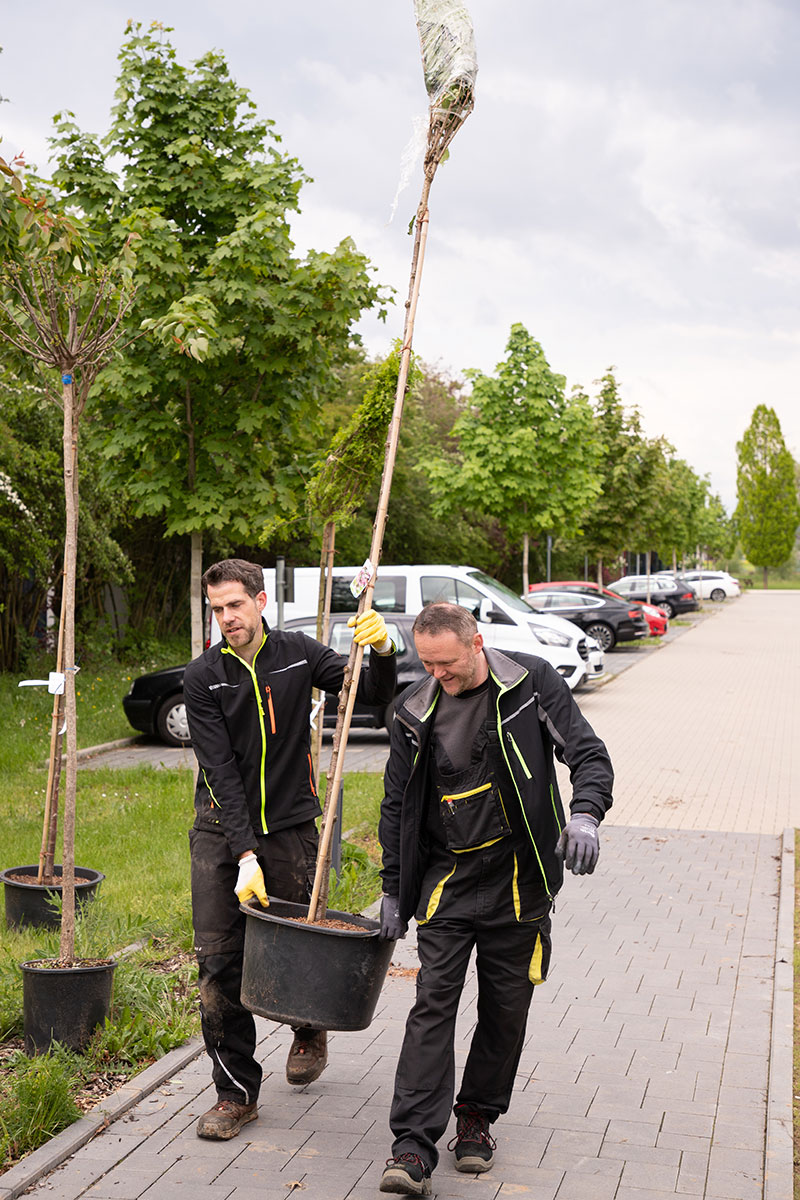
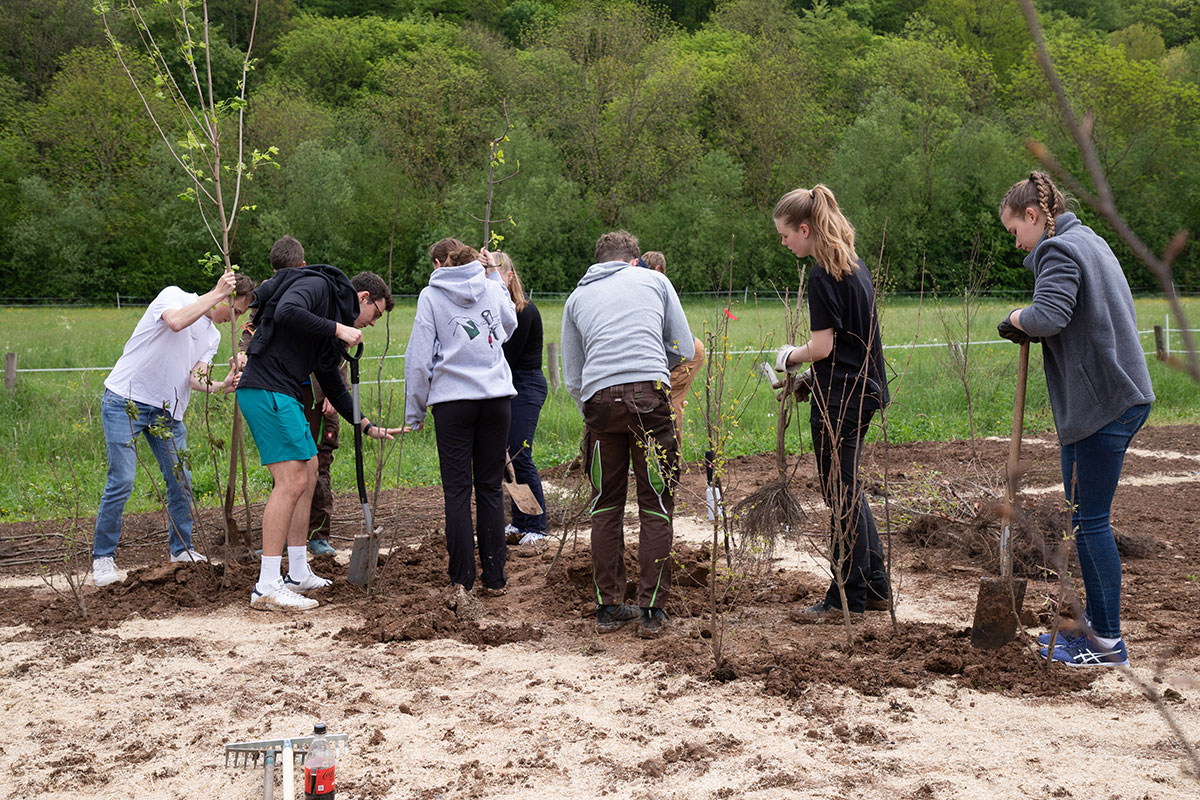
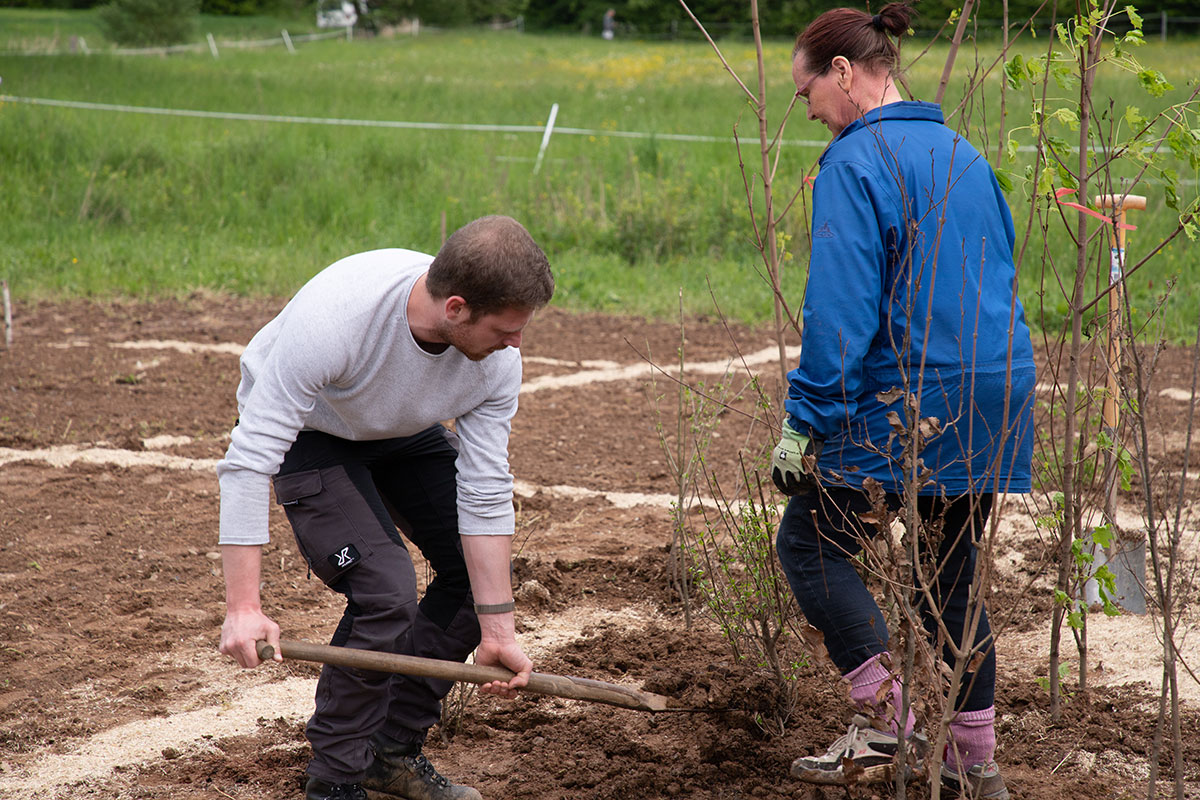
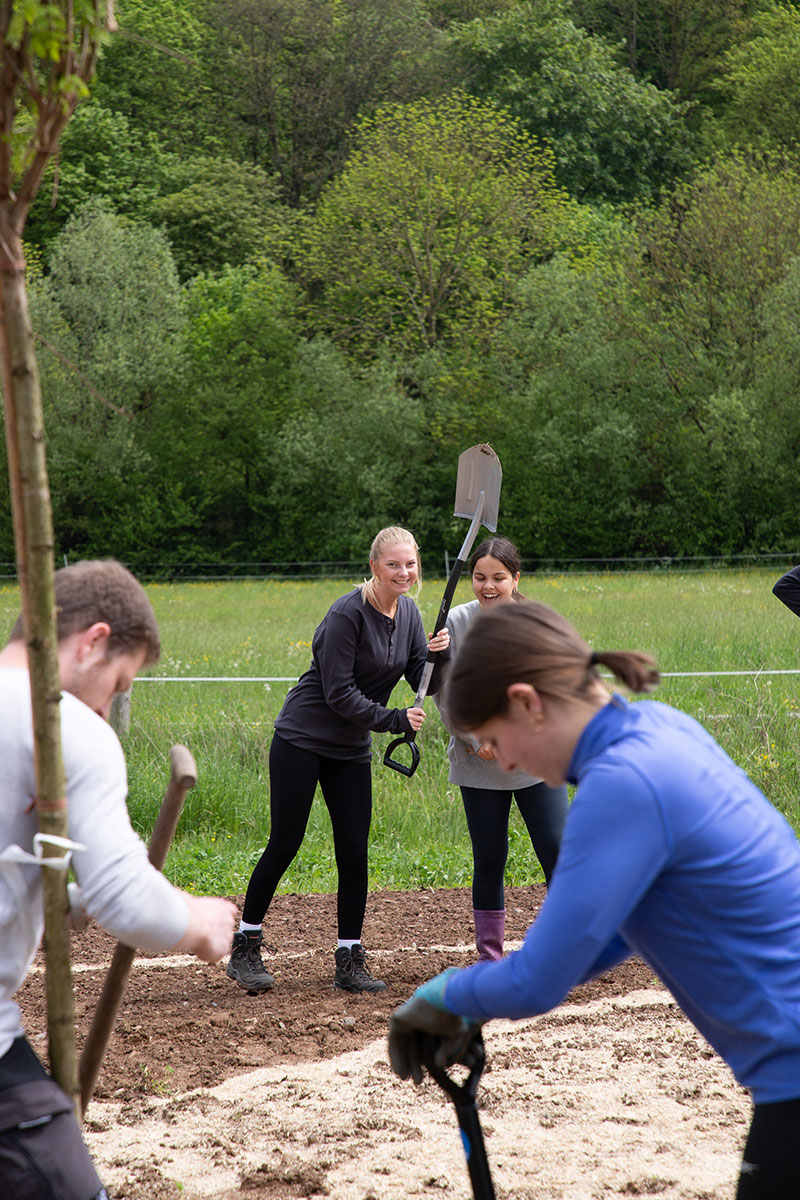
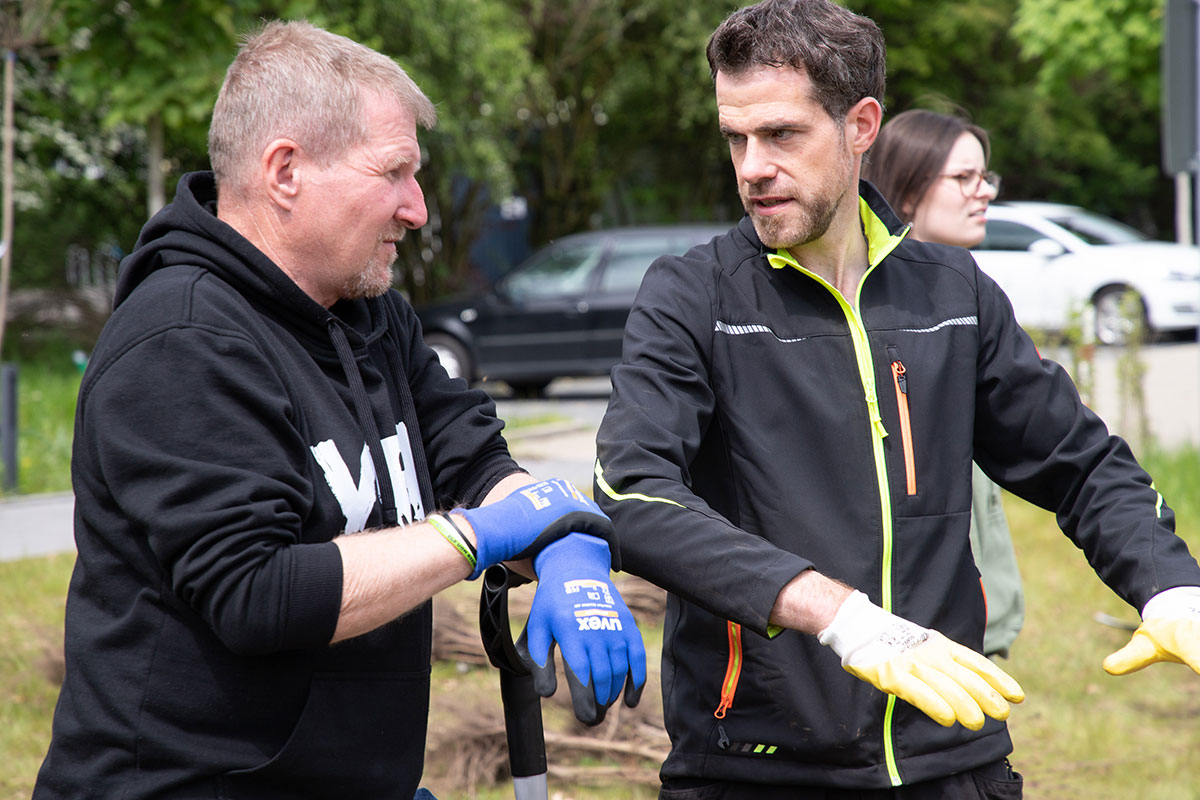
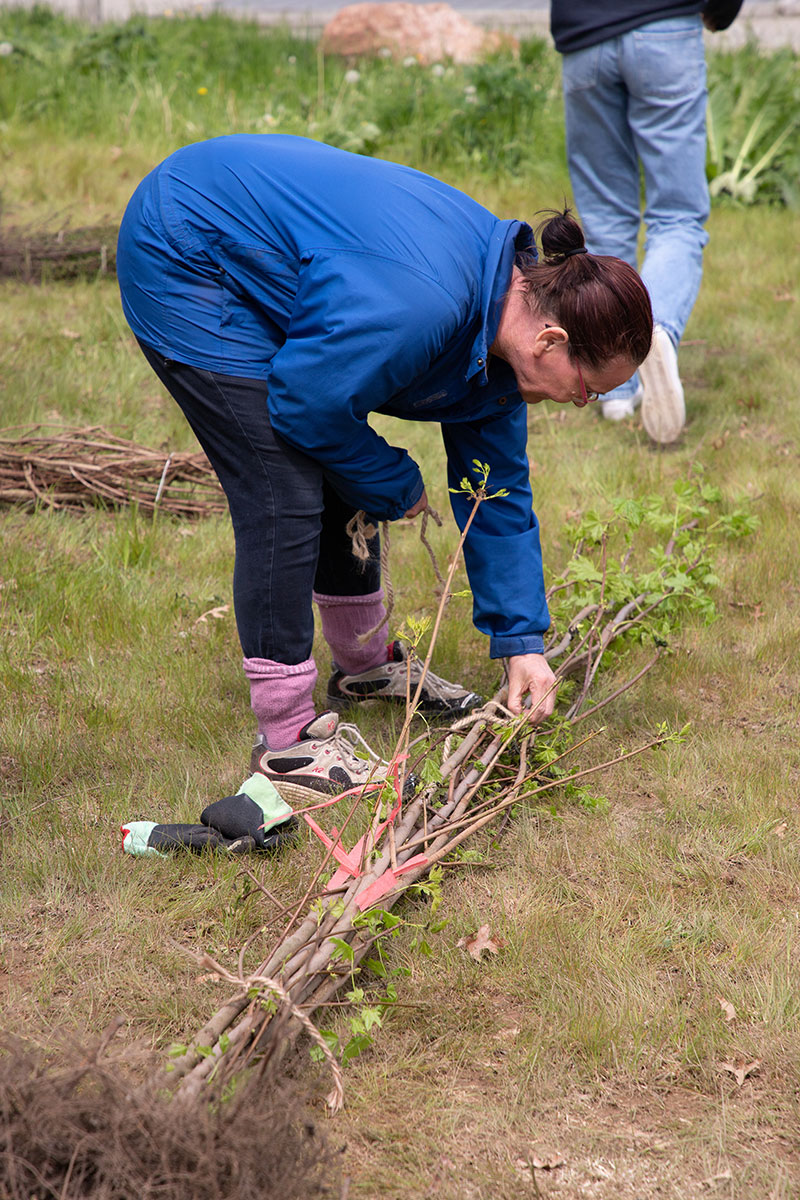
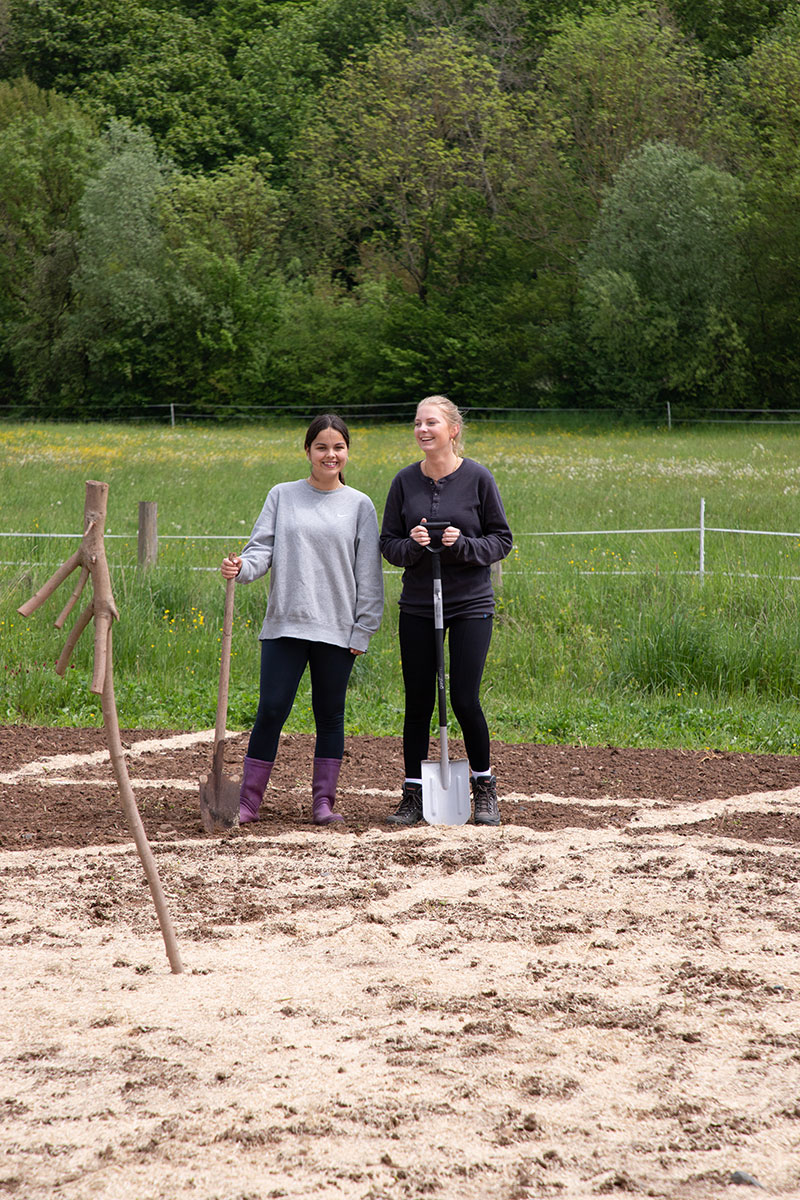
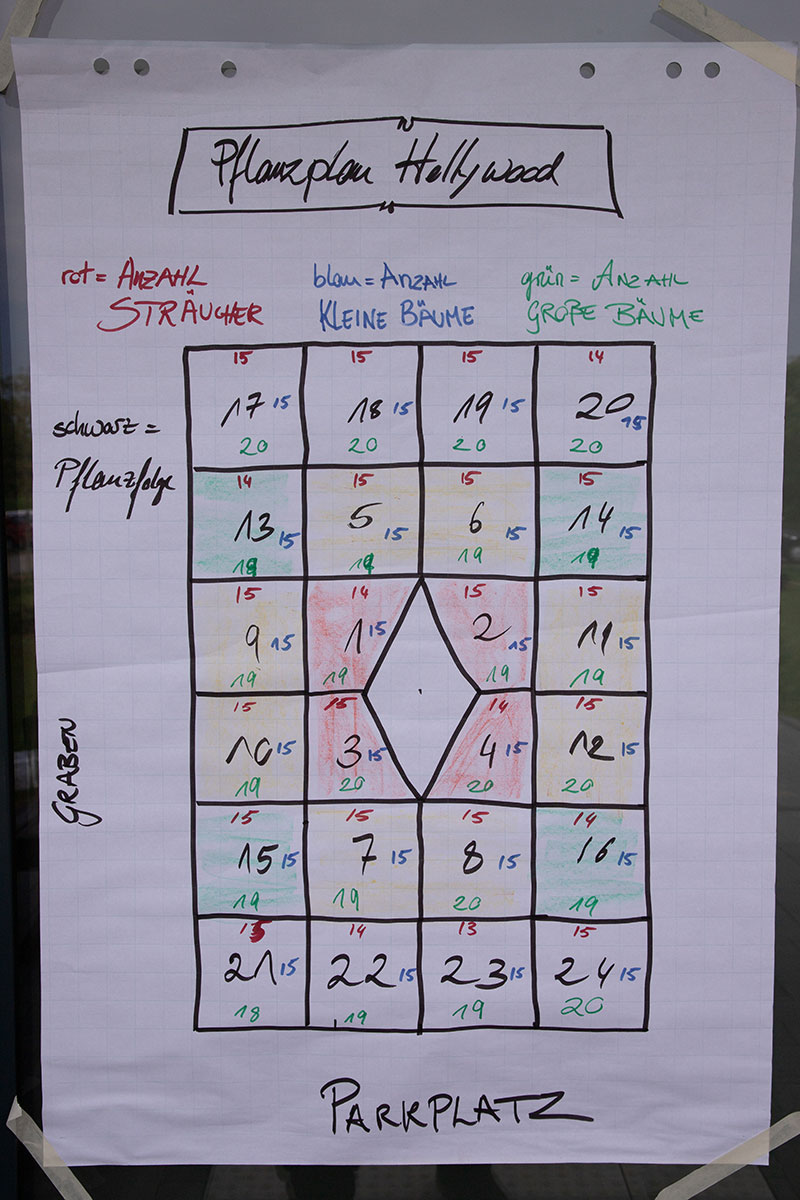
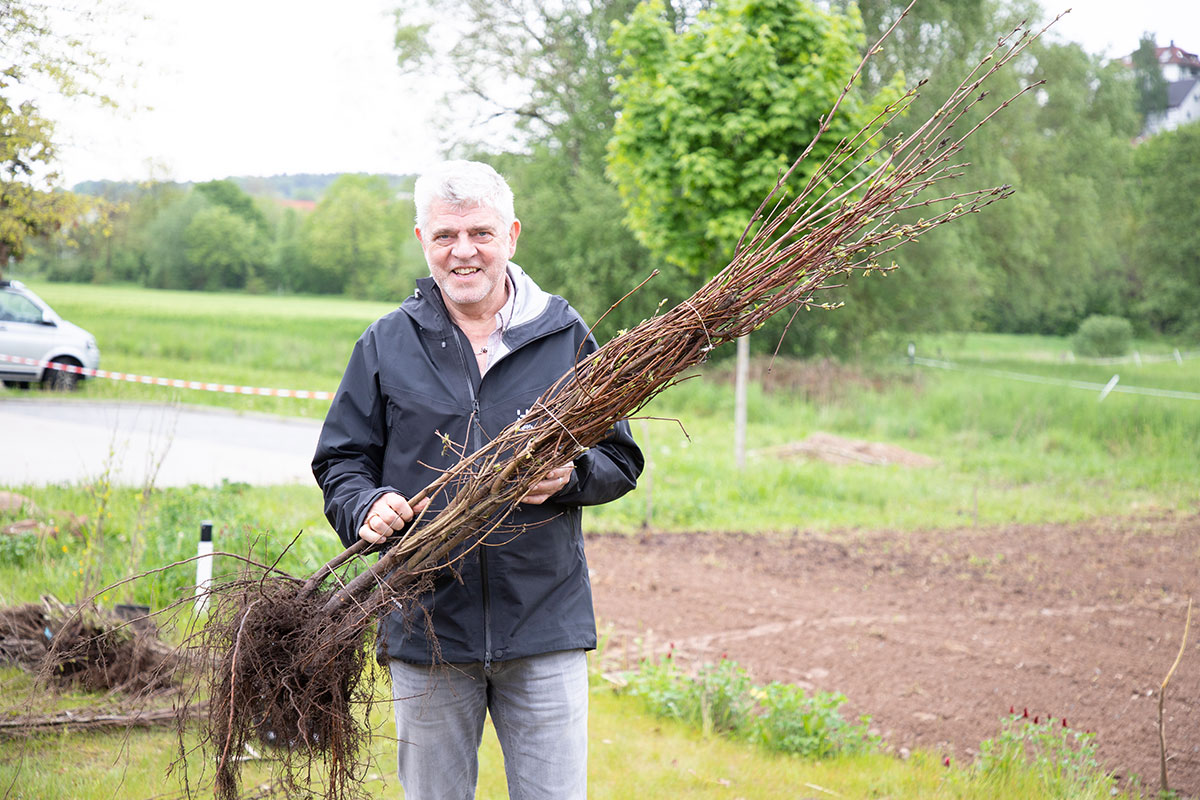
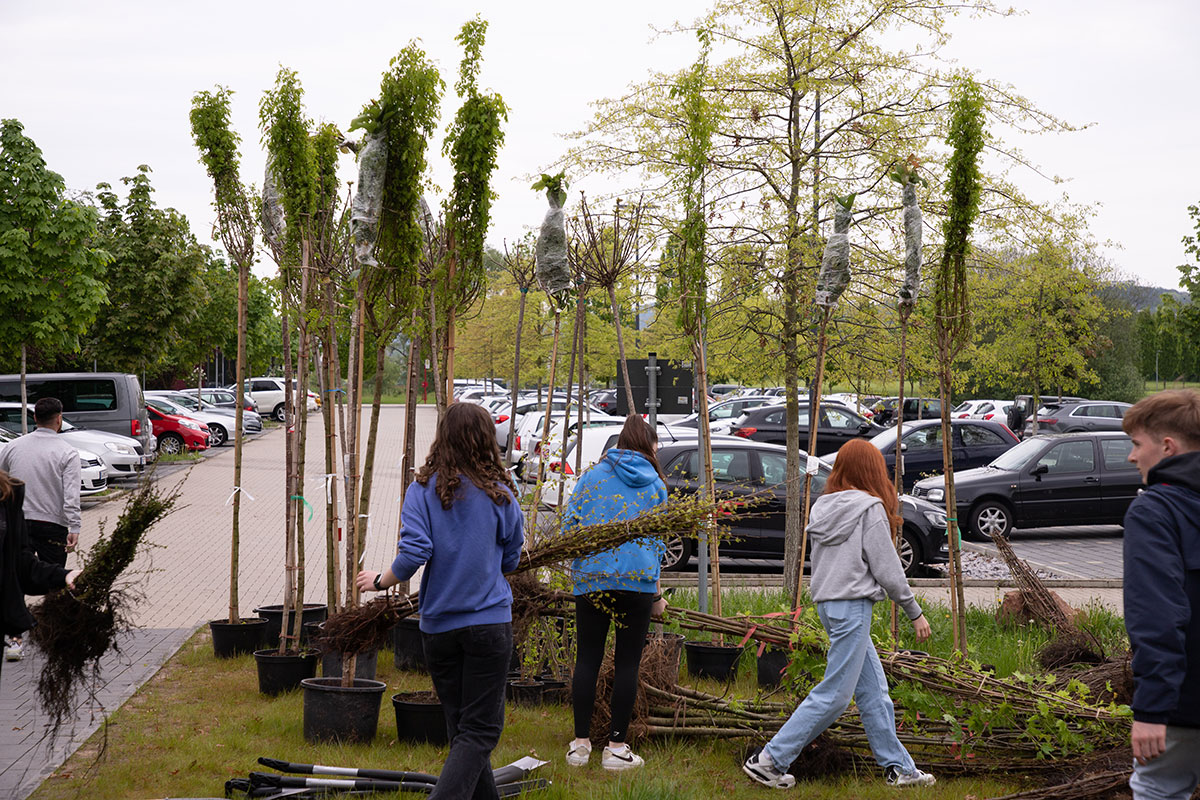
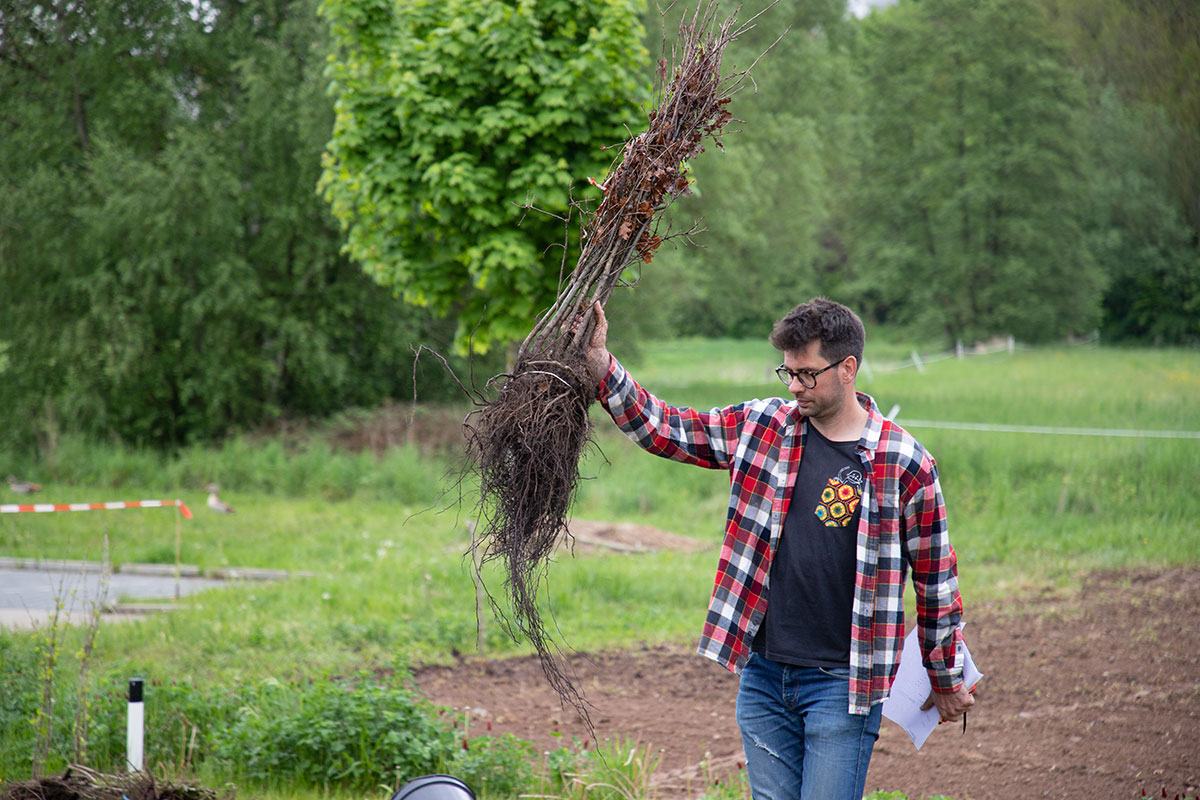
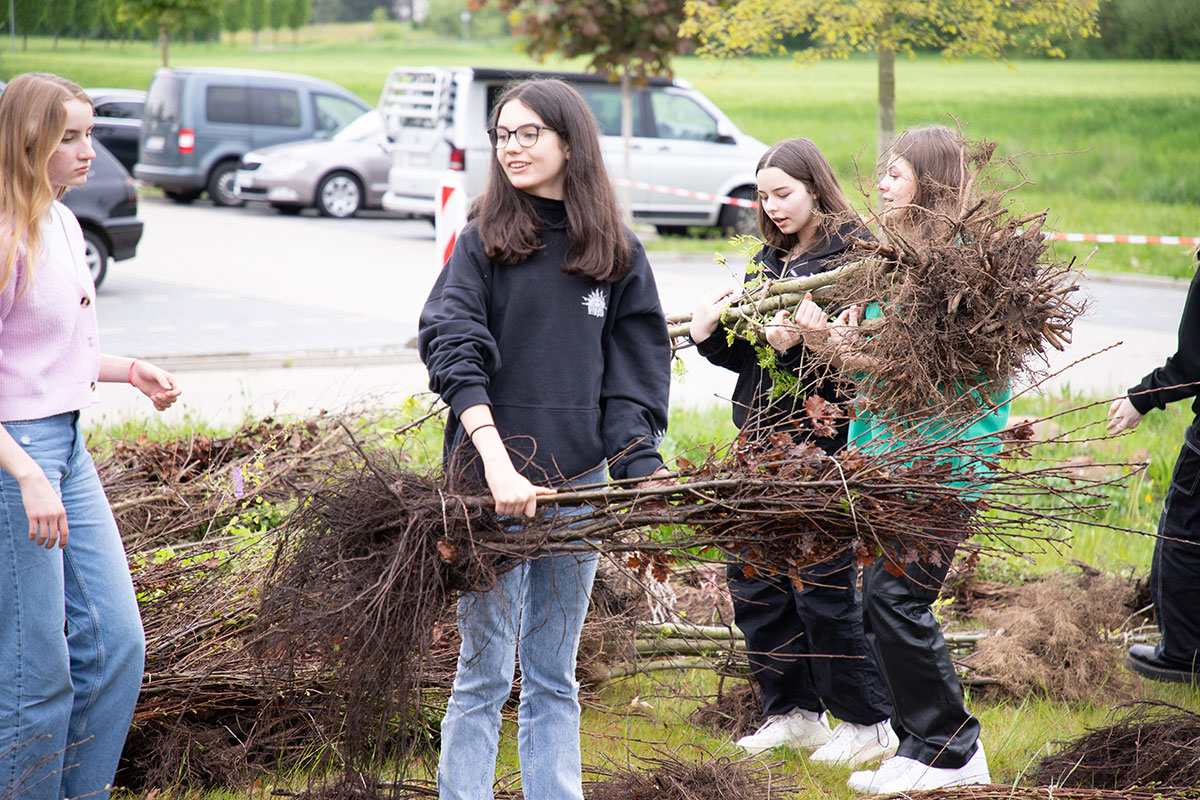
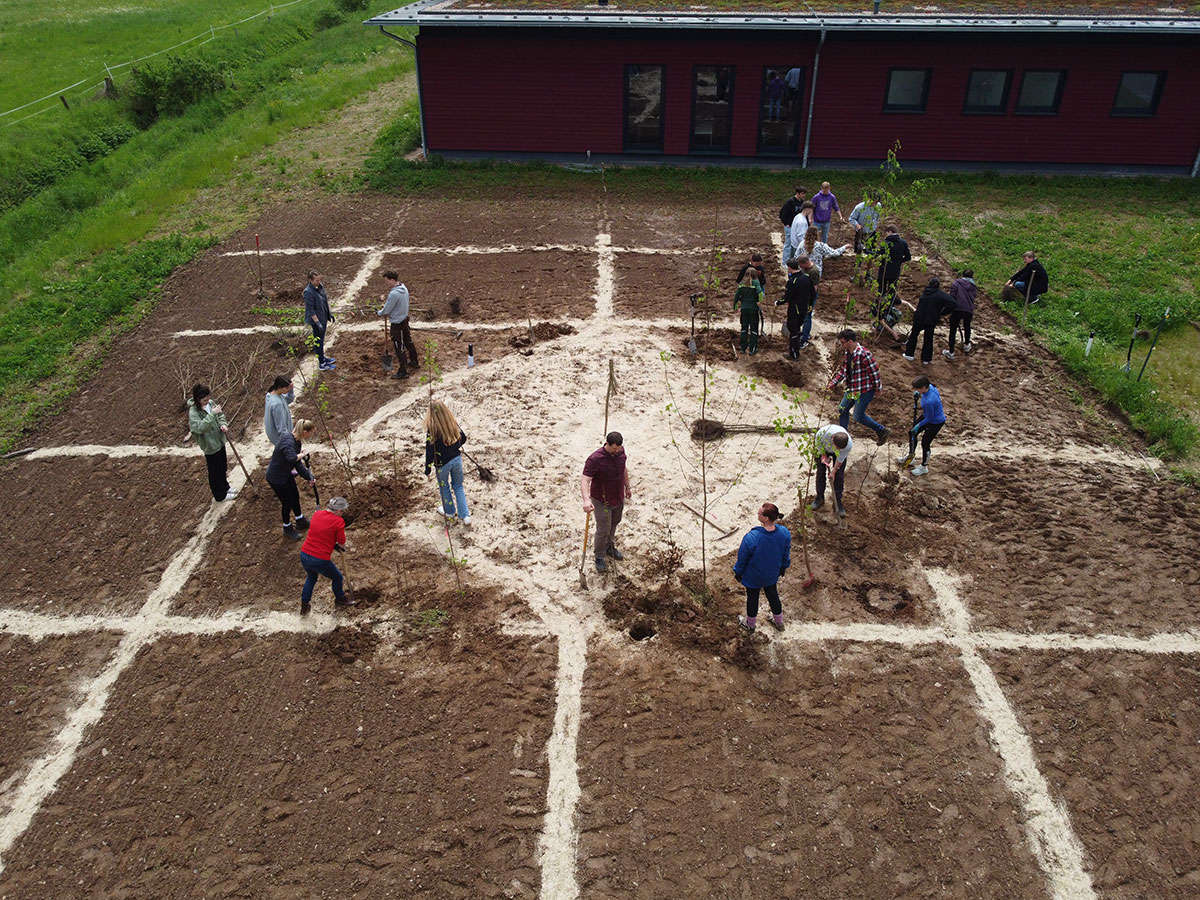
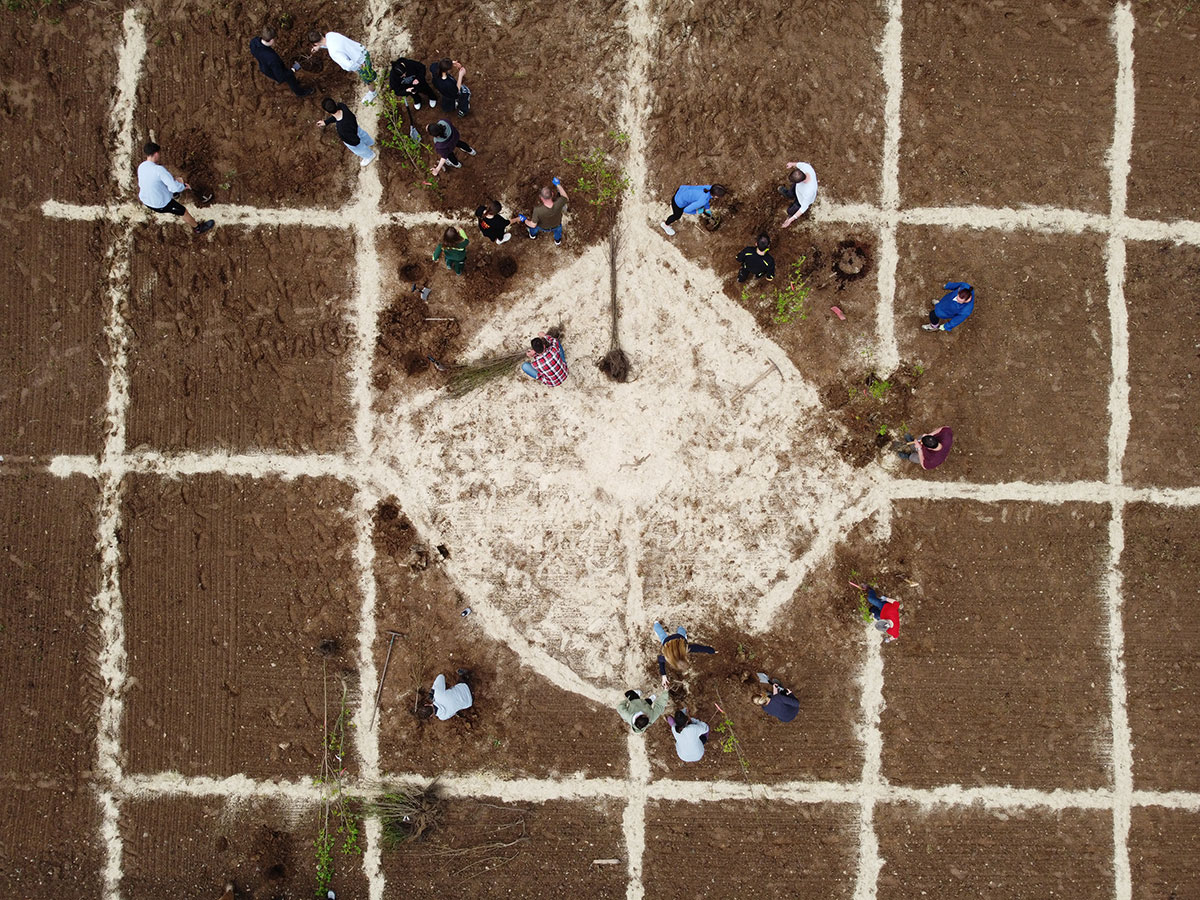
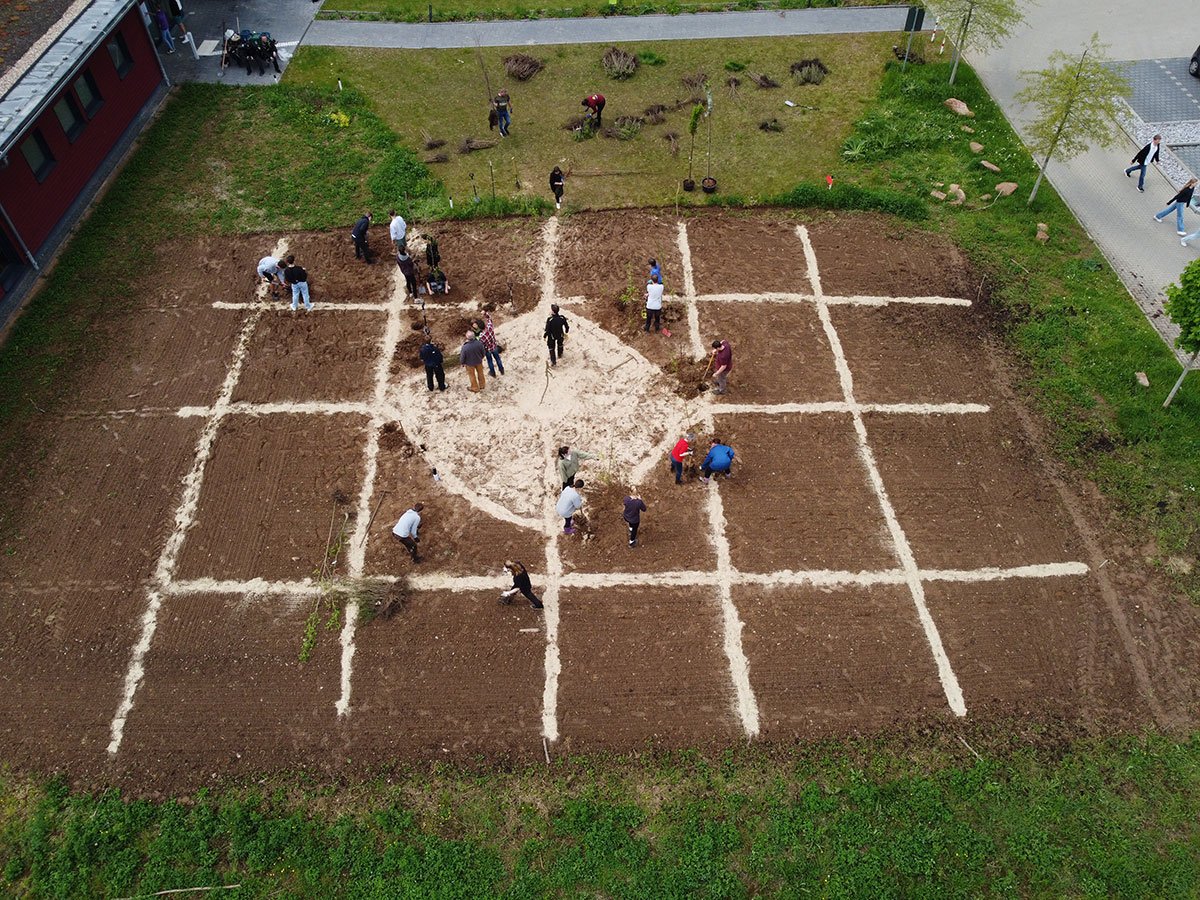
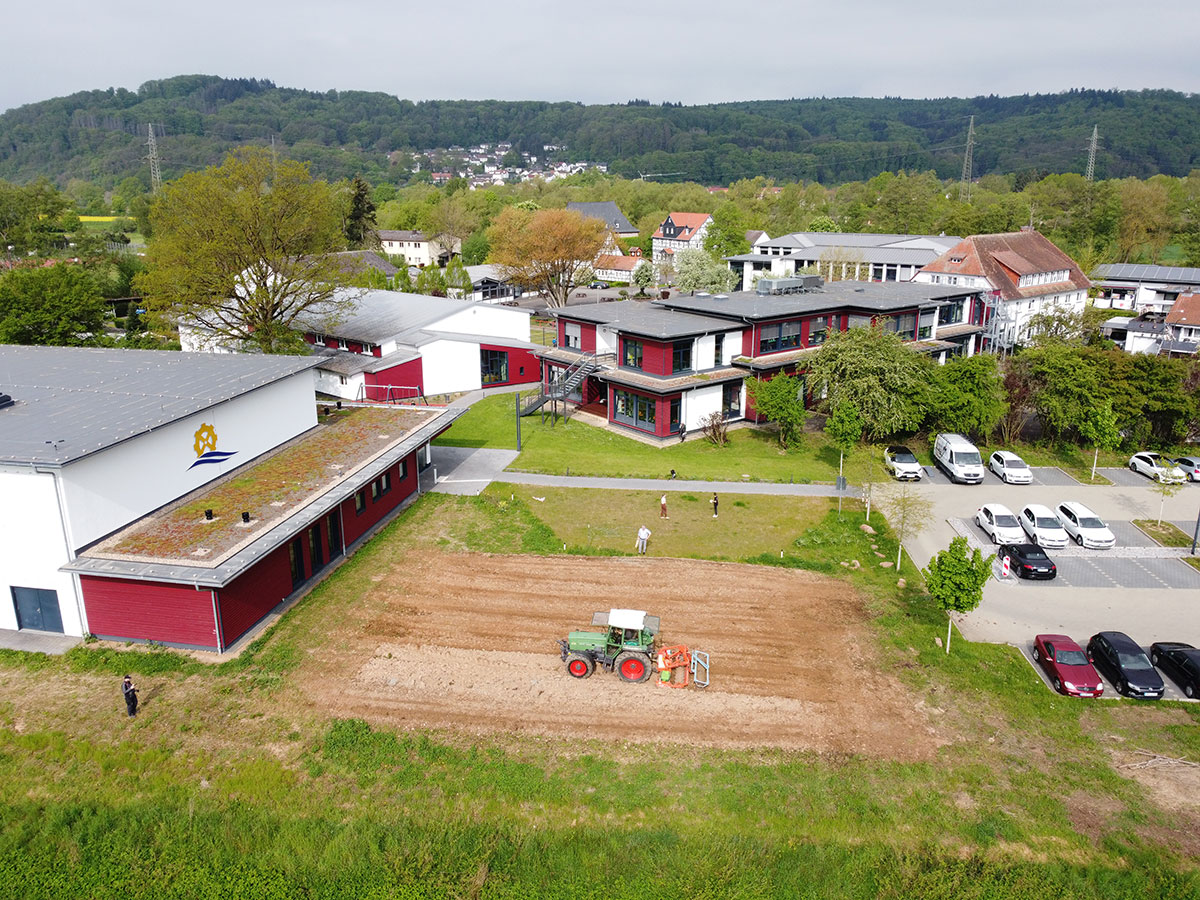
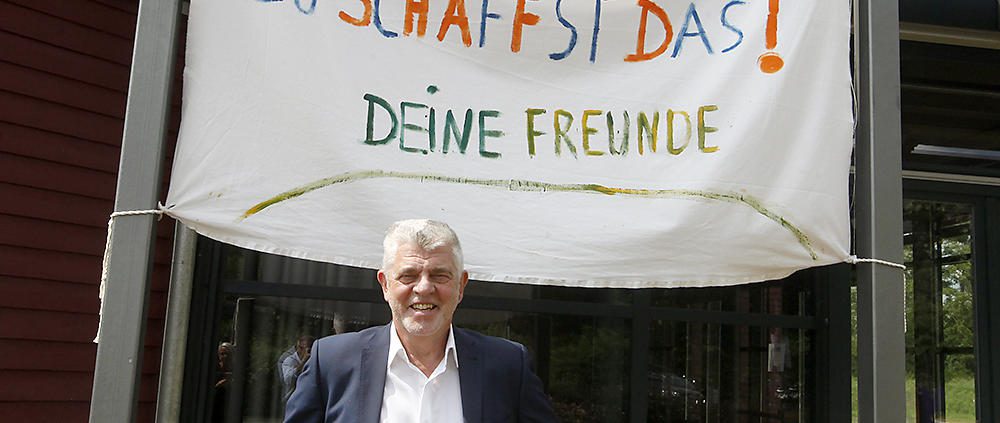
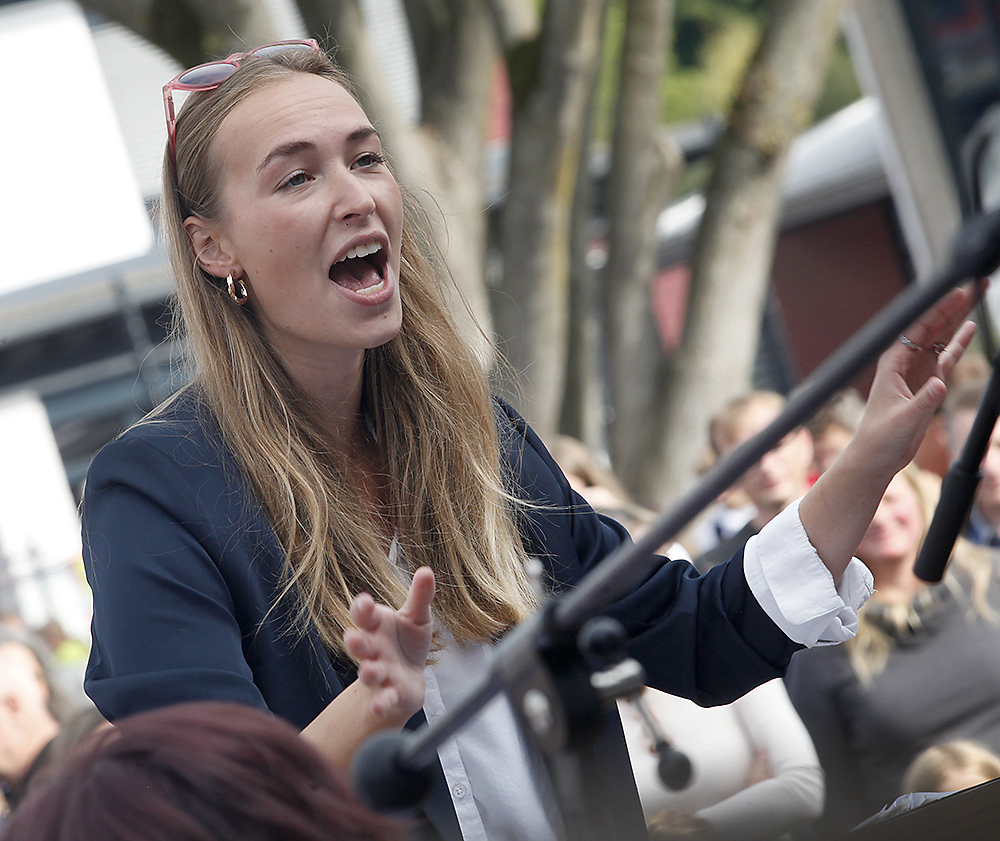
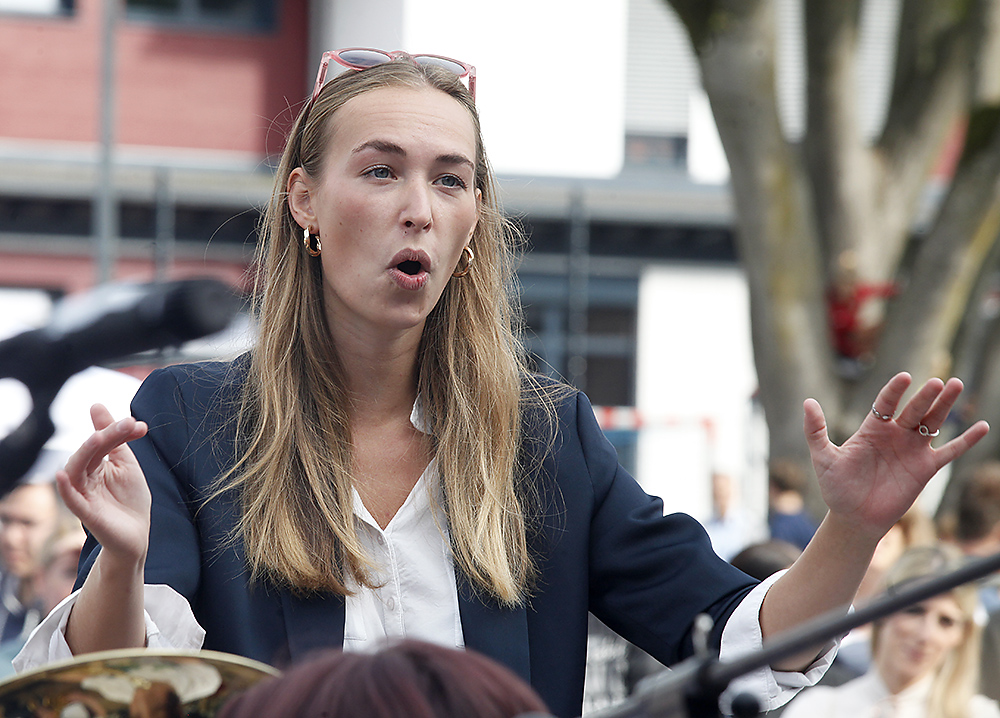
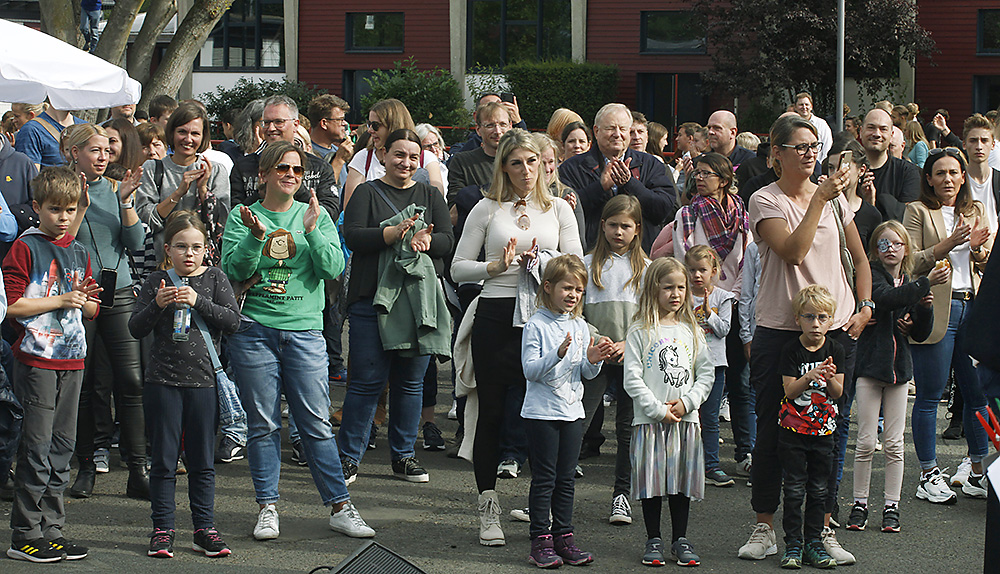
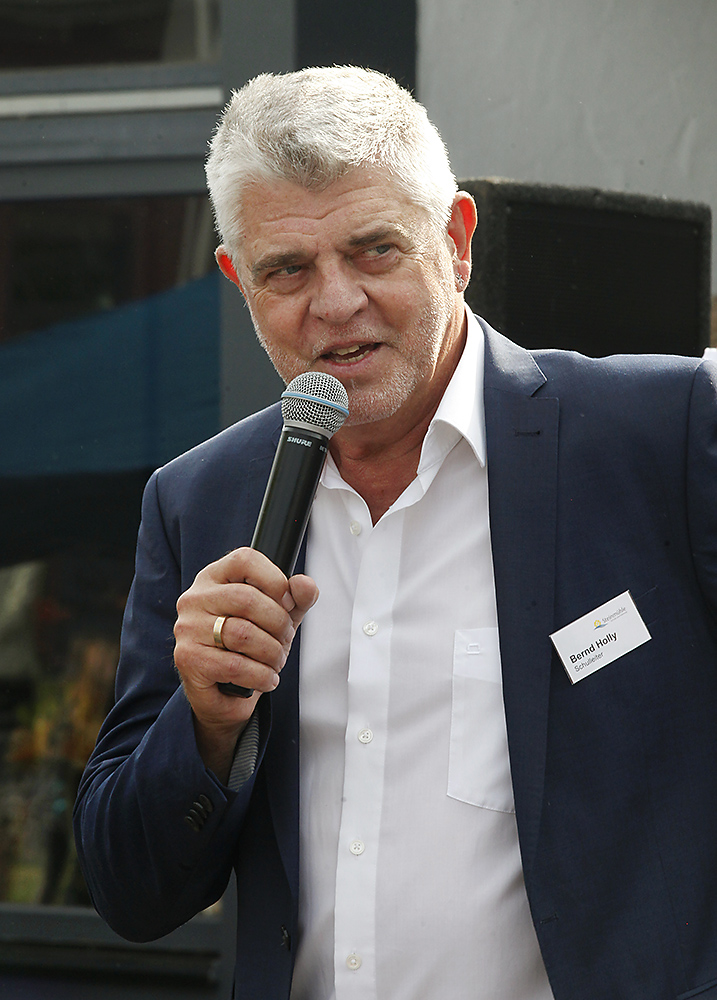
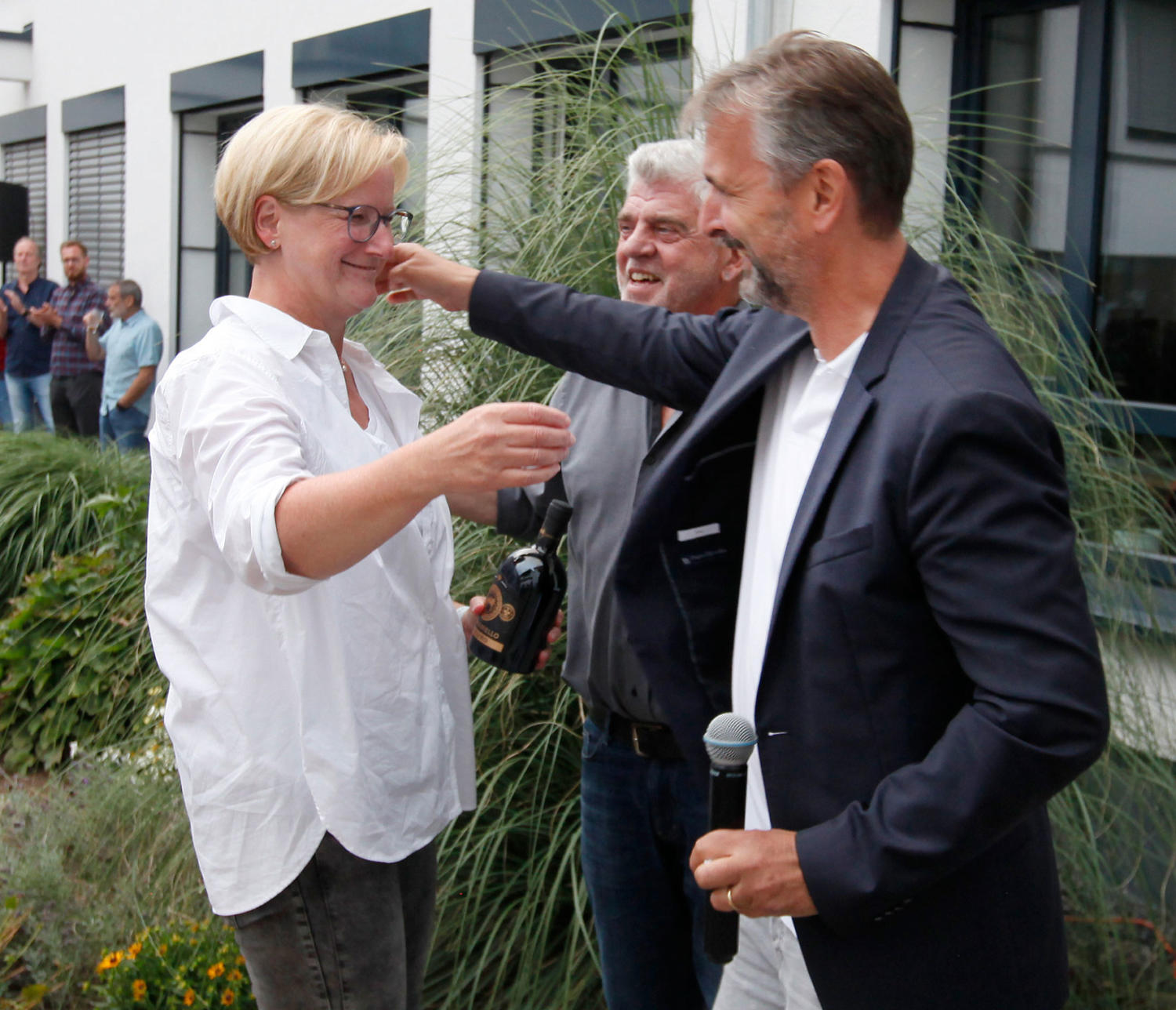
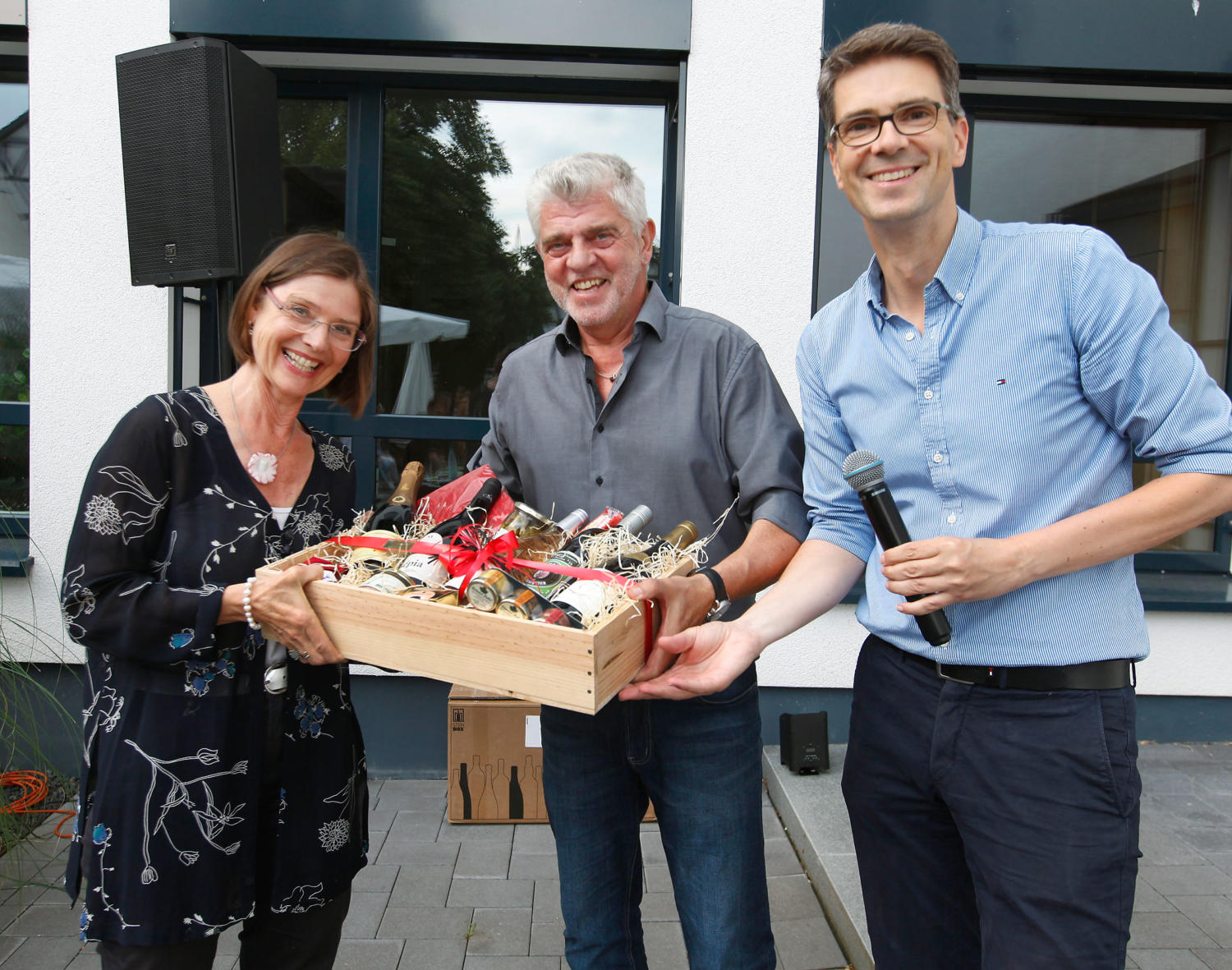
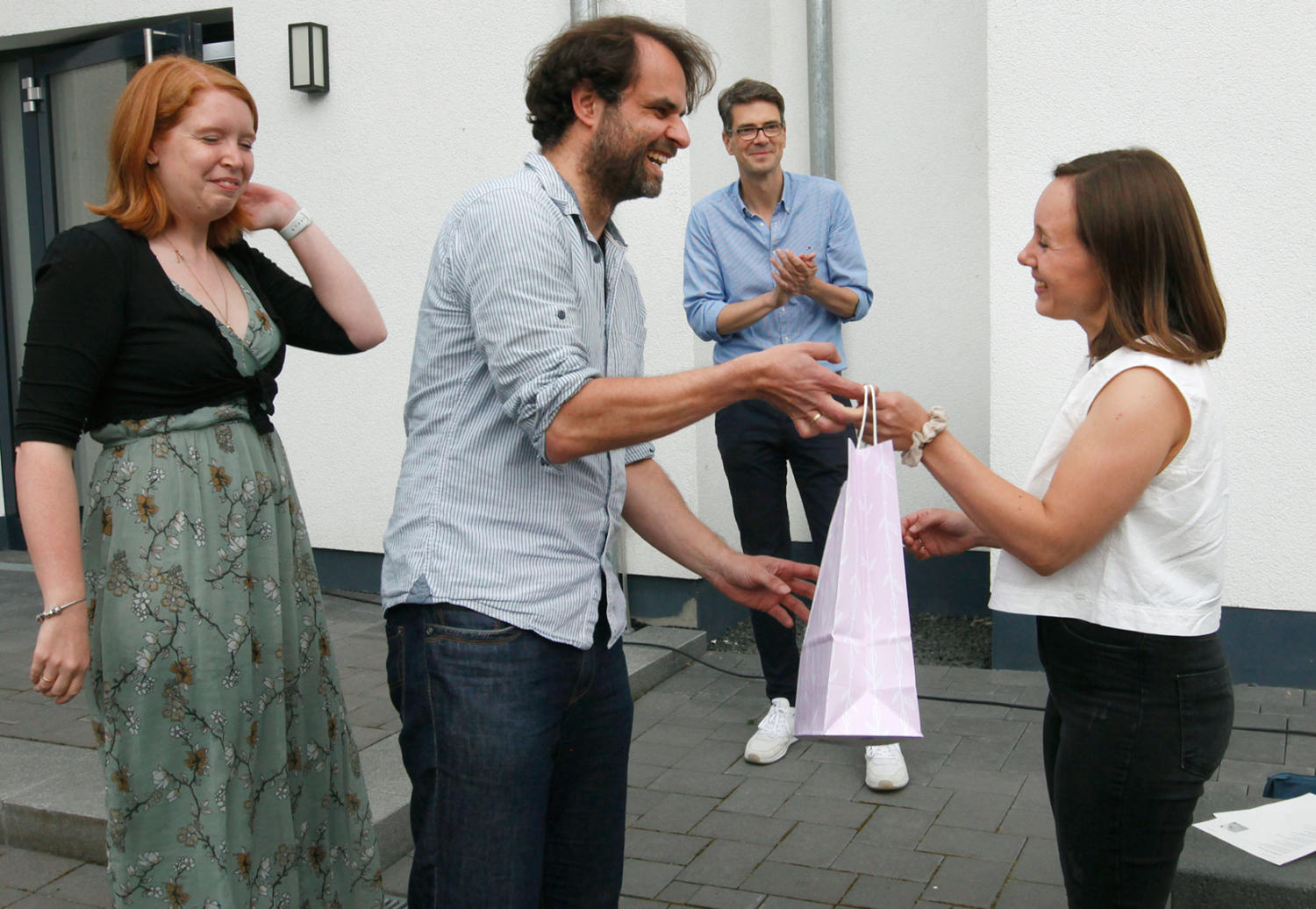
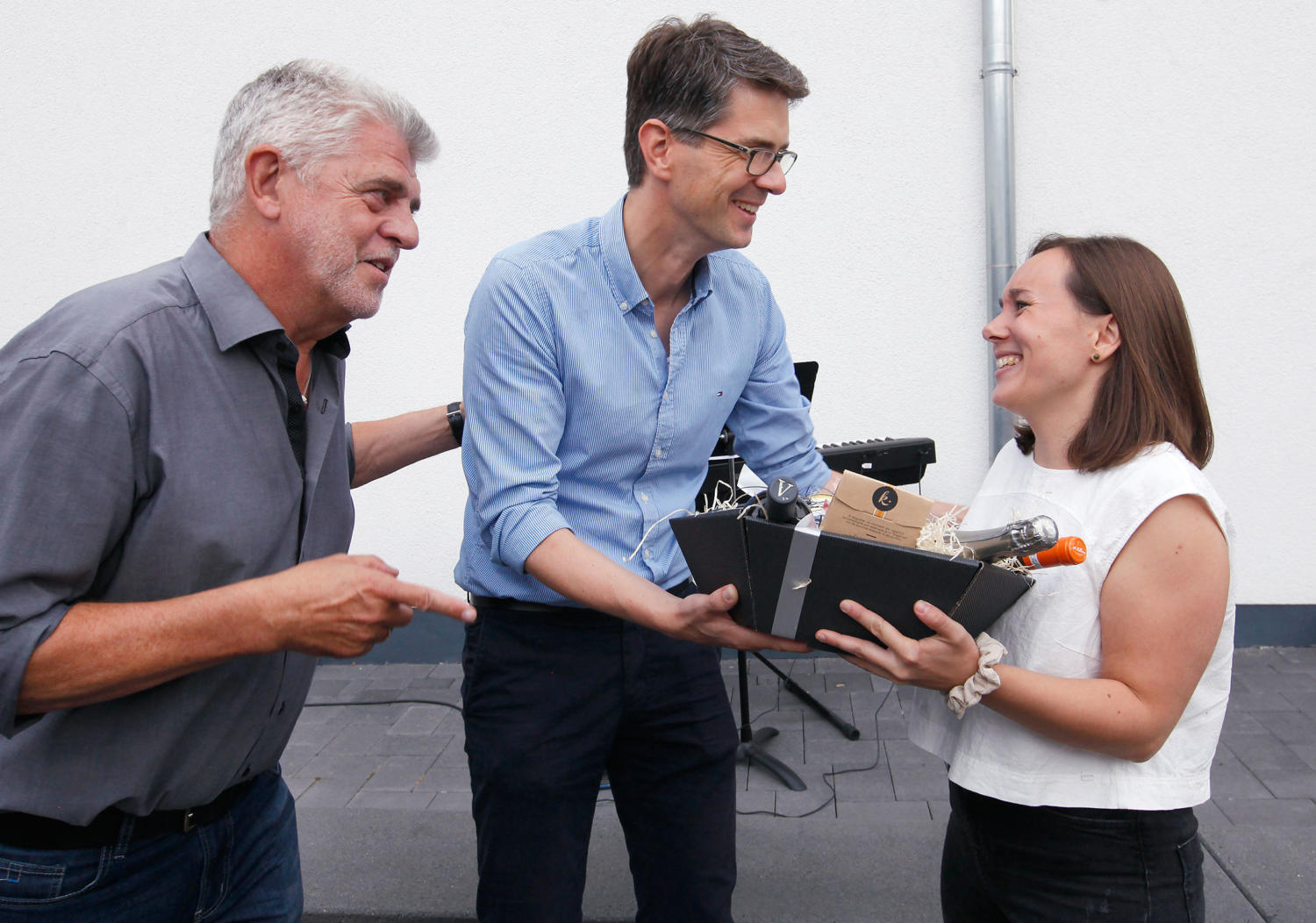
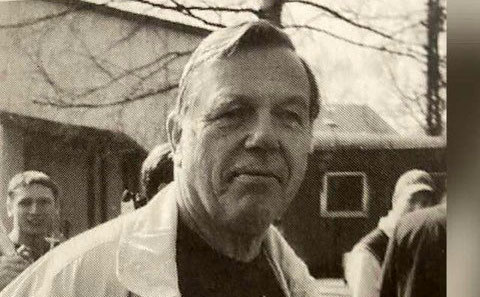
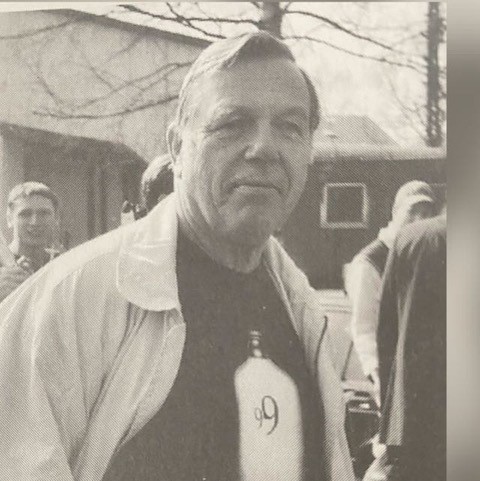
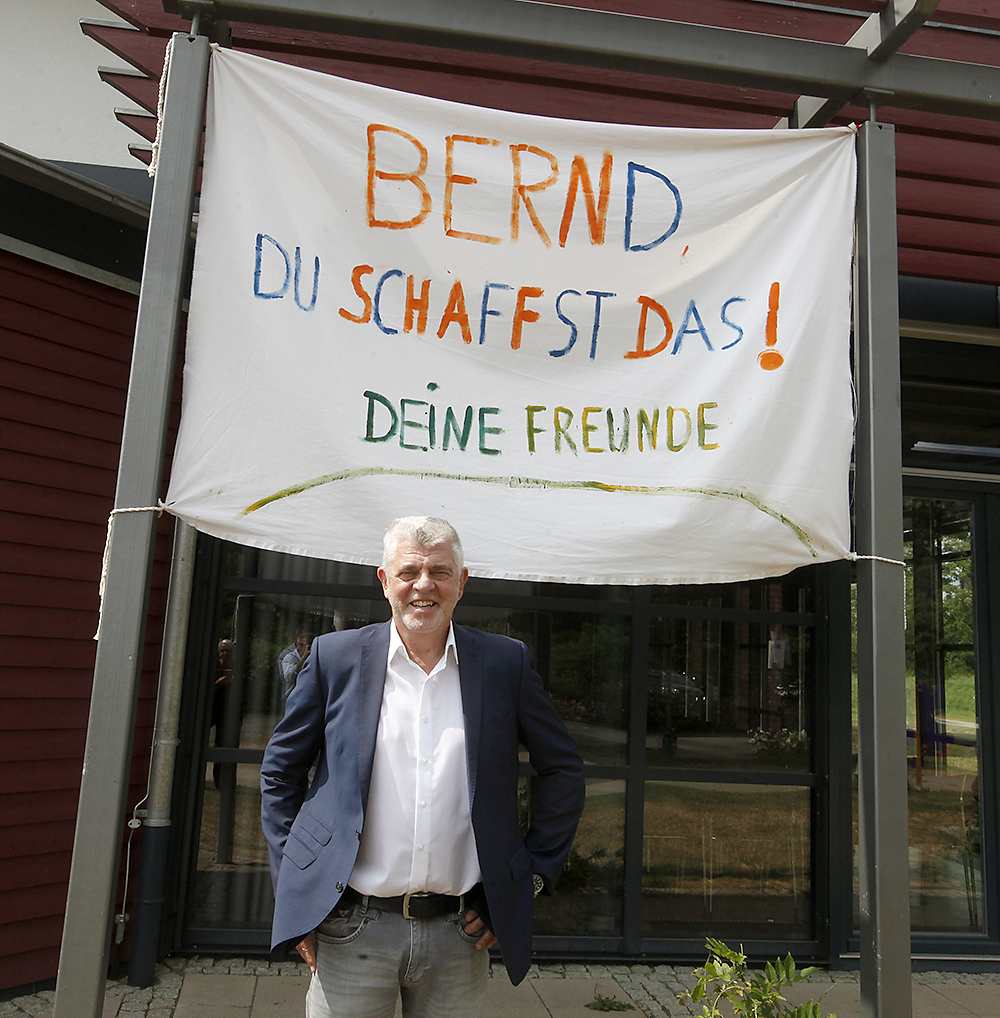
The Steinmühle now boasts yet another ecosystem: As part of an impressive planting campaign, a mini-forest was created in May. The planting process, based on the Miyawaki method, was truly extraordinary—after all, 1,200 different native deciduous trees and shrubs were planted in an area of just 150 square meters. The project was initiated by Bernd Holly, who is leaving the forest to the school as a farewell gift before retiring after a long career.
Over the course of two days, about 50 dedicated volunteers worked together to make the vision of a thriving forest a reality. They planted a wide variety of trees and shrubs, including oaks, chestnut trees, hornbeams, and elderberries. The selection of these species is intended to ensure that the emerging forest offers a rich ecological diversity comparable to that of native forest areas.
During the two days of the planting campaign, the student and teacher volunteers were able to experience the school’s sense of community firsthand. In addition to planting, there was time for pleasant conversations over shandy, cake, and pizza.
The planting campaign was a complete success and not only leaves a lasting ecological legacy but also strengthens awareness of environmental protection at the school and in the surrounding community. The Miyawaki forest will continue to grow in the coming years, providing the school community with a green oasis and a place to remember their longtime principal. The small forest is already affectionately known as “Hollywood.”

An interview with Principal Bernd Holly on the occasion of his retirement: “Looking forward to life beyond the school gates”

The end of July 2023 is drawing inexorably closer. It is the date on the certificate issued by the Minister of Education that signals Principal Bernd Holly’s retirement from the teaching profession. He has reached the mandatory retirement age. Retirement after 22 years at Steinmühle, after nearly 40 years in his dream job as a teacher. And now? Angela Heinemann spoke with Bernd Holly about defining moments in his life and his current thoughts.


It’s hard to even bring myself to ask. How are you doing right now?

Holly: It is a little awful. Who would willingly leave a place like this? It’s like saying goodbye to a dream. Right now, I’m really aware of what I’m losing. And I’m having so many very emotional goodbyes.


Until now, it’s been a heavy workload—but now there’s time to travel and spend time with the two grandchildren. Isn’t that something to look forward to?

Holly: Oh, absolutely. They’re looking forward to having Grandpa around more often soon. I also love the idea of traveling through Europe in a RV. Or maybe even visiting Ireland sometime. I have an Irish grandfather—that’s where my last name comes from. But I’m being honest with myself: going from endless work hours—a 60-hour week—down to zero is quite something. First, I need to figure out how I’ll define myself now—just through the Steinmühle, or as my own person. I’m curious to see what life will be like in front of the bollard.


Retirees often fall into a slump…

Holly: Not really. I have a wonderful social circle, a great family, and I’m privileged when it comes to the people around me. I’ve also had some very lucrative job offers, but I’m not accepting them. I’ll only be volunteering at the Marburg Food Bank, and I’ll be encouraging people to plant trees.


We know that social involvement was important to you during your time at Steinmühle. So that hasn’t changed?

Holly: I come from a very humble background, from a small village in the Westerwald. My father was a railroad crossing guard, and my mother was a seamstress. They were wonderful parents! In our family of five, there was no money for extras. Whenever I needed money or wanted to buy something, I’d get a part-time job—as a construction laborer, a mail carrier, or an industrial diver. The latter was really risky, but it paid well.


Is that why you’re committed to helping the socially disadvantaged?

Holly: The term “socially disadvantaged” is incorrect and derogatory. People labeled that way aren’t socially disadvantaged—they just don’t have money. I know some people who are very wealthy but are truly socially disadvantaged. The problem isn’t in their wallets—it’s somewhere else.


And you don’t have much trouble expressing that? Social skills are important to you…

Holly: I’ve always been straightforward, which didn’t always sit well with my own teachers. Although I was an A student, I often rubbed people the wrong way. I was excused from the graduation ceremony and wasn’t allowed to give the student speech, even though that’s what my classmates had actually wanted. The school’s reasoning: “General insubordination and insistence on my own opinion.”


Is that something you wanted to do differently as a teacher?

Holly: Actually, I always wanted to be a teacher—both because of good role models and because of bad ones. Even though I got straight A’s on my exams, I couldn’t find a job at first; as we all know, the job market for teachers has been crazy for decades. Sometimes there are too many teachers, sometimes too few. Then it finally worked out.


After stops in Frankfurt and Giessen, you ended up at the Steinmühle…

Holly: I came from the Willy-Brandt-Schule in Gießen. It’s a vocational school, and to some extent, a school in a high-risk neighborhood. As the youngest staff member, I quickly became a department head and “supervisor” for more than 50 colleagues. That’s where I got to know all the different aspects of the job. At the time, many people didn’t understand my application to Steinmühle because it didn’t seem to fit at all. I even heard comments like, “You’re usually a decent person. What do you want at this school?”


In 2001, the Steinmühle was facing a crisis that threatened its very existence…

Holly: The school had only 445 students, was in a precarious financial situation, and, for various reasons, had a very poor reputation. As a team, we managed to turn the school around back then and, over time, turn it into a sought-after educational institution. This approach—combined with having the right people in various key positions—has made Steinmühle what it is today. I’ve put a lot of my heart and soul into it.


Is the stone mill facing challenges today as well?

Holly: Steinmühle faces the challenge of finding teachers. Teaching is a highly complex profession; more needs to be invested in building relationships. At Steinmühle, this is even more difficult because teachers are expected to be more present than at public schools. Presence in more ways than one. And we don’t have tenured positions. Then there’s the power of “anti-social” media and a culture of debate that needs to be nurtured. But the last two points apply to all schools.


And at a time like that, Holly’s leaving?

Holly: Well, I’m not going willingly. And I’m not dead, after all. I’ll join the school association and stay on top of things.


So many people are sad to see you go and have expressed their feelings. Something in particular touched you…

Holly: Every day, two girls from elementary school bring me an apple or some other piece of fruit. They want me to stay healthy. They want me to live to a ripe old age—at least until they graduate from high school. Unfortunately, I can’t grant that second wish…
 

On September 1, Wilhelm “Willi” Stehling presented his new book, *Die Marburger Turmwächter* (The Marburg Tower Guards), at his former place of work. The former music, sports, and geography teacher at Steinmühle took the hundred guests on a journey back in time during his richly illustrated reading and made it clear that the tower guards had been watching over the city from the high castle tower since the Middle Ages, ensuring its safety. Day and night, they warned of fires, enemies, and other dangers, and used signals to announce all travelers approaching the city. At the same time, the tower guards—who served as princely castle and city musicians for centuries—were regarded as the most important representatives of instrumental music. These musical all-rounders performed at weddings, dances, church and civic events, as well as at courtly occasions.

Willi Stehling did more than just provide an introduction to the complex working lives of guards and musicians. In particular, the stories from the professional and personal lives of one or two colorful characters were highly entertaining and made it clear that with his book, Stehling has not only made an important contribution to the cultural history of Marburg, but has also produced an engaging read offering previously unknown insights into the city’s musical and social life.

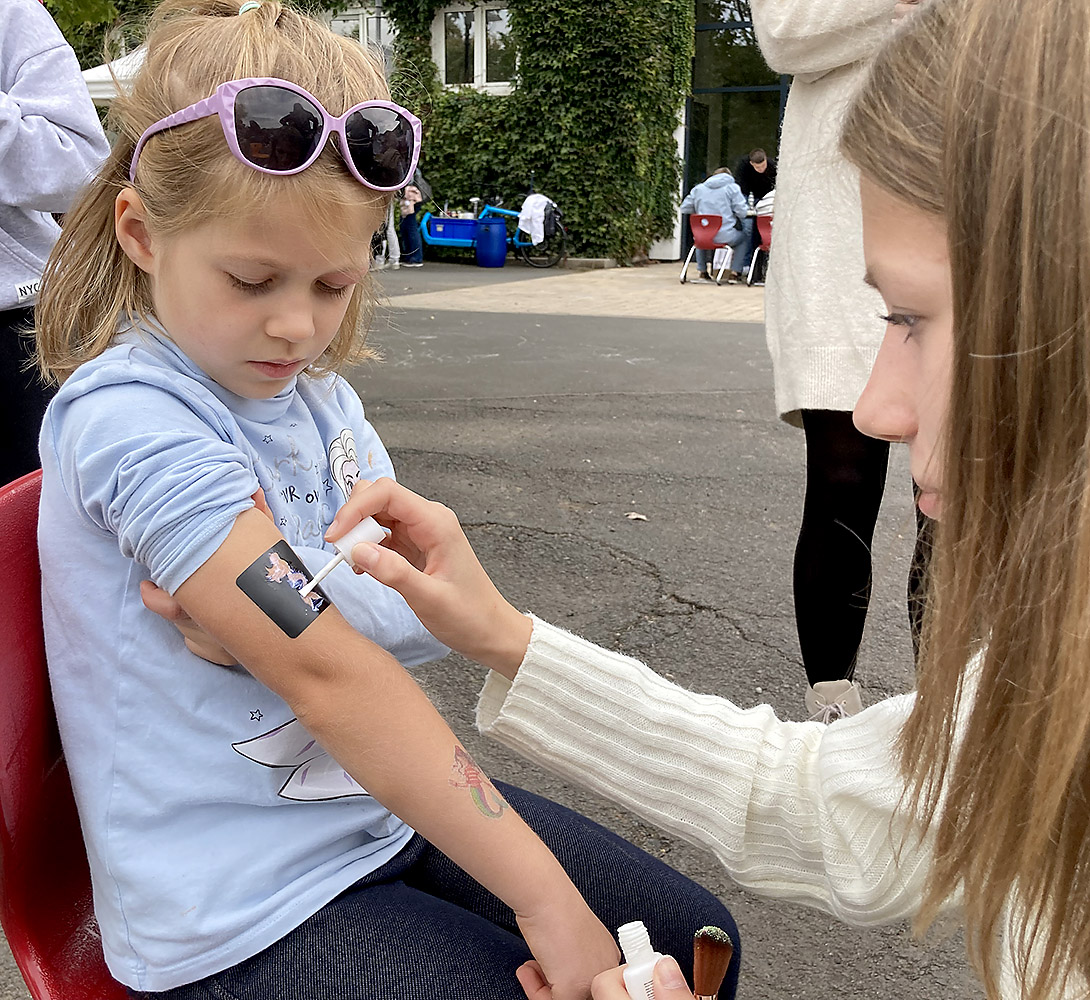
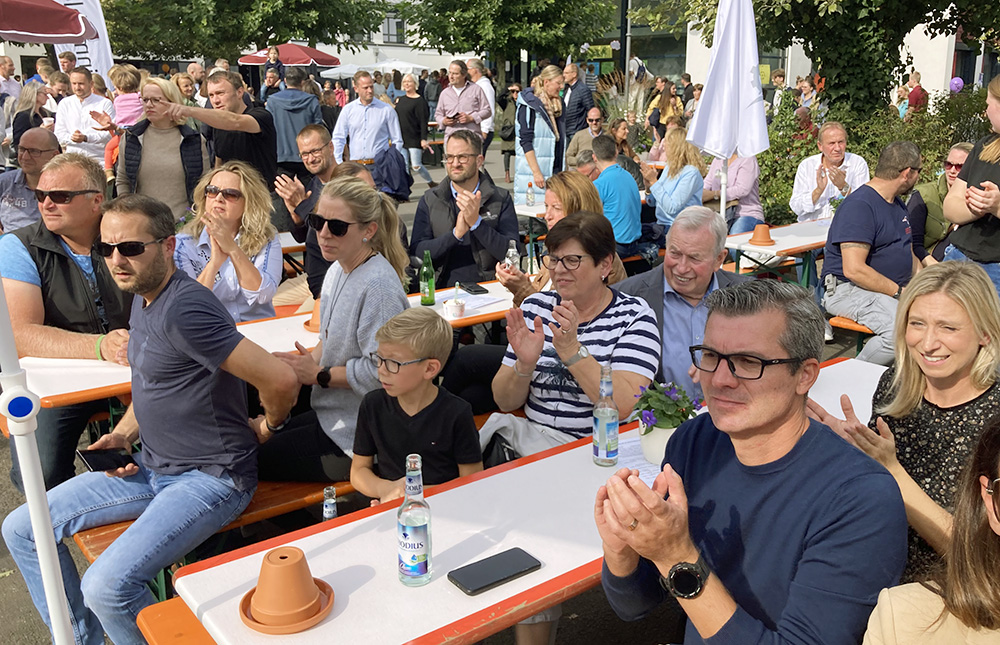
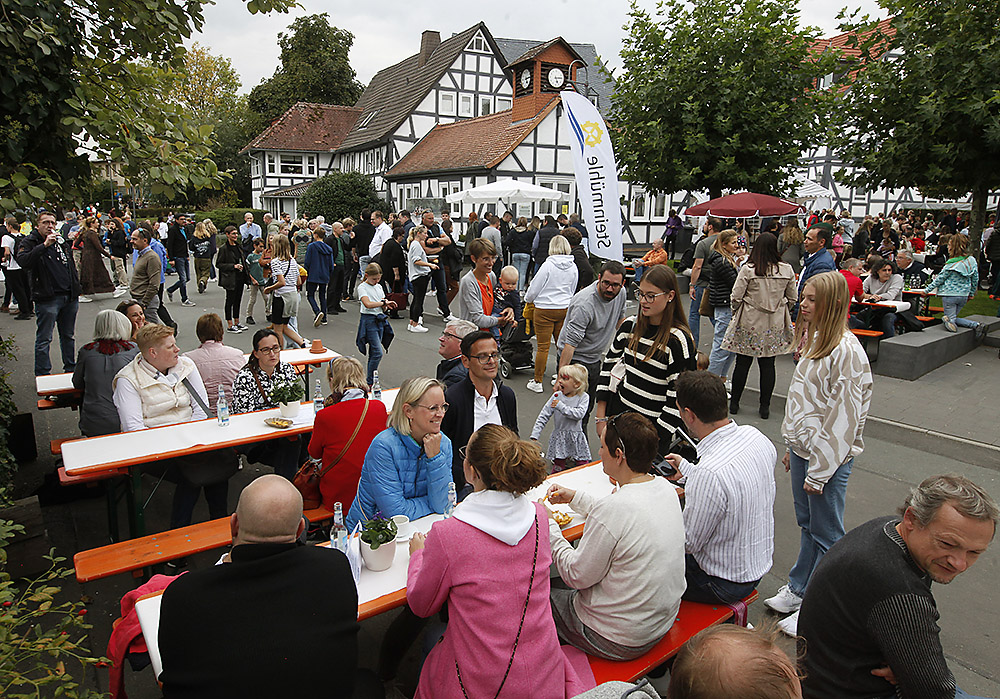
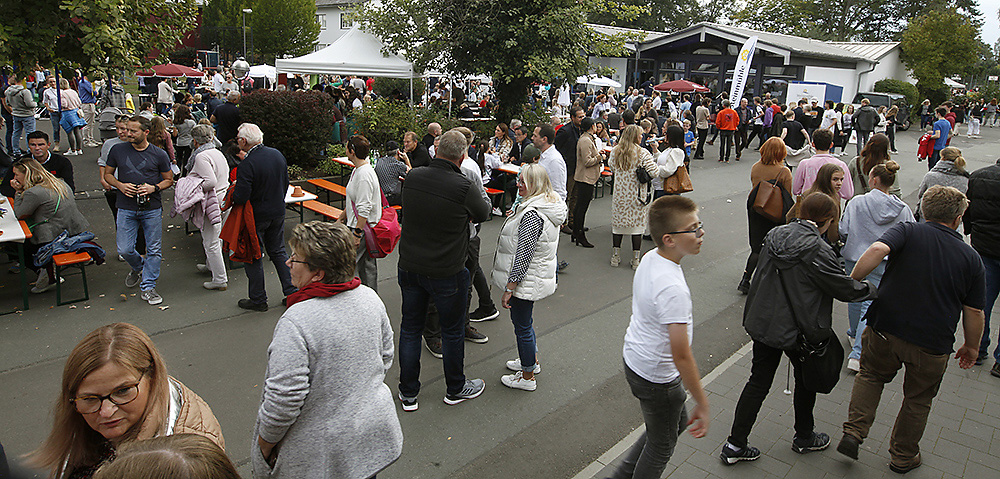
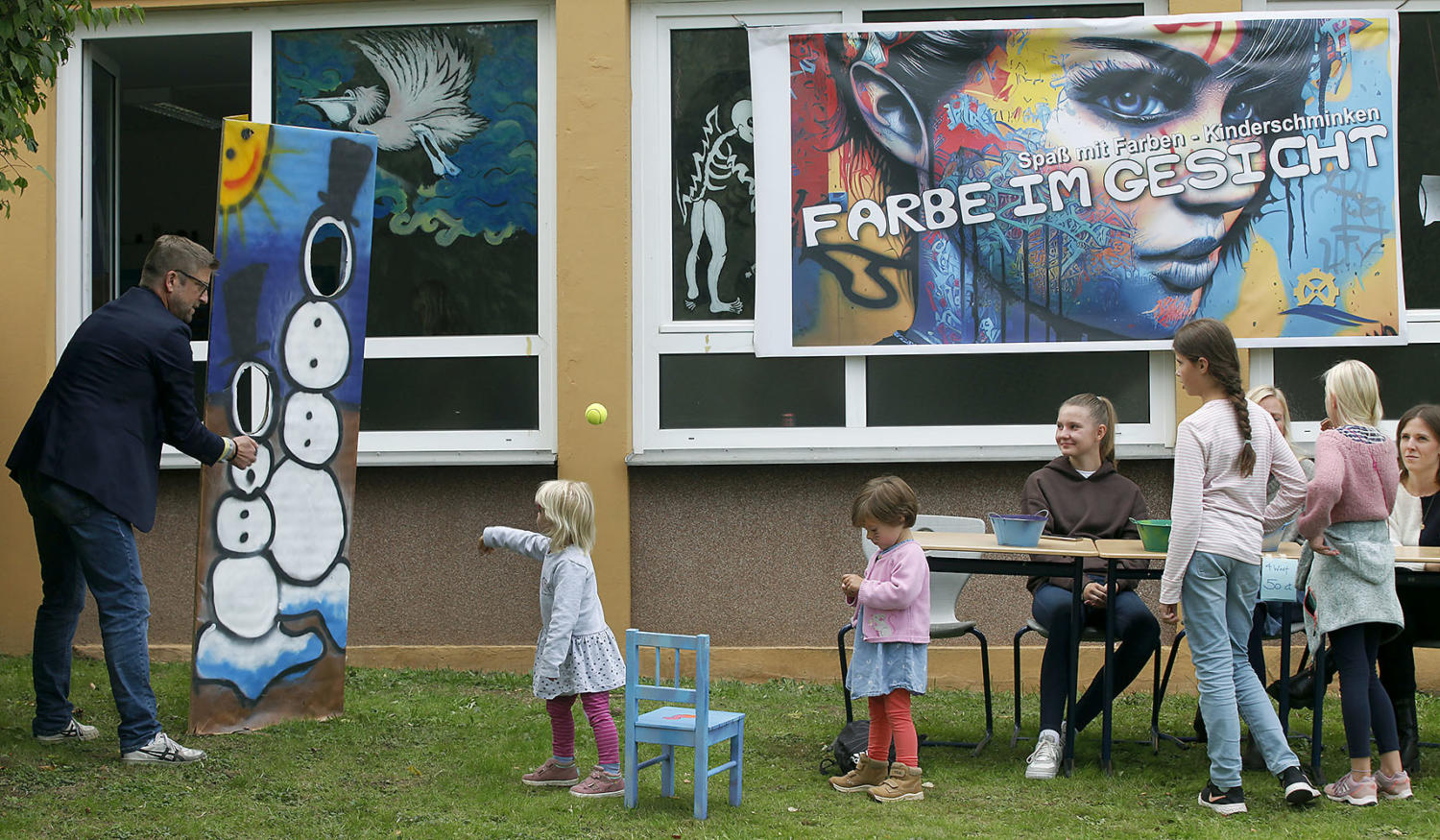
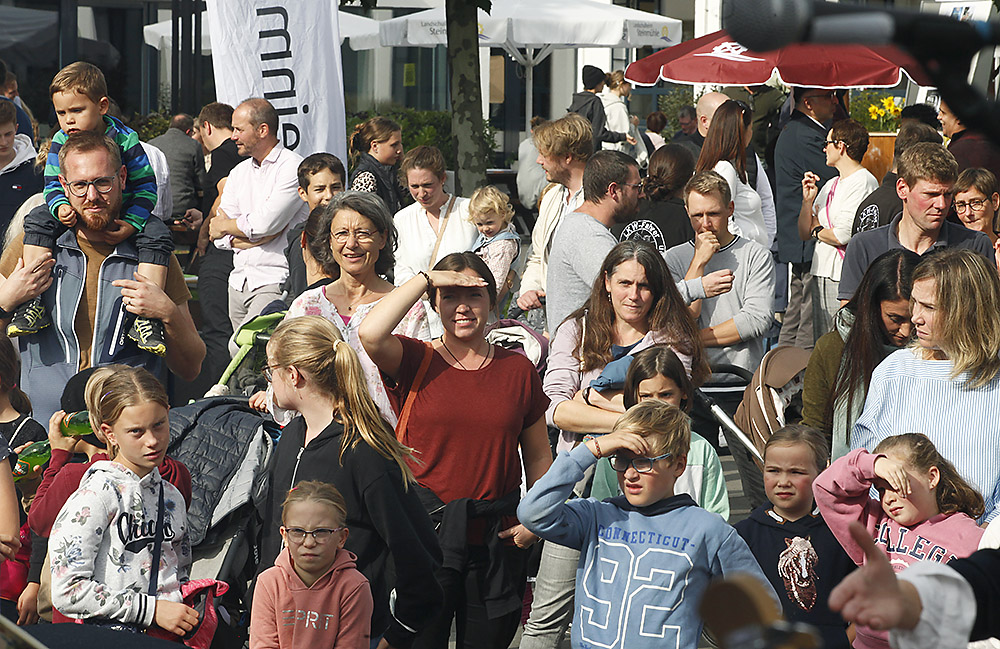
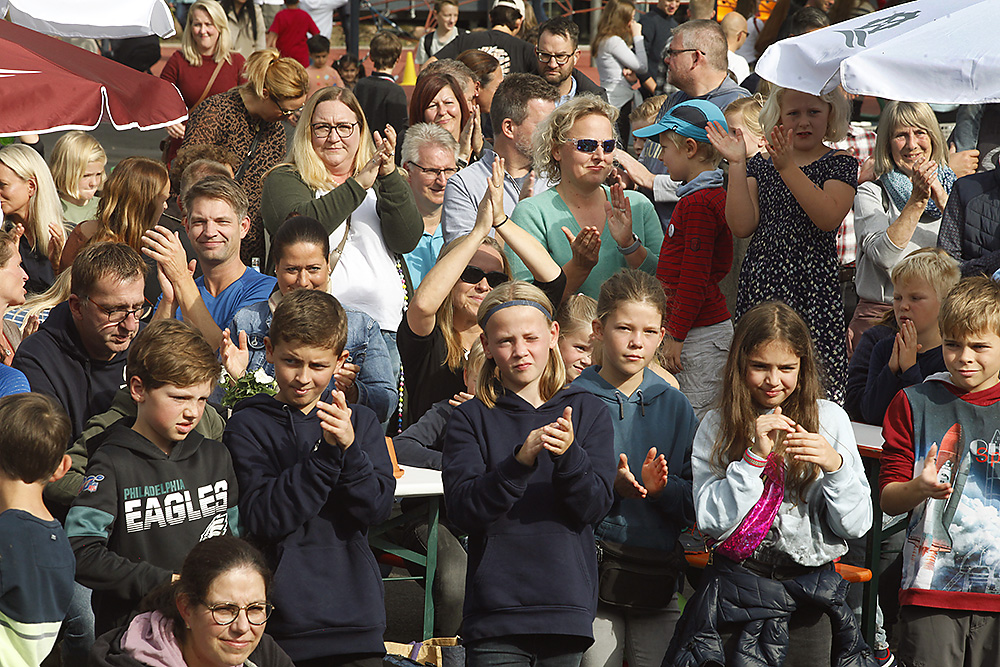
Finally, an autumn festival again! With more guests than before the pandemic, Steinmühle School and Boarding School celebrated their traditional event last Saturday. Thanks to the excellent organization by Frank Wemme, the head of the lower secondary school, everything ran smoothly and according to plan for the students at their booths and during their performances in the classrooms. Visitors were thrilled by all the activities. Alumni were amazed at how much “their Steinmühle” has changed for the better over the past few years.

The Steinmühle has expanded to include several new buildings, giving it a uniform and modern look. The grounds have become more spacious, which meant that the large number of visitors was spread out across the site. There had been some concern beforehand about the weather for the Fall Festival, but those concerns proved unfounded. The autumn sun shone brightly from the sky—as if it knew just how important this festival is to the Steinmühle community.

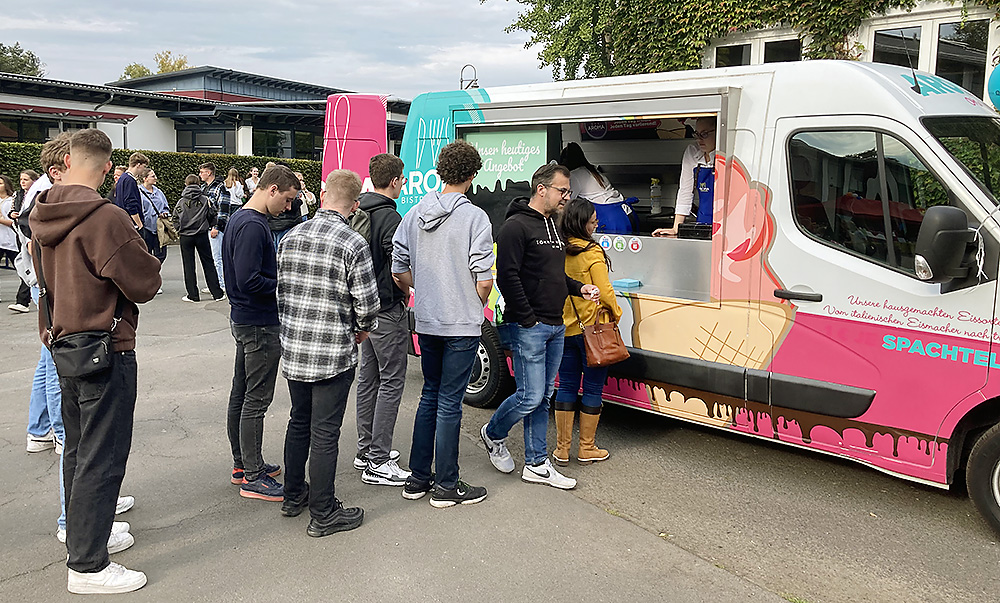
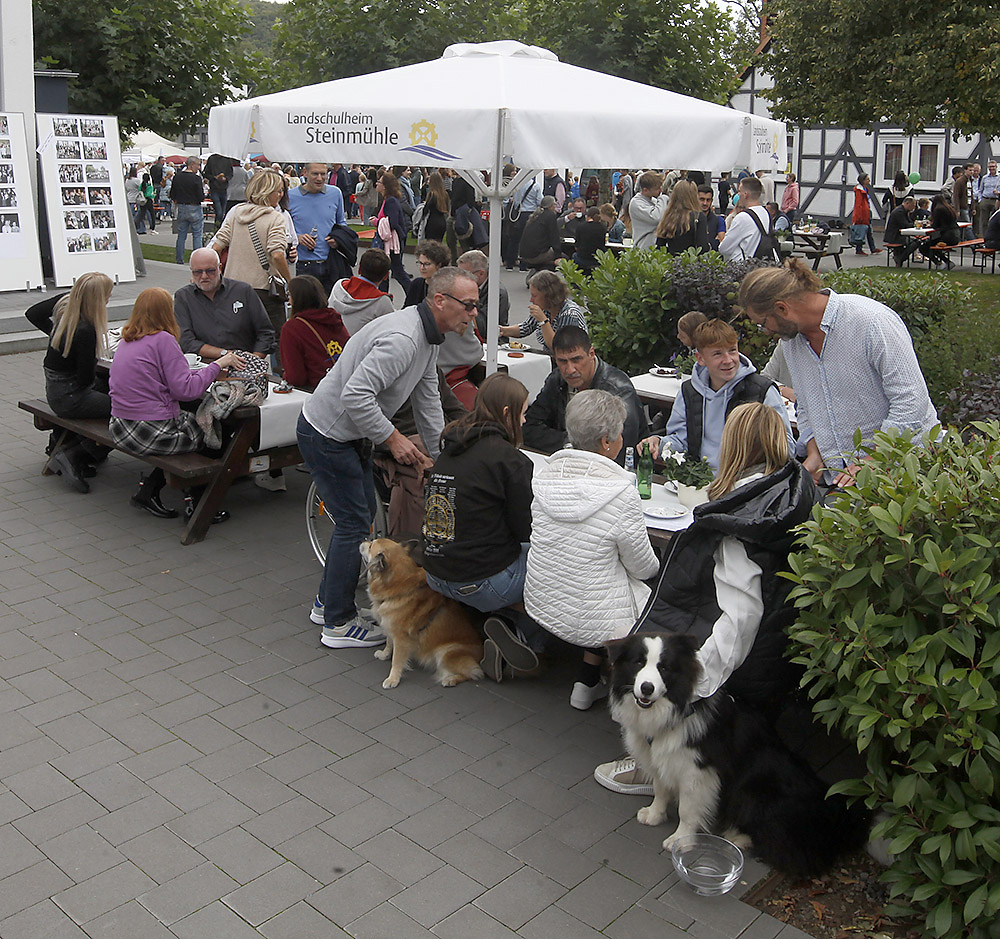
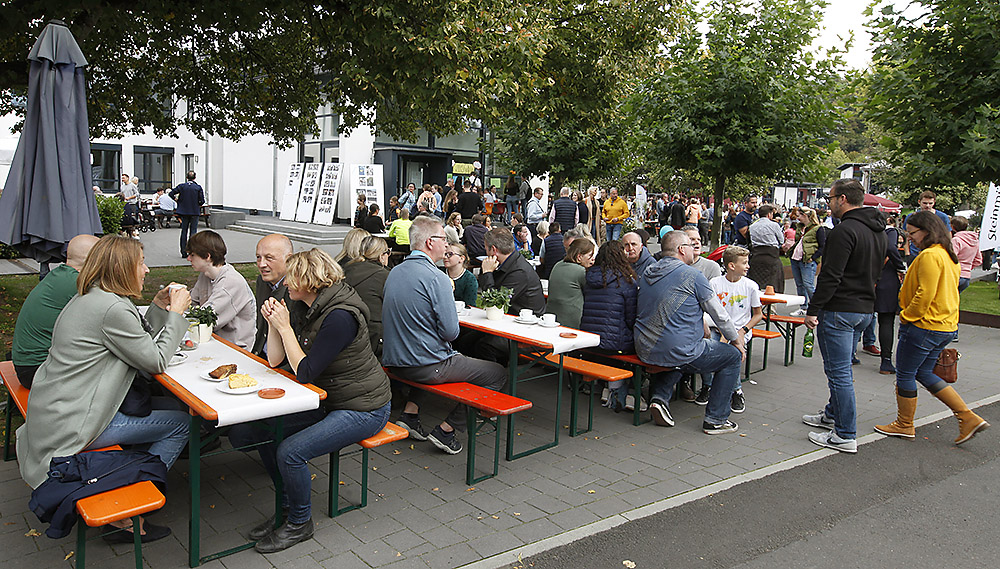
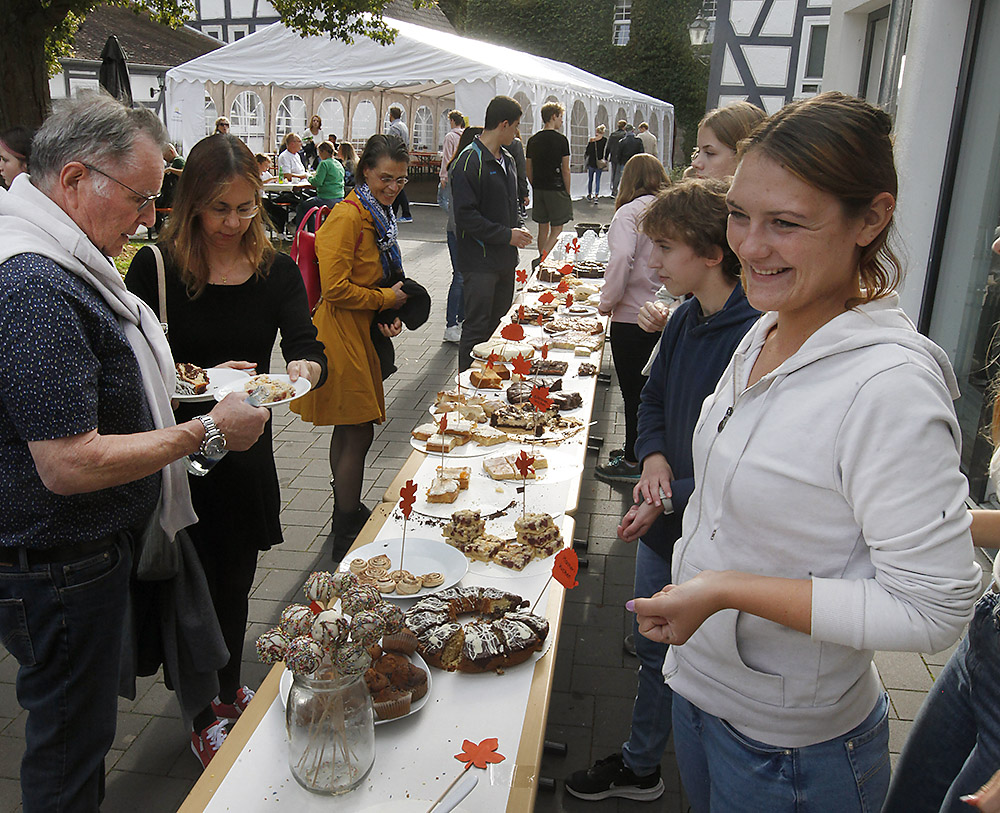
Since good food and drinks are naturally part of a successful and convivial celebration, this aspect was in the capable hands of the boarding school. From coffee and cake to grilled meats and the wine bar, there was a delicious and comprehensive selection of food and drink available. This was complemented by the popular Aroma ice cream truck on the grounds, which—as in previous years—drew long lines of people. The proceeds from the sales are regularly donated.

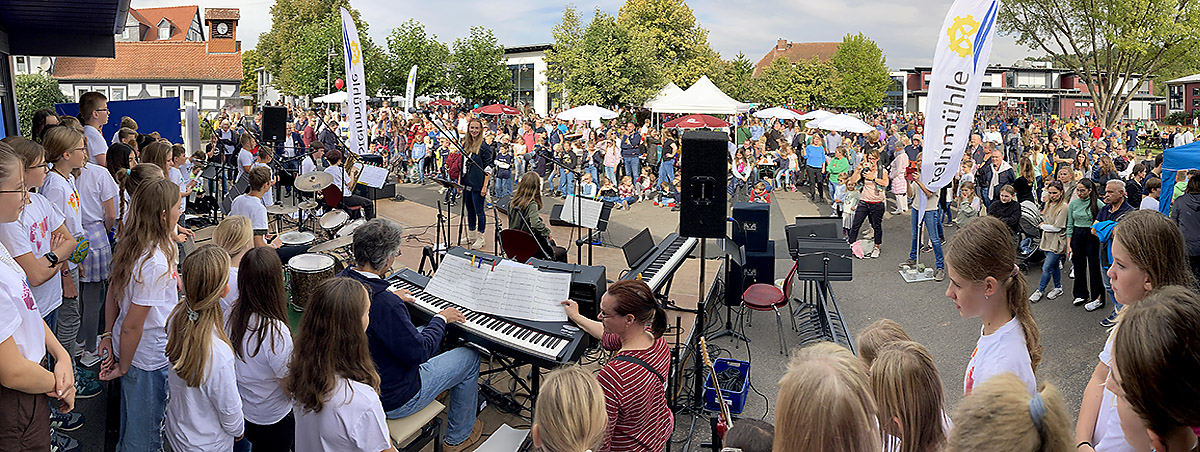
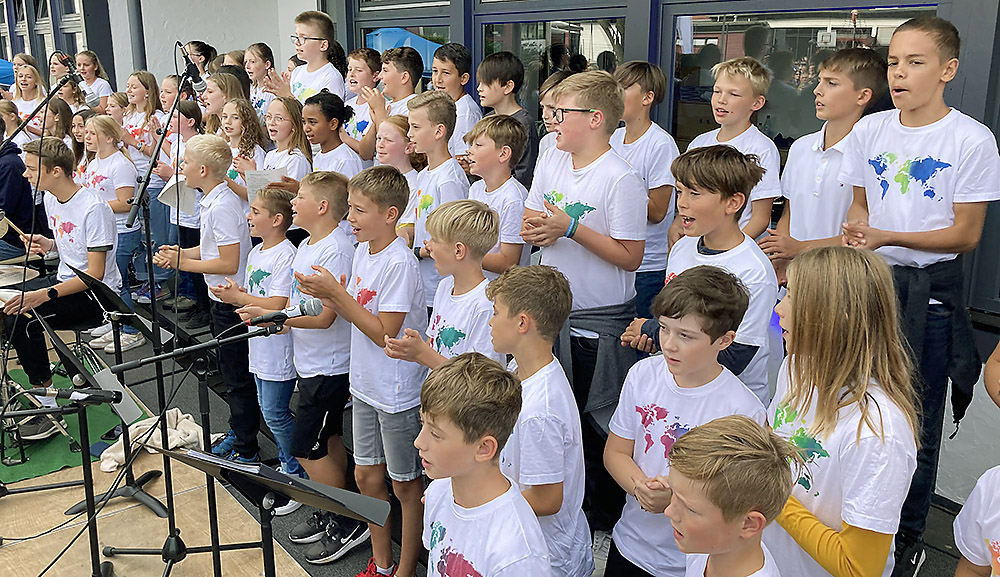
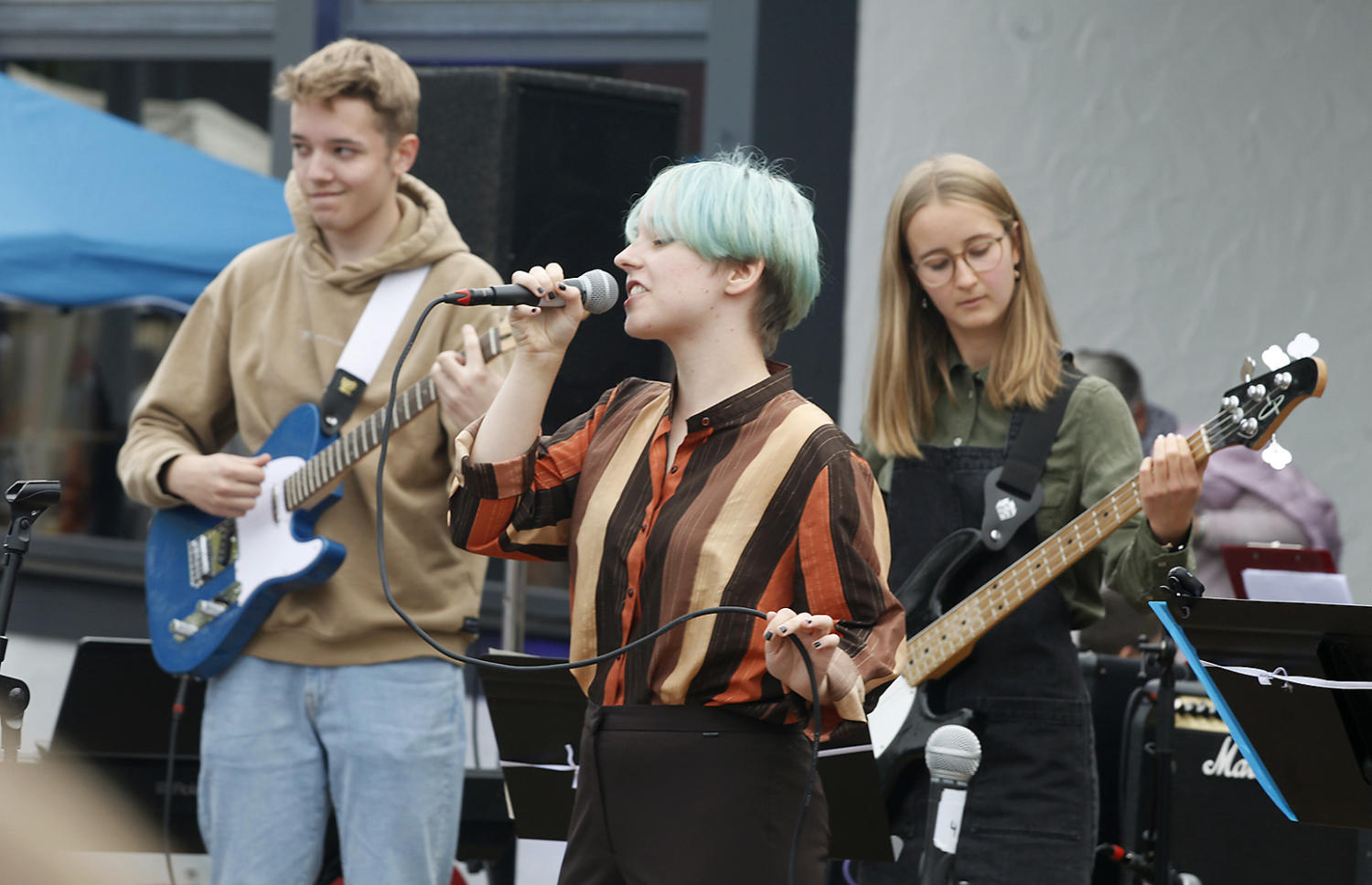
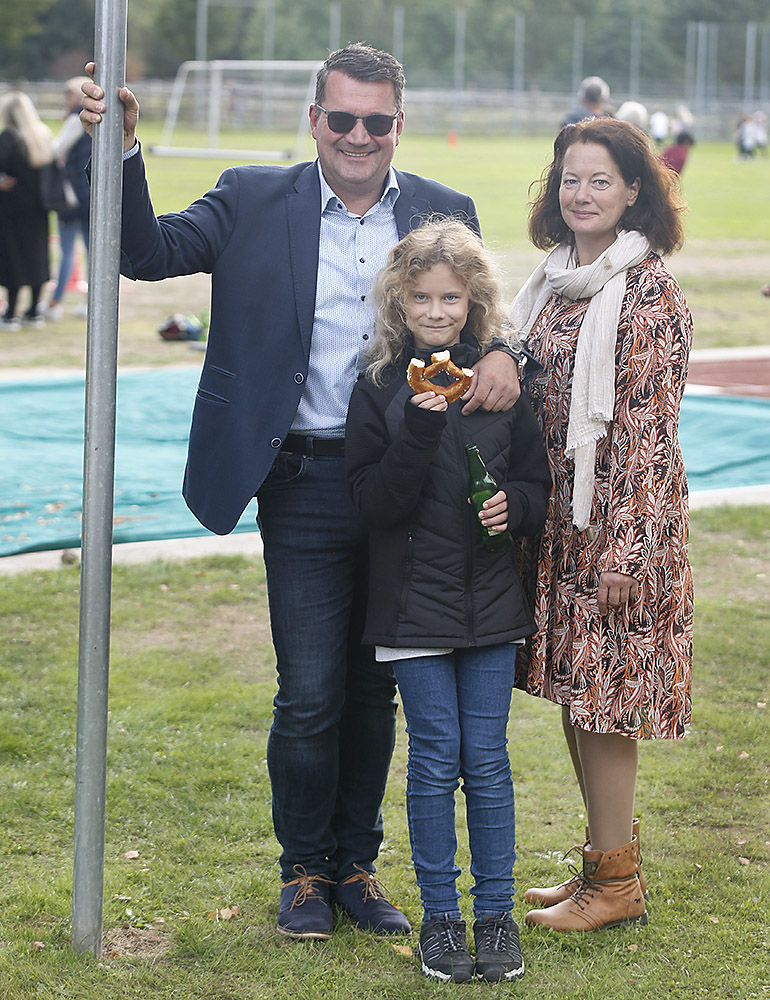
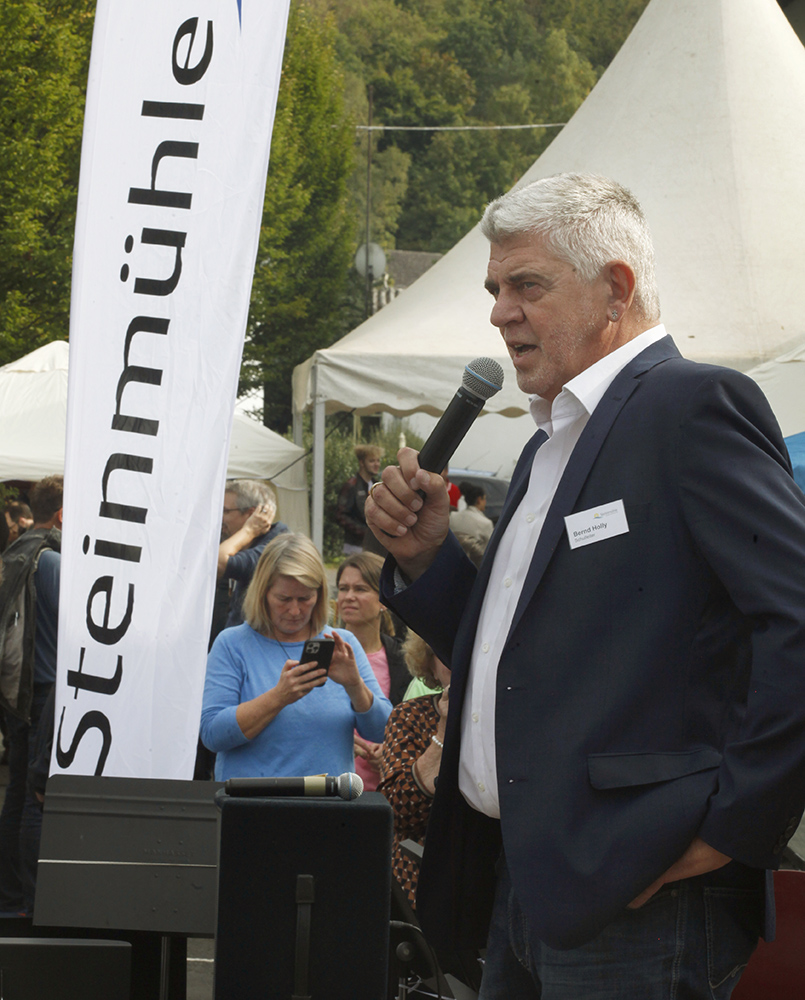
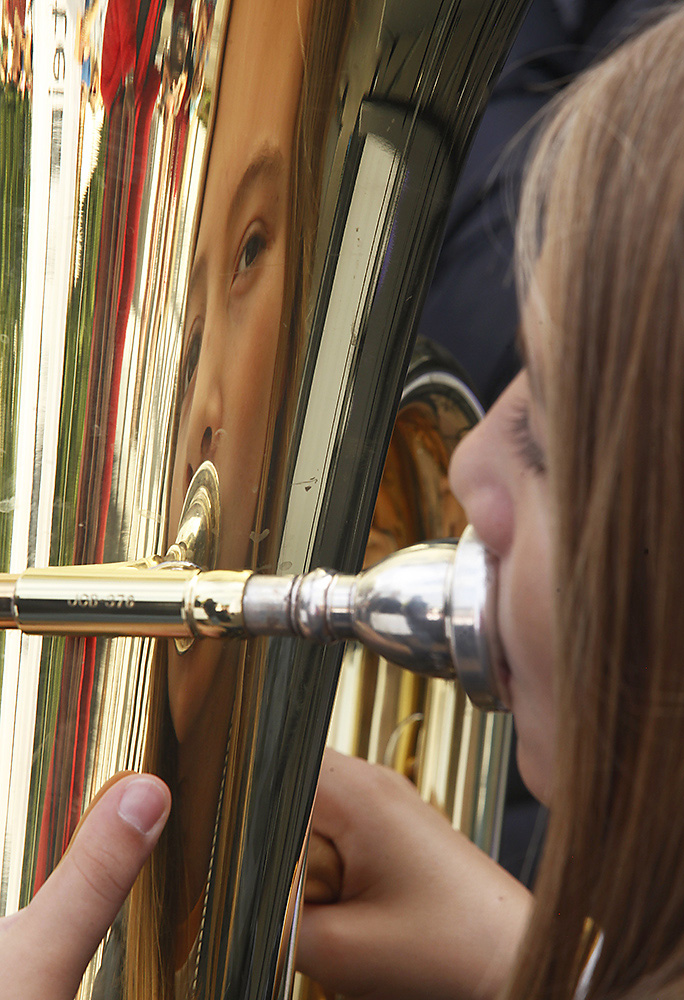
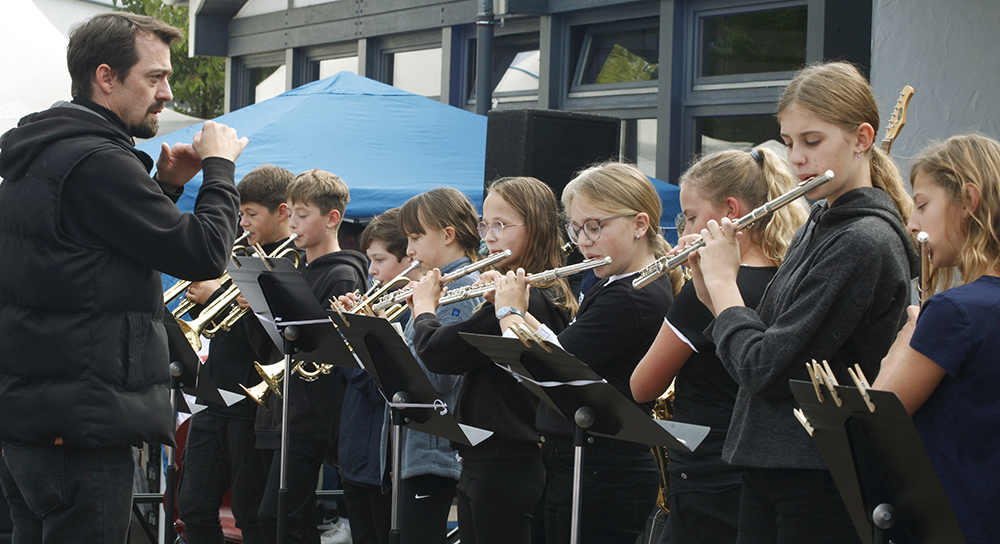
Shortly after the opening remarks by Principal Bernd Holly, who welcomed the guests alongside Boarding School Director Anke Muszynski and Nils Schwandt, the stage program got underway. The 6th-grade choir entertained the audience with musical theater songs, followed by the musical theater elective class. Next, the 5th-grade band, the StoneMill House Band, and the Jazz Ensemble took the stage. Starting at 8:00 p.m., DJ Veit kept the party going in the tent.

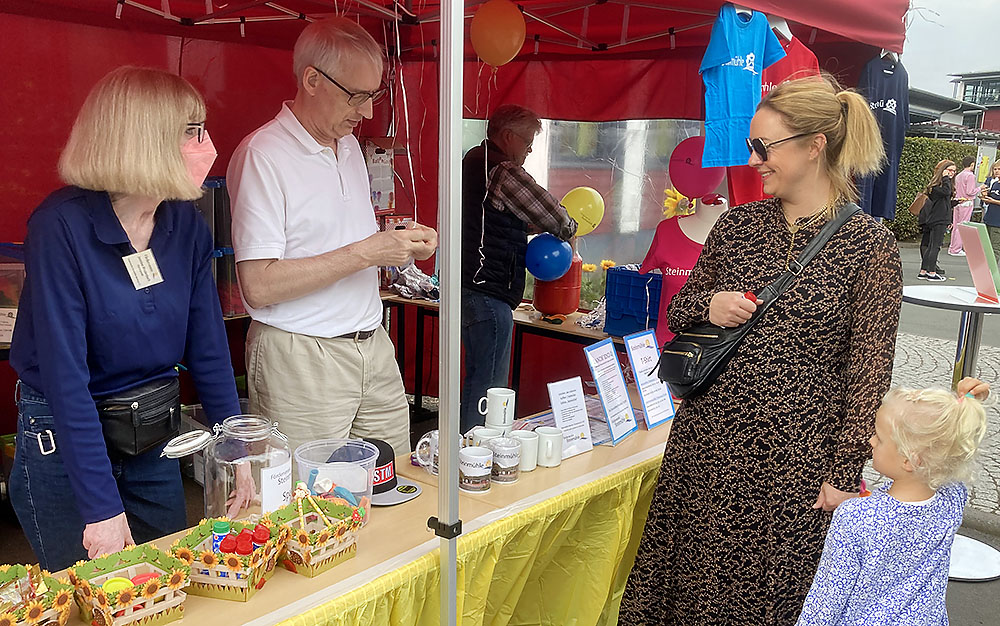
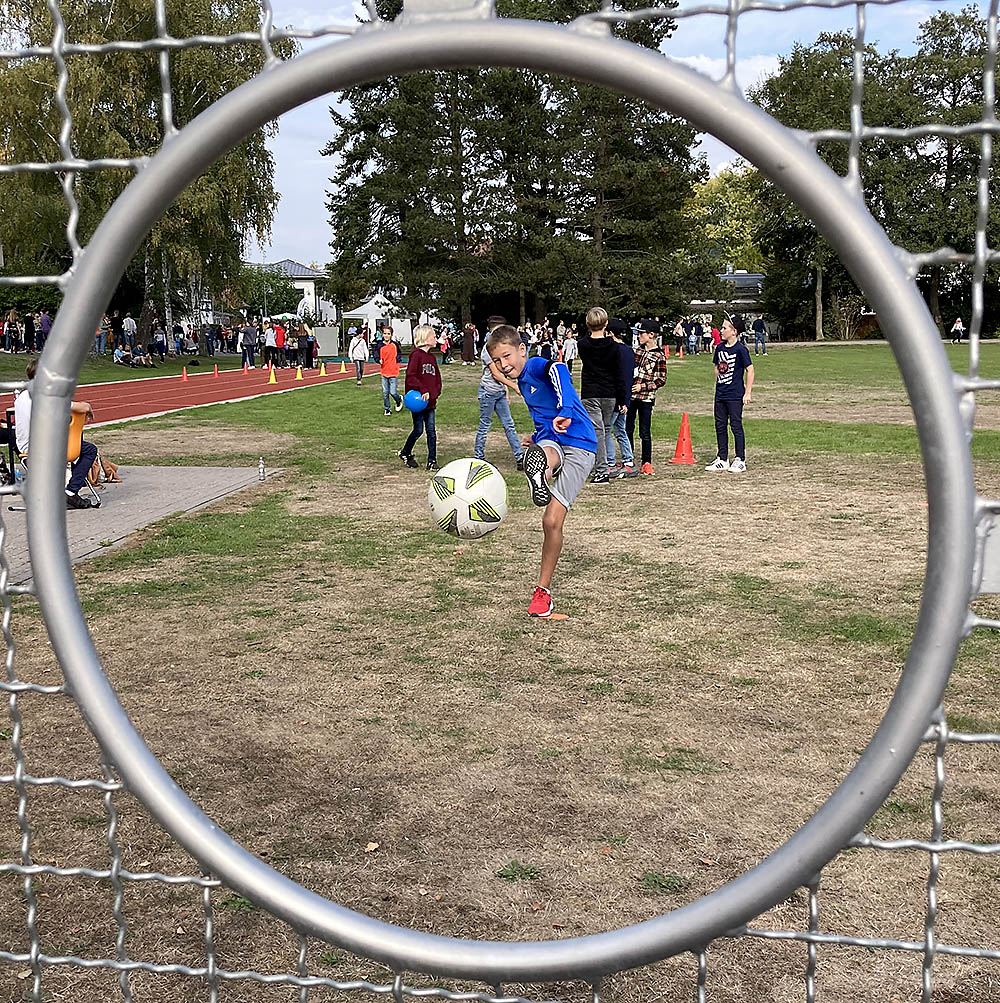
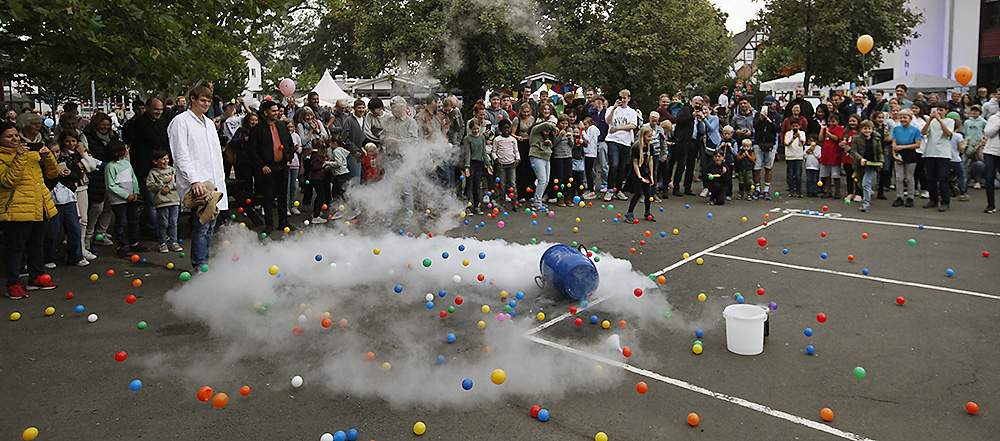
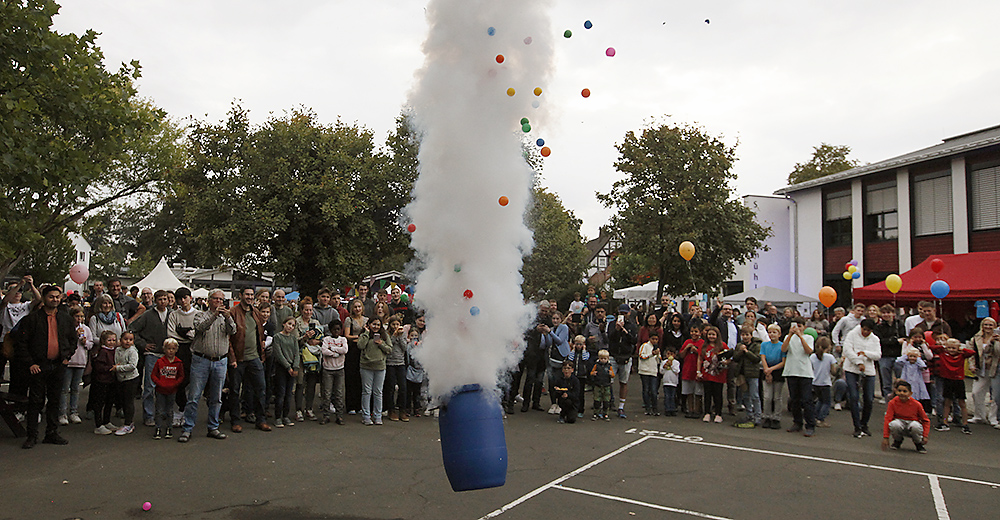
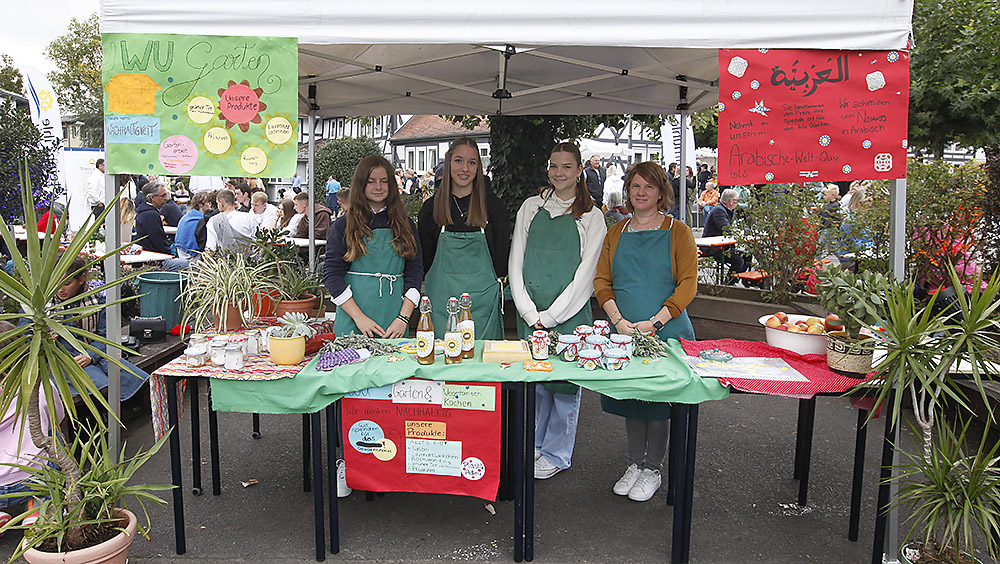
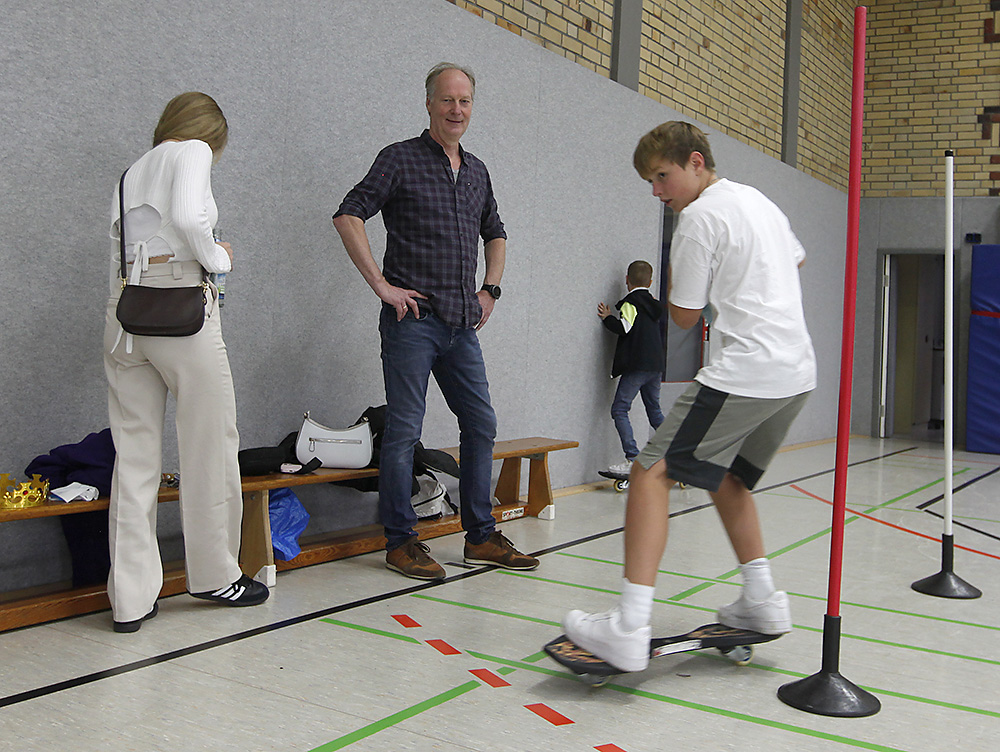
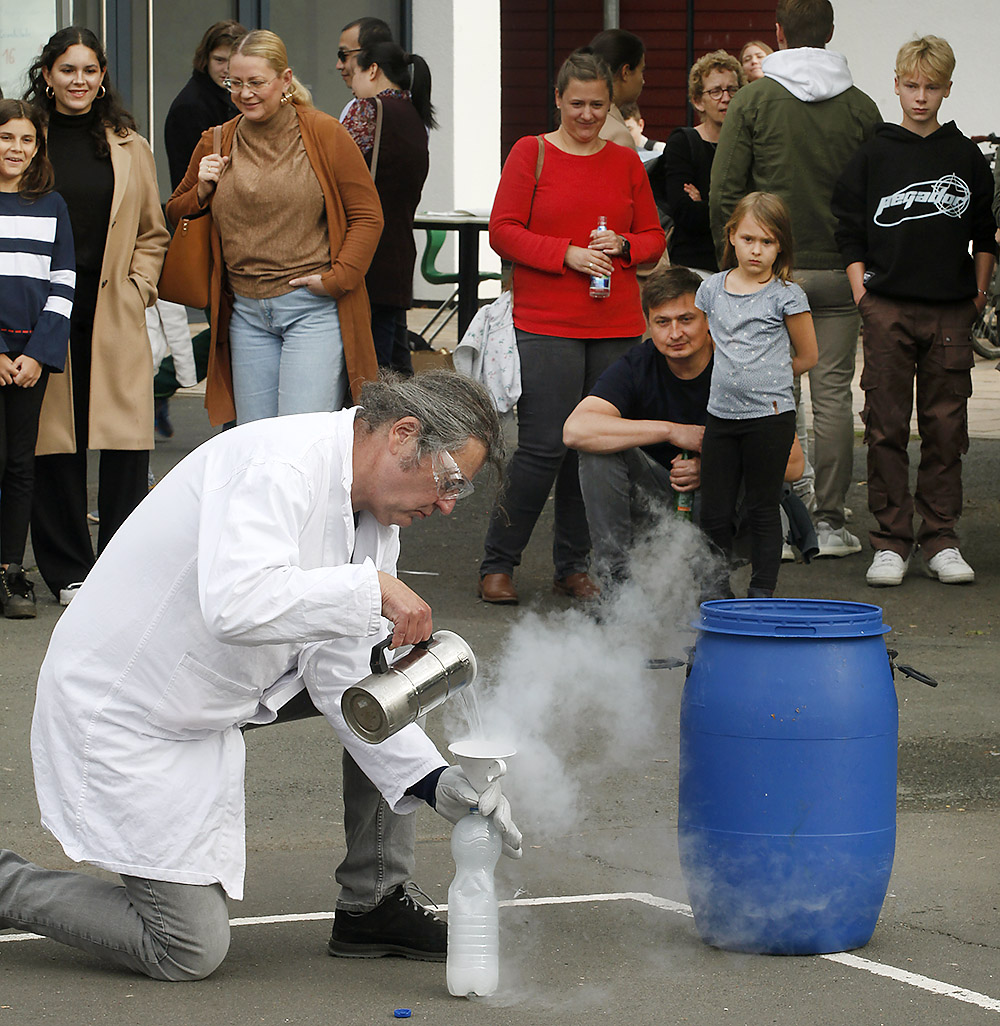
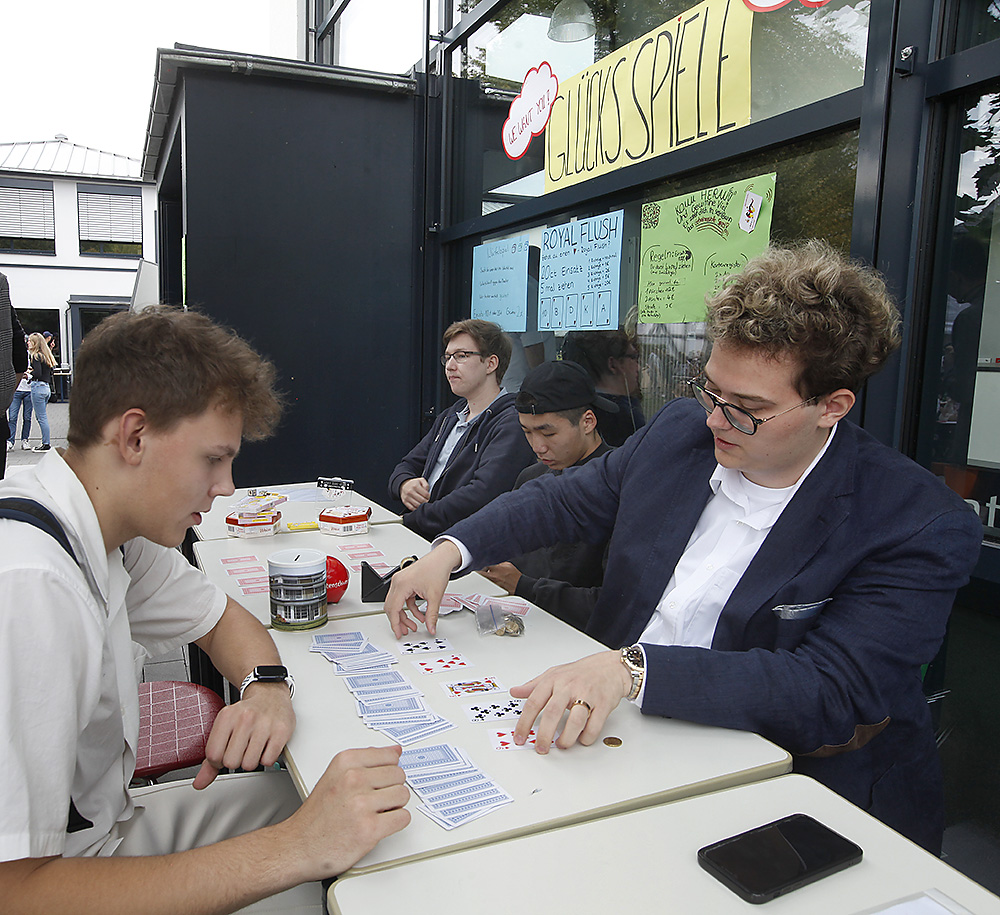
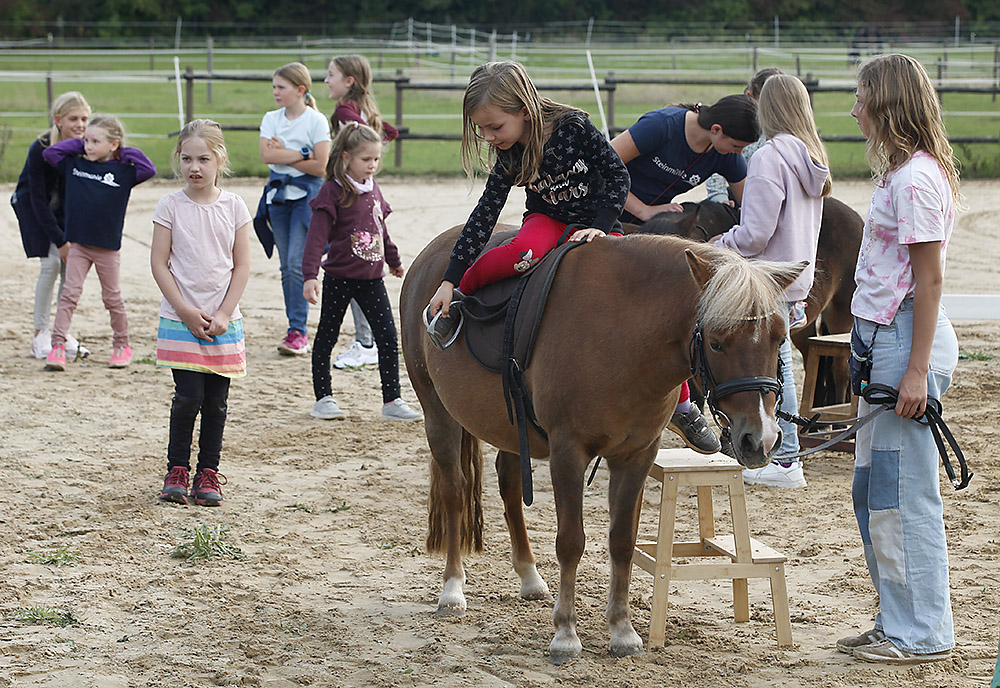
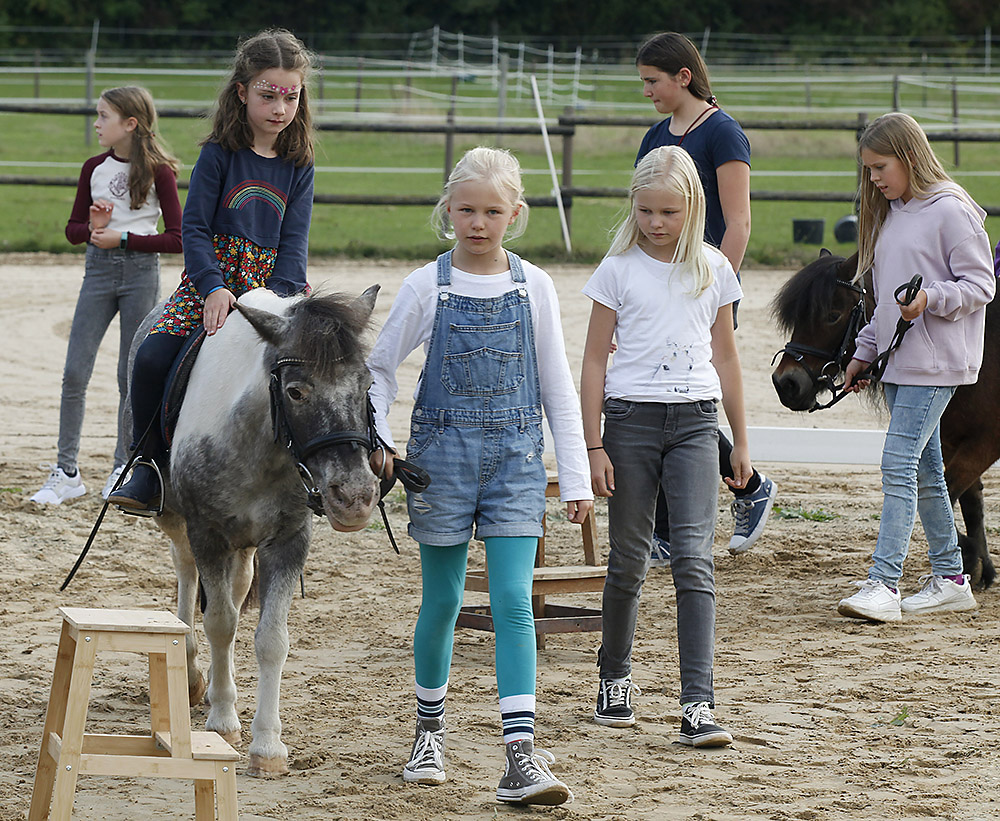
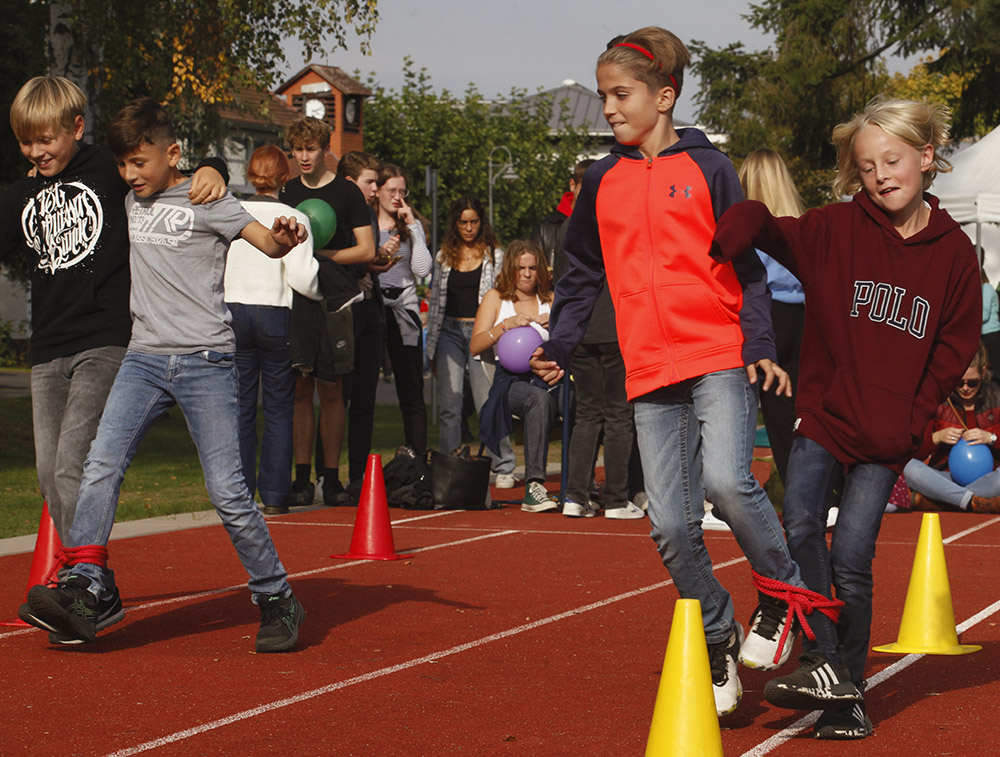
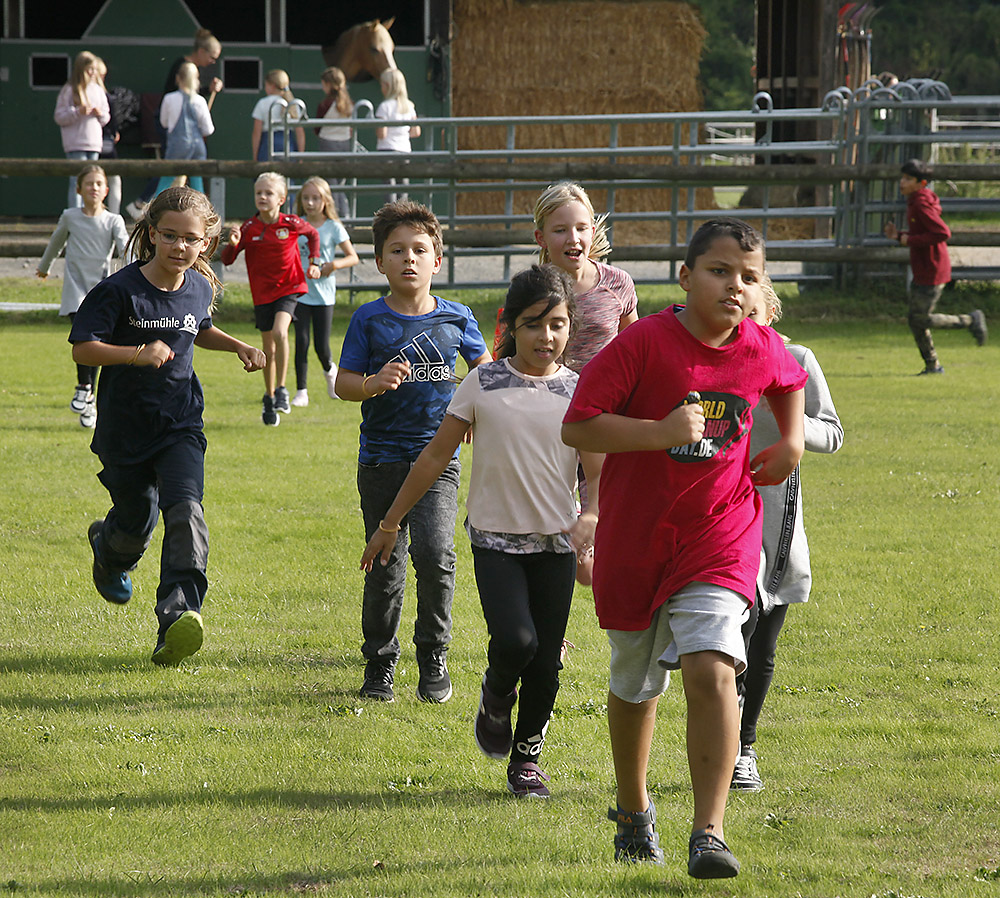
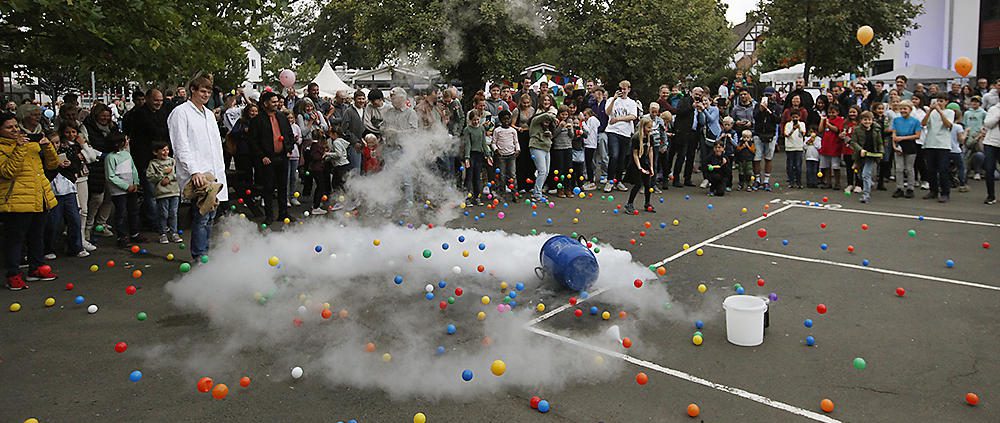
More than three dozen booths and activities were spread across the grounds and in some classrooms, and it’s very difficult to single out any particular ones here. Once again, the “Chemikum mobil” with its elective research class in front of the Bremerhaus was a crowd-pleaser. The experiment with the “exploding” colorful balls just never loses its appeal! The “Chicken Run” on the sports field at the Hessenhaus was a big hit. The goal here was to raise funds for Tanzania, organized and carried out by the elementary school and its team of teachers. Neighboring activities also focused on movement, speed, and agility. The Steinmühle Riding Club also invited visitors to go pony riding.

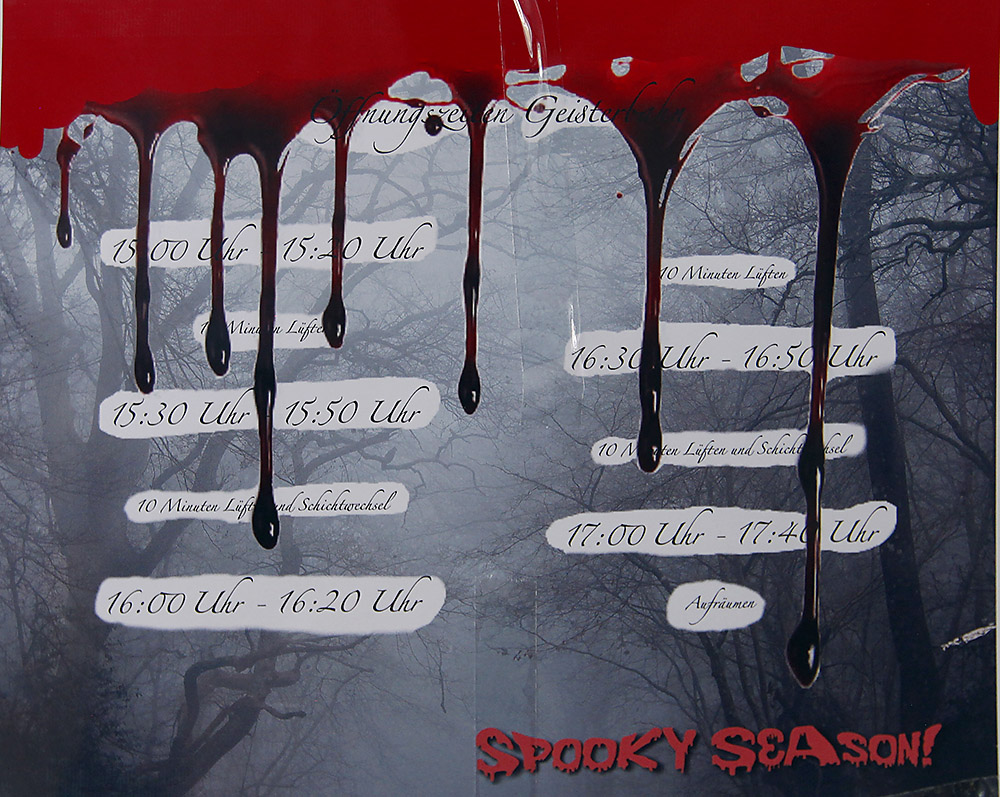
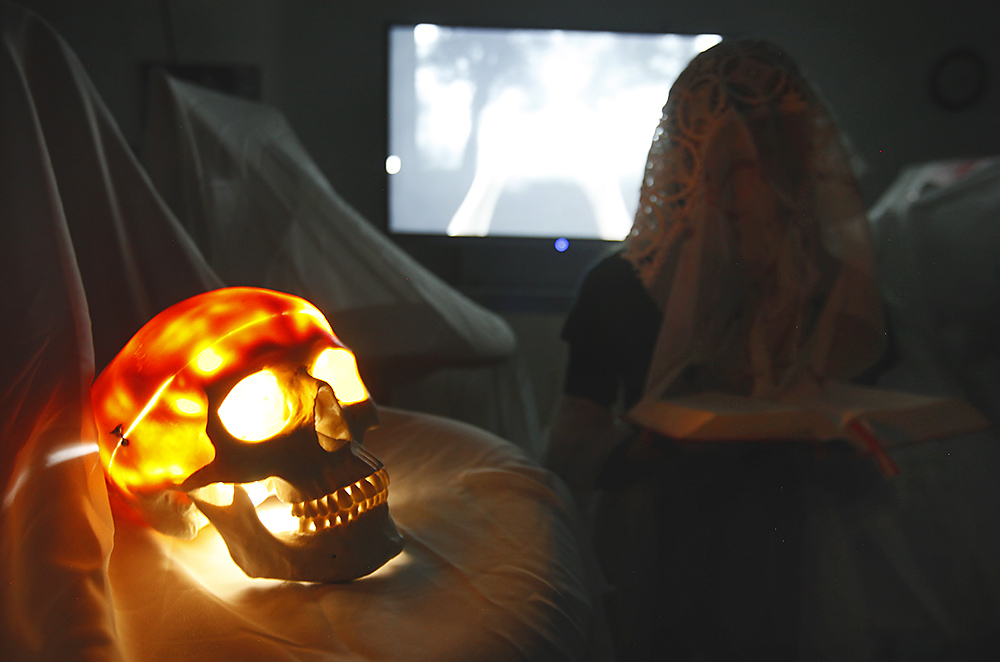
One of the longest lines on the grounds was for the “Ghost Train Reloaded” run by Class 7b at the Hessenhaus. The chance to get a real scare—this idea clearly appealed to many guests, both young and old.

While other activities offered games, fun, and brain teasers, there were also booths that are closely tied to the Steinmühle School. The Friends of the School Association, chaired by Jasmine Weidenbach, provided information about its important work and invited Fall Festival guests who are not yet members to join. Membership is open at any time, by the way! An information booth for prospective students in the new 1st and 5th grades was set up right at the entrance, under the first awning. Principal Björn Gemmer and his team were on hand to answer questions and had organized tours of the Centrum 5&6 building.

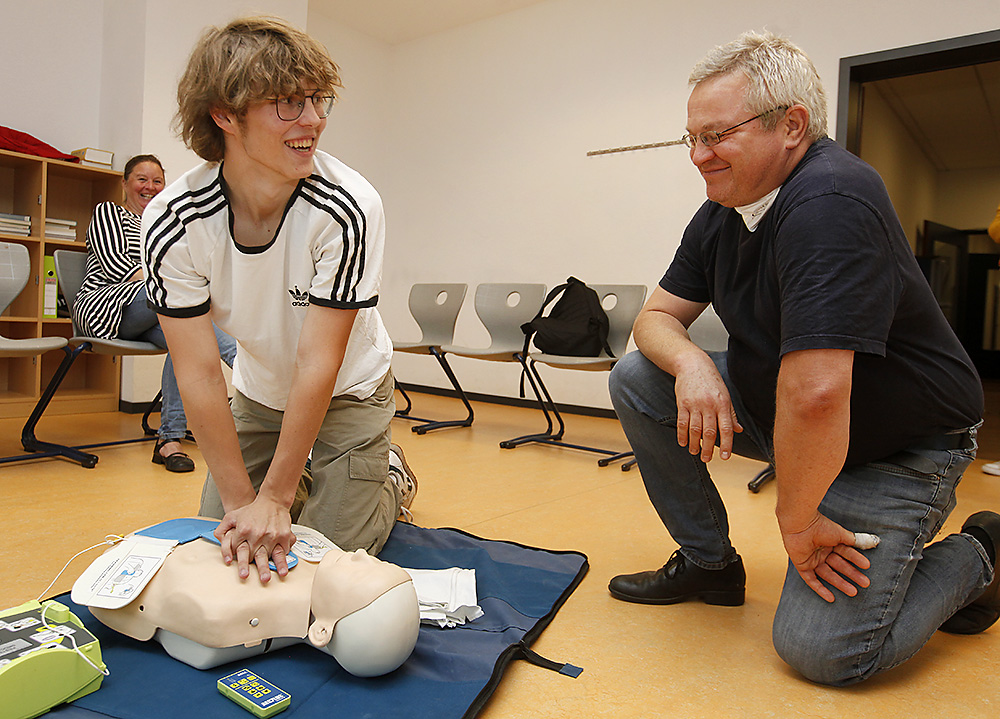
In the main building, visitors were able to learn about the vital topic of “CPR.” There, anesthesiologist Markus Spies answered questions, provided instructions on the resuscitation process, and let guests try their hand at it themselves using a mannequin. “It’s so easy to help—anyone can do it,” he emphasized, reinforcing the campaign’s goal of preventing sudden cardiac death.

With this in mind, the “Students Save Lives” campaign (www.schuelerrettenleben.de) was launched by the Professional Association of German Anesthesiologists (Berufsverband Deutscher Anästhesisten e.V.). For several years now, the school has offered an annual summer course on this topic—under professional guidance. Eighth-grade students are taught CPR. The Steinmühle School is thus playing a pioneering role in Marburg in this area.


The Fall Festival: for the students of Steinmühle, a well-known and beloved celebration that has been held for decades. On this one day of the year, all former students of Steinmühle School and Boarding School are invited to reminisce and share what they’ve been up to since leaving. “Those were such wonderful times at the boarding school,” you hear people say from all corners.

On the last Saturday in September, the time had finally come: the Fall Festival was able to take place in its usual format. There hadn’t been such a large reunion of former Steinmühle students since 2019.

For weeks beforehand, the boarding school students had been preparing for this big event. Everything was planned down to the last detail, because there was still a lot to do behind the scenes. The students did a fantastic job organizing everything. They selected recipes, scheduled baking times, and supported one another. Working independently and with great enthusiasm, the students immersed themselves in their baking, resulting in the most amazing and delicious variety of cakes. Their goal was not simply to bake the same recipes over and over, but to offer as many different flavors as possible and to let their creativity run wild.

And so it came to pass that Bremerhaus, Stammhaus, Mühle, Hessenhaus, Westfalenhaus, and Biohaus baked nearly a hundred cakes.

Several students also volunteered to help set up. With their handyman skills, they worked diligently to build the huts. At the fall festival itself, the boarding school students had their own tasks: they sold cake, grilled food, and cleared away dishes. All boarding school students carried out these duties until 6 p.m. to ensure that all guests had a wonderful day. From 6:00 p.m. onward, however, everyone became a guest and celebrated the fall festival together. Former and current boarding school students met and exchanged stories about boarding school life then and now.

On Sunday afternoon, a few of us met up again in the dining hall at “SchniPoSa” and talked about what a great festival it had been. We’re already looking forward to the Fall Festival in 2023.

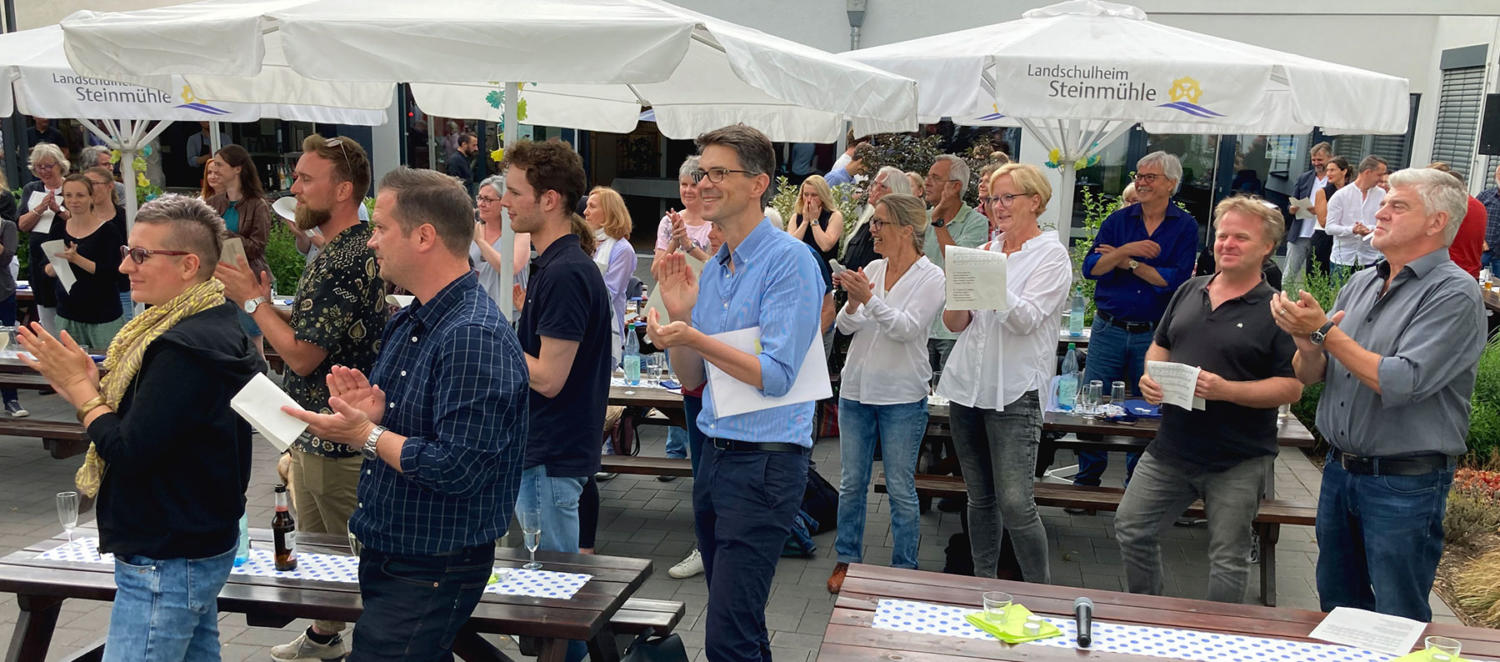
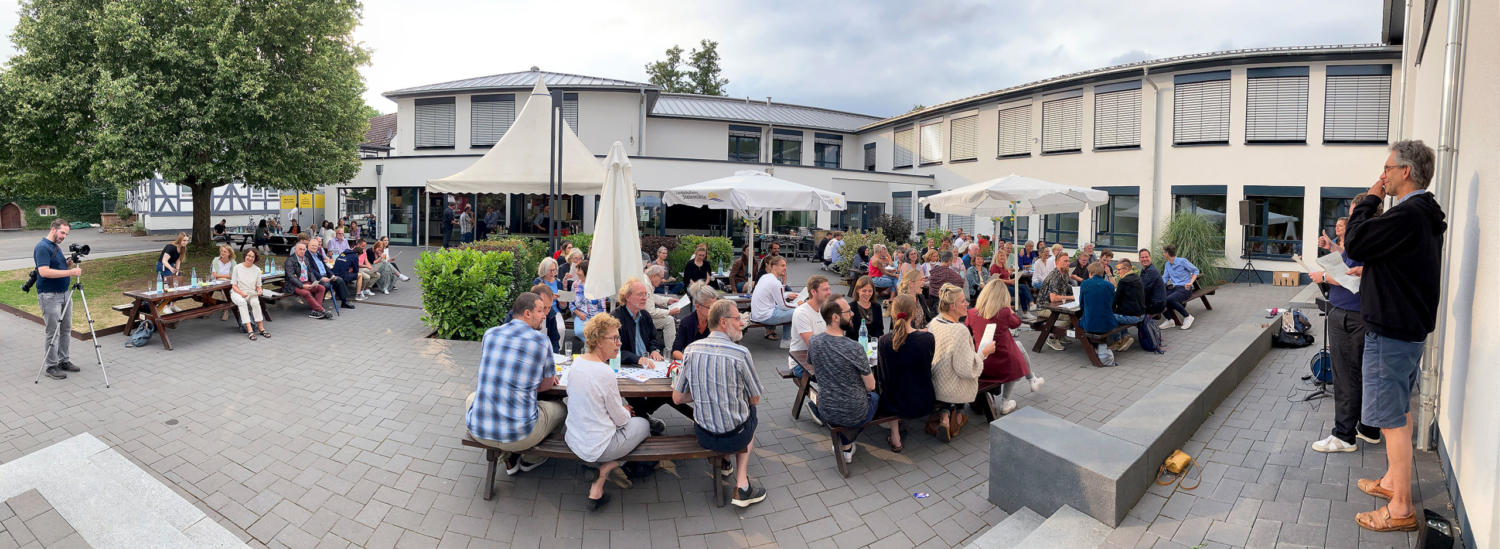
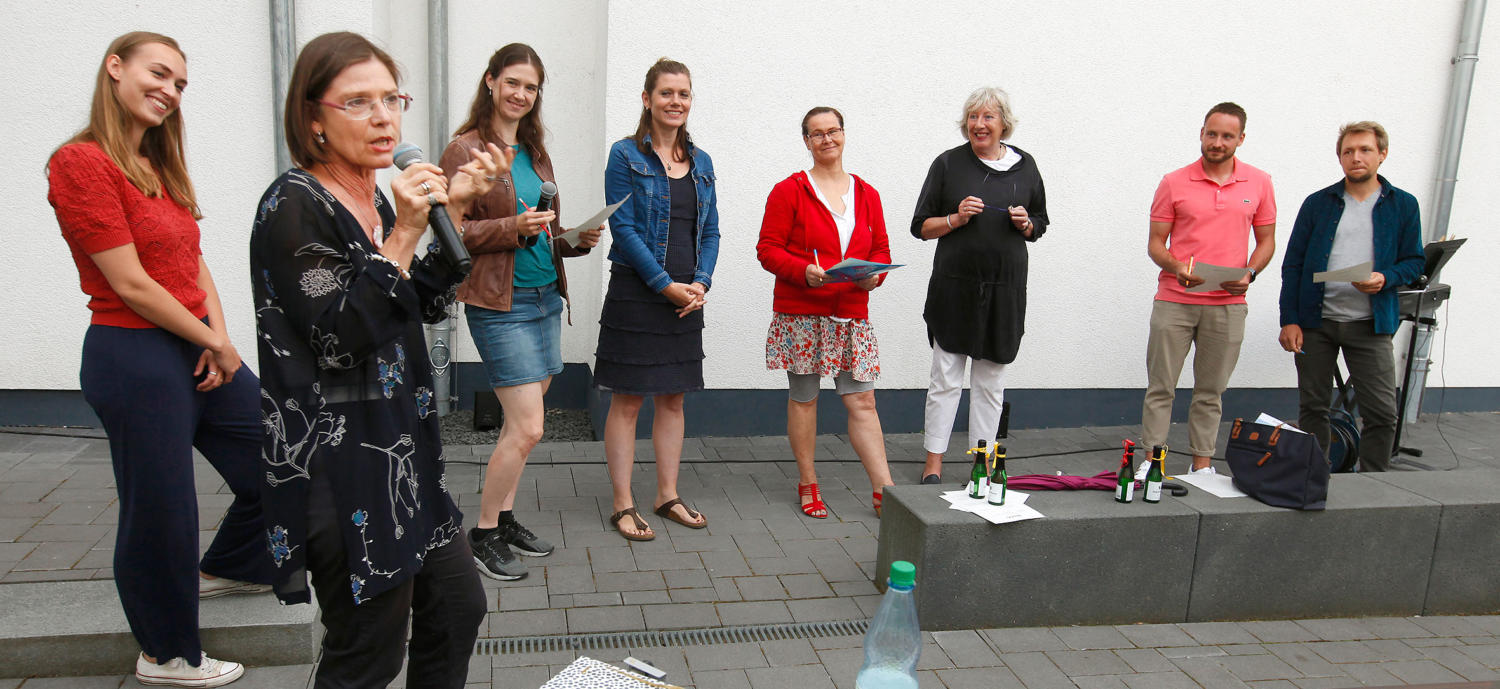
The faculty’s summer party, held on the last Thursday before summer break, is a roller coaster of emotions: a sigh of relief that everyone has made it through another year, but also a moment of reflection as teachers leave Steinmühle.

First of all, a big round of applause: The food at this event was once again absolutely delicious! One thing we can say right off the bat as a summary of this school year is this: Whenever the boarding school kitchen on campus provided the meals—it was fantastic!

Under these circumstances, the end of the school year got off to a splendid start. Although there was a touch of sadness as the farewells began. It was time to say goodbye to Johanna Zuschlag, who had helped out as a teacher for half a year and is now heading to Sweden. A heartfelt thank you went to Max Rubrecht, who—according to principals Björn Gemmer and Bernd Holly—“was not only reliable in his subjects of physical education and math, but could also be counted on for any task.” Those present said “Goodbye,” “Thank you very much,” and “Farewell” to Jolanta Hilbert after eight years on the Steinmühle cleaning team.

Charlotte Stroh’s colleagues expressed their hope that this would not be a permanent farewell. She teaches math and Spanish, and Spain will be her home for the next 12 months.

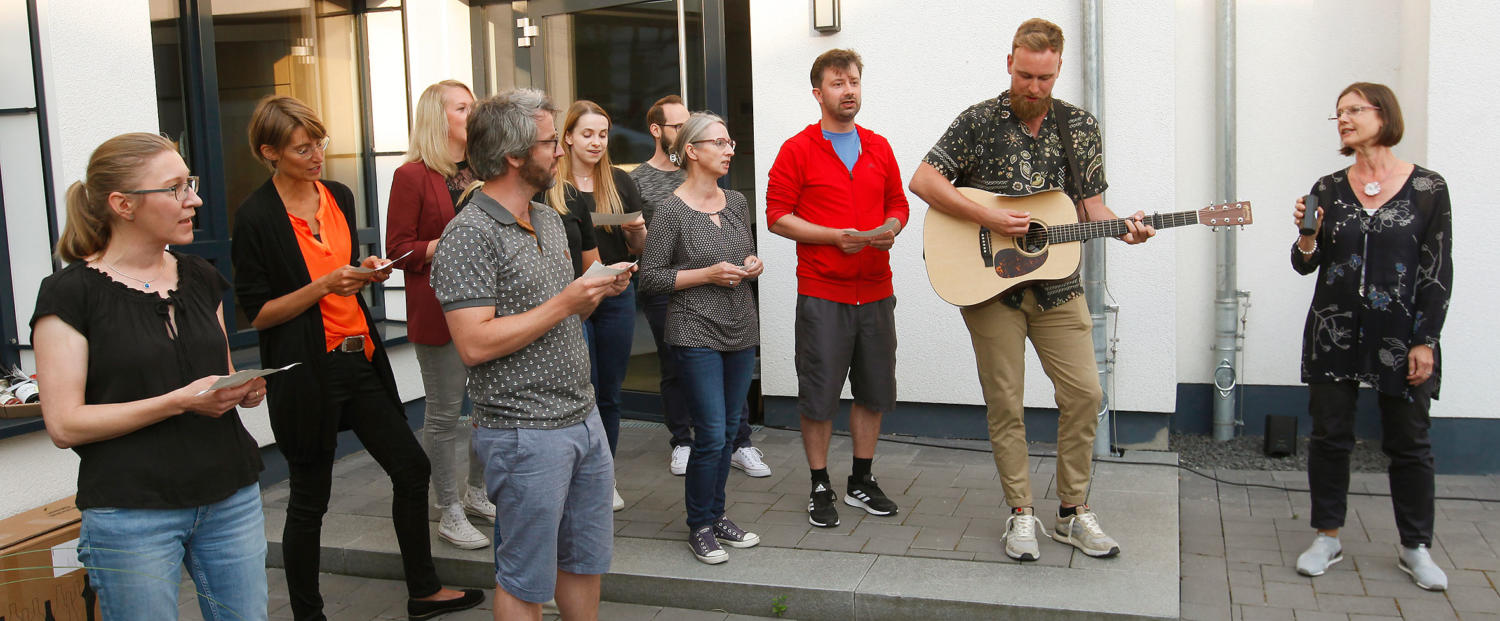
For Günter Eschenbrenner, who was unable to attend the farewell celebration for health reasons, his colleagues had prepared a special farewell ceremony. Led by Daniel Sans, those present sang a song for the Greek and Latin teacher—who also holds a teaching certification in ethics—and recorded it: “Gaudeamus igitur”! It was an original idea and a gesture through which everyone conveyed their best wishes for his recovery.

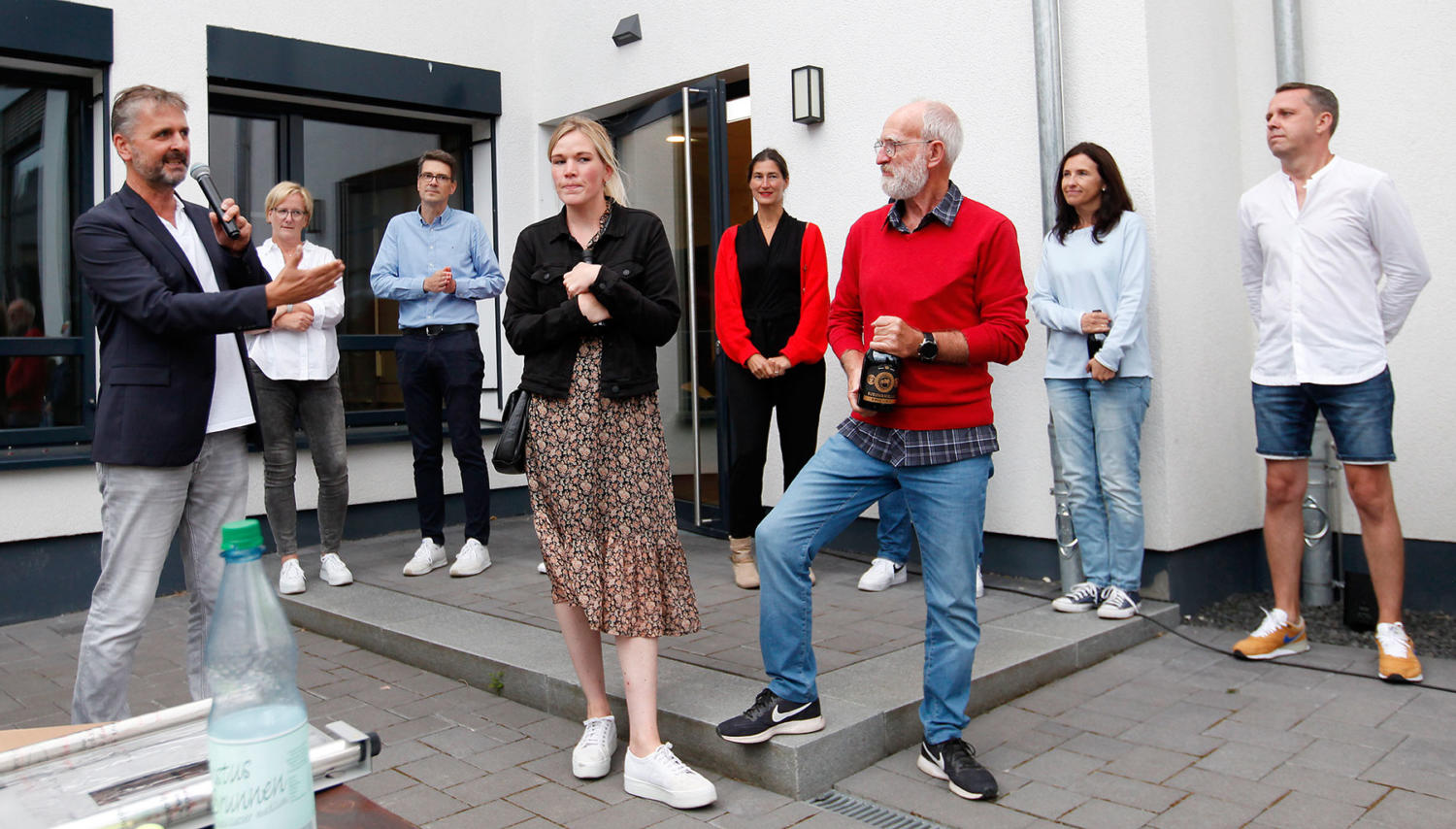
An exceptionally large number of warm farewell messages, tributes, and gifts were given to a teacher who, after 28 years and three months, is leaving Steinmühle to begin her retirement: Jeannine Walter. This multitalented language specialist—head of the Languages and Arts Department and a teacher of English, French, and Italian—was honored with praise and expressions of respect from the school administration and management, as well as from numerous colleagues: The mother of two, who once completed her teaching internship at Steinmühle with a grade of 1.0, had earned a reputation at Steinmühle as a fighter who always prioritized professionalism. “Respected and feared,” she tackled pedagogically challenging tasks and was regarded as demanding, extremely organized, energetic, and assertive. With a twinkle in their eyes, colleagues recounted Jeannine Walter’s nickname, “Master of the Raster”—everything had to be in a logical and understandable order at all times. Many said they had learned a great deal from Jeannine Walter and ultimately concluded that saying goodbye weighed heavily on their hearts, as today they had to bid farewell to a colleague who was not only capable but also very warm-hearted.

Jeannine Walter expressed her gratitude for the numerous gifts and the “fireworks of ideas that had been set off in her honor.” She said that at the Steinmühle, she had not only learned an incredible amount herself, but had also experienced a tremendous sense of camaraderie among her colleagues. Jeannine Walter: “Many friendships have developed that enrich my life.”

At the end of the evening, school director Dirk Konnertz thanked everyone present for an eventful year: “A round of applause for everyone who achieves the impossible.” Konnertz directed this message to the administrative office, to Till Buurman in his dual role as IT specialist and photographer, to Cornelia Oestreicher-Gold for “pulling off the Abitur,” and to Marcel Kalb, Lisa Ebinger, and Lothar Potthoff for their dedication to sports, particularly girls’ soccer. He also extended his thanks to the boarding school, specifically to Director Thomas Hoffmann for the fruitful collaboration. The final praise of the evening went to the head of lower secondary school, Frank Wemme: “A master of organization.”

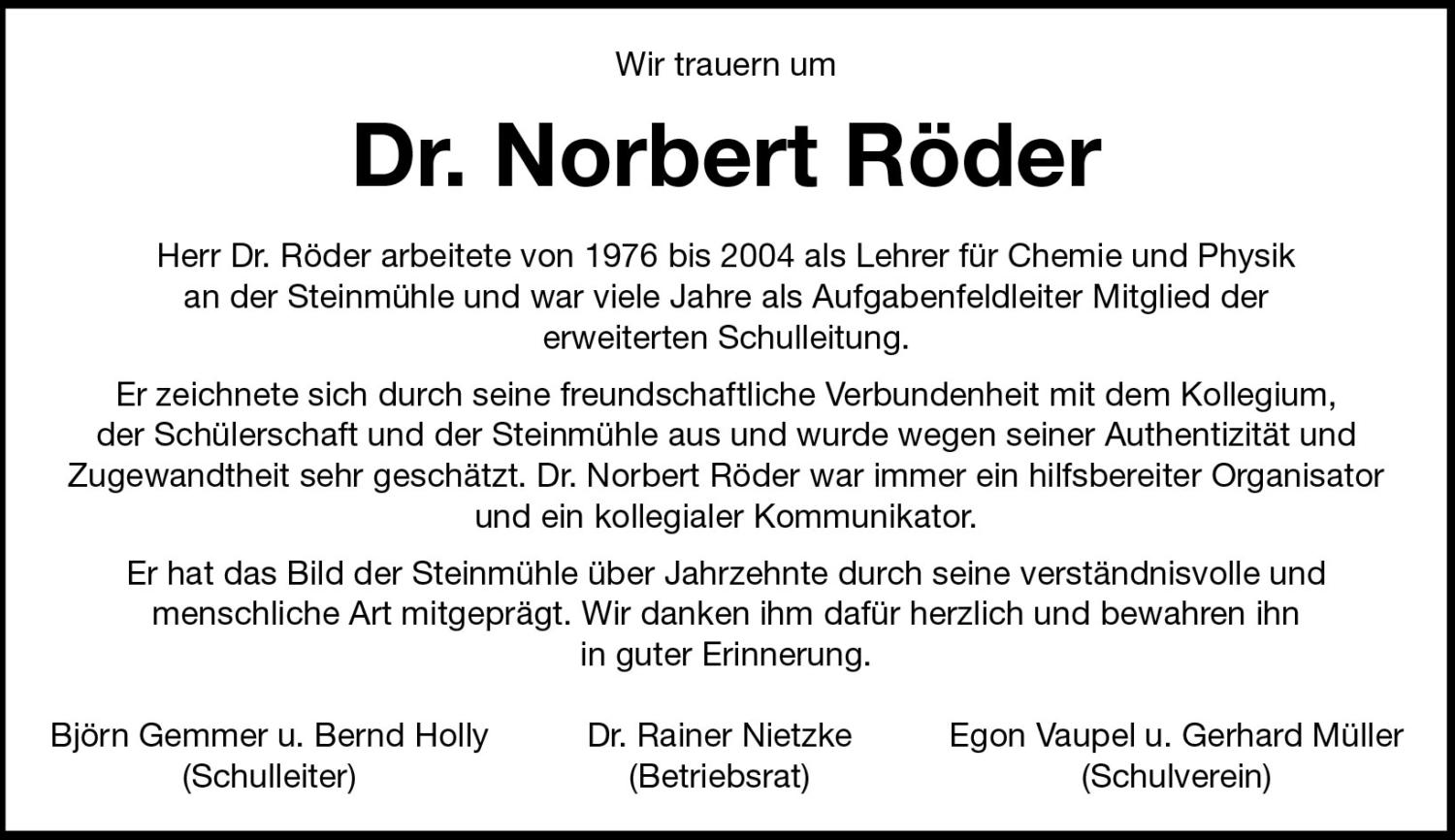
Dr. Norbert Röder worked as a chemistry and physics teacher at Steinmühle from 1976 to 2004 and served for many years as a department head on the extended school administration team.
He was known for his warm rapport with the faculty, the student body, and the Steinmühle, and was highly regarded for his authenticity and approachability. Dr. Norbert Röder was always a helpful organizer and a collegial communicator.
For decades, he helped shape the image of the Steinmühle with his understanding and compassionate nature. We thank him warmly for this and will always remember him fondly.

Images of bombed-out houses, scenes of war, dust, rubble, and ash: The images of Iraq shown on the news are authentic, but they don’t tell the whole story. This country—which is actually rich yet plagued by extreme poverty—has other facets as well. Selfies, hookah, bike races, pool, and excessive drinking under one of Baghdad’s Tigris bridges, where young men gather at night. At night, “at a bearable 35 degrees,” as Vincent Haiges says. People’s lives take place outdoors.

The former student at the Steinmühle boarding school lived in Iraq for two years—first in the north, then in the capital. He also visits other crisis-stricken areas—to touch on sensitive issues, to contribute to global transparency, and to get to know other perspectives. To provide a more complete picture, offer explanations, and share knowledge.


“Freedom comes with responsibility”

After graduating from high school, Haiges went on his first trip; at age 21, he arrived in Morocco. “Tell me about Germany,” he can still hear Mustafa say today. That was the moment Haiges began to become aware of global inequality. But what was he to do with that realization? he asked himself.

He realized that freedom comes with responsibility. Vincent Haiges began his studies in Vienna and London, focusing on conflict studies and international law.

He graduated from the university with a master’s degree in political science. His drive to seek out the world’s hotspots, capture the events through photography, and present them has remained undiminished.

This works well through images, and his documentaries resonate with audiences. A high-profile group of clients in the media sector is interested in what Vincent Haiges brings back to the safety of Central Europe: *Der Spiegel*, Deutsche Welle, *Die Zeit*, and the Goethe-Institut. But foreign publications are also interested: from Japan, Switzerland, and even Al Jazeera. Vincent Haiges also documents events in crisis zones for the UN.


“They were wearing masks— not because of COVID-19″

When the reporter talks about excessive drinking under the Tigris Bridge, he does not intend to downplay the violence and terror in the country. His visit to a maximum-security prison in Mosul, northern Iraq, remains his worst memory. According to Haiges, photos were able to capture what was happening there. “You could see people wearing masks.” “…But not because of COVID-19, but because of the smell of corpses.”

Over time, these experiences have instilled a certain humility in the reporter. Not everyone is cut out to be a crisis reporter, even if they can write or take photographs. It takes the ability to connect with people, a clear willingness to adapt, and a genuine desire to be one of them—at least temporarily. Vincent Haiges learned Arabic and always works with a female colleague who conducts on-site interviews with women—due to the social role of Iraqi women. In their presence, a foreign man is taboo, let alone as an interview subject. Nevertheless, bringing in a local producer and translator—a so-called “fixer”—is a necessity. It’s a system—albeit a manageable one—that must be organized and made to function.


“Let’s not get too at once”

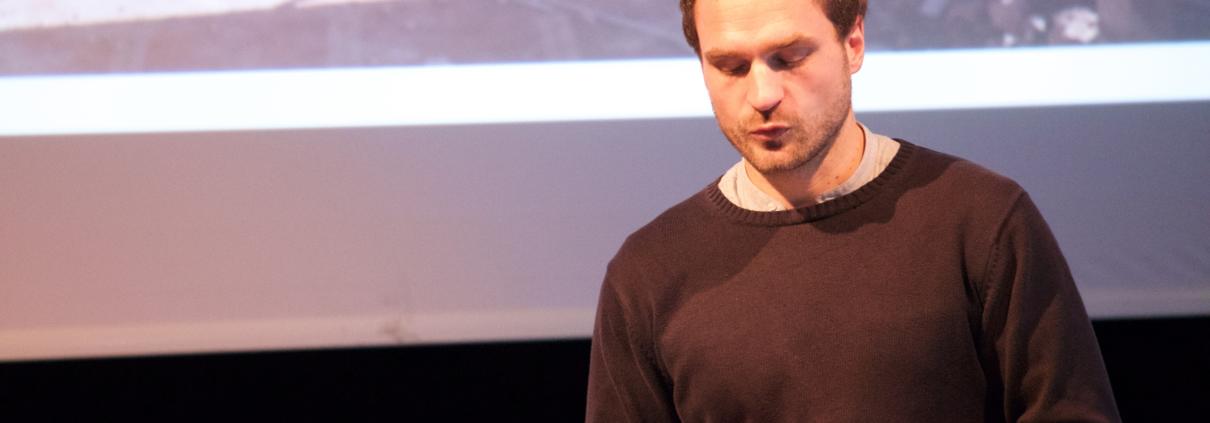
During the lecture at the Steinmühle, Haiges is asked if he ever burns out. He finds peace during necessary breaks at his apartment in Berlin-Kreuzberg—a place whose very name instills respect in many people from the provinces. Some ways to maintain strength and energy are time-honored but still effective, says Haiges: taking breaks, not trying to do too much at once, eating well and sleeping well, and exercising.

His invisible adversary: post-traumatic stress disorder.

Vincent Haiges, born in 1988, still remembers rowing coach Martin Strohmenger as the head of his boarding house. Memories linger on both sides, though their priorities are certainly different today. While the Steinmühlen community began the new year quietly amid the ongoing lockdown, Haiges was preparing for his next mission in January. This time, it was in Europe—Bosnia, near the Croatian border.

He was asked if he would be ready again so soon, and his answer was clear: “Believe in what you’re doing. It’s the most important factor in resilience.”

(Vincent Haiges gave the presentation in December to 13th-grade students, in compliance with pandemic-related regulations. The event was organized by Bernd Hülsbeck, a teacher of politics, economics, and history at Steinmühle.)