• Anruf
  • E-Mail
  • Zu Facebook
  • Zu Instagram
  • Zu LinkedIn
Loading
Steinmühle – Schule & Internat
  • About us
    • Organization & History
    • Teams
    • Stakeholders
    • Internal clubs
      • Riding School
      • Rowing Club
      • Friends of the School Association
    • Partners
    • Mission Statement & Vision
    • Ecology & Sustainability
    • A Safe Place
    • Quality Management
  • School
    • High School
    • Bilingual Elementary School
    • Project-Based Learning
    • Promoting STEM Talent
    • Languages & International Affairs
    • Sports & Health
    • Art, Music & Theater
    • Social Responsibility
    • Digitization
    • Promoting Independence & Individuality
    • Social Responsibility & Strengthening the Community
  • Boarding School
    • Boarding School as an Opportunity
    • Support for Families
    • Life
    • Learning
    • Sports & Recreation
    • Trips & Weekends
    • Talent Program Plus STEM
    • Fit for Life
  • Admission
    • Boarding School Admission
    • High School Admission
    • International High School Program
    • Bilingual Elementary School
    • Costs & Contract Terms
  • News
    • News
    • News Archive
    • Events
    • Support Current Projects
  • Friends & Alumni
    • Stories
    • Alumni Reunion
    • Steinmühle Alumni Network
  • Fan Shop
  • English
    • German
    • Spanish
    • French
    • Italian
    • Russian
  • Search
  • Menu Menu
  • English
    • German
    • Spanish
    • French
    • Italian
    • Russian

Media Policy and Sexuality Policy: In-House Training at Steinmühle Boarding School

Archive, News


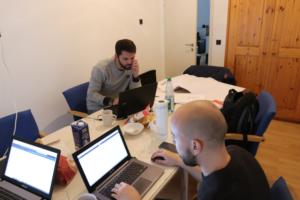
On November 26 and 27, the boarding school’s educational staff had internal training days on their schedule. The two days were used to continue working on current initiatives. Currently, a media policy is being developed and a sex education program is being formulated.

The goal of the media policy is to formulate a wide range of rules, recommendations, and conditions for media use, drawing on the groundwork laid out previously. The policy is intended to highlight the limitations and opportunities of various media and integrate them into the daily life of the boarding school in order to teach students how to use each medium responsibly.

The group of educators used the first day to formulate guidelines and define their educational mission with regard to media literacy. They also identified potential risks associated with media and discussed ideas on how a media strategy could help protect against them.

On the second day, the team examined a wide variety of media, focusing on highlighting both the legal situation and the risks and limitations involved. The opportunities and possibilities offered by the media were also discussed.

In addition, the group discussed the practical implementation of these structures in the day-to-day life of the boarding school. For example, they also discussed a crisis plan for cyberbullying, including the corresponding responsibilities.


A sexuality policy was developed to address a very sensitive and personal aspect of personal development within the daily life of the boarding school. It addresses the opportunities, possibilities, risks, and boundaries of sexuality and its expression.

As part of the concept development process, the participants have made it their mission to provide clarification on a legally sound basis. The goal is to promote tolerance and sensitivity as well as holistic development, while at the same time protecting privacy and personal space. In order to incorporate the students’ concerns and needs as fully and accurately as possible, discussion sessions on this topic had already been held with the boarding school residents.

The goal of the sexuality education plan is to establish a foundation for sexuality education as part of the overall educational approach at Steinmühle Boarding School.
 

10. December 2018
https://steinmuehle.de/wp-content/uploads/sites/5/2018/12/IMG_0175.jpg 1000 1500 Angela https://steinmuehle.de/wp-content/uploads/sites/5/2025/11/Logo_SchuleInternat_Steinmuehle_2026_3.png Angela2018-12-10 16:29:342026-06-18 15:43:50Media Policy and Sexuality Policy: In-House Training at Steinmühle Boarding School

Steinmühle Becomes a Partner School of Philipps University

Archive, News

University and Marburg School Sign Cooperation Agreement

Philipps University of Marburg and the Steinmühle High School and Bilingual Elementary School have signed a cooperation agreement. Principal Björn Gemmer and University President Prof. Dr. Katharina Krause signed the agreement.

“We view the collaboration between our two educational institutions as a cornerstone for further development in our respective fields,” explains Principal Björn Gemmer. The school and the university plan to work even more closely together in the future. The primary focus is on responding to the growing and evolving challenges facing both the school and the university.

The goal of the partnership between the school and the university is the joint advancement and improvement of quality in schools and teacher education. Steinmühle and Philipps University have agreed to a continuous exchange of theoretical, experiential, and practical knowledge for the joint conceptual development of teacher education, particularly in the areas of teaching practicums and school development projects.

The Steinmühle enables the Center for Teacher Education (ZfL) at Philipps University of Marburg to conduct research on learning theory and subject-specific pedagogy in the use of digital media in the classroom as part of the introduction of tablet-based instruction starting in 7th grade. The research findings are shared with the school so that they can be incorporated into the further development of the curriculum. The collaboration also includes professional development for teachers, on the one hand, and internships for student teachers at Philipps University, on the other.

The Center for Teacher Education supports the mentors at Steinmühle during student teaching placements and offers specialized training courses on mentoring. For the duration of the partnership, the Steinmühle Bilingual Elementary School and High School will hold the title “Partner School of Philipps University of Marburg.” The agreement is initially valid for five years.

Caption: Annette Huppert, Executive Director of the Center for Teacher Education at Philipps University (from left), Bernd Holly, principal of Steinmühle School, Björn Gemmer, principal of Steinmühle School, and Prof. Dr. Thomas Nauss, director of the Center for Teacher Education, holding the plaque designating Steinmühle as a partner school of the university.


6. December 2018
https://steinmuehle.de/wp-content/uploads/sites/5/2018/12/Steinmuehle_Uni_Marburg.jpg 690 1500 konnertz https://steinmuehle.de/wp-content/uploads/sites/5/2025/11/Logo_SchuleInternat_Steinmuehle_2026_3.png konnertz2018-12-06 15:02:442026-06-18 15:39:53Steinmühle Becomes a Partner School of Philipps University

Entertaining Performances at the Cultural Evening

Archive, News

Many dedicated participants and a diverse array of performances made the traditional Cultural Evening a success.

The jazz ensemble kicked things off with “Work Song” and “Smoke Gets In Your Eyes,” featuring Talea Funk (10b, vocals), Tom Herfert (11a, tenor sax), Evelyn Damer (11b, alto sax), Samuel Ruff (11e, trombone), Marit Winterstein (9c, euphonium), and ensemble director Frank Wemme (bass and piano).

Fifth-graders Janne Elsaßer, Marie Grosse, Lina Hoyer, Lena Kissling, Antonia Kurlinsky, Carlotta Meyer, Felix Linne, Anneli Petri, Jona Schneider, and Emma Wagner recited autumn poems from the writing workshop with Kristina Sokoli.

Class 6c, led by Nicole Hohm, impressed the audience with their performance of “How Young Arthur Became King” as part of the “English On Stage” project-based learning program.

Under the title “The Empathetic School,” the Theater Club for Grades 5 & 6 (directed by Flûte Seifart) performed with Annica Bartsch, Zoë Closmann, Anna Feußner, Neyla Fritz, Celia Giebing, Marie Grosse, Rosalie Hainer, Antonia Kurlinsky, Carlotta Meyer, Stella Preiß, Sophia Rogosch, Livia Schulze, Ana Greta Törner, and Philipp Zielen.

Nela Haeberle, Emma Schnabel, and Lilian Seiler from class 7c presented some exciting highlights from the “Crime Novels” project-based learning course taught by Melisande Lauginiger.

“The Wolf and the Two Little Goats” was presented by Luisa Bamberger, Franka Preising, Anna Reinhardt, Zoe Reisch, and Lina Zippel (Writing Workshop, 6th grade, Lisa Braun).

This was followed by a poetry slam (Nela Haeberle, 7c, and Lilly Teetz, 10c), “Mariage d’amour” on the piano (Anna Steinfeldt, 8b), and a scene from *Dead Poets Society* (12th-grade DS class, Dagmar Müller) featuring Hannah Busch, Lars Dieling, Moritz Eichstädt, Frederic Feldmann, Raphael Hetche, Lena Joußen, Sam Kempkes, Lukas Kießling, Lars Lauer, Maximilian Lotz, Robert Mahl, Jaqueline Mopils, Dana Plamper, Niklas Pohl, Jacob Roth, Chiara Scheffczyk, Julian Seeger, Flûte Seifart, Janina Seip, Sophie Stöber, and Julian Zimmer.

Also presented was the music video created by the WU Film Class 8/9 during the 2017–18 school year, directed by Ines Vielhaben and featuring Finn and Sam Kempkes, Lilly Teetz, Amelie Schulze, Louisa Merle, Aaron Ruff, Lars Froemel, Robin Konnertz, and the WU Graffiti class. This was followed by the Hamilton Project (Talea Funk, 10b, director; Evelyn Damer, 11b; Lars Froemel, 10c; Svea Turba, 8a; Nela Haeberle, 7c), followed by the 11th-grade DS course led by Michael Schmidt, which presented the play “Schichtarbeit.” The cast included Veit Gemmer, Vivien Hallfeldt, Luca Ledro, Till Maier, Lasse Michel, Jonas Neirich, Malte Paulenz, Morten Röser, Nele Rupp, Amèlie Schreyer, Tim Schultheis, Hannes Schweitzer, Merle Schweitzer, Deciel Shongo, Finn Steinfeldt, Jonathan Tesseraux, Franca Törner, Simon Veyl, Walther Moses, and Calvin Weide.

The evening came to a close with the same performers who had opened it: The jazz ensemble sent the audience home with the songs “Dear Lord” and “The Night Has A Thousand Eyes.”

4. December 2018
https://steinmuehle.de/wp-content/uploads/sites/5/2018/12/RW_Kultureller-Abend-3890.jpg 821 1500 konnertz https://steinmuehle.de/wp-content/uploads/sites/5/2025/11/Logo_SchuleInternat_Steinmuehle_2026_3.png konnertz2018-12-04 10:23:092026-06-18 15:39:55Entertaining Performances at the Cultural Evening

Bilingual Elementary School: Parents Learned the Details and Had the Opportunity to Ask Questions

Archive, News

Following the official approval of the bilingual elementary school program at Steinmühle for the 2019–20 school year, an information evening for interested parents was scheduled. Welcomed by principals Bernd Holly and Björn Gemmer, parents attended the event at the Steinmühlenforum to learn about the organizational details of the planned elementary school program, so they could get a sense of how things would work and see how their own wishes and expectations aligned with the program.

After an introduction to the school’s focus areas and character by Principal Björn Gemmer, former elementary school principal Sabine Rektorschek explained the planned flexible classroom model. The experienced educator had successfully led a primary school in the neighboring district of Gießen based on this model and now works as a consultant.

At the information evening, Sabine Rektorschek described the advantages of individualized learning and the distinctions between skill acquisition and learning objectives. The audience learned that assessment and progress monitoring are not just terms used in medicine, but can also apply in an educational context. “Assessing children and their skills at the outset and tracking the acquisition of additional skills in stages throughout their school years are among the fundamental tools for a successful elementary school experience,” she said.

Hannah Achenbach also introduced herself to the visitors; she will be returning from Leipzig to her hometown of Marburg to work as a teacher at the Steinmühle Bilingual Elementary School.

Afterward, interested parents asked questions primarily about the possibility of a trilingual education in specific cases and about the enrollment of so-called “children who are ready to start school.” Jeannine Walter, the pentilingual department head at Steinmühle, and Principal Bernd Holly—a father of two children who had not yet turned six when they started school—provided expert answers on these topics.

Among other things, it was announced toward the end of the event that the Steinmühle Bilingual Elementary School will facilitate transition into the Hessian and international school systems. It already has the necessary partner schools in place for this purpose.

Parents who are considering enrolling their child at the Steinmühle Bilingual Elementary School can sign up for an admissions interview by email (bjoern.gemmer@steinmuehle.net). The admission interviews will take place in February 2019. Key information about the Steinmühle Bilingual Elementary School is summarized in a brochure that attendees of the event were able to take home. The brochure is also available for download at the following link: http://gymnasium-steinmuehle.de/download/Bilinguale_Grundschule_Steinmuehle.pdf

4. December 2018
https://steinmuehle.de/wp-content/uploads/sites/5/2018/12/RW_Infoabend_Bilinguale-Schule-4341.jpg 1246 1500 konnertz https://steinmuehle.de/wp-content/uploads/sites/5/2025/11/Logo_SchuleInternat_Steinmuehle_2026_3.png konnertz2018-12-04 10:10:492026-06-18 15:39:54Bilingual Elementary School: Parents Learned the Details and Had the Opportunity to Ask Questions

“Health-Promoting School” as a Goal: The First Certificate Is Hanging on the Wall

Archive, News

Steinmühle has cleared the first hurdle toward certification as a “Health-Promoting School.” The State Board of Education recently awarded the school a partial certificate in the area of “Nutrition and Consumption.”

The title “Health-Promoting School” is an award presented by the Hessian Ministry of Education and Cultural Affairs. Efforts to further develop a health-promoting school environment can initially be recognized through partial certifications for the individual areas of focus within “School & Health”—specifically in areas that are particularly relevant to health in helping a school fulfill its educational and instructional responsibilities:

  • Movement & Perception
  • Food & Consumption
  • Addiction & Violence Prevention
  • Transportation & Mobility
  • Teacher Health

Based on at least four partial certificates earned (of which the “Nutrition & Consumption” and “Physical Activity & Perception” partial certificates are mandatory, along with two additional health-related profile elements from the areas of addiction and violence prevention, Traffic & Mobility, and Teacher Health), schools can then apply for overall certification as a “Health-Promoting School.”

The topic of “Health-Promoting Schools” was incorporated into the Steinmühle School’s current work program in 2015. The faculty conference approved the decision to undergo the certification process. Since then, individual teachers have been assigned to various areas. These are

  • Manuela Schmidt (Steering Committee—Leadership/Teacher Health)
  • Friedhelm Wagler (Partial Certificate/Field: Nutrition and Consumption)
  • Nicole Hohm and Heike Rabben-Martin (Division: Addiction and Violence Prevention)
  • Michael Neirich (Movement and Perception Division)

As the school’s Ecology Coordinator, Carmen Bastian represents the field of ecology. This topic was included to ensure a holistic approach to the subject, even though no official certification is required in this area.

Friedhelm Wagler fulfilled the requirements for the recently awarded “Nutrition and Consumption” certificate through a variety of projects. These included, among other things, the installation of water dispensers, the “Healthy Snack” campaign, and the elective course on catering services.

The topic was also integrated into the curriculum in an interdisciplinary manner. It was covered in classes such as English, politics and economics, Latin, chemistry, physical education, and biology.

“As early as 2006, there were discussions about offering more variety and choices for lunch,” reports Friedhelm Wagler. The school administration, parents, a small group of teachers and students, the boarding school, its managing family (the Buurmans), and the head chef at the time, Bernd Schumertl, held discussions on the topic. As the years went on, according to Friedhelm Wagler, individual projects on nutrition led to elective courses in the middle school/catering program, an extracurricular club for grades 5 and 6 with strong parental involvement, and mandatory project-based lessons on bread baking, healthy cooking, the dietary habits of different cultures, and more. Over time, the overall theme was expanded to include individual initiatives such as breakfast and fruit offerings during breaks.

Arno Bernhardt, Director of the Marburg State Education Office (2nd from left) and Carmen Martin, coordinator and head of the School and Health Division (center), presented the principal team—Björn Gemmer (left) and Bernd Holly (right), along with Manuela Schmidt (head of the steering committee, second from the right)— the first partial certificate toward the overall “Health-Promoting School” designation, which a total of 54 schools in Hesse held in 2015.


It is his “brainchild”: Over the course of two school years, Friedhelm Wagler has compiled all the materials on the subject into a comprehensive file containing teaching projects, explanations, photos, evaluations, and brief summaries.

4. December 2018
https://steinmuehle.de/wp-content/uploads/sites/5/2018/12/Titel.jpg 720 1500 konnertz https://steinmuehle.de/wp-content/uploads/sites/5/2025/11/Logo_SchuleInternat_Steinmuehle_2026_3.png konnertz2018-12-04 09:44:352026-06-18 15:39:39“Health-Promoting School” as a Goal: The First Certificate Is Hanging on the Wall

JtfO Basketball Week IV: Girls Take “Bronze,” Boys Finish Fourth Out of Eight

Archive, News

The big day had finally arrived. Steinmühle fielded two teams in Competition Class IV at the “Youth Trains for the Olympics” basketball tournament. The girls and boys competed with great dedication. In the end, the girls’ team took home the “bronze,” while the boys’ team finished in fourth place. Coach Marc Bepperling is confident: “We’ll do even better next time.”

Girls and boys born between 2006 and 2009 had the chance to showcase their skills. A long day of competition lay ahead for both teams. The boys played a total of 5 games and the girls 4. Before the group stage began, all teams had to complete a multi-event competition. The times for all students were added together, and an average was calculated. The girls completed the course in an average of 58.8 seconds, while the boys took 50.2 seconds. Before each game, the times of the opposing teams were compared. The team that had completed the course faster started the game with a 6-point lead. Unfortunately, our teams very often had to make up this deficit.

Unfortunately, the girls’ group stage began with a loss in a very close game against Gymnasium Philippinum 1; the team fell short 19–22. So they needed a win in their second group stage game. Backing up their 6 points from the competition, the girls played very well against the Elisabethschule 2 team and won 39–04. The girls thus finished the group stage in second place; everything was still up for grabs in the next game against the top team from the other group.


Relief After Game 2

The boys had a pretty similar experience in the preliminary round. In the first game, we were defeated by the Elisabethschule 1 team with a score of 06 : 32. It quickly became clear that the boys needed to focus on the upcoming games. The second game against Gymnasium Philippinum 2 brought some relief to our team, and we won 51–02. We also won the third game of the group stage against the Freie Waldorfschule, 25–16.

We were generally satisfied with our performance in the preliminary round. Now we had to prove ourselves against the first-place team from the other group. Among the boys, there was a clear disparity in the teams’ skill levels. Nevertheless, we scored a few points, but lost to the MLS by a score of 18 to 50. Unfortunately, we weren’t able to walk off the field victorious in the 3rd/4th-place game either. We lost our final match 19–35. The physically strong teams posed major challenges for us in this tournament. Nevertheless, we’re not dissatisfied with our 4th-place finish out of a total of 8 participating schools.

We really missed our “Big Man,” Christopher Mewes, during these games. Unfortunately, he was unable to play due to illness; we wish him a speedy recovery. Otherwise, the team performed well and played consistently, led by the two playmakers, Bruno Schneider and Jonah Schorn.


High level of willingness to work

The young, up-and-coming basketball players received strong support from Leo Rumpel, Victor Teres Loytved, and Jaron Häußermann, who are also active members of the club and delivered solid performances. Johnny Eckard, Jonas Nolte, and Anton Neßler—who are not actually from this sport—made up for it with their strong commitment and ensured a lively game with their willingness to run.

The girls also started this important game trailing by 6 points once again. Thanks to a very strong starting five, however, the team was able to hold the opponents scoreless for the first 6 minutes. We caught up, tied the game, and suddenly, after a hard-fought battle, we were even leading 12–8.

The clock was already set for the final. But the game wasn’t over yet. Because of all the fouls, our opponents punished us with good free throws. Unfortunately, we couldn’t maintain the dominance we’d shown in the first half and fell behind 13–15. Even in the final two minutes of the game, we were unable to change the outcome. Unfortunately, we fell just short and missed out on a spot in the final. In the final game for 3rd and 4th place, however, we prevailed with a score of 44–4, securing the “bronze” medal after all.


Motivation and Ambition

We finished the competition with mixed feelings. As soon as the final whistle blew, it was clear to us that we want to come back even stronger next year. Many of the girls enjoy practicing at BC Marburg and other clubs, which was evident in their ball-handling skills and understanding of the game. None of the 10 players lacked motivation or ambition. Junia Molsberger once again proved herself to be a strong center, showing plenty of dominance under the basket. Stella Preiß more than lived up to her role as point guard, demonstrating assertiveness and a drive to the basket. Sisters Merle and Finja Herwig displayed great dynamism on the court and plenty of tenacity driving toward the basket. Lilo Riegels shone with excellent ball-handling skills and impressive crossovers that often left her opponents looking foolish. Anna Rumpel, Sophia Nolte, Zoé Closmann, Livia Schule, and Paula Hartmann impressed with their versatility, reliable ball-handling, and unwavering motivation.

Of course, we’re proud and satisfied with our performance. But we also know that we want to achieve even more next year. The boys’ team will have to be largely rebuilt, as some players will exceed the age limit. The girls’ team, on the other hand, can remain almost exactly the same. So we’re looking forward to a great new generation of young players and hope for many successful years ahead.

The following players took the field:

Boys:
Bruno Schneider
Jonas Nolte
Victor Teres Loytved
Jonah Schorn
Johnny Eckardt
Leo Rumpel
Jaron Häußermann
Anton Neßler
(Christopher Mewes)

Girls:
Anna Rumpel
Junia Molsberger
Stella Preiß
Merle Herwig
Finja Herwig
Paula Hartmann
Zoé Closmann
Livia Schulze
Lilo Riegels
Sophia Nolte

Coaches:
Gordian Bachmann
Marc Bepperling

4. December 2018
https://steinmuehle.de/wp-content/uploads/sites/5/2018/12/1.jpg 960 1280 konnertz https://steinmuehle.de/wp-content/uploads/sites/5/2025/11/Logo_SchuleInternat_Steinmuehle_2026_3.png konnertz2018-12-04 09:33:462026-06-18 15:39:38JtfO Basketball Week IV: Girls Take “Bronze,” Boys Finish Fourth Out of Eight

Learning German Without Supplanting One’s Native Language—The DIV Working Group on International Affairs Met at the Boarding School

Archive, News

How can students solve a word problem in math if they have difficulty understanding the language? How are they supposed to write text analyses if they are unfamiliar with sentence connections and the structure of arguments? These and other challenges were addressed in a workshop led by Prof. Dr. Una Dirks, who works in the field of German as a Foreign Language (DaF) and German as a Second Language (DaZ) at the Institute for German Linguistics at Philipps University of Marburg. It was part of the conference organized by the International Affairs Working Group of the association “Die Internate Vereinigung” (DIV), which took place this year at the Steinmühle Boarding School.

About a dozen representatives from German boarding schools exchanged ideas at the event, which was organized by Steinmühlen’s German as a Foreign Language (DaF) coordinator, Jan Müller. The discussion highlighted the multitude of challenges that teachers must overcome together with their international students. Learning the language and the subject matter simultaneously must be both facilitated and managed. Most international students are eager to succeed.

Learning German without supplanting one’s native language—introducing students to German culture while also honoring the cultures of international students: this is what everyday life looks like in the “DaF” (German as a Foreign Language) field. “We have to think cross-curricularly,” participants reported based on their experiences. That means, for example, having students write a dictation using scientific terms or compose essays on the topic of biology. These are all possibilities—to name a few.

From a scientific perspective, according to Una Dirks, one should not leave things to chance when it comes to teaching the German language. “Every school and every class needs experts who can assess students’ skill levels as accurately as possible. This is a very complex task that cannot be handled by teachers alone”. This step is so important, she explains, because only by accurately assessing skills such as listening, speaking, reading, and writing can tailored support measures be developed. Otherwise, she adds, it should come as no surprise if there’s a rude awakening—at the latest—when tests and class exams roll around.

That said, the foundational knowledge a foreign student brings with them is important. Teaching a Russian student presents different challenges than teaching a Chinese one: “The structure of the text is quite different there, as are the linguistic tools.” Creativity is fundamentally valuable, but too much of it when learning a language is not effective. The professor stated: “Language needs a foundation on which to build. First comes the basics, then the advanced skills!”

“Total freedom isn’t for everyone”

As a result, some of the reformed teaching models have been reevaluated somewhat: lecture-style teaching isn’t necessarily “bad.” When it comes to learning to write, too, new research findings clearly call into question long-held assumptions: “In contrast to structured approaches using a primer, freer methods have produced spelling errors much more frequently and significantly more dyslexic students.”

“Total freedom isn’t for everyone,” the speaker summarized, making it clear that everyone benefits from systematic guidance. Unfortunately, this is not the case with open educational opportunities: “These can usually only be put to good use by those who are already educationally advantaged.”

Encouraging Self-Reflection

Self-reflection is definitely an essential part of learning and steady progress. What can I do? What do I still need to learn? — The answers to these questions are helpful for expanding one’s own knowledge and skills, and nonverbal behavior plays an important role in this process.

Learning about the importance of punctuality in Germany, living by that principle, and reviewing one’s own language use in a learning video to see what works and what doesn’t in terms of social behavior—all of this facilitates progress.

The fact that there are things that simply require hard work and initiative hasn’t changed even today: sentence transitions and linguistic elements used in argumentation, for example. You have to memorize these and, above all, practice them repeatedly in the context of various topics. This is in stark contrast to how vocabulary was learned in the past: “If we don’t learn how to integrate vocabulary into the topic right away, we simply accumulate more and more passive knowledge that is then quickly forgotten.” Prof. Dirks refers here to an empirically proven finding, and the participants have already developed ideas for the next workshop to address this issue.

3. December 2018
https://steinmuehle.de/wp-content/uploads/sites/5/2018/11/Unbenannt.png 1008 1500 Angela https://steinmuehle.de/wp-content/uploads/sites/5/2025/11/Logo_SchuleInternat_Steinmuehle_2026_3.png Angela2018-12-03 17:26:222026-06-18 15:39:53Learning German Without Supplanting One’s Native Language—The DIV Working Group on International Affairs Met at the Boarding School

Direct contact with the developers of the medical test

Archive, News

Anyone who wants to study medicine knows the hurdles involved: Even a very good high school diploma isn’t always enough to gain admission to college in this field. Taking the so-called “medical school entrance exam” can be one way to achieve that goal. The Steinmühlen Class of 2012 recently had the privilege of meeting the developers of this test in person during an event hosted by the Deutsche Apotheker- und Ärztebank (apoBank).

Dr. Alexander Zimmerhofer and Dr. Jana Montassa, both psychologists at “ITB Consulting”—the company that developed the medical school entrance exam—answered questions from the Steinmühle students during their visit to the school. All admission options for this degree program were presented, the medical school entrance exam was described, and, for illustrative purposes, students completed a mini-test with typical original questions as an individual exercise. This was followed by a review of the questions and tips for solving the various question types—since the comprehensive test assesses not only academic aptitude, knowledge, and expertise, but also, for example, social skills.

“Our two speakers develop the tests themselves and therefore know better than anyone else what’s important in these assignments,” said Principal Björn Gemmer, who thanked Petra Stremel, branch manager of apoBank in Gießen, for organizing the event. Petra Knödler, regional manager at apoBank, explained that the event at the Steinmühle was designed to help students prepare for medical school. Students who want to become doctors and are considering taking the medical school entrance exam can save themselves the time and effort of online research and preparation by attending the seminar. apoBank offers students additional information on preparing for medical school through the online portal step2doc.de .

28. November 2018
https://steinmuehle.de/wp-content/uploads/sites/5/2018/11/IMG_5899.jpg 1125 1500 konnertz https://steinmuehle.de/wp-content/uploads/sites/5/2025/11/Logo_SchuleInternat_Steinmuehle_2026_3.png konnertz2018-11-28 09:55:072026-06-18 15:44:02Direct contact with the developers of the medical test

Class 7c raised 555 euros for the Rakai Initiative

Archive, News

Some time ago, Class 7c took over fundraising for the St. Francis Rakai Initiative in Marburg. Previously, a 10th-grade class had been in charge of this project. The St. Francis Rakai Initiative supports the renovation of a school for AIDS orphans in Africa. The goal is to raise enough donations by 2020 so that the school in Uganda will no longer be dependent on this aid.
When Class 7c heard about the project, all the students voted to get involved in supporting the initiative. As a result, many donations have already been collected in various ways, reports Nela Haeberle on behalf of the class. At the fall festival, the class seized the opportunity to bake crêpes—not only to delight the visitors, of course, but also to raise as much money as possible for the initiative. In the end, they raised 555 euros.
A few weeks later, the donation was officially presented. The two leaders of the initiative, Armin Hedwig and Thomas Komm, came to the Steinmühle to accept the donation check. They explained that the money would be used to purchase new playground equipment for the African children. According to Nela Haeberle’s report, the class would like to continue helping the orphans in Uganda in the future.

27. November 2018
https://steinmuehle.de/wp-content/uploads/sites/5/2018/11/Spendenuebergabe1.jpg 530 1024 konnertz https://steinmuehle.de/wp-content/uploads/sites/5/2025/11/Logo_SchuleInternat_Steinmuehle_2026_3.png konnertz2018-11-27 09:38:112026-06-18 15:41:10Class 7c raised 555 euros for the Rakai Initiative

Commitment to STEM subjects leads to an official award

Archive, News

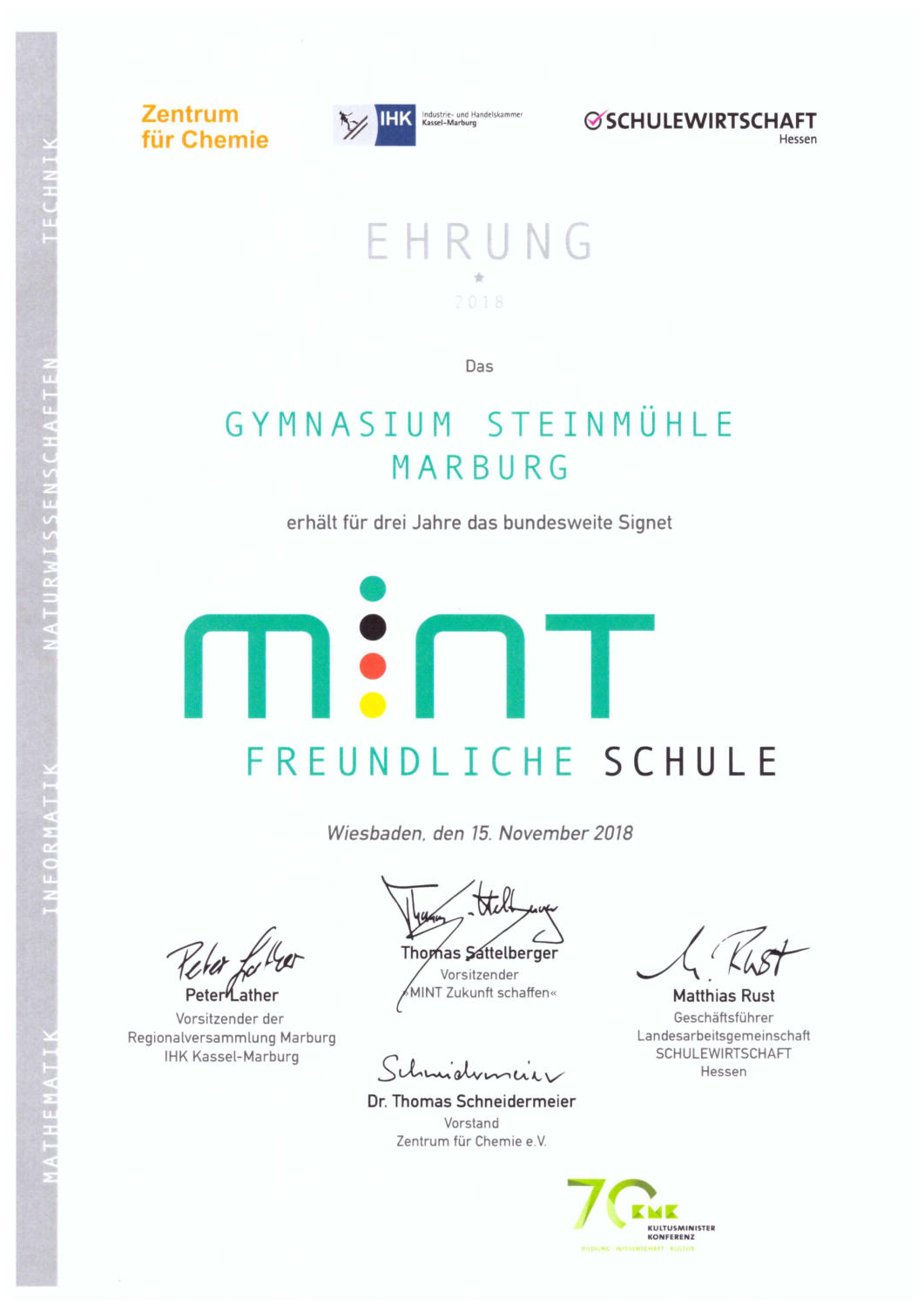
The Steinmühle has now been recognized as a “STEM-friendly school” by the Hessian State Parliament in Wiesbaden. This official recognition honors the school’s focus on mathematics, computer science, natural sciences, and technology.

The award, which was accepted by Steinmühlen teachers Dr. Jutta Töhl-Borsdorf (STEM coordinator) and Constanze Oestreicher-Gold (department head), took place during a joint celebration organized by “MINT Zukunft Schaffen!” and the Center for Chemistry, at the invitation of Dr. Thomas Schneidermeier, at the Hessian State Parliament in Wiesbaden. The award for schools in Hesse is held under the patronage of Minister of Education Prof. Dr. Alexander Lorz and the Conference of Ministers of Education (KMK).

In addition to a 20-page application, Steinmühle’s various self-imposed standards led to the award, explained Dr. Jutta Töhl-Borsdorf. These include, among other things, the introduction of computer science as an exam subject, the subject “Natural Science Education” (NaUnt) as an additional course offering, competitions in STEM subjects as part of elective courses (WU), participation in “Jugend Forscht,” career counseling in related fields, and partnerships with businesses and universities.

Steinmühlen School principals Björn Gemmer and Bernd Holly, along with Dirk Konnertz, executive director of the school association, are pleased that another key area of development has now become official and visible.

The “STEM-Friendly Schools” initiative raises awareness among students, parents, businesses, and the general public through this recognition, and these schools are not only acknowledged by the business community but also receive special support from it. Nationwide partners of the “MINT Zukunft schaffen” initiative, in coordination with state employers’ associations and business-affiliated educational organizations, recognize those schools that consciously prioritize STEM subjects. The schools are evaluated based on a rigorous, standardized set of criteria and undergo a nationally uniform application process.

Among the partners—and thus those who honor the schools—are, in addition to other associations and companies, the Kassel-Marburg Chamber of Commerce and Industry.

22. November 2018
https://steinmuehle.de/wp-content/uploads/sites/5/2018/11/schule_3punkt0_108.jpg 1000 1500 konnertz https://steinmuehle.de/wp-content/uploads/sites/5/2025/11/Logo_SchuleInternat_Steinmuehle_2026_3.png konnertz2018-11-22 11:06:322026-06-18 15:39:24Commitment to STEM subjects leads to an official award
Page 2 of 49‹1234›»

Pages

  • A Safe Place
  • About Us
  • Alternative Sports
  • Alumni Feed
  • Alumni Login
  • Alumni Reunion
  • Annual Calendar Download
  • Art, Music & Theater
  • Awards
  • Bilingual Elementary School
  • Bilingual Elementary School
  • Boarding School
  • Boarding School Admission
  • Boarding School as an Opportunity
  • Charity Projects
  • Contact
  • Costs & Contract Terms
  • Digitization
  • Donation Failed
  • Donation Receipt
  • Donor Dashboard
  • Ecology & Sustainability
  • Elementary School Registration
  • Events
  • Fan Shop
  • Fit for Life
  • Forgot your password?
  • Friends & Alumni
  • Friends of the School Association
  • Funding Partners
  • Fundraising
  • Groups
  • High School
  • High School Admission
  • High School Registration Form
  • Home
  • Internal Clubs
  • International High School
  • International High School Program
  • International High School Registration Form
  • International School
  • International School Registration
  • Keyword Search
  • Languages & International Affairs
  • Learning
  • Legal Notice
  • Life
  • Members
  • MINT Lab Equipment
  • Mission Statement & Vision
  • My Profile
  • News
  • News
  • News Archive
  • Newsletter
  • Newsletter
  • Organization & History
  • Partners
  • Privacy Policy
  • Privacy Policy (Detailed)
  • Project-Based Learning
  • Promoting Independence & Individuality
  • Promoting STEM Talent
  • Publications
  • Quality Management
  • Recording
  • Registration Form for the Bilingual Elementary School
  • Reset Password
  • Riding School
  • Rowing Club
  • School
  • School as a Community
  • Signed up for the newsletter
  • Social Responsibility
  • Social Responsibility & Strengthening the Community
  • Sponsorship
  • Sports & Health
  • Sports & Recreation
  • Stakeholders
  • Steinmühle Alumni Network
  • Steinmühle as a Youth Welfare Agency
  • Stories
  • Summer Camps
  • Support Current Projects
  • Support for Families
  • Talent Program Plus STEM
  • Teams
  • Terms and Conditions for High School
  • Terms and Conditions for the Bilingual Elementary School
  • Terms and Conditions of the International High School
  • Terms of Contract for the Bilingual Primary School
  • Terms of Contract for the International School
  • Trips & Weekends
  • Upload Transcript
  • What is … up to today, anyway?
  • Why Steinmühle?
  • Work at the Steinmühle

Categories

  • Archive
  • Art, Music & Theater
  • Bilingual Elementary School
  • Boarding School
  • Class Trips, Field Trips, and School Outings
  • Collaborations & Partnerships
  • Contests & Awards
  • Digitalization & AI
  • Ecology and Sustainability
  • Events & Celebrations
  • Former Students & Alumni
  • International High School
  • Job Openings
  • Languages & International Affairs
  • Life at Boarding School
  • News
  • Politics, Business & Responsibility
  • Rowing
  • Social Engagement
  • Sports
  • Sports & Health
  • Steinmühle on the Road
  • Steinmühle Riding School
  • STEM
  • Surveys & Studies
  • Talent Development
  • Uncategorized

Archive

  • June 2026
  • May 2026
  • April 2026
  • March 2026
  • February 2026
  • January 2026
  • December 2025
  • November 2025
  • October 2025
  • September 2025
  • August 2025
  • July 2025
  • June 2025
  • May 2025
  • April 2025
  • March 2025
  • February 2025
  • January 2025
  • December 2024
  • November 2024
  • October 2024
  • September 2024
  • August 2024
  • July 2024
  • June 2024
  • May 2024
  • April 2024
  • March 2024
  • February 2024
  • January 2024
  • December 2023
  • November 2023
  • October 2023
  • September 2023
  • August 2023
  • July 2023
  • June 2023
  • May 2023
  • April 2023
  • March 2023
  • February 2023
  • January 2023
  • December 2022
  • November 2022
  • October 2022
  • September 2022
  • August 2022
  • July 2022
  • June 2022
  • May 2022
  • April 2022
  • March 2022
  • February 2022
  • January 2022
  • December 2021
  • November 2021
  • October 2021
  • September 2021
  • August 2021
  • July 2021
  • May 2021
  • April 2021
  • March 2021
  • February 2021
  • December 2020
  • November 2020
  • October 2020
  • September 2020
  • August 2020
  • July 2020
  • June 2020
  • May 2020
  • April 2020
  • March 2020
  • February 2020
  • January 2020
  • December 2019
  • November 2019
  • October 2019
  • September 2019
  • August 2019
  • July 2019
  • June 2019
  • May 2019
  • April 2019
  • March 2019
  • February 2019
  • January 2019
  • December 2018
  • November 2018
  • October 2018
  • September 2018
  • August 2018
  • July 2018
  • June 2018
  • May 2018
  • April 2018
  • March 2018
  • February 2018
  • January 2018
  • December 2017
  • November 2017
  • October 2017
  • September 2017
  • August 2017
  • July 2017
  • June 2017
  • May 2017
  • April 2017
  • March 2017
  • February 2017
  • January 2017
  • December 2016
  • November 2016
  • October 2016
  • September 2016
  • August 2016
  • July 2016
  • June 2016
  • May 2016
  • April 2016
  • March 2016
  • February 2016
  • December 2015
  • November 2015
  • October 2015
  • September 2015
  • July 2015
  • June 2015
  • May 2015
  • April 2015
  • March 2015
  • February 2015
  • January 2015
  • December 2014
  • November 2014
  • October 2014
  • September 2014
  • July 2014
  • June 2014
  • May 2014
  • April 2014
  • March 2014
  • February 2014
  • January 2014
  • December 2013
  • November 2013
 
PreviousNext
12
 
PreviousNext
123456

Do you have questions about the school?

School Administration & Management

Björn Gemmer & Dirk Konnertz
Phone: 06421 408-20

schule@steinmuehle.de

Do you have questions about the boarding school?

Boarding School Administration & Management

Anke Muszynski & Dirk Konnertz
Phone: 06421 408-0

internat@steinmuehle.de

  • NEWSLETTER
  • PUBLICATIONS
  • CAREERS AT STEINMÜHLE
  • SUMMER CAMPS
  • LEGAL NOTICE
  • PRIVACY POLICY
  • CONTACT

Do you have questions about the school?

School Administration & Management

Björn Gemmer & Dirk Konnertz
Phone: 06421 408-20

schule@steinmuehle.de

Do you have questions about the boarding school?

Boarding School Administration & Management

Anke Muszynski & Dirk Konnertz
Phone: 06421 408-0

internat@steinmuehle.de

  • NEWSLETTER
  • PUBLICATIONS
  • WORK AT THE STONE MILL
  • SUMMER CAMPS
  • LEGAL NOTICE
  • PRIVACY POLICY
  • CONTACT

© Copyright – Steinmühle 2026 | Erneuern oder ändern Sie Ihre Cookie-Einwilligung
Scroll to top