

Learning German Without Supplanting One’s Native Language—The DIV Working Group on International Affairs Met at the Boarding School
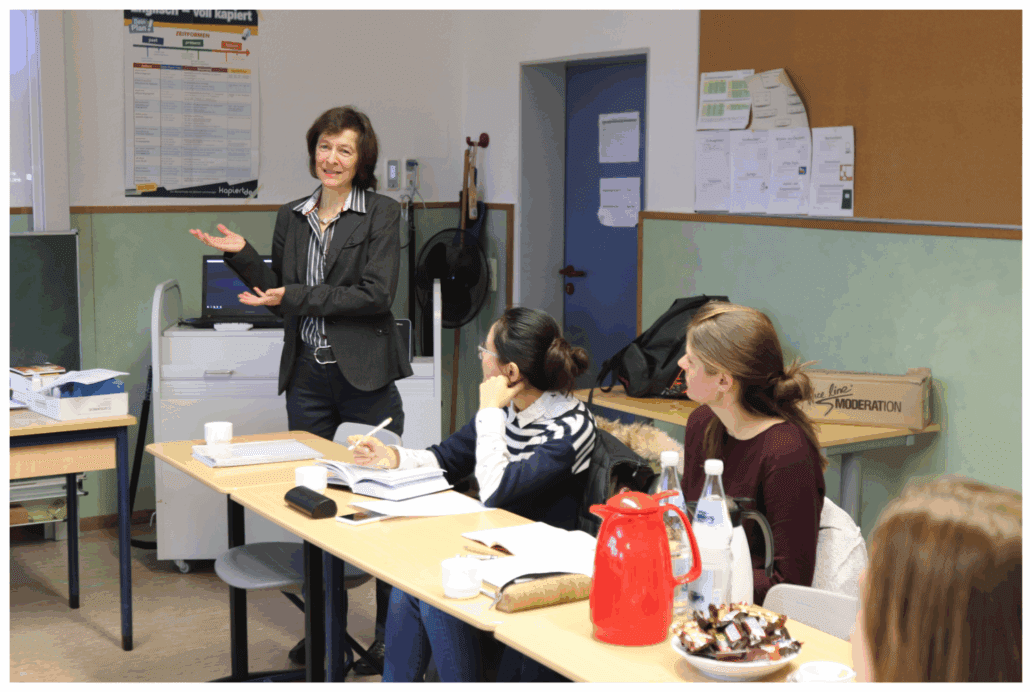
How can students solve a word problem in math if they have difficulty understanding the language? How are they supposed to write text analyses if they are unfamiliar with sentence connections and the structure of arguments? These and other challenges were addressed in a workshop led by Prof. Dr. Una Dirks, who works in the field of German as a Foreign Language (DaF) and German as a Second Language (DaZ) at the Institute for German Linguistics at Philipps University of Marburg. It was part of the conference organized by the International Affairs Working Group of the association “Die Internate Vereinigung” (DIV), which took place this year at the Steinmühle Boarding School.
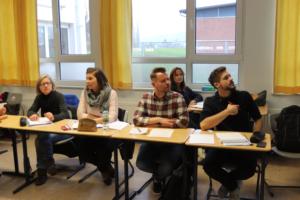
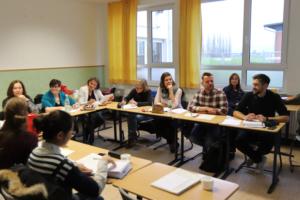
About a dozen representatives from German boarding schools exchanged ideas at the event, which was organized by Steinmühlen’s German as a Foreign Language (DaF) coordinator, Jan Müller. The discussion highlighted the multitude of challenges that teachers must overcome together with their international students. Learning the language and the subject matter simultaneously must be both facilitated and managed. Most international students are eager to succeed.
Learning German without supplanting one’s native language—introducing students to German culture while also honoring the cultures of international students: this is what everyday life looks like in the “DaF” (German as a Foreign Language) field. “We have to think cross-curricularly,” participants reported based on their experiences. That means, for example, having students write a dictation using scientific terms or compose essays on the topic of biology. These are all possibilities—to name a few.
From a scientific perspective, according to Una Dirks, one should not leave things to chance when it comes to teaching the German language. “Every school and every class needs experts who can assess students’ skill levels as accurately as possible. This is a very complex task that cannot be handled by teachers alone”. This step is so important, she explains, because only by accurately assessing skills such as listening, speaking, reading, and writing can tailored support measures be developed. Otherwise, she adds, it should come as no surprise if there’s a rude awakening—at the latest—when tests and class exams roll around.
That said, the foundational knowledge a foreign student brings with them is important. Teaching a Russian student presents different challenges than teaching a Chinese one: “The structure of the text is quite different there, as are the linguistic tools.” Creativity is fundamentally valuable, but too much of it when learning a language is not effective. The professor stated: “Language needs a foundation on which to build. First comes the basics, then the advanced skills!”
“Total freedom isn’t for everyone”
As a result, some of the reformed teaching models have been reevaluated somewhat: lecture-style teaching isn’t necessarily “bad.” When it comes to learning to write, too, new research findings clearly call into question long-held assumptions: “In contrast to structured approaches using a primer, freer methods have produced spelling errors much more frequently and significantly more dyslexic students.”
“Total freedom isn’t for everyone,” the speaker summarized, making it clear that everyone benefits from systematic guidance. Unfortunately, this is not the case with open educational opportunities: “These can usually only be put to good use by those who are already educationally advantaged.”
Encouraging Self-Reflection
Self-reflection is definitely an essential part of learning and steady progress. What can I do? What do I still need to learn? — The answers to these questions are helpful for expanding one’s own knowledge and skills, and nonverbal behavior plays an important role in this process.
Learning about the importance of punctuality in Germany, living by that principle, and reviewing one’s own language use in a learning video to see what works and what doesn’t in terms of social behavior—all of this facilitates progress.
The fact that there are things that simply require hard work and initiative hasn’t changed even today: sentence transitions and linguistic elements used in argumentation, for example. You have to memorize these and, above all, practice them repeatedly in the context of various topics. This is in stark contrast to how vocabulary was learned in the past: “If we don’t learn how to integrate vocabulary into the topic right away, we simply accumulate more and more passive knowledge that is then quickly forgotten.” Prof. Dirks refers here to an empirically proven finding, and the participants have already developed ideas for the next workshop to address this issue.