Following the student council elections on February 17, 2017, there are some new faces on the student council. Here is the student council lineup for the coming months:

Student Council Team: Efstathios Loannidis & Leon Sauer
Upper School Student Council Team: Efstathios Loannidis & Leon Sauer
Middle School Student Council Team: Pauline Fehlinger & Merle Duncker
Lower School Student Council Team: Morten Köhler & Benjamin Schul

Another 10 members of the General Conference:

1. Lennart Holly
2. Bennet Meier
3. Leon Rees
4. Gordian Bachmann
5. Emma Sander
6. Chiara Weber
7. David Binz
8. Christian Eifert
9. Urs Seifert
10. Tim Höfer

Student Council Advisor: Ms. Bernhart
Student Council Advisor: Mr. Lange

The three class winners, Paula Auschill (6a), Ellen Hilt (6b), and Emilia Ouaissa (6c) demonstrated their reading talent on December 8, 2016, during the Steinmühle school competition in front of their classmates by reading a passage from a book of their own choosing and then a text they hadn’t seen before. Paula Auschill emerged as the winner. This was determined by a jury consisting of students and teachers.

With that, Paula had qualified for the next round. At the city-level competition, held in the conference room of the Marburg Building Authority, she put on a good performance but was narrowly defeated.

This January, Steinmühle once again took part in the eighth-grade school ski trip to the Gschösswandhaus in Mayrhofen in the Zillertal. The group included 69 eighth-graders and 10 chaperones.

At the Gschösswandhaus, the students were greeted by the very friendly Mitterer family, who ran the inn, along with delicious food and rooms with 4, 6, 8, 10, 12, and even 15 beds. Living together in these rooms can sometimes be a social challenge for the students, but thanks to the generally positive atmosphere at the lodge, there were hardly any serious conflicts.

In ability groups of 6–10 students, they spent about 2 hours on the slopes in the morning and up to three hours in the afternoon. Naturally, the beginners made the most progress, and many of them were able to tackle their first blue run by the end of the second day of skiing. The students who already had skiing experience were able to improve their technique and explore the expansive ski area. Theoretical instruction was also a key part of the program: adhering to international slope rules, adjusting one’s skiing style to external conditions, and learning about alpine hazards are all integral components of the school ski course.

To mark the 35th visit by a Steinmühlen group to the Gschößwandhaus, the Steinmühlenweg—a trail connecting the ski slope to the lodge — a new sign, which was ceremoniously unveiled on the evening of the last day and will hopefully continue to guide many more generations of Steinmühlen students to the hut.

In late February 2017, the finals of the Youth Cup and Ring Tournaments took place at the Steinmühle. In the Youth Cup, all four team members from each club had to complete a dressage test and take a theory exam. In the Ring Tournament, in addition to dressage, the discipline of show jumping was included, in which riders competed on a short course. Under the guidance of coach Beate Schridde, the hosts came out on top.

Since late 2016, Ms. Schridde (Level A Competitive Sports Trainer) has officially been managing the Steinmühlen Riding Center. As a rider, she herself has successfully competed at the highest level in international tournaments (e.g., Festhallenturnier, Euroclassics Bremen). As a trainer, Schridde has also won many awards alongside her students (e.g., German Junior Eventing Championships, Hesse Eventing Championships).

Their services for riders and horses include riding lessons for beginners and advanced riders in dressage, show jumping, and cross-country riding; specialized training with your own horse; young horse training; horse conditioning; and personalized competition support.

With the appointment of Beate Schridde as operations manager, the Steinmühle Riding and Sports Club has gained a true equestrian professional and looks forward to continuing its excellent collaboration with her.

He holds a degree in public administration (FH), is married, and has two children. Most recently, he successfully managed an international guesthouse and conference center for youth and families in Upper Austria.

“Steinmühle 2.0—that is the goal I have set for myself for the coming years. Steinmühle, known for its pioneering approach to education, is set to achieve a similarly strong position in the area of boarding. This will require numerous measures. Over the next few years, we plan to modernize the furnishings in the boarding rooms, reactivate the tennis facilities, and completely renovate all boarding buildings from top to bottom. Furthermore, a stronger international focus and close collaboration with the Steinmühle School Association (Schulverein Steinmühle e.V.) are among the priorities I have made my own. To achieve these ambitious goals, I look forward to strong support—especially from the school administration, the school association, and the parents. Our shared goal must be to preserve Steinmühle’s uniqueness and guide it toward a bright future.”

We extend a warm welcome to Mr. Ritter and look forward to a successful collaboration.

The opening polonaise and the beautifully choreographed dance performances quickly put all the students in a festive Carnival mood. The students were happy to comply with the costume requirement, and many teachers had also dressed up beyond recognition. The winners of the class costume contests—which Ms. Boebel used to organize a fun game—proudly presented their outfits.

In addition to dancing, the classes took part in other physical activities: the class relays, which were a lot of fun for both participants and spectators.

And to top it all off, there were the popular Carnival fries again.


Following the traditional Friday house evenings, which we spent cooking and eating together as well as going to the movies, there were once again numerous activities with the boarding school community last weekend. In addition to sports activities like soccer and rock climbing, there was plenty of time for relaxation—during the Beauty and Wellness event, we unwound and treated ourselves to a break from everyday life in an atmospheric, candlelit setting. We made the masks and scrubs ourselves using natural ingredients. Of course, we couldn’t end the session without a massage! The weekend also included a lively game night in the tea room. We pulled out the classics “Activity” and “Taboo” and were surprised by how eloquent some of our fellow players were!

Last weekend also marked the founding of the “Steinmühle Bowling Club.” Armed with sneakers and 1-euro coins, eleven bowling-crazy recreational athletes headed to the nearby bowling alley in Cappel. In this diverse group, there were, of course, a few who had confused skittles with bowling or even boules and were surprised by the somewhat dated-looking venue; but after a short while, everyone recognized and enjoyed the charm of skittles. From then on, not a single ball sat still. After a few failed attempts that ended in “puddles,” new throwing techniques were tried out: Sometimes the ball was nudged slowly and gently, sometimes it was sent onto the floor with momentum and speed, or even thrown with one’s back to the lane through outstretched legs—and in the end, the “strike” bell rang more than once.

Similarly, our girls kicked off their first forays into sales by actively participating in the girls’ flea market at the Rittalarena in Wetzlar. Armed with countless items, they set out at 9:30 a.m. on Sunday morning, lovingly set up their booth, and immediately reinvested the few euros they earned. This event certainly won’t be the last of its kind.

The 2017 “Jugend Forscht” regional competition took place in February in Lollar at Bosch-Thermotechnik (formerly Buderus). For the first time, two groups from Steinmühle participated and immediately achieved very good results. The groups had to present their projects to a jury at an exhibition booth they had designed themselves.
The girls won second place in the technology category, while the boys took second place in chemistry and the special prize for environmental technology (worth €50).

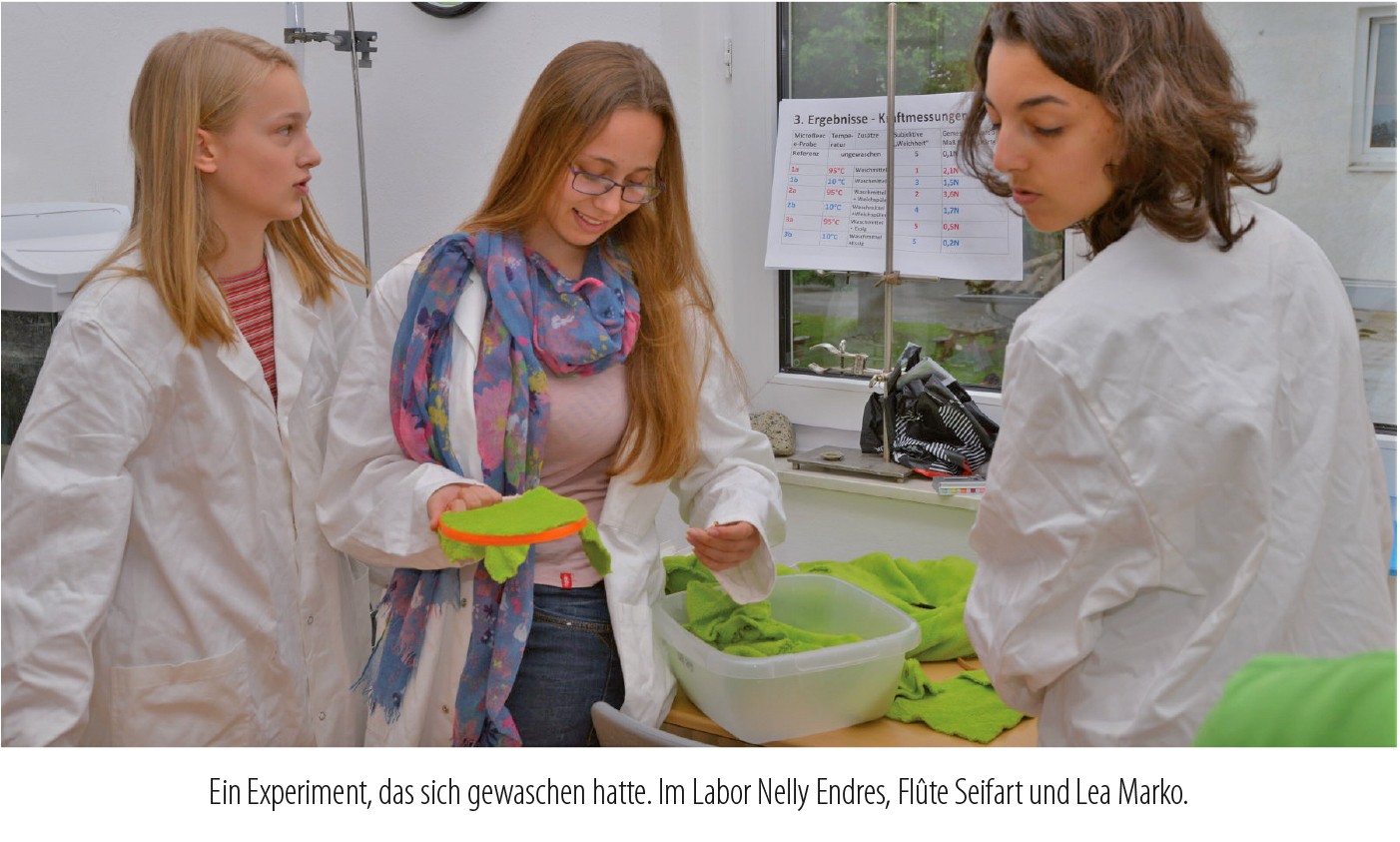
Problems with the microfleece. A group of girls who are part of the “WU Forschen” program (grades 8–9) at Steinmühle under the guidance of Dr. Töhl-Borsdorf participated in the “Jugend forscht” competition for teens aged 15 and older: Nelly Endres (8b), Lea Marko (8a), and Flûte Seifart (9b). Their topic was: “Microfleece—Does Superfleece Fail Even When Washed?”

The starting point was the observation that microfleece fabrics are very common in Germany. They’re cozy, but unfortunately they get dirty pretty quickly. What can you do when these items aren’t as soft and cozy after washing, and using fabric softener isn’t always the solution? What works quite well for terry cloth towels is, unfortunately, only partially effective with microfleece.
To verify that these weren’t just subjective impressions, Nelly, Lea, and Flûte built a device that can measure the “softness” of a fleece fabric and provide other insights into what kinds of washing processes preserve the “softness” of microfleece. The students also examined the fleece samples under a microscope and investigated how the texture of microfleece changes as a result of different washing processes.
In the end, the students were able to report:

“In this project, we succeeded in developing a machine and a method to measure the ‘softness’ of microfleece. Other findings include that microfleece should not be washed at very high temperatures, that the use of fabric softener is generally not recommended as it causes the fibers to ‘stick together,’ and that adding vinegar results in a very good softness rating.”

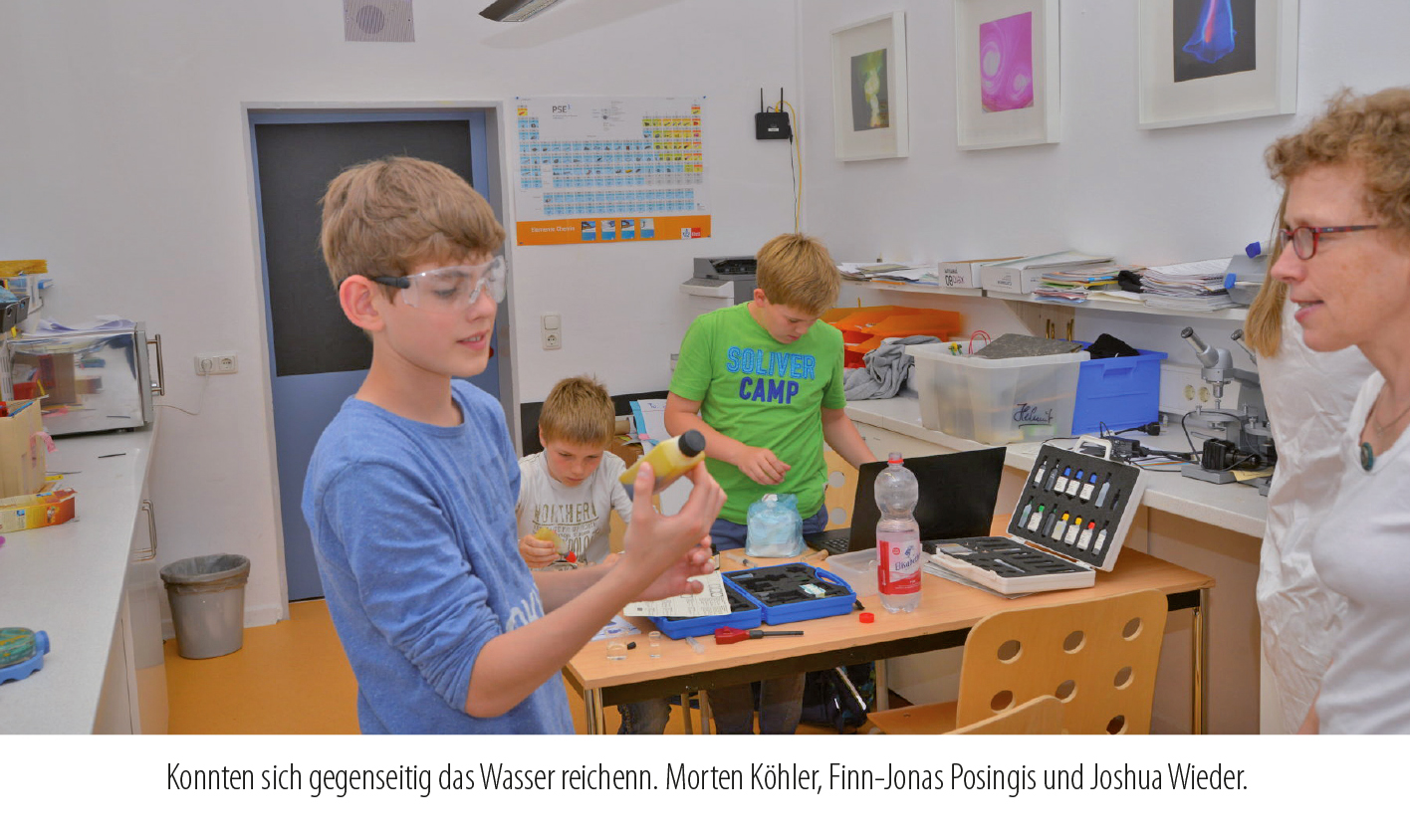
Expensive and cheap types of water. A group of students from Dr. Töhl’s GuFi course took part in the “Schüler experimentieren” competition. This is the junior division of “Jugend forscht.” The participants were sixth-graders Morten Köhler, Finn-Jonas Posingies, and Joshua Wieder. They were the youngest team in the competition. With their experiments, they wanted to find out:
Is premium water really better than discount store water? The students explained their research question:

“When we tested various tap water and river water samples for their components, we came up with the idea of analyzing mineral waters. We wondered whether the expensive premium mineral waters are really better or healthier than cheap discount store waters. To do this, we tested various water samples for different components (nitrate, nitrite, phosphate, etc.) that aren’t listed on the label. Our goal was to determine whether it’s worth spending so much money on mineral water. And here’s what we found: Overall, it’s fair to say that the price differences are only partially justified. Cheap mineral water can be good (tegut) or rather poor (Quellbrunn), but even expensive water sometimes has a higher nitrate content than discount store water, which isn’t exactly ideal. However, we cannot make a definitive assessment because we were unable to test for other critical substances (e.g., heavy metals such as arsenic, radioactive uranium) or residues of pesticides or bacteria.”

For the fourth time, the Marburg School Chess Championships will be held at the Steinmühle

It has been clear since at least February 2, 2017, that chess in Marburg is no longer an exclusive game, but is instead experiencing a resurgence and enjoying popularity among many people. On that day, the fourth Marburg School Chess Championship took place at the Steinmühle. With well over 50 participating students from ten schools in Marburg, the tournament was bigger and more exciting than ever before. In addition to the number of participants, this was due above all to the diverse field of competitors. Students ranging from elementary school through high school were in attendance, searching the chessboard for combinations, traps, threats, and the best next move. Once again, the competition was conducted in a very sportsmanlike manner throughout, and special mention must be made of the elementary school students, who mustered the courage to compete against the others despite the sometimes significant age difference.

The tournament was held in cooperation with SK Marburg 1931/72 e.V. and the Steinmühle. Daniel Allig, who heads the chess club at Steinmühle, once again organized this tournament in an exemplary manner: nothing fazes him, and he always keeps everything under control—especially since the unexpected increase in the number of participants presented particular challenges.

In the end, after five exciting rounds, there were several deserving winners, as the final standings were determined in two age groups. In many cases where players were tied on points, the results were decided by the narrowest of margins through special tiebreakers. The overall winner—and thus also the winner in his age group—was Dimitri Schuster (7th grade) from the Martin Luther School, who was the only player that day to win all of his games. The top elementary school student was Samuel Opitz, who even managed to finish in a strong 15th place overall. The Marburg Chess Club awarded medals to all participants and invited them to the club’s training sessions. Trophies were awarded to the top three players in each age group.

The Steinmühle fielded a strong team of 18 players. However, they narrowly missed out on the medal positions. In Age Group 1, Finn Krausch (7a) finished fifth and Urs Seifart (7c) seventh. In Age Group 2, Nikolas Becker (6b) finished fifth, Robin Tatje (5c) seventh, Julian Röser (5b) eighth, and Adriano Doimo (5b) ninth.

Age Group 1 (7th–13th grade):

Dimitri Schuster (Martin Luther School, 7th grade) – 5 points

Alexander Hein (Emil-von-Behring School, 9th grade) – 4.5 points

Roman Qayumi (Carl-Strehl-Schule, 12th grade) – 4.5 points

Age Group 2 (Elementary School – 6th Grade):

Nico Siemon (Otto-Ubelohde School, 6th grade) – 4 points

Christian Uhde (Otto-Ubelohde School, 6th grade) – 4 points

Emil Dierkes (Elisabethschule, 6th grade) – 3 points

2017 Education Evening with Olaf Axel Burow

Thanks to scientific research, we now know quite a lot about how successful and sustainable learning works and what matters most. However, key structures in schools and many aspects of current teaching methods and pedagogy stem from an outdated conception of learning. Prof. Dr. Olaf Axel Burow illustrated this fundamental problem using clear examples and compelling research findings.

Building on this analysis, Burow presented to an interested and open-minded audience the possible paths toward School 4.0. Citing examples from the German school system, he was able to demonstrate that the future may not be all that far off.

As far as schools are concerned, the future structure of a forward-looking school must incorporate the following aspects digitalization, the new role of teachers, networking, changes in the teaching and learning environment, and a focus on health, democratization/participation and happiness-oriented approach as defining factors.

As far as the students are concerned, the key will be to specific talent profile to do justice to each individual and thus make learning an enjoyable activity that sustains the joy of learning and fosters happiness at school. Standardized graduation profiles and assessments of knowledge levels should be critically examined.
It was an educational evening that sparked a lively exchange of ideas between the speaker, parents, colleagues, and representatives from the teacher-training programs at the University of Marburg and the teacher-training college—especially afterward, during a light reception with refreshments provided by WU Partyservice.