Following the official approval of the bilingual elementary school program at Steinmühle for the 2019–20 school year, an information evening for interested parents was scheduled. Welcomed by principals Bernd Holly and Björn Gemmer, parents attended the event at the Steinmühlenforum to learn about the organizational details of the planned elementary school program, so they could get a sense of how things would work and see how their own wishes and expectations aligned with the program.

After an introduction to the school’s focus areas and character by Principal Björn Gemmer, former elementary school principal Sabine Rektorschek explained the planned flexible classroom model. The experienced educator had successfully led a primary school in the neighboring district of Gießen based on this model and now works as a consultant.

At the information evening, Sabine Rektorschek described the advantages of individualized learning and the distinctions between skill acquisition and learning objectives. The audience learned that assessment and progress monitoring are not just terms used in medicine, but can also apply in an educational context. “Assessing children and their skills at the outset and tracking the acquisition of additional skills in stages throughout their school years are among the fundamental tools for a successful elementary school experience,” she said.

Hannah Achenbach also introduced herself to the visitors; she will be returning from Leipzig to her hometown of Marburg to work as a teacher at the Steinmühle Bilingual Elementary School.

Afterward, interested parents asked questions primarily about the possibility of a trilingual education in specific cases and about the enrollment of so-called “children who are ready to start school.” Jeannine Walter, the pentilingual department head at Steinmühle, and Principal Bernd Holly—a father of two children who had not yet turned six when they started school—provided expert answers on these topics.

Among other things, it was announced toward the end of the event that the Steinmühle Bilingual Elementary School will facilitate transition into the Hessian and international school systems. It already has the necessary partner schools in place for this purpose.

Parents who are considering enrolling their child at the Steinmühle Bilingual Elementary School can sign up for an admissions interview by email (bjoern.gemmer@steinmuehle.net). The admission interviews will take place in February 2019. Key information about the Steinmühle Bilingual Elementary School is summarized in a brochure that attendees of the event were able to take home. The brochure is also available for download at the following link: http://gymnasium-steinmuehle.de/download/Bilinguale_Grundschule_Steinmuehle.pdf

Steinmühle has cleared the first hurdle toward certification as a “Health-Promoting School.” The State Board of Education recently awarded the school a partial certificate in the area of “Nutrition and Consumption.”

The title “Health-Promoting School” is an award presented by the Hessian Ministry of Education and Cultural Affairs. Efforts to further develop a health-promoting school environment can initially be recognized through partial certifications for the individual areas of focus within “School & Health”—specifically in areas that are particularly relevant to health in helping a school fulfill its educational and instructional responsibilities:

  • Movement & Perception
  • Food & Consumption
  • Addiction & Violence Prevention
  • Transportation & Mobility
  • Teacher Health

Based on at least four partial certificates earned (of which the “Nutrition & Consumption” and “Physical Activity & Perception” partial certificates are mandatory, along with two additional health-related profile elements from the areas of addiction and violence prevention, Traffic & Mobility, and Teacher Health), schools can then apply for overall certification as a “Health-Promoting School.”

The topic of “Health-Promoting Schools” was incorporated into the Steinmühle School’s current work program in 2015. The faculty conference approved the decision to undergo the certification process. Since then, individual teachers have been assigned to various areas. These are

  • Manuela Schmidt (Steering Committee—Leadership/Teacher Health)
  • Friedhelm Wagler (Partial Certificate/Field: Nutrition and Consumption)
  • Nicole Hohm and Heike Rabben-Martin (Division: Addiction and Violence Prevention)
  • Michael Neirich (Movement and Perception Division)

As the school’s Ecology Coordinator, Carmen Bastian represents the field of ecology. This topic was included to ensure a holistic approach to the subject, even though no official certification is required in this area.

Friedhelm Wagler fulfilled the requirements for the recently awarded “Nutrition and Consumption” certificate through a variety of projects. These included, among other things, the installation of water dispensers, the “Healthy Snack” campaign, and the elective course on catering services.

The topic was also integrated into the curriculum in an interdisciplinary manner. It was covered in classes such as English, politics and economics, Latin, chemistry, physical education, and biology.

“As early as 2006, there were discussions about offering more variety and choices for lunch,” reports Friedhelm Wagler. The school administration, parents, a small group of teachers and students, the boarding school, its managing family (the Buurmans), and the head chef at the time, Bernd Schumertl, held discussions on the topic. As the years went on, according to Friedhelm Wagler, individual projects on nutrition led to elective courses in the middle school/catering program, an extracurricular club for grades 5 and 6 with strong parental involvement, and mandatory project-based lessons on bread baking, healthy cooking, the dietary habits of different cultures, and more. Over time, the overall theme was expanded to include individual initiatives such as breakfast and fruit offerings during breaks.

Arno Bernhardt, Director of the Marburg State Education Office (2nd from left) and Carmen Martin, coordinator and head of the School and Health Division (center), presented the principal team—Björn Gemmer (left) and Bernd Holly (right), along with Manuela Schmidt (head of the steering committee, second from the right)— the first partial certificate toward the overall “Health-Promoting School” designation, which a total of 54 schools in Hesse held in 2015.


It is his “brainchild”: Over the course of two school years, Friedhelm Wagler has compiled all the materials on the subject into a comprehensive file containing teaching projects, explanations, photos, evaluations, and brief summaries.

The big day had finally arrived. Steinmühle fielded two teams in Competition Class IV at the “Youth Trains for the Olympics” basketball tournament. The girls and boys competed with great dedication. In the end, the girls’ team took home the “bronze,” while the boys’ team finished in fourth place. Coach Marc Bepperling is confident: “We’ll do even better next time.”

Girls and boys born between 2006 and 2009 had the chance to showcase their skills. A long day of competition lay ahead for both teams. The boys played a total of 5 games and the girls 4. Before the group stage began, all teams had to complete a multi-event competition. The times for all students were added together, and an average was calculated. The girls completed the course in an average of 58.8 seconds, while the boys took 50.2 seconds. Before each game, the times of the opposing teams were compared. The team that had completed the course faster started the game with a 6-point lead. Unfortunately, our teams very often had to make up this deficit.

Unfortunately, the girls’ group stage began with a loss in a very close game against Gymnasium Philippinum 1; the team fell short 19–22. So they needed a win in their second group stage game. Backing up their 6 points from the competition, the girls played very well against the Elisabethschule 2 team and won 39–04. The girls thus finished the group stage in second place; everything was still up for grabs in the next game against the top team from the other group.


Relief After Game 2

The boys had a pretty similar experience in the preliminary round. In the first game, we were defeated by the Elisabethschule 1 team with a score of 06 : 32. It quickly became clear that the boys needed to focus on the upcoming games. The second game against Gymnasium Philippinum 2 brought some relief to our team, and we won 51–02. We also won the third game of the group stage against the Freie Waldorfschule, 25–16.

We were generally satisfied with our performance in the preliminary round. Now we had to prove ourselves against the first-place team from the other group. Among the boys, there was a clear disparity in the teams’ skill levels. Nevertheless, we scored a few points, but lost to the MLS by a score of 18 to 50. Unfortunately, we weren’t able to walk off the field victorious in the 3rd/4th-place game either. We lost our final match 19–35. The physically strong teams posed major challenges for us in this tournament. Nevertheless, we’re not dissatisfied with our 4th-place finish out of a total of 8 participating schools.

We really missed our “Big Man,” Christopher Mewes, during these games. Unfortunately, he was unable to play due to illness; we wish him a speedy recovery. Otherwise, the team performed well and played consistently, led by the two playmakers, Bruno Schneider and Jonah Schorn.


High level of willingness to work

The young, up-and-coming basketball players received strong support from Leo Rumpel, Victor Teres Loytved, and Jaron Häußermann, who are also active members of the club and delivered solid performances. Johnny Eckard, Jonas Nolte, and Anton Neßler—who are not actually from this sport—made up for it with their strong commitment and ensured a lively game with their willingness to run.

The girls also started this important game trailing by 6 points once again. Thanks to a very strong starting five, however, the team was able to hold the opponents scoreless for the first 6 minutes. We caught up, tied the game, and suddenly, after a hard-fought battle, we were even leading 12–8.

The clock was already set for the final. But the game wasn’t over yet. Because of all the fouls, our opponents punished us with good free throws. Unfortunately, we couldn’t maintain the dominance we’d shown in the first half and fell behind 13–15. Even in the final two minutes of the game, we were unable to change the outcome. Unfortunately, we fell just short and missed out on a spot in the final. In the final game for 3rd and 4th place, however, we prevailed with a score of 44–4, securing the “bronze” medal after all.


Motivation and Ambition

We finished the competition with mixed feelings. As soon as the final whistle blew, it was clear to us that we want to come back even stronger next year. Many of the girls enjoy practicing at BC Marburg and other clubs, which was evident in their ball-handling skills and understanding of the game. None of the 10 players lacked motivation or ambition. Junia Molsberger once again proved herself to be a strong center, showing plenty of dominance under the basket. Stella Preiß more than lived up to her role as point guard, demonstrating assertiveness and a drive to the basket. Sisters Merle and Finja Herwig displayed great dynamism on the court and plenty of tenacity driving toward the basket. Lilo Riegels shone with excellent ball-handling skills and impressive crossovers that often left her opponents looking foolish. Anna Rumpel, Sophia Nolte, Zoé Closmann, Livia Schule, and Paula Hartmann impressed with their versatility, reliable ball-handling, and unwavering motivation.

Of course, we’re proud and satisfied with our performance. But we also know that we want to achieve even more next year. The boys’ team will have to be largely rebuilt, as some players will exceed the age limit. The girls’ team, on the other hand, can remain almost exactly the same. So we’re looking forward to a great new generation of young players and hope for many successful years ahead.

The following players took the field:

Boys:
Bruno Schneider
Jonas Nolte
Victor Teres Loytved
Jonah Schorn
Johnny Eckardt
Leo Rumpel
Jaron Häußermann
Anton Neßler
(Christopher Mewes)

Girls:
Anna Rumpel
Junia Molsberger
Stella Preiß
Merle Herwig
Finja Herwig
Paula Hartmann
Zoé Closmann
Livia Schulze
Lilo Riegels
Sophia Nolte

Coaches:
Gordian Bachmann
Marc Bepperling

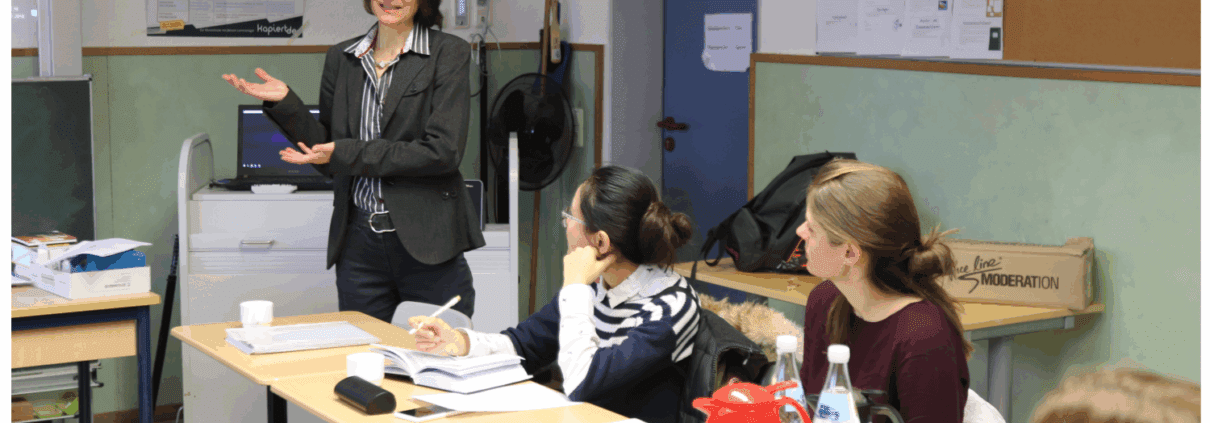
How can students solve a word problem in math if they have difficulty understanding the language? How are they supposed to write text analyses if they are unfamiliar with sentence connections and the structure of arguments? These and other challenges were addressed in a workshop led by Prof. Dr. Una Dirks, who works in the field of German as a Foreign Language (DaF) and German as a Second Language (DaZ) at the Institute for German Linguistics at Philipps University of Marburg. It was part of the conference organized by the International Affairs Working Group of the association “Die Internate Vereinigung” (DIV), which took place this year at the Steinmühle Boarding School.

About a dozen representatives from German boarding schools exchanged ideas at the event, which was organized by Steinmühlen’s German as a Foreign Language (DaF) coordinator, Jan Müller. The discussion highlighted the multitude of challenges that teachers must overcome together with their international students. Learning the language and the subject matter simultaneously must be both facilitated and managed. Most international students are eager to succeed.

Learning German without supplanting one’s native language—introducing students to German culture while also honoring the cultures of international students: this is what everyday life looks like in the “DaF” (German as a Foreign Language) field. “We have to think cross-curricularly,” participants reported based on their experiences. That means, for example, having students write a dictation using scientific terms or compose essays on the topic of biology. These are all possibilities—to name a few.

From a scientific perspective, according to Una Dirks, one should not leave things to chance when it comes to teaching the German language. “Every school and every class needs experts who can assess students’ skill levels as accurately as possible. This is a very complex task that cannot be handled by teachers alone”. This step is so important, she explains, because only by accurately assessing skills such as listening, speaking, reading, and writing can tailored support measures be developed. Otherwise, she adds, it should come as no surprise if there’s a rude awakening—at the latest—when tests and class exams roll around.

That said, the foundational knowledge a foreign student brings with them is important. Teaching a Russian student presents different challenges than teaching a Chinese one: “The structure of the text is quite different there, as are the linguistic tools.” Creativity is fundamentally valuable, but too much of it when learning a language is not effective. The professor stated: “Language needs a foundation on which to build. First comes the basics, then the advanced skills!”

“Total freedom isn’t for everyone”

As a result, some of the reformed teaching models have been reevaluated somewhat: lecture-style teaching isn’t necessarily “bad.” When it comes to learning to write, too, new research findings clearly call into question long-held assumptions: “In contrast to structured approaches using a primer, freer methods have produced spelling errors much more frequently and significantly more dyslexic students.”

“Total freedom isn’t for everyone,” the speaker summarized, making it clear that everyone benefits from systematic guidance. Unfortunately, this is not the case with open educational opportunities: “These can usually only be put to good use by those who are already educationally advantaged.”

Encouraging Self-Reflection

Self-reflection is definitely an essential part of learning and steady progress. What can I do? What do I still need to learn? — The answers to these questions are helpful for expanding one’s own knowledge and skills, and nonverbal behavior plays an important role in this process.

Learning about the importance of punctuality in Germany, living by that principle, and reviewing one’s own language use in a learning video to see what works and what doesn’t in terms of social behavior—all of this facilitates progress.

The fact that there are things that simply require hard work and initiative hasn’t changed even today: sentence transitions and linguistic elements used in argumentation, for example. You have to memorize these and, above all, practice them repeatedly in the context of various topics. This is in stark contrast to how vocabulary was learned in the past: “If we don’t learn how to integrate vocabulary into the topic right away, we simply accumulate more and more passive knowledge that is then quickly forgotten.” Prof. Dirks refers here to an empirically proven finding, and the participants have already developed ideas for the next workshop to address this issue.