The German-language press hails the book as “the funniest work about the German provinces…,” praises its style with its “lively cascades of sentences,” and describes the author himself as a “magician and wanderer of worlds”: Reason enough for the Steinmühle to invite the young author Sven Pfizenmaier to a reading at the Forum. The bottom line: The book *Draußen feiern die Leute* was also well received at the Forum.

Before the event, Principal Bernd Holly (pictured with the author) raved about the novel, which he had devoured with enthusiasm. After the event, audience members lined up for an autograph. In between, the audience got to see a young man who read a sample from his successful book and came across as reserved.

His novel is different. Using a magnifying glass with an enormous focal length, Sven Pfizenmaier focuses on village life in the Lower Saxony countryside—not in the sense of an absence of big cities, but as something that can also make one feel lonely. The author describes three characters with exuberant precision, with an imagination that seems to run wild but reveals what it means to be different. The book revolves around these relatable characters—the drug lord Rasputin from the nearby city of Hanover, immigrants from Kazakhstan, and the ever-growing number of people who disappear from the town while the locals are partying. The Onion Festival, for example.

As one can see, the novel certainly has autobiographical elements. Everyday social problems are woven into anecdotes and placed within a broader context. The unflinching nature of the descriptions—without, however, exposing the characters to ridicule—is likely one of the secrets to Pfizenmaier’s success.

We saw many beaming faces as they rode by on skateboards, waveboards, scooters, or longboards: For the last few weeks before summer break, a so-called “WHEELUP! trailer” was parked in our schoolyard, filled to the brim with just about everything that has wheels.

The action week kicked off with a scooter training session for the advanced sports class, which was led competently and with a sense of humor by the professional staff from CITY SKATE. This was followed by a brief training session and instruction on how to use the trailer for all interested teachers. Under the motto, “Helmets on, pads on, and let’s go!” young and old alike rushed to the trailer during substitute classes, breaks, or even during physical education classes and rolled together across the schoolyard.

As part of an AOK sponsorship program, the Hessian sports agency CITY SKATE is equipping this trailer with the latest sports equipment so that it can be made available to children at as many schools as possible. “Thanks to a fortunate turn of events, our school had the opportunity to use this trailer during the most sought-after time slot before the break,” reports Steinmühlen teacher Benedikt Hohmann. It’s no secret that exercise and physical activity play a central role in physical and mental health. Furthermore, the WHEELUP! project offered the ideal opportunity to make good use of the infamous “last few hours before the break” outdoors and to get the students excited about skating.

A promise kept: Steinmühle celebrated the start of spring with a festival, marking the return of group activities after the COVID-19 restrictions, which had previously prevented events of this scale. People chatted and laughed together—the lively bustle in the Steinmühle courtyard was back! Organizer Frank Wemme said, “It was wonderful to hear the buzz of voices again and to see students of all ages gathering at the various booths. Everyone pitched in—from elementary school all the way up to 12th grade. It was a wonderful and lively day after a period that wasn’t always easy.”

Thanks to Frank Wemme, who planned the party down to the last detail and organized it perfectly!

2015 – the large wave of refugees reached Germany. Steinmühle, too, made it its mission to provide active assistance and organized a residential group for unaccompanied minor refugees, designed to help these young people find their footing in Germany as quickly as possible and take their first steps toward successful integration. Not least because of this experience, the exhibition “Faces and Stories” by the bsj Marburg immediately piqued the interest of the Steinmühle’s leadership.

The exhibition traces the journey of Tarek, Ali, and Muhi Eddin, who arrived in Marburg in 2015 and, several years later, reflect on their experiences over the past few years. Sometimes enthusiastic, sometimes pensive, but always optimistic, they talk about their experiences and adventures.

Together with educators from bsj Marburg, the three young Syrians also compiled diaries of their flight, featuring cell phone photos of their families, their hometowns—Damascus, Idlib, Al-Hasaka—and of individual stops along their journey of flight to the Marburg-Biedenkopf district. The young people developed the concept for illustrating their stories during a weekend workshop together with a graphic designer. There, they counted the days of their journey and illustrated each stage with photos, their own drawings, and handwritten notes in Arabic and German

What has become of Tarek, Ali, and Muhi Eddin since 2015? Have the three of them found a new home in the Marburg-Biedenkopf district? Which of their wishes have come true, and which have not?

The three young men come to very different conclusions on this matter, but they all emphasize that they feel they have found their place, even if things haven’t turned out exactly as they had hoped five years ago.

The exhibition was on display for two weeks on the upper floor of the Steinmühle high school building and drew a great deal of interest from the students.

(Bernd Hülsbeck)

For the first time, a team from Steinmühle participated in the “Jugend testet” competition. This is a nationwide competition organized by Stiftung Warentest in Germany, in which young people can independently test products and services. A jury composed of experts from Stiftung Warentest, the media, and consumer protection organizations awards prizes for the best tests. The goal of the competition is to encourage young people to adopt a critical approach to consumer behavior.

This year, under the patronage of Federal Minister for Consumer Protection Steffi Lemke, 3,152 young people participated, and a total of 826 tests were submitted.
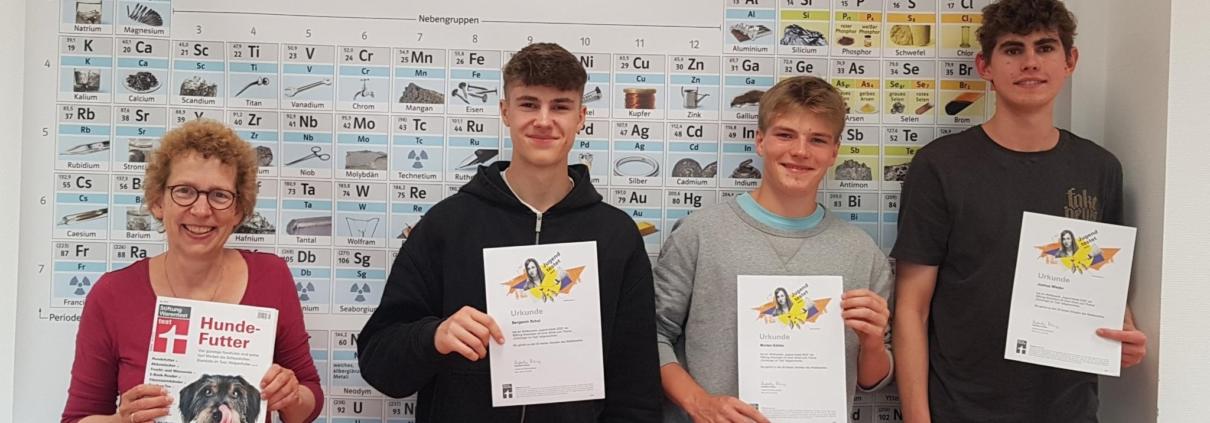
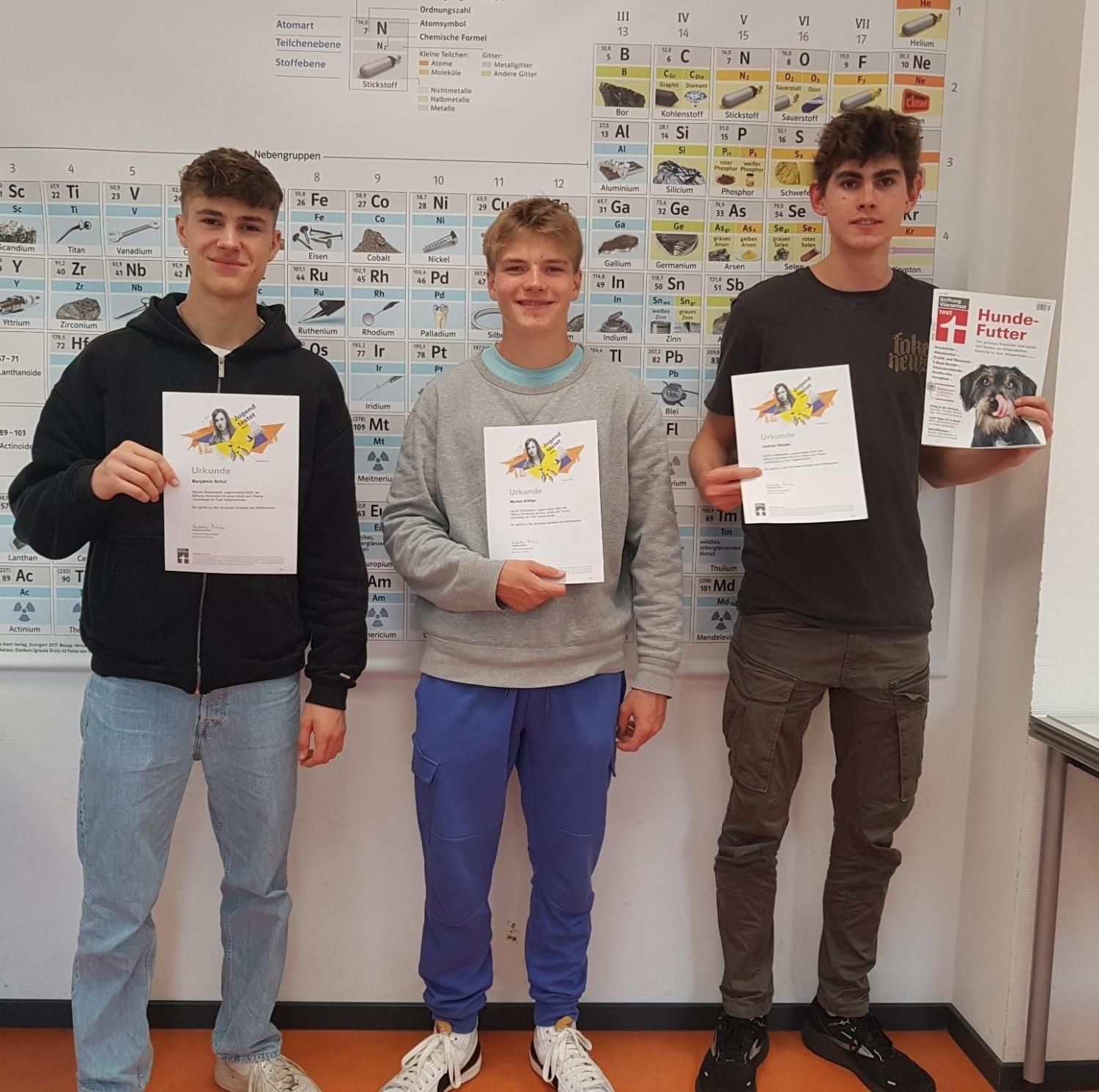
Joshua Wieder, Benjamin Schul, and Morten Köhler tested so-called “oxi-cleaners,” which are also used in laundry as stain removers or bleaches (we reported on this in March). Their submitted project has now been recognized as one of the top 50 tests in all of Germany. For this achievement, they were honored with a certificate and a one-year subscription to the magazines *Test* and *Finanztest*.

The three participants offered nuanced assessments of the competition. They thought it was cool that their research had practical relevance and that the whole thing wasn’t quite as complex as the “Jugend forscht” competition. In short: it was less time-consuming and less exhausting.
However, all three are critical of the fact that the “Top 50” ranking is vague overall and that there is no feedback. They would have liked to know how they could improve for a potential next time.
Furthermore, this competition does not include in-person events where teams can exchange ideas. Without regional qualifying rounds, as is the case with the “Jugend forscht” competitions, for example, the competition is already very fierce with over 3,000 participants.
Nevertheless, it was an interesting experience overall, and I certainly wouldn’t rule out participating again in the future.