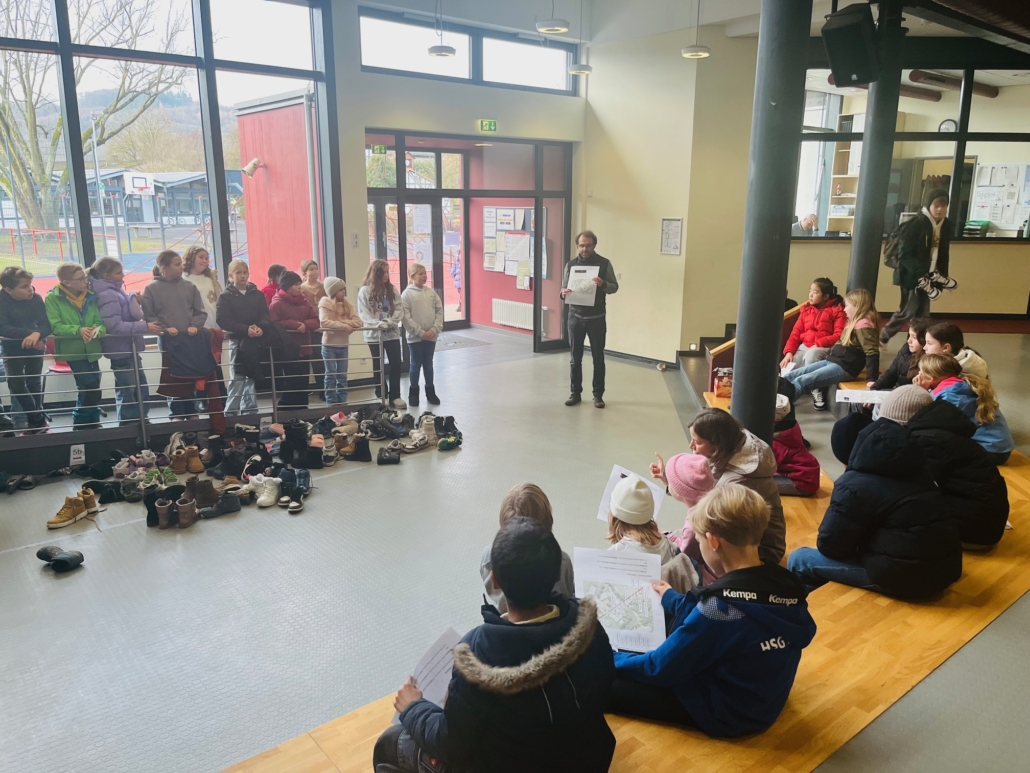
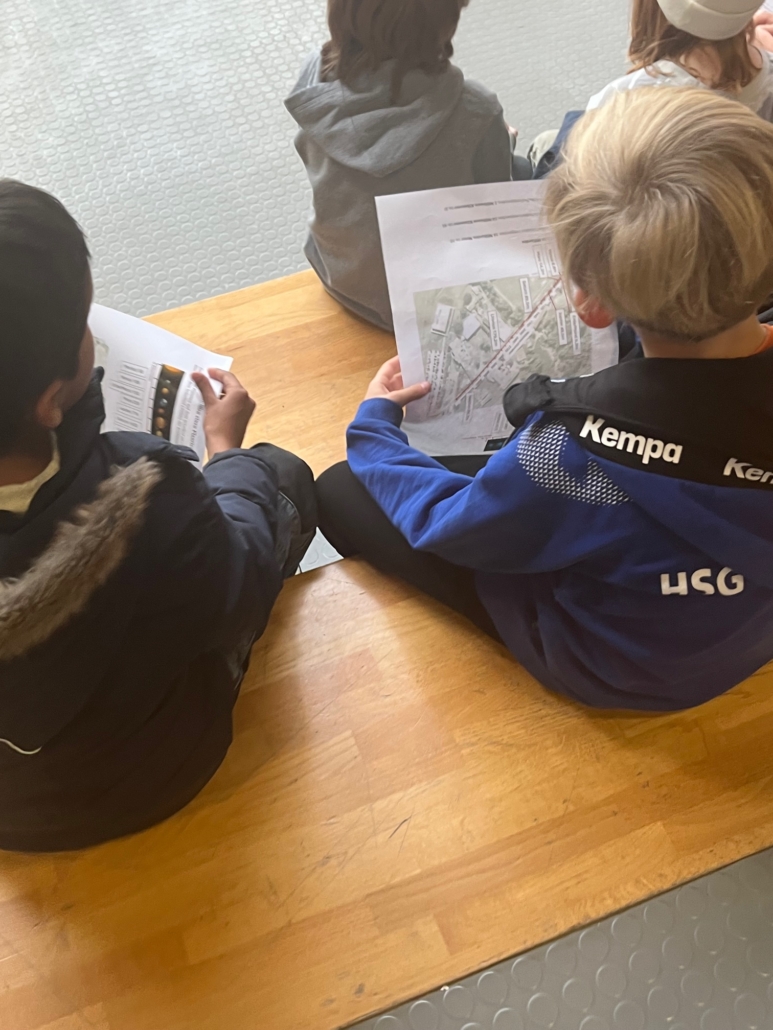
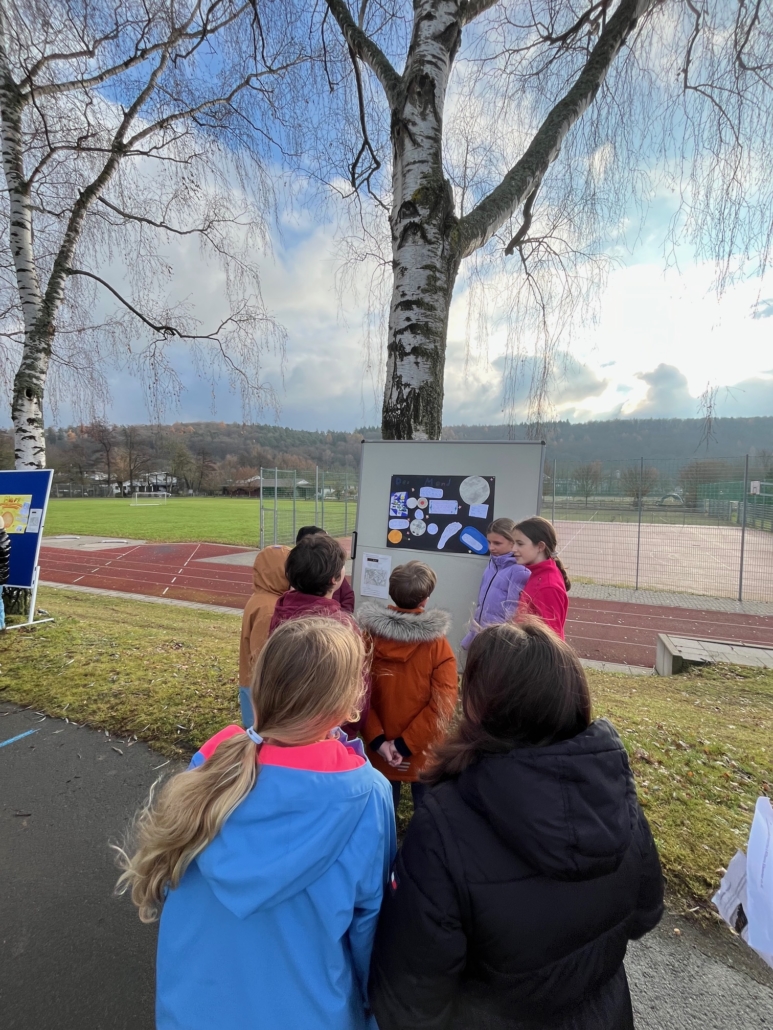
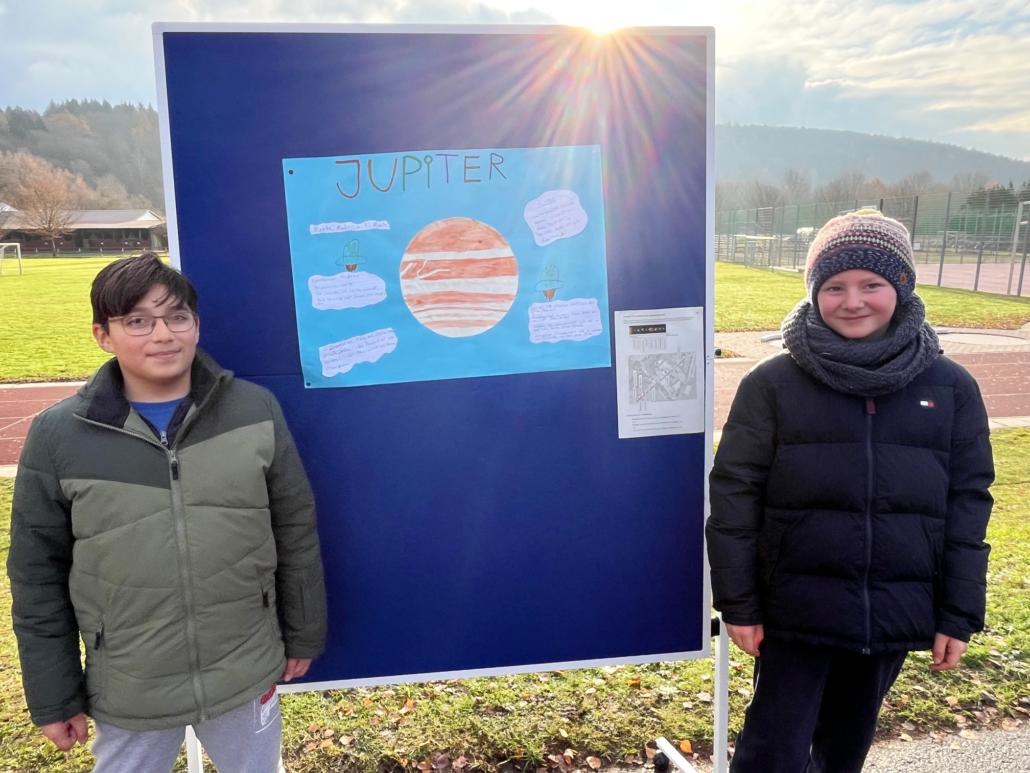
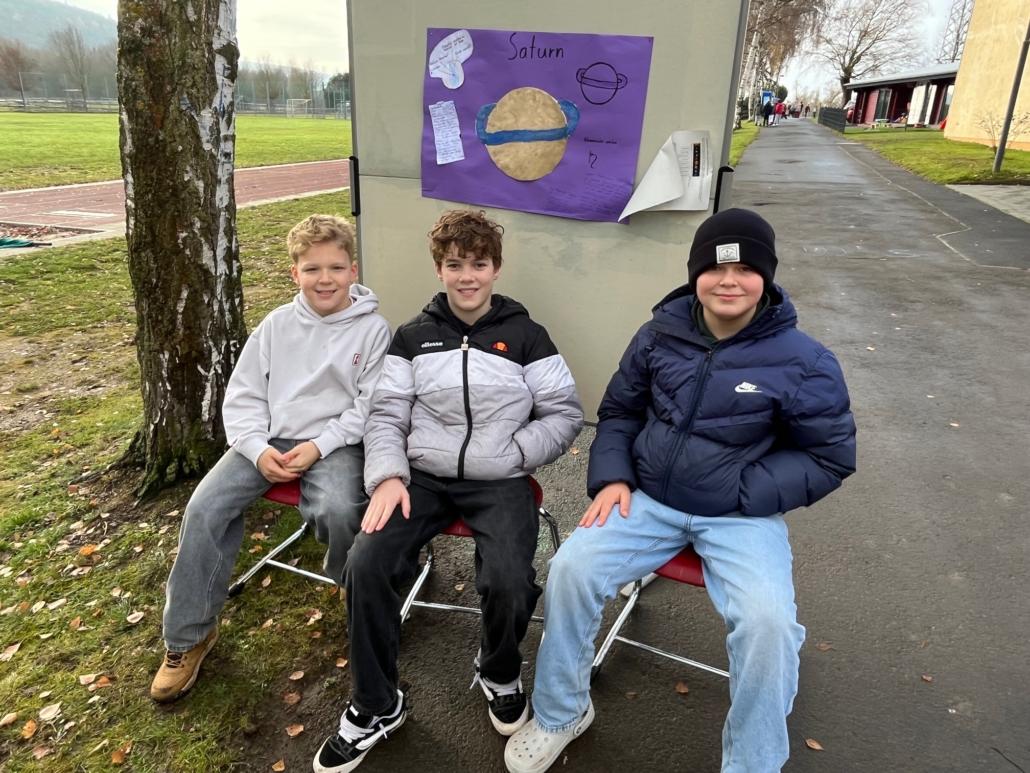
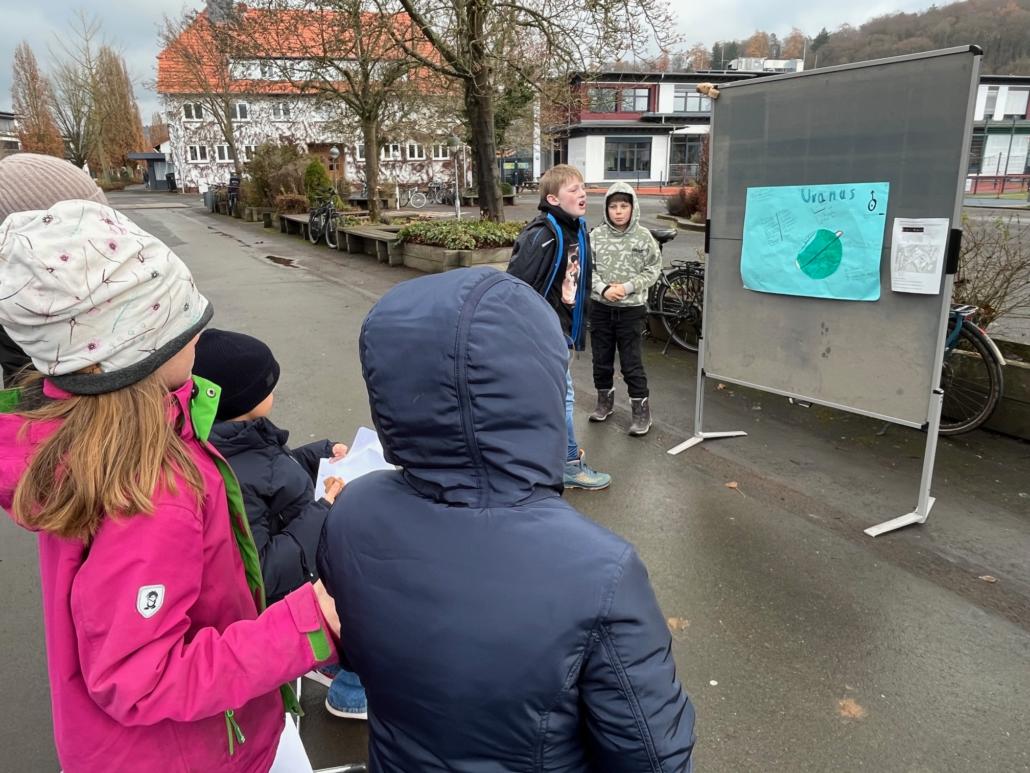
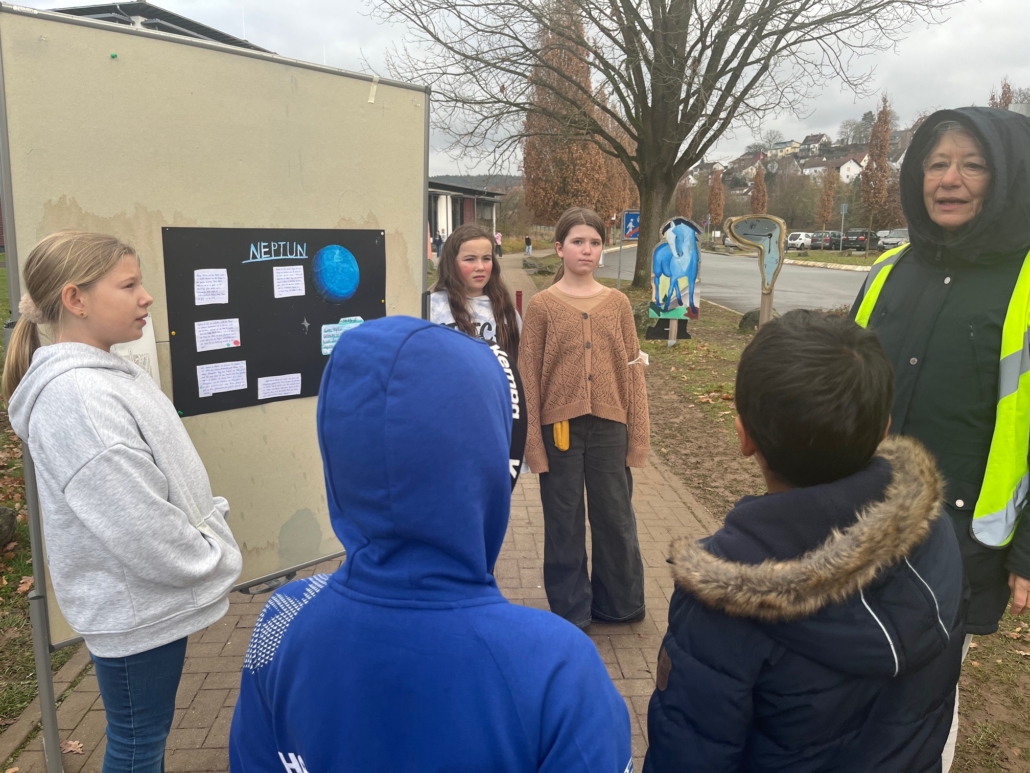
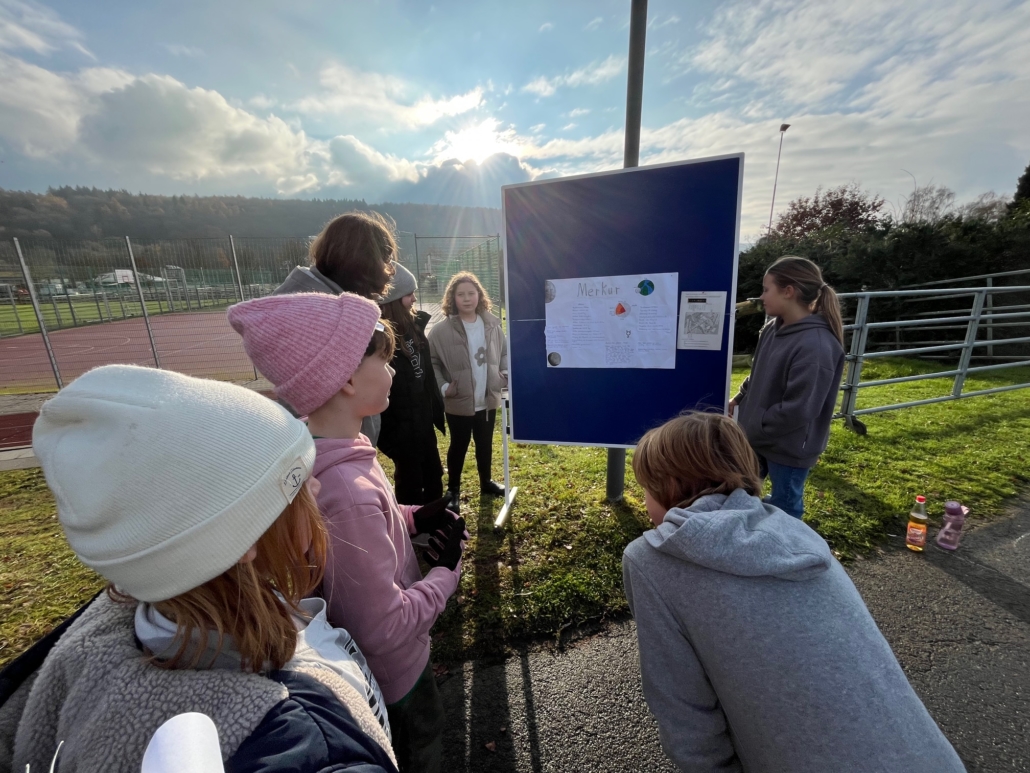
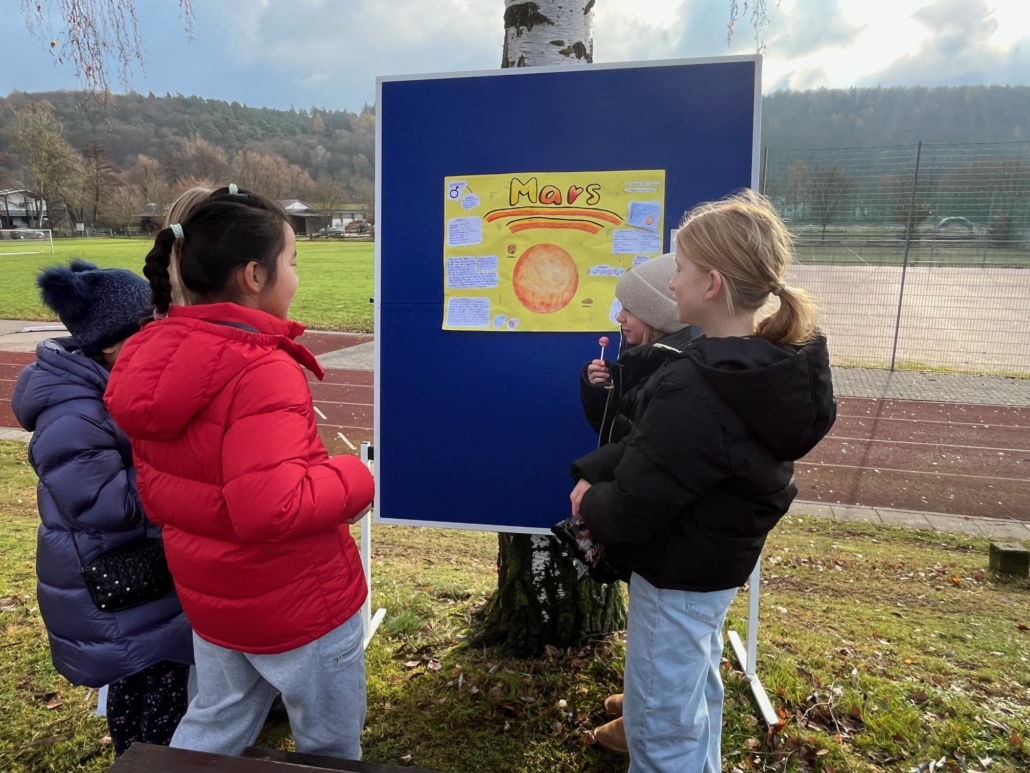
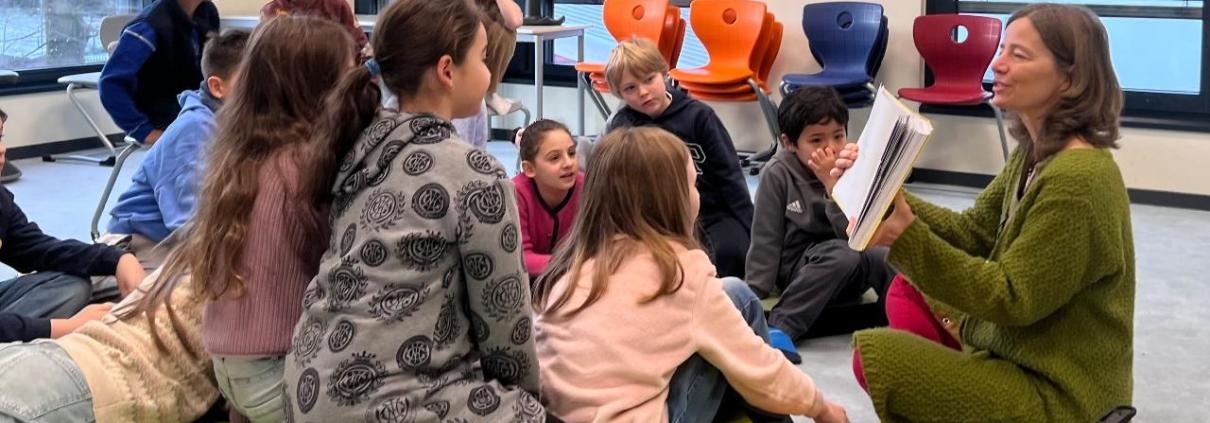
To help 5th-grade students develop a sense of space, time, and dimensions, math teacher Malte Klimczak launched a project to create a planetary nature trail—right on the Steinmühle school grounds!


How long is 15 million kilometers?

How long is a meter? How long is a kilometer? And just how vast—almost beyond our imagination—is a distance of 15 million kilometers? —It’s impossible to visualize this, but even the youngest students at Steinmühle High School can get a sense of it: Along a 300-meter-long stretch, the planets of our solar system were to be placed at the correct distances from the Sun.


A small group chose “their” planet

Working in small groups, the girls and boys set up a station in the schoolyard for a planet of their choice. Geography quickly came into play: How big and heavy is the planet? How far is it from the Sun? And how long would it take to get there from Earth?

Using this key information, the students then designed an information board and a model of the planet—the artistic aspect. Using the scale—where one meter in the schoolyard corresponds to 16 million kilometers in space—they then calculated where each planet should be located in the “schoolyard solar system.” This required mathematical skills.


Explaining the Solar System in Five Minutes

To help people understand these very large numbers and their significance in terms of distance and time, illustrative comparisons were made: how many times one would have to circle the Earth, how many years one would spend traveling by car, and so on.

Since even younger children can develop a basic understanding of this, the young experts from Grade 5 presented their planet project to the students in Grade 4 at the Steinmühle Bilingual Elementary School. The fifth graders mastered the challenge of explaining the topic as clearly as possible in just a few minutes with flying colors. The fact that preparing for this presentation had taken several school hours beforehand was quickly evident in the quality of their presentation.

This fantastic project, which not only drew on interdisciplinary knowledge but was also implemented across grade levels and school types, must be considered a complete success. Creative, challenging—and yet accessible even to the youngest students at Steinmühle.

The sun—which is often mistakenly referred to as a planet but is actually a star—certainly seemed to be in a good mood on the day of the event. It cast its wintery rays over the Steinmühle grounds.

Angela Heinemann


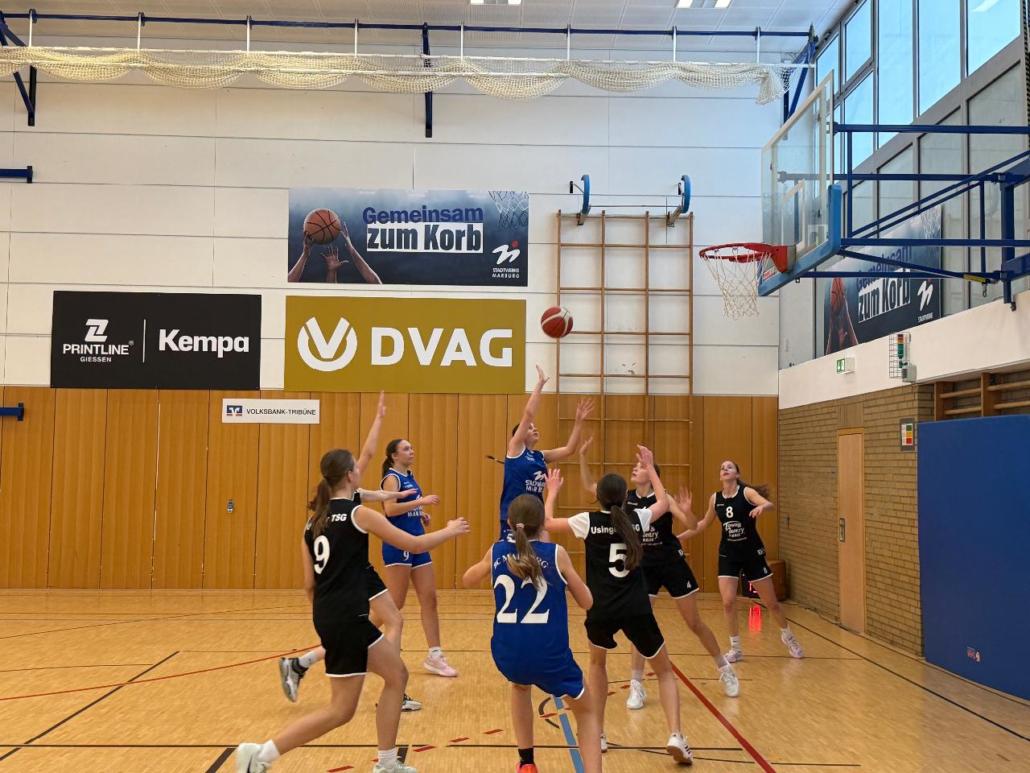
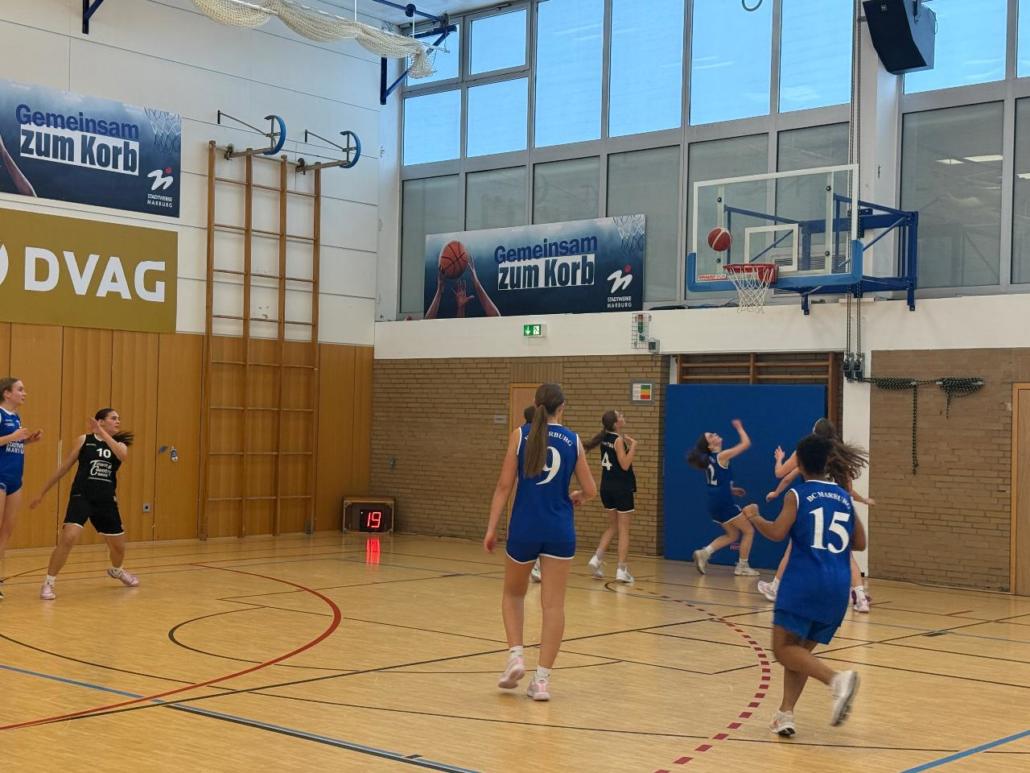
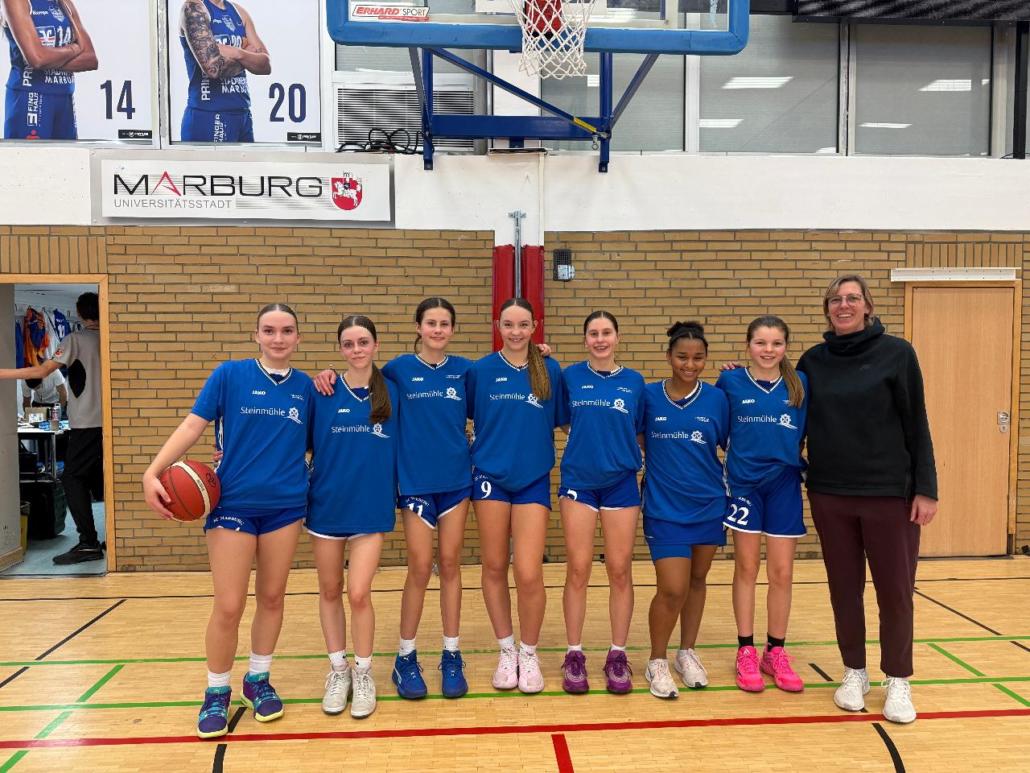
What an incredible achievement: For the first time in Steinmühle’s history, our U18 girls’ basketball team has made it to the state finals in Gelnhausen. In the regional tournament, the team defeated Usingen and thus qualified for the state finals, according to school sports director Marcel Kalb.

Our new colleague at the Steinmühle Bilingual Elementary School, Nicole “Nikki” Johnson—a former Olympic basketball player on Canada’s national team—took charge of coaching and preparing the team for the competitions. A heartfelt thank you for her dedication—and, of course, to all the players who gave it their all.
These were:

Emilia Schneider, Samrawit Wulf, Nike Hütte, Malin Häußermann, Sophia Kirschning, Fenja Schlegel, Anna Thies.

We offer our heartfelt congratulations on this magnificent achievement and will continue to keep our fingers crossed for you!


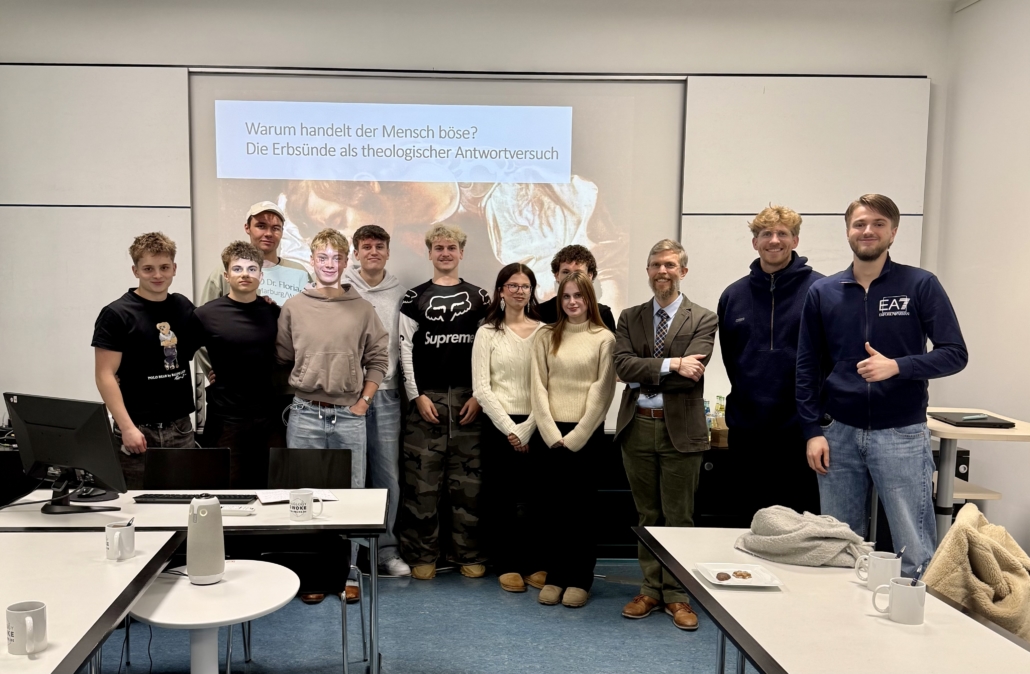
On Tuesday evening, the students in the introductory religion course swapped the classroom for the lecture hall: As part of the student preparatory program, Bene Hohmann’s class visited the Catholic Theological Seminary at the University of Marburg.

The evening offered the Q1 students an exciting look behind the scenes of academic theology. After an initial orientation led by enthusiastic students who guided us through the building and told us about their daily life at the university, the main event of the visit began.


From the Biblical Fall to Modern Narcissism: Insights into Theology

The focus was on the lecture by PD Dr. Florian Klug, a professor of dogmatic theology in Marburg and Vienna. He spoke about a topic that is traditionally difficult to grasp: original sin.

Dr. Klug presented original sin not as a historical event, but as a theological attempt to interpret humanity’s inclination toward evil. The connection to the present day was particularly fascinating: Dr. Klug interpreted original sin as a kind of collective narcissism—the constant exaltation of one’s own ego as the cause of separation from goodness. The students took advantage of the opportunity to ask questions, which led to a lively and engaging discussion.


A resounding success and a taste of college life

The students were thrilled by this glimpse into university life. The evening was not only relevant in terms of content—it also fit perfectly with our Christology unit in Q1—but it also provided the young adults with valuable guidance.

Conclusion: An all-around successful evening that not only imparted knowledge but also—hopefully—sparked an interest in further academic education among the young adults!

Benedikt Hohmann


At this year’s MINTSPACE national competition, organized by school supplies provider Hohenloher, Steinmühle achieved an outstanding 3rd place. The music video “Another Lab in the Hall,” filmed live in the science lab with great dedication, impressed the MINTSPACE jury. Since 2021, the school supplier Hohenloher and the “Jugend forscht” Foundation have been presenting the MINTSPACE School Award to recognize innovative learning spaces and laboratories for STEM education—that is, for mathematics, computer science, natural sciences, and technology.

Students at Steinmühle had set out with great enthusiasm and dedication to write, rehearse, perform, and record a piece of music as their entry for the MINTSPACE National Competition. “Hey, Teacher, let the kids explore!” rang out in unison to the live orchestral sounds of the Pink Floyd classic “Another Brick in the Wall” (as we reported).


The video impressed the jury

Dr. Dr. Dierk Suhr, educational director at Hohenloher and chair of the MINTSPACE jury, was immediately impressed by the competition entry. The entire jury was particularly impressed by the fact that the storyboard, text, audio and video recordings, mastering, and editing had all been handled entirely by the students. Last but not least, a well-rehearsed choir made up of students and teachers from the Steinmühle Lab, along with the school’s own band, “Die lauten Laubfrösche,” made the performance a resounding success.


Prize Money to Go Toward a New Laboratory at Steinmühle

The victory comes with a gift certificate worth 500 euros, which Hohenlohe Regional Advisor Guido Jäger has now presented. Principal Björn Gemmer said, “The prize is a wonderful recognition of what has been built up in the STEM field at Steinmühle over the past few years. It honors the creativity and broad commitment of our students and teachers. The prize money will be reinvested immediately, as we plan to set up an S2 lab for our students next year.”

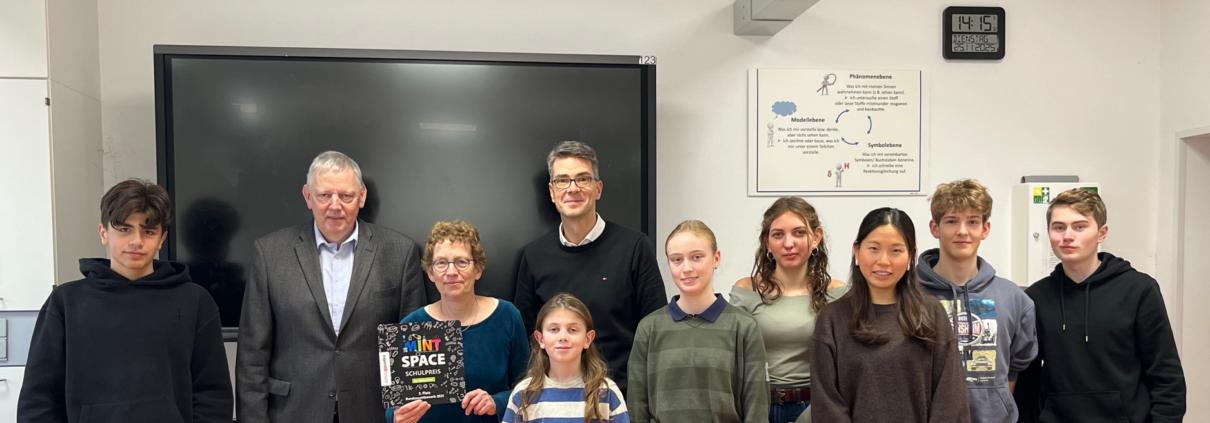
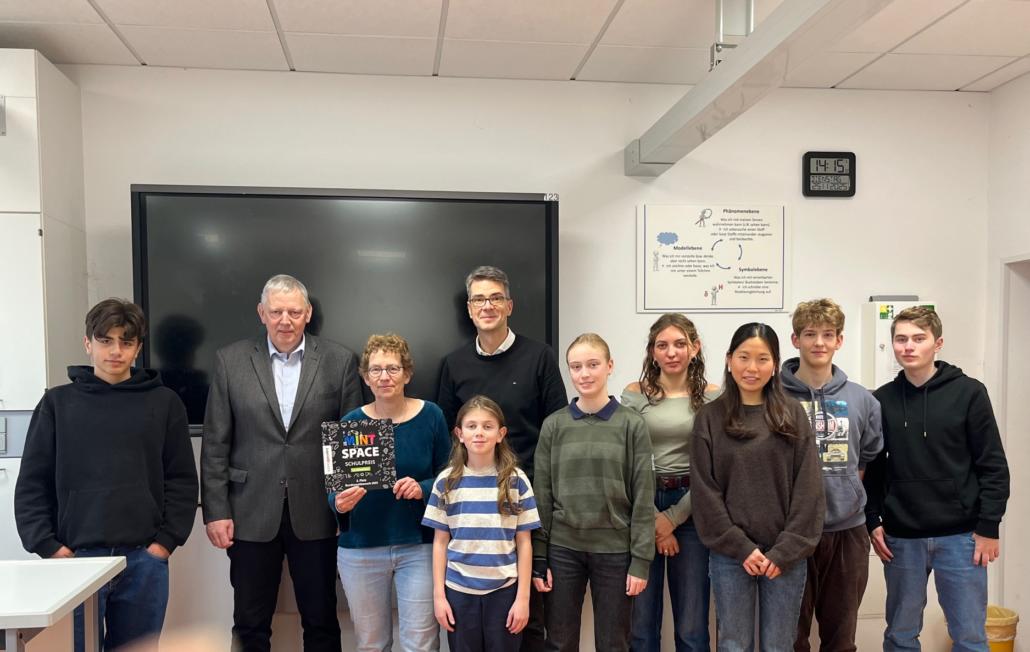
Our photo shows Hohenlohe Regional Advisor Guido Jäger, the Steinmühle STEM coordinator, Dr. Jutta Töhl-Borsdorf, and Principal Björn Gemmer at the presentation of the MINTSPACE School Award, surrounded by students from the STEM module.
The Steinmühle Bilingual Elementary School recently dedicated the morning of National Reading Aloud Day to the themes of reading aloud and reading. Some parents came to school in the morning, and the children had the opportunity to join groups and have stories read to them. Afterward, all elementary school students worked on a book in their respective classes.