

Homosexuality in the Third Reich—A Firsthand Account

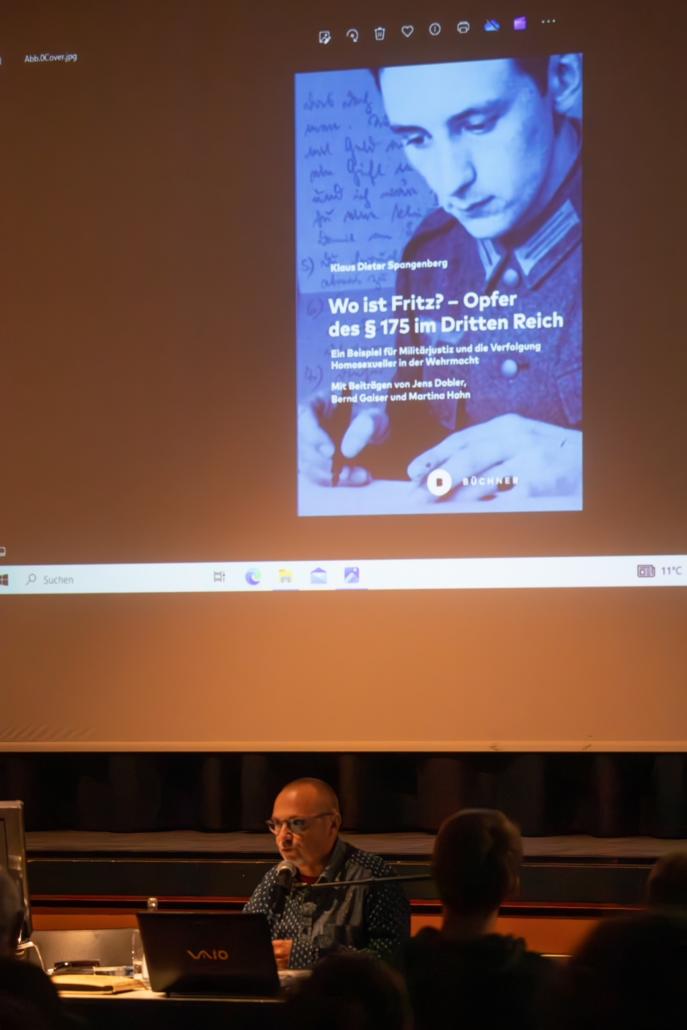
A colorful rainbow shone over the Cappel neighborhood of Marburg and the Steinmühle on Thursday evening, as if it wanted to extend a special invitation to the Forum for Klaus Dieter Spangenberg’s reading. A native of Marburg and a certified social worker, Spangenberg presented his book there, titled “Wo ist Fritz” (Where Is Fritz?). In it, he recounts the fate of his great-uncle as an example of the victims of military justice and the persecution of homosexuals in the Third Reich.
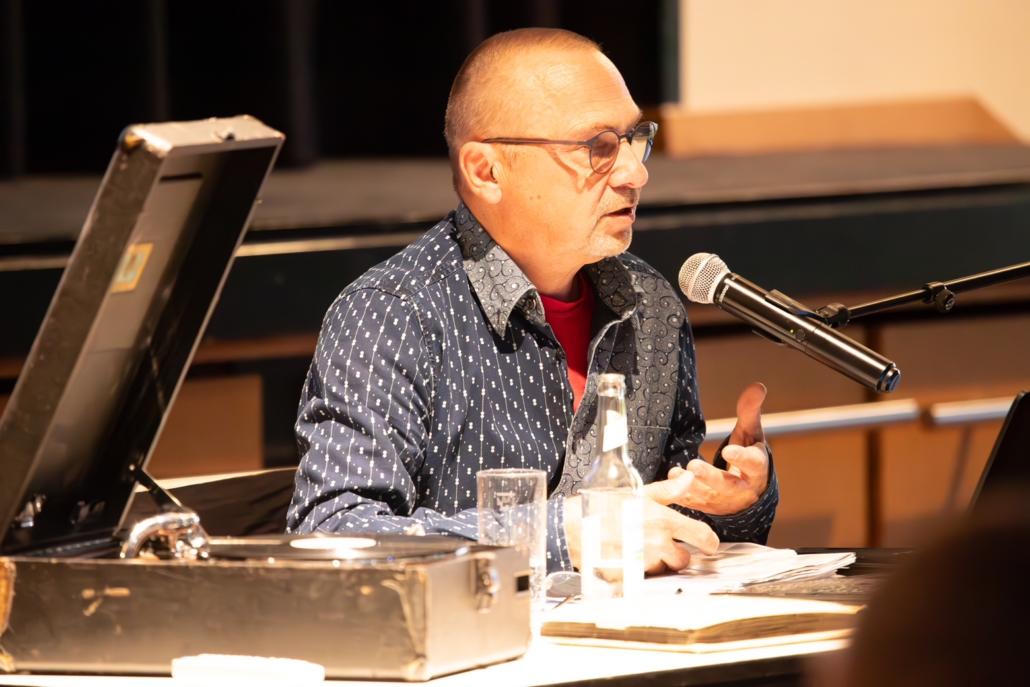
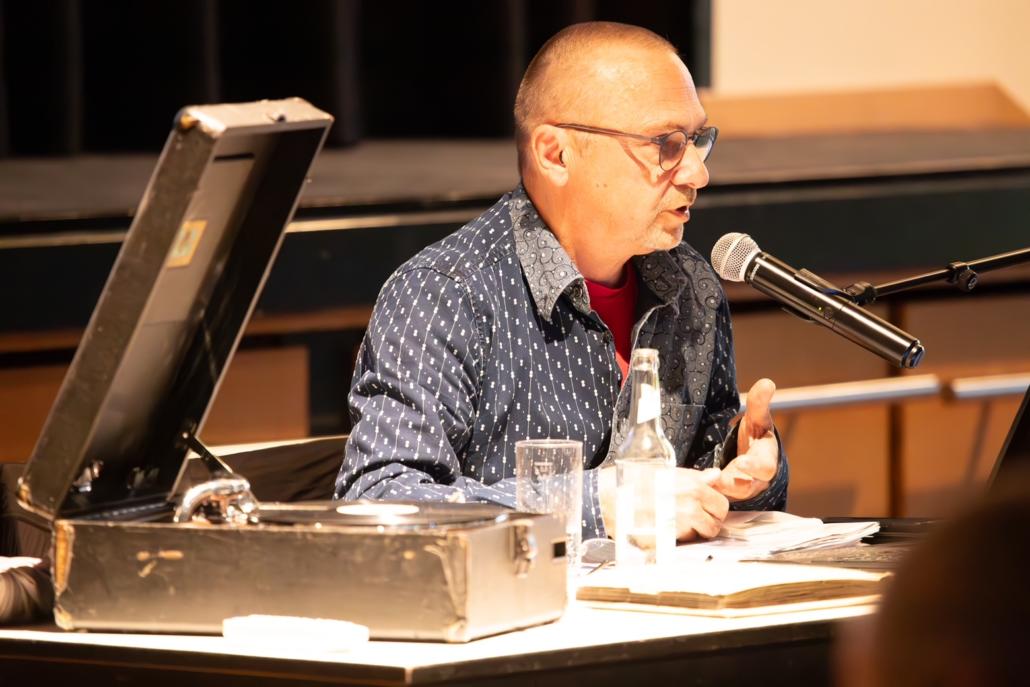
Visitors of all ages did not get to attend a reading in the strict sense of the word. Instead, they listened to a heartfelt account of the family history, with a focus on the life of Great-Uncle Fritz Spangenberg.
Still Something Special
When author Klaus Dieter Spangenberg, born in 1964, came out himself in 1982–83 and revealed his sexual orientation to his family, he was told, “You’re not the first.” There had already been someone else at Bahnhofstraße 11 in Marburg: his great-uncle Fritz Spangenberg. As a gay man during the Third Reich, he had experienced the particular harshness of Paragraph 175 of the Criminal Code—with all its inhumane consequences.
Even though, decades later, more and more rights were won for people in same-sex relationships, and Paragraph 175 of the German Criminal Code (StGB) was later relaxed and finally repealed in 1994—according to the speaker’s account, it always remained something special. In his own family home, the unspoken rule was not to talk about it; after all, the family was well-known and ran an established café in Marburg—and, according to his family, there was no room for gossip. Klaus Dieter Spangenberg—incidentally, a graduate of Steinmühlen High School—who, as a gay man, saw “no future in a small town,” left Marburg for Berlin. He left the city behind—but thoughts of his great-uncle Fritz stayed with him.
Research through 2022
“Can love really be a sin?” asked Zarah Leander in her song from the album of the same name, which the guest played during his lecture. According to his own account, Spangenberg began researching the fate of his great-uncle several years later—in 2009—and continued his research until 2022. Documents—including criminal records, details about his time in the penal battalion, a photo album belonging to his grandfather, and letters from his great-uncle to his own sister—documented the obstacles, resistance, demotions, and punishments that Fritz Spangenberg, born in 1914, had been forced to endure. The photos showed the pharmacy student and later pharmacist first as an assistant cook, often fooling around—sometimes even in women’s clothing—but also, in 1935, in an SA uniform, which promised certain privileges. That same year, Section 175 of the German Criminal Code (StGB) had been further tightened.
Fritz Spangenberg often appeared in public as part of a trio, with his sister Elfriede and her fiancé Hans Hahn. The three pharmacists went on many outings and had their pictures taken. – For Klaus Dieter Spangenberg, these are documents from a time when his great-uncle seemed, at least on the surface, to be doing well.
Witnessing Enforcement Proceedings
Fritz Spangenberg completed his basic military training in Kassel. At some point, an allegation of attempted seduction of minors—an age group that at the time included anyone under the age of 21—appeared in Fritz Spangenberg’s criminal record. The evidence was scant. Nevertheless, Spangenberg was targeted by the “Department for Combating Homosexuality.”
Nevertheless, in December of that same year, he had to say goodbye to his family once again to report for duty in the so-called “punishment company” on the Eastern Front. This unit carried out its operations in Russia and Belarus. His family members had always hoped afterward that he would be taken prisoner. Instead, they—and later Klaus Dieter Spangenberg—learned from a commander’s report in the archives that Fritz Spangenberg and his Unit 299 had gone missing during a night raid in a swampy and forested area.
Fritz Spangenberg’s remains were never found; he was declared dead in 1969. There is no memorial site. His name appears only on a memorial plaque honoring the victims of World War I and World War II.
Social ostracism, the loss of his medical license, shame, and ultimately death in a penal battalion on the Eastern Front make up the sad and moving story of Fritz. The book is an attempt to reconstruct his tragic fate based on documents from the Wehrmacht files and the family archives. Fritz is one of over 50,000 victims of the Nazi justice system and one of approximately 7,000 individuals convicted within the Wehrmacht.
Klaus Dieter Spangenberg: Where Is Fritz? – Victims of § 175 in the Third Reich. An Example of Military Justice and the Persecution of Homosexuals in the Wehrmacht. The book has 116 pages and was published by Büchner Verlag, Marburg, in 2024, as a paperback or e-book (ISBN: 978-3-96317-349-3).