

Impressive as a drawing and a model: Art class plans the future of the former university library
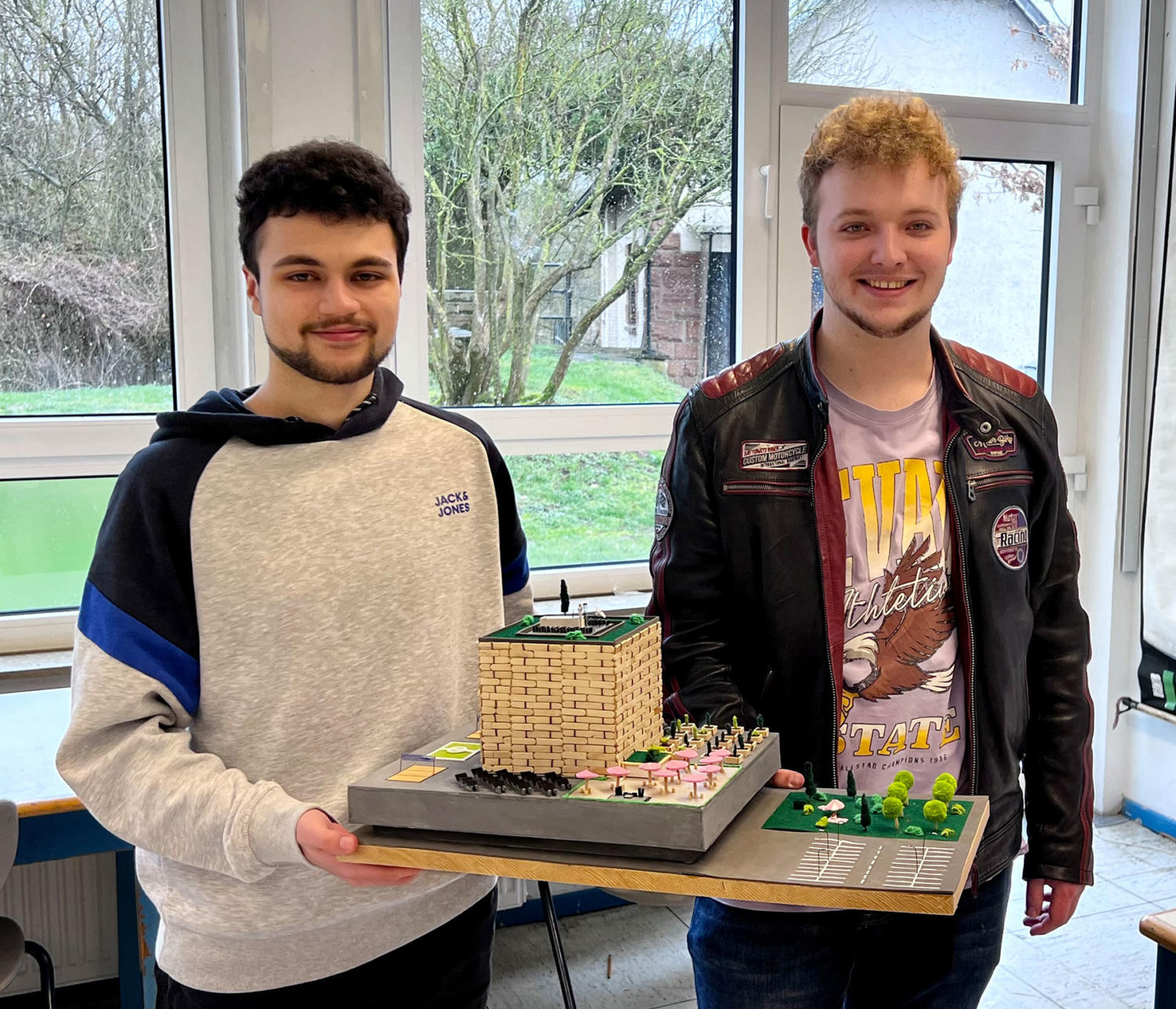
What might the future hold for the former Marburg University Library? The introductory art class taught by instructor Ines Vielhaben has been exploring how the striking building on Wilhelm Röpke Street—which has been practically “obsolete” since the new building was erected at Pilgrimstein—might be used in the near future. Two students decided they’d rather design and build a model than take a written exam. The model, based on a floor plan they drew themselves, was recently presented at the Steinmühle and discussed with two professionals.
It was truly amazing what the students Fabian and Joel had managed to pull off! Even the floor plan on graph paper, drawn to a scale of 1:100 like an architectural blueprint, looked professional. “Of course we had to ask for tips on how to draw a floor plan,” Joel explained, glancing at their teacher, Ines Vielhaben. He was the project partner who focused on the drawing. The result was extremely impressive, as even the tiniest details were taken into account—clean and precise.
“We focused on the tower,” the students explained regarding their assignment. They assumed 11 stories, and although the windows were not included in the model, their number was calculated for the sake of practical implementation: “The building would have 1,000 to 1,400 windows.” If it were up to Fabian and Joel, the old university library would be transformed into a modern student residence. Four shared apartments per floor, with individual rooms of about 18 square meters, each with a shared bathroom including a toilet, as well as a common room.
Housing for Students in a modern setting
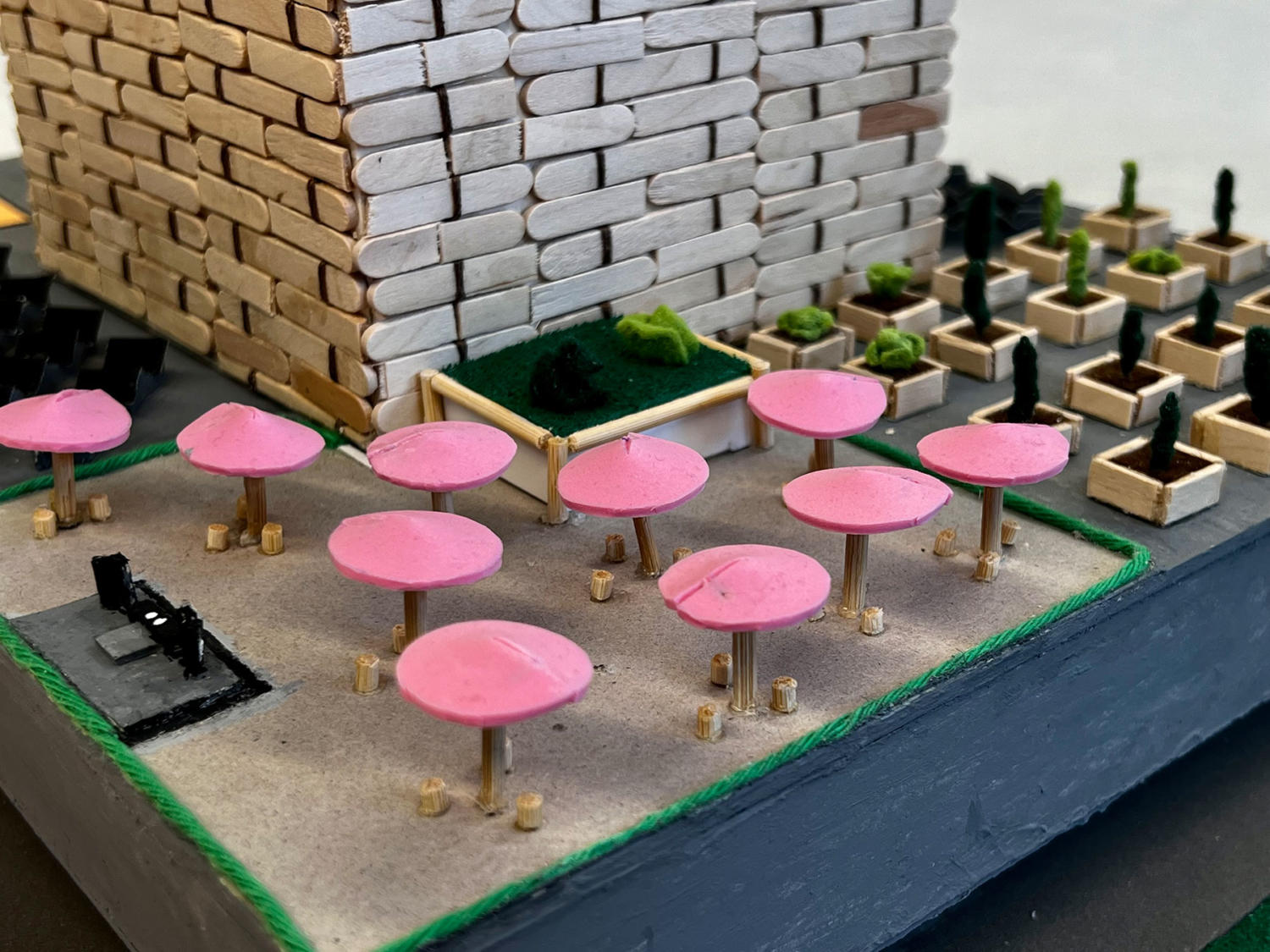
But the students went even beyond basic housing needs and considered how the surrounding area could be designed as a contemporary living space. On the top floor, they envisioned a rooftop café. They planned for a wooden exterior façade—in keeping with the concept of sustainable construction—as well as solar panels in the outdoor area facing the sun. Designing the building’s surroundings proved to be a successful challenge in terms of miniature details, whether it was sun loungers and umbrellas, landscaping, raised garden beds, a volleyball court, or bicycle parking spaces. A truly impressive model that clearly showed the ambition and enthusiasm with which the many tiny details had been crafted.
To the expert eyes of Maja Turba and Ute Kohlhauer from the Department of Civil Engineering and Safety Engineering at the University of Marburg, these significant investments of ambition, energy, and interest in the field of construction were a delight. “The result is all the more impressive given that it’s ‘just’ a basic art course,” says project leader and art teacher Ines Vielhaben with delight. The young planners and model builders took note with interest of the minor adjustments that would be necessary if the miniature designs were actually turned into a real project: fire escapes and a utility shaft were missing. Maja Turba: “A building of this scale houses kilometers of cable.”
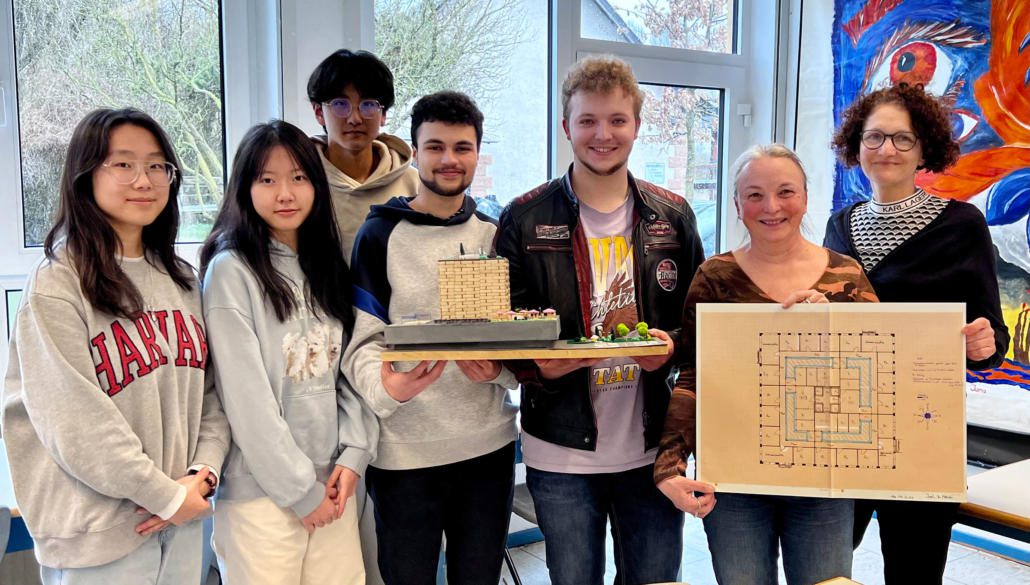
At the end of the meeting, all the students in the class, along with Fabian, Joel, and the two construction experts, posed for a photo with photographer Ines Vielhaben. Everyone agreed: a project like this should definitely set a precedent!