


The defendant’s future as a key factor: Case 8b heard in district court
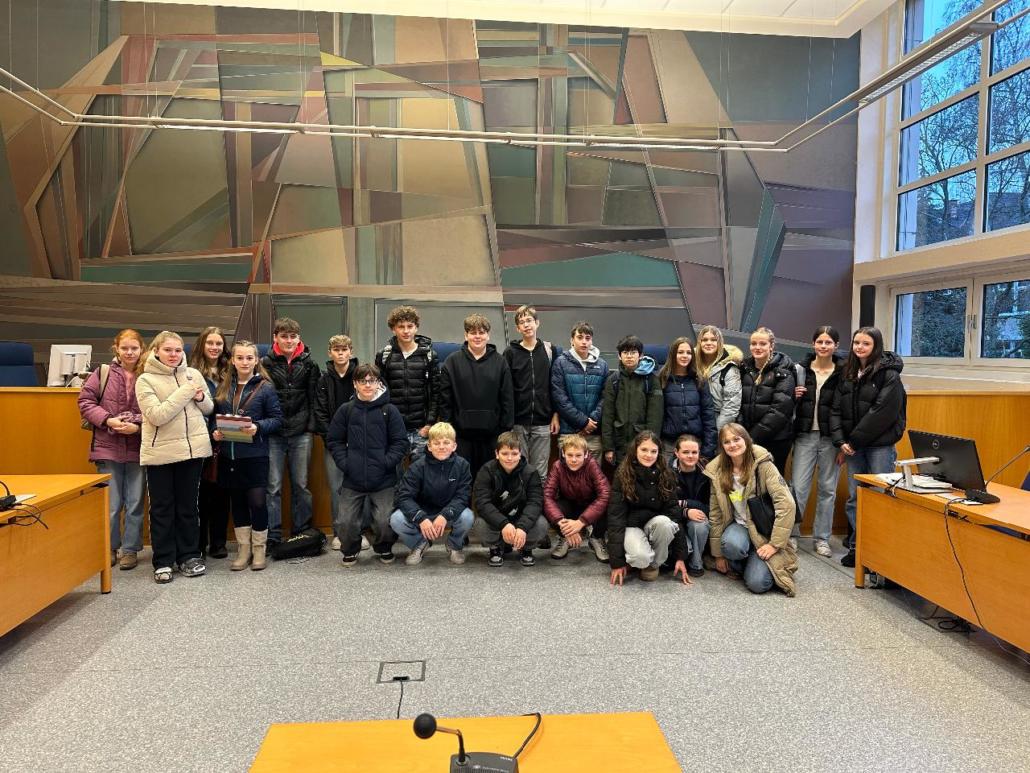
As part of the “Youth and Crime” project, Class 8b attended an exciting court trial at the Marburg District Court. One student wrote the following report about the experience:
On November 20, the 8th-grade class from Steinmühle visited the district court in Marburg. Thanks to our intensive preparation—which involved studying various offenses as well as background information and legal terminology—our class had acquired a certain amount of prior knowledge that proved useful during the subsequent trial.
A Look Inside the Detention Cells
At 8 a.m., we all met in front of the district court on Universitätsstraße. There, our teacher, Dr. Claudia Röder, introduced us to Dr. Wilhelm, who works as a judge at the district court. We were also lucky enough to run into two court officers there who were willing to give us a tour of the court’s holding cells.
Ten minutes later, we were all standing in the narrow hallway in front of the five simply furnished detention cells. The interior of the detention cells was basic: a wooden table mounted on the wall, a simple chair, a sink, and a toilet. The police officers also shared a few anecdotes from their daily work, which gave us a small theoretical insight into how people feel when they’re held here for a short time.
Visit to the Criminal Courtroom
As a result, before the trial began, we had a little time left, during which the court officers showed us around the criminal courtroom. There, the court officers and Dr. Wilhelm explained further examples of different types of court proceedings and their specific characteristics. This was good preparation for us ahead of the upcoming trial.
Narcotics were the topic
The trial began at 9 a.m., and as it progressed, we were able to get a good overview of the general structure of such a trial. This case mainly concerned the use and trafficking of narcotics—a topic we had covered in class, but not nearly in such detail.
Reading Chat Histories Aloud
Despite the many legal details, we were able to follow the proceedings well, even though it was harder to stay focused at times. For example, when the evidence was being reviewed. The defendant’s cell phone had been analyzed by the police, and the reading of the chat histories and call records ended up taking almost exactly one hour.
26 prior convictions and a report from a psychiatrist
The two police officers who had been called as witnesses reported on the investigation into the defendant, which was very informative and provided yet another perspective on the trial. Twenty minutes later, there was another rather theoretical segment in which the judge read aloud the defendant’s 26 prior convictions, which gave each of us a small glimpse into the defendant’s past and childhood. As we saw from the statements of the probation officer and the psychiatrist—and as we realized for ourselves—such background information is always important. Most likely, everyone—including the prosecutor and the judge—would have had a different impression of the defendant before hearing the statements from the probation officer and the psychiatrist. But with this assessment, which was a great help to the judge, many aspects of the case changed.
It’s not about the maximum sentence, but about the future
After all, in the end, everyone wants to find a good solution to the problem or the situation at hand. The goal is not to sentence someone to the maximum penalty, but to find a solution for the person in question. Everyone involved worked to secure a future for the defendant and to guide him, thereby enabling him to find his way back into society.
Annamierl Pierenkemper, Class 8b


