

An Architectural City Tour
According to research, interactive instruction is effective and has a positive impact on learning outcomes and motivation—especially when it is digitally supported and cognitively stimulating.
This approach was confirmed on Monday, September 22, when the 13th-grade advanced and regular art classes met in Marburg’s Oberstadt for a city tour that the students had planned themselves.
The exhaustion that had been so pervasive at first was soon dispelled by the autumn wind that cut right through us and Zoe’s anecdotes about the clock tower and the interesting architectural design of City Hall.
A Closer Look at City Hall
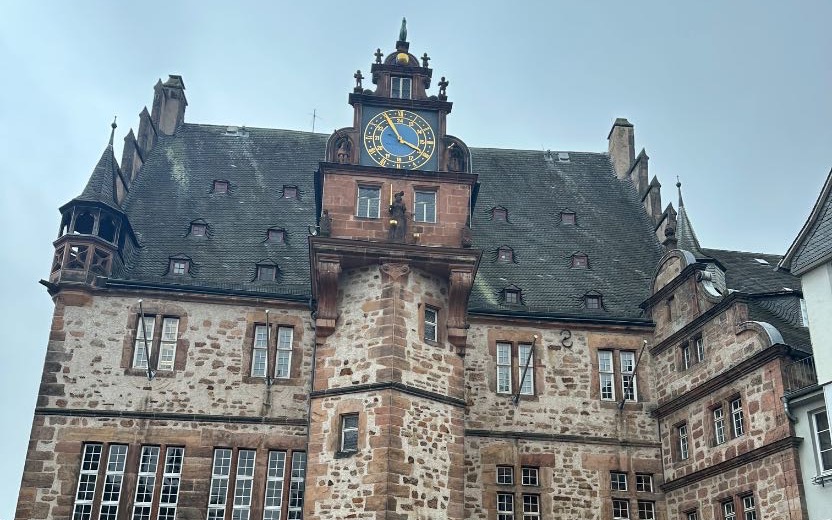
This well-known building stands on the south side of the market square, with its main facade facing north. The stone building is three stories high and dates from the Late Gothic period. A striking feature is the hexagonal stair tower in the center of the town hall’s facade. The tower has its own entrance, above which is a relief of a saint. Above this tower is the richly decorated roof pediment with the town hall clock, which was added later in 1581–1582.
Above the clock stands a copper rooster that flaps its wings up and down every hour. The trumpeter to the left of the clock also blows his trumpet on the hour. We were particularly impressed by these fascinating decorations on the clock.
Kilian—the oldest house in Marburg that is still inhabited
Even though many of the buildings we noticed during our tour of the Upper Town were already familiar to most people, it was still a different experience to learn about their unique features, characteristics, and history. The “Kilian,” for example, is the oldest house in Marburg that is still standing and inhabited.
With a history spanning some 800 years, it bears the marks of numerous cultural and artistic eras. Until 500 years ago, it was still the oldest church in Marburg, but it then became a gathering place for shoemakers. That is why the square next to St. Kilian’s is also called “Schuhmarkt” (Shoe Market). Half-timbered elements were later added to the foundation walls of the Romanesque stone church. It is a remarkable example of the many ways a building can be repurposed over time. In this case, a sacred building was transformed into a guild meeting place, a police station, and finally a residential building. Some of the eras this building has witnessed are still visible on its walls today—even though some of them date back several centuries. The same is true of the Old University and its church. Upon closer inspection, one notices the difference in the primary building material between the church’s main structure and the university buildings attached to it.
Old university made of white sandstone
Unlike the church, the Old University is built of white sandstone—though this is hardly noticeable today due to weathering. In fact, the monastery church is about 400 years older than the Old University, which is nonetheless considered the world’s first Protestant university. It differs from the University Church in its architectural history: While the University Church is a historic building that was later redesigned in the Neo-Gothic style, the Old University was conceived and built from the ground up in the Neo-Gothic style.
Upon closer inspection, however, the age difference becomes apparent—despite the efforts of the architects and builders to conceal it.
More memorable than any presentation
The many beautiful, old half-timbered houses found in Marburg’s Old Town are so steeped in history and architecturally impressive that some people were even able to forget that they had failed their driver’s license test that very morning.
After this informative tour through the Upper Town and its buildings, everyone agreed: This (inter)active lesson was more memorable than any presentation could have been. In those two hours, we learned more about the wide variety of architectural styles and buildings in Marburg than we had in all the years we’d lived in our historic hometown.
Paula Koch