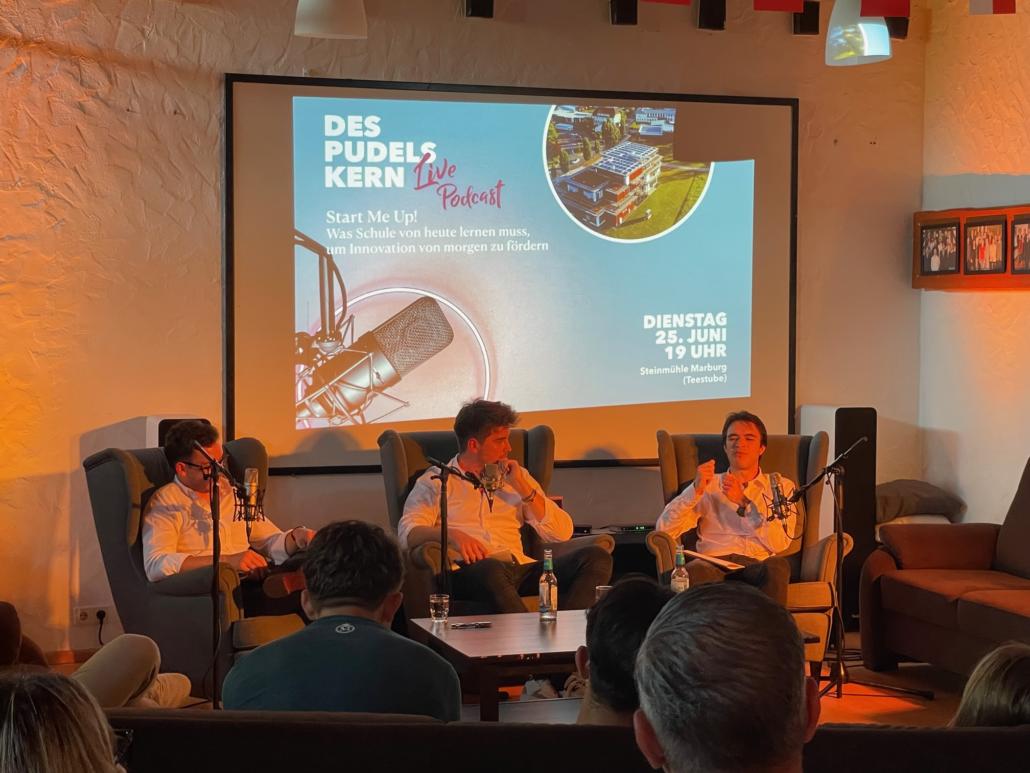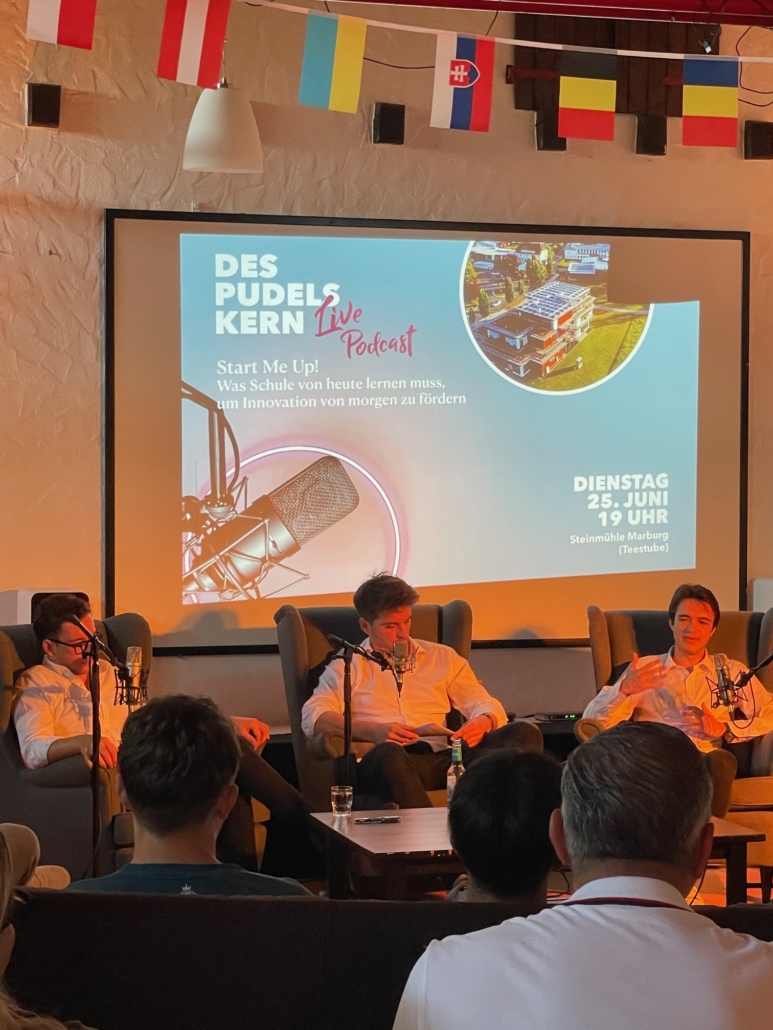


Back at the Steinmühle with the podcast “Des Pudels Kern”
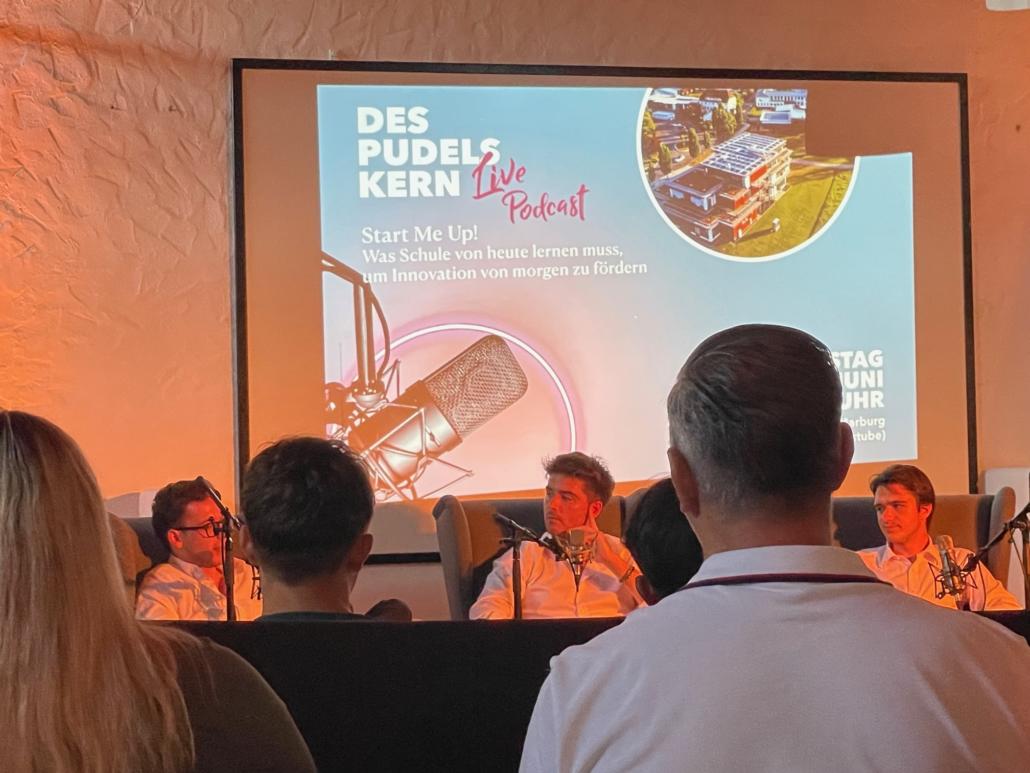
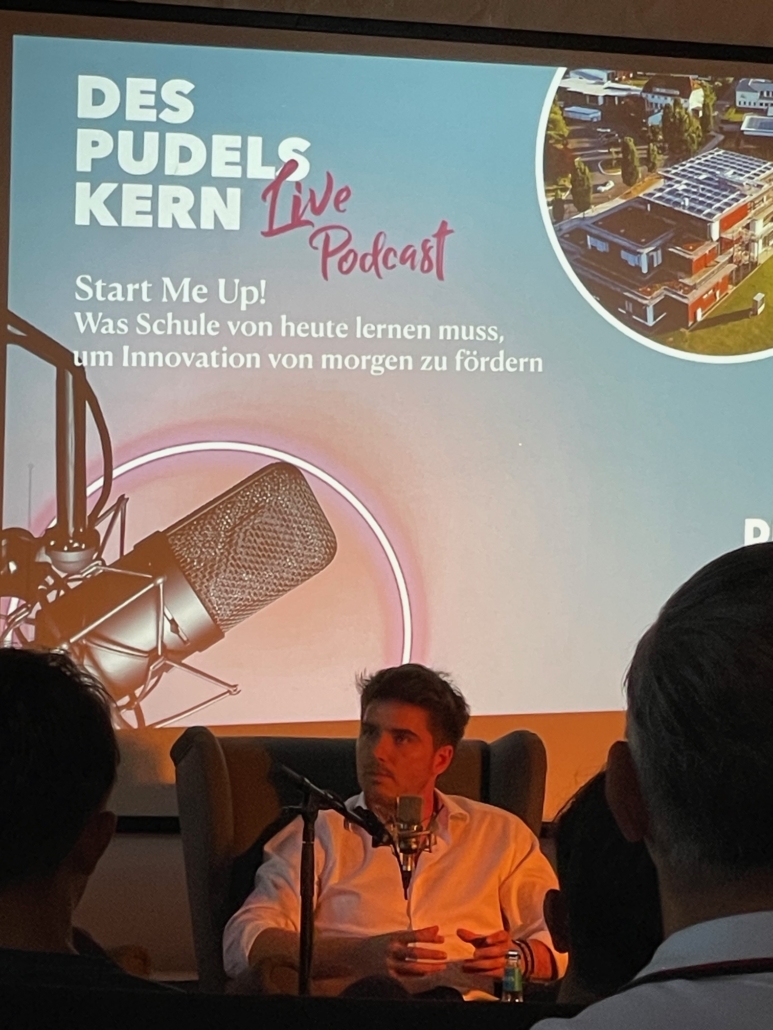
“Des Pudels Kern” is the name of a podcast that recorded a live segment on campus during Steinmühlen Festival Week: After an extensive look back at the past during festival events and the like, the focus has now shifted to the future. Former Steinmühlen students Philipp-Leo Mengel, Philipp Kreiter, and Marco Kosic posed the following question to the audience in the boarding school’s well-attended tea room: Does school actually prepare students well for the future, and does it inspire future innovators?
The Environment Influences Innovative Thinking
What could schools do better to inspire innovative ways of thinking and ideas in their students? What role does education play in fostering creativity and adaptability? — Two essential qualities for innovation.
The participants reflected on their own formative school experiences and examined which structures and teaching methods foster innovative thinking. Particular emphasis was placed on the importance of environments that support experimentation, a willingness to take risks, and critical thinking. At the same time, the podcast episode questioned traditional educational approaches and emphasized how interdisciplinary approaches and tackling real-world problems can better prepare students for the challenges of a rapidly changing world. In doing so, they compared educational systems in different countries and also noted a correlation with the social environment. Good grades in school or college are not necessarily an indication of strong professional performance. The podcasters cited examples of students who struggled in high school, such as Steve Jobs and Dr. Martin Luther King.
Respond flexibly to problems
The podcasters noted that schools can learn from innovators to raise awareness and create the necessary conditions. As for the personal qualities of potential innovators, the key points ranged from “being good at math and science” to “responding flexibly to problems” and “knowing how to search effectively on Google”. Other qualities mentioned included an open-minded approach to outcomes and an answer to the question: “How do I apply my knowledge?” The role of college dropouts and career changers was also discussed.
Leo, Philipp, and Marco have personally experienced in recent years that the conditions for innovative projects, startups, and ultimately for innovative thinking and action are not the same everywhere in the world. Leo, who is now an economist at Bocconi University in Chicago, studied at Oxford and at University College London. Philipp Kreiter also studied at Oxford and now works at Mercedes-Benz in Stuttgart as a product manager for strategy for the Mercedes-Benz Operating System.
Steinmühle as a Learning Organization
The third member of the trio, Marco Kosic, works in the creative industries. He is an editor and communications consultant who focuses on topics relevant to culture and society. Among other things, he is responsible for the design of the podcast, which covers a wide range of topics in the fields of culture, philosophy, music, and science and is often produced in collaboration with institutions such as WDR.
“For us at Steinmühle, hosting this event was both refreshing and educational,” enthused Dirk Lange, a member of the school administration. “After all, Steinmühle sees itself as a learning institution—and there were plenty of opportunities to learn something new.”