

Students from Steinmühlen Win Prizes in the “Jugend Forscht” Competition
The 2017 “Jugend Forscht” regional competition took place in February in Lollar at Bosch-Thermotechnik (formerly Buderus). For the first time, two groups from Steinmühle participated and immediately achieved very good results. The groups had to present their projects to a jury at an exhibition booth they had designed themselves.
The girls won second place in the technology category, while the boys took second place in chemistry and the special prize for environmental technology (worth €50).
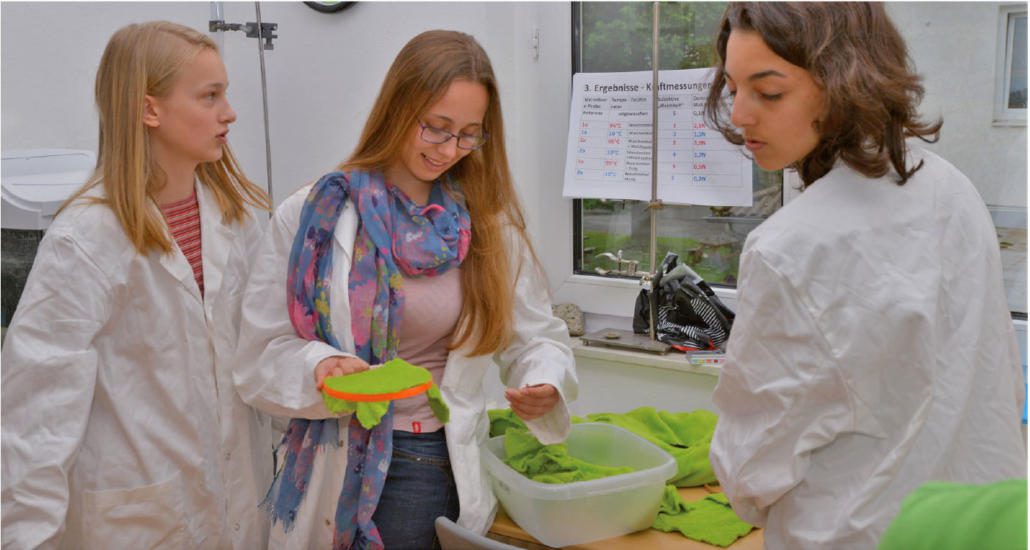
Problems with the microfleece. A group of girls who are part of the “WU Forschen” program (grades 8–9) at Steinmühle under the guidance of Dr. Töhl-Borsdorf participated in the “Jugend forscht” competition for teens aged 15 and older: Nelly Endres (8b), Lea Marko (8a), and Flûte Seifart (9b). Their topic was: “Microfleece—Does Superfleece Fail Even When Washed?”
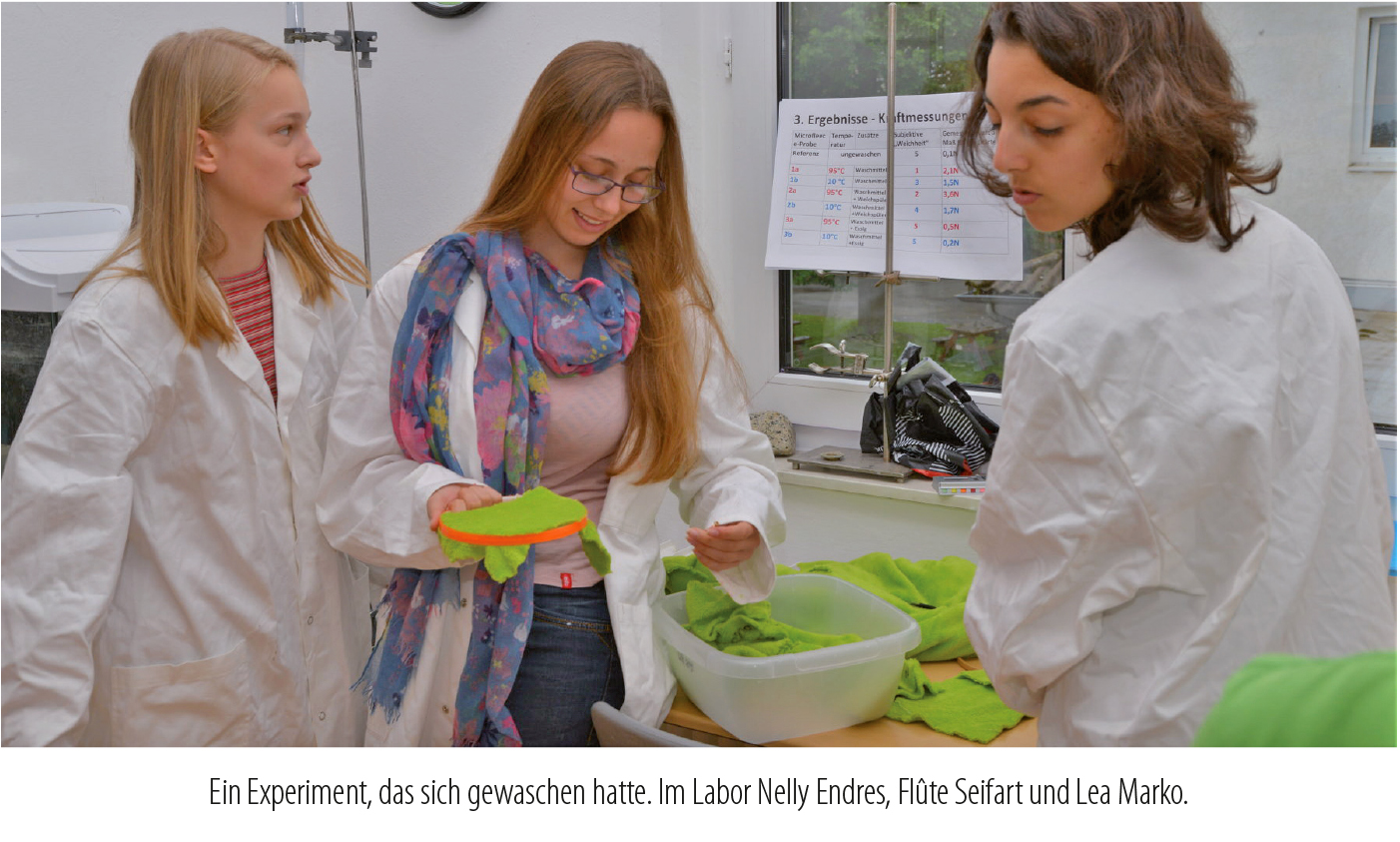
The starting point was the observation that microfleece fabrics are very common in Germany. They’re cozy, but unfortunately they get dirty pretty quickly. What can you do when these items aren’t as soft and cozy after washing, and using fabric softener isn’t always the solution? What works quite well for terry cloth towels is, unfortunately, only partially effective with microfleece.
To verify that these weren’t just subjective impressions, Nelly, Lea, and Flûte built a device that can measure the “softness” of a fleece fabric and provide other insights into what kinds of washing processes preserve the “softness” of microfleece. The students also examined the fleece samples under a microscope and investigated how the texture of microfleece changes as a result of different washing processes.
In the end, the students were able to report:
“In this project, we succeeded in developing a machine and a method to measure the ‘softness’ of microfleece. Other findings include that microfleece should not be washed at very high temperatures, that the use of fabric softener is generally not recommended as it causes the fibers to ‘stick together,’ and that adding vinegar results in a very good softness rating.”
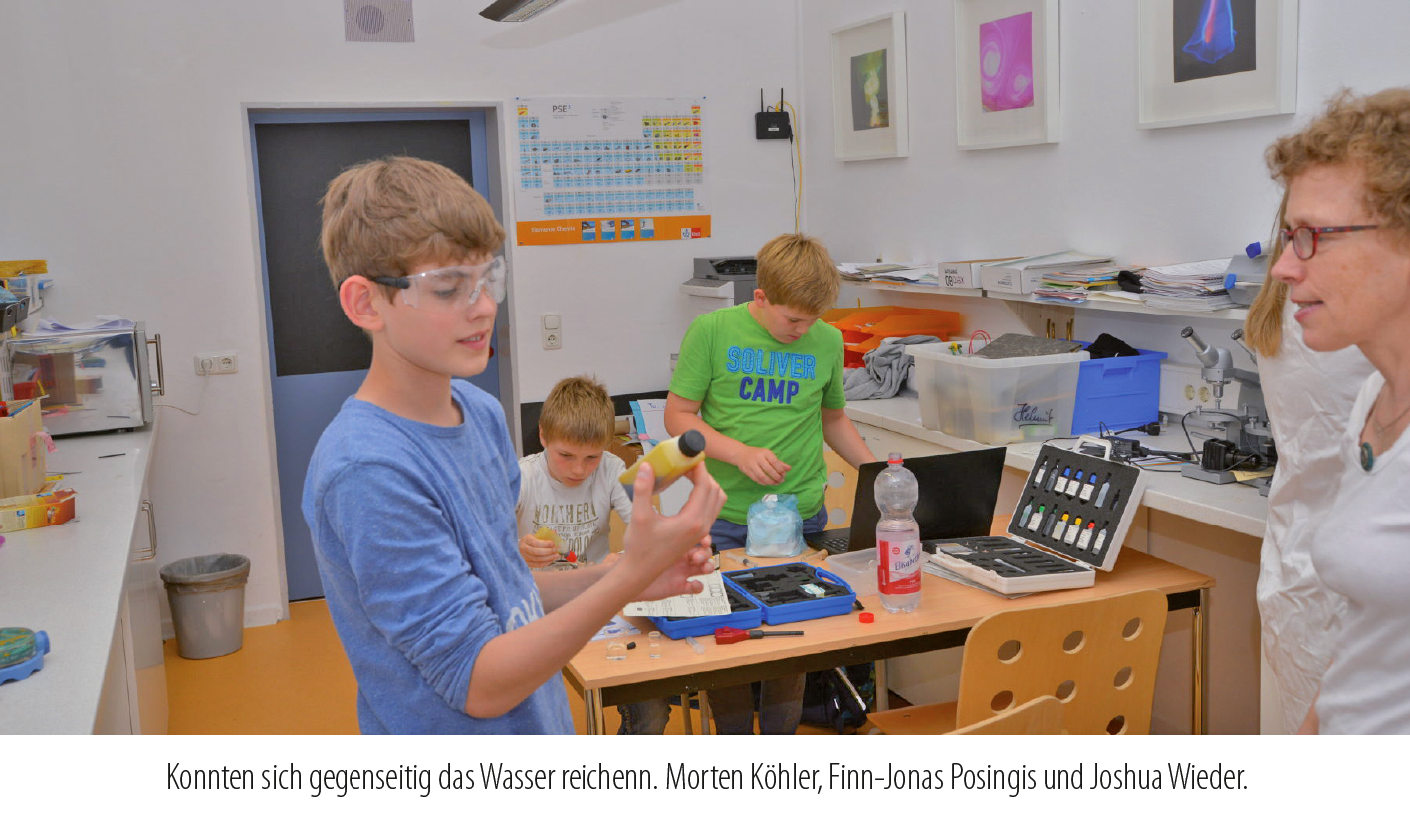
Expensive and cheap types of water. A group of students from Dr. Töhl’s GuFi course took part in the “Schüler experimentieren” competition. This is the junior division of “Jugend forscht.” The participants were sixth-graders Morten Köhler, Finn-Jonas Posingies, and Joshua Wieder. They were the youngest team in the competition. With their experiments, they wanted to find out:
Is premium water really better than discount store water? The students explained their research question:
“When we tested various tap water and river water samples for their components, we came up with the idea of analyzing mineral waters. We wondered whether the expensive premium mineral waters are really better or healthier than cheap discount store waters. To do this, we tested various water samples for different components (nitrate, nitrite, phosphate, etc.) that aren’t listed on the label. Our goal was to determine whether it’s worth spending so much money on mineral water. And here’s what we found: Overall, it’s fair to say that the price differences are only partially justified. Cheap mineral water can be good (tegut) or rather poor (Quellbrunn), but even expensive water sometimes has a higher nitrate content than discount store water, which isn’t exactly ideal. However, we cannot make a definitive assessment because we were unable to test for other critical substances (e.g., heavy metals such as arsenic, radioactive uranium) or residues of pesticides or bacteria.”