


Microbes and the Climate Crisis: A Top-Notch Lecture Sparked Interest in Research
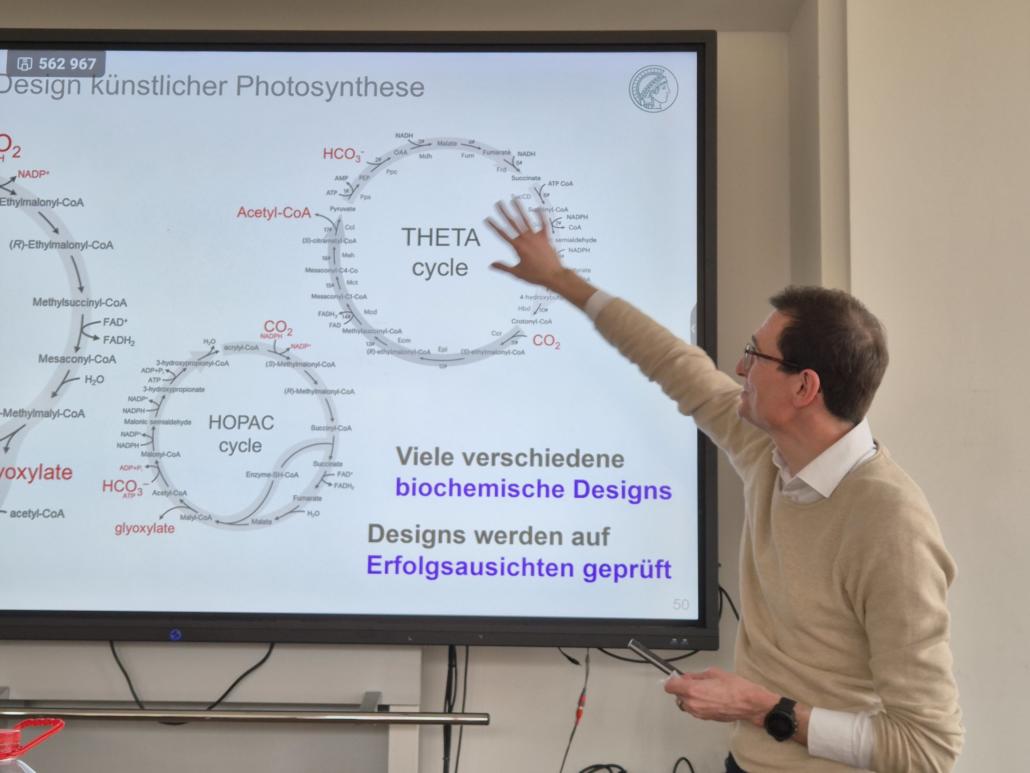
Conveying complex topics in a way that is tailored to the audience—this is, at best, a skill possessed by professors, lecturers in general, and also by teachers. With this in mind, Björn Gemmer, principal of Steinmühle School, expressly praised the Marburg-based biologist and chemist Prof. Dr. Tobias Erb of the Max Planck Institute for Terrestrial Microbiology for his public lecture at Steinmühle.
About 100 interested attendees came to hear the presentation on the topic “Microbial Power—New Paths Out of the Climate Crisis.” In the auditorium were students from the advanced biology classes in grades Q2 and Q4, students from the introductory biology class in our Q4, as well as external attendees and all members of the plus-MINT group from Steinmühle.
How can microbiology help reduce the CO2 content of the atmosphere?
That was the topic of the lecture, which biology and math teacher Dr. Sven Freibert—a member of Steinmühle’s Plus-MINT support team—summarized as follows:
The “terrestrial microbiome” plays an enormously important role in the carbon cycle. The sequestration of CO2—including anthropogenic CO2—is carried out almost entirely by terrestrial plants and aquatic microorganisms. The latter are primarily found in the world’s oceans. However, the efficiency of CO₂ fixation by microorganisms is not very high. Due to the comparatively high availability of CO₂ throughout both the older and more recent geological history, there has been—and continues to be—no evolutionary pressure to significantly improve this efficiency.
Microbiology—or, more specifically in this case, synthetic microbiology—and, above all, the team led by Prof. Dr. Tobias Erb has now made this “problem” of efficiency the focus of its research. The goal is to use microbiological, genetic, and biochemical methods to identify and isolate metabolic pathways in microorganisms and increase their efficiency, with the ultimate aim of using these molecular machines for artificial CO₂ fixation. It should be noted, however, that the goal is not to release artificially produced microorganisms!
Another approach being pursued by Prof. Erb’s team is to genetically modify crops that are grown in large quantities so that these plants can fix CO2 more efficiently. This would have the dual advantage of removing large amounts of anthropogenic CO₂ from the atmosphere and enabling the plants to grow significantly faster, which in turn would make food much more readily available and thus contribute to global food security. “Killing two birds with one stone”!
The audience’s full attention
It’s not usually the case that an audience listens spellbound to a speaker from start to finish. Tobias Erb managed to hold the audience’s full attention throughout his nearly 45-minute presentation. He struck the right balance between technical expertise and clarity, and during the subsequent Q&A session—which lasted about 30 minutes—it became clear that he had truly engaged the audience with his content.
In closing, Erb expressly praised the keen interest shown by the Steinmühlen students as well as the quality of their questions.
Speaker Sparked Interest in Research
Professor Erb began by introducing the Max Planck Institute in Marburg as one of a total of 86 Max Planck Institutes. He highlighted the quality of the research, which is evident not least in the numerous awards, including several Nobel Prizes. The scientist highlighted the work of the international research teams and sparked an interest in scientific research.
Central Hesse Student Research Center as the organizer
In closing, Steinmühlen School Principal Björn Gemmer thanked not only the speaker, Prof. Dr. Tobias Erb, and Dr. Virginia Geisel, the press officer, but also the Central Hesse Student Research Center, which initiated and organized the event. As part of this group, Steinmühle is hosting four lectures in the “Microbes@School” lecture series.
(Gem / Dr. S. Freib / Heinm)


