From time to time, parents or relatives of our students are able to make valuable contributions to Steinmühlen’s curriculum—thanks to their professional experience or knowledge. The visit by Herbert Köller, the grandfather of Alexandra Köller (6b), was one such example. Together with Hans-Jürgen Wolff, he spoke to Steinmühlen students in grades 8, 10, and 13 about the work of the Stadtallendorf Documentation and Information Center (DIZ), founded in 1994, which is Germany’s first and oldest memorial dedicated to forced labor.
The DIZ (www.diz-stadtallendorf.de) has received photographs and records from the late phase of World War II from the estate of Hilmar Eisenhut. Hilmar Eisenhut was a 15-year-old student in Eschwege when his friends from the grade above him, who were serving as anti-aircraft gunners near Kassel, were killed by a crashing airplane. Shortly thereafter, Hilmar also became an anti-aircraft gunner and was stationed in Stadtallendorf.
From a Poor Village to the No. 1 Industrial City
In the first part of the double period, Hans-Jürgen Wolff used a PowerPoint presentation to explore why Stadtallendorf is now a thriving industrial city. He traced the town’s journey from a poor Catholic village, through its history as an ammunition depot and a refuge for displaced persons and guest workers, to its current status as the number one industrial town in the Marburg-Biedenkopf district. In doing so, he also explored the question of why Stadtallendorf was not bombed during World War II. This is where 16-year-old Hilmar Eisenhut, his accounts, and his photographs came into play.
A 16-Year-Old’s War Experiences
In the second part, the presentation took on a more personal tone and was told from the boy’s perspective. Herbert Köller read vividly, taking on various roles, and emotionally brought Hilmar’s notes to life—sometimes in the loud tone of the sergeant, sometimes with a tear-choked voice. In between, Hans-Jürgen Wolff repeatedly interrupted the reading to provide factual, matter-of-fact, and even technical information to help the audience contextualize what they had heard.
The title “History Up Close” can therefore be understood in two ways. On the one hand, it was about regional proximity—that is, the history of a town in our county. On the other hand, the accounts were emotionally moving, as the fate of the anti-aircraft gunner and his friends—who were the same age as the audience—struck a deep chord—not even ten days before another war of aggression began in Europe.
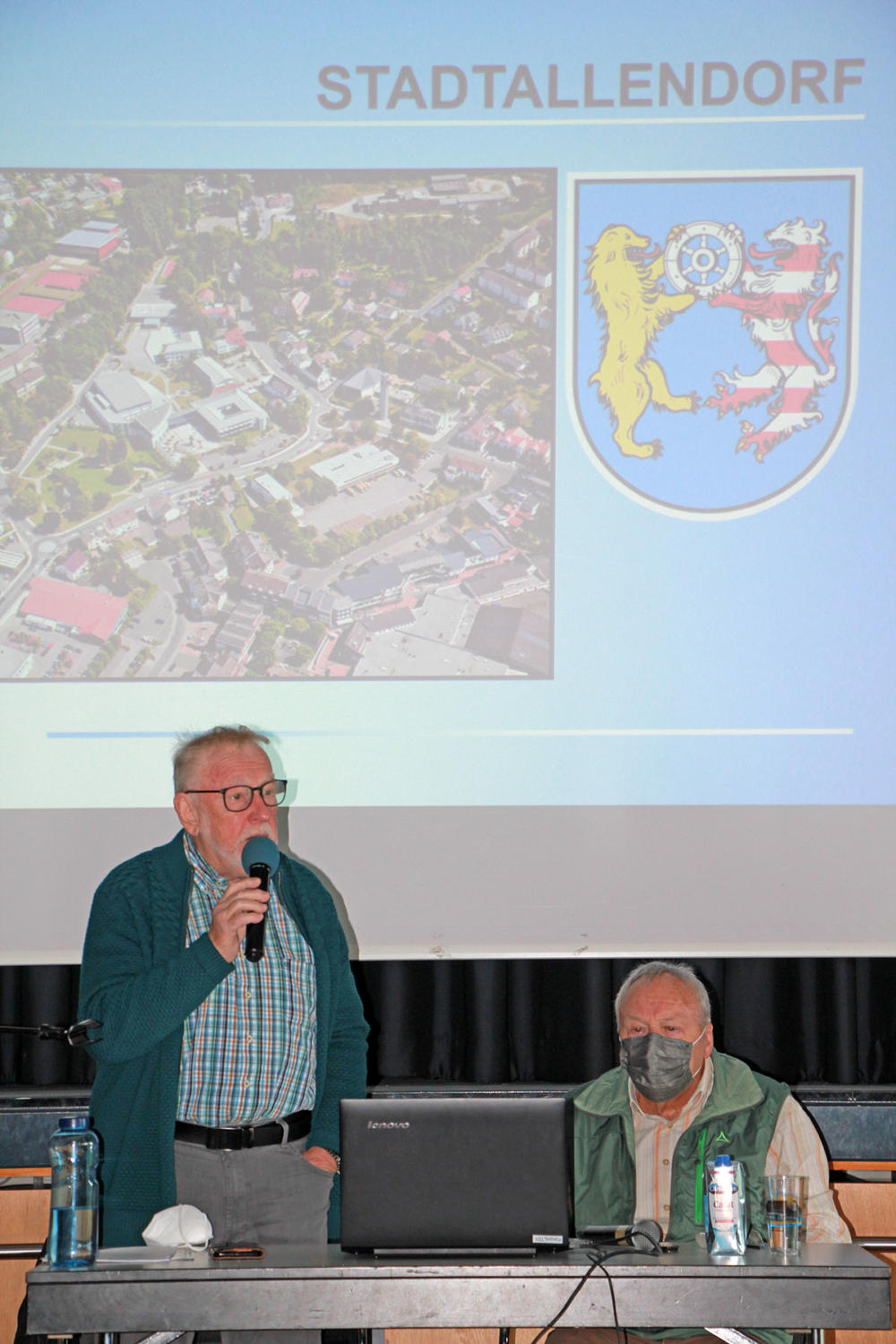
Our photo shows the speakers Herbert Köller (left) and Hans-Jürgen Wolff.



History Up Close: Stadtallendorf’s Turbulent Development and People’s Life Stories
Collaborations & Partnerships, News, Politics, Business & ResponsibilityFrom time to time, parents or relatives of our students are able to make valuable contributions to Steinmühlen’s curriculum—thanks to their professional experience or knowledge. The visit by Herbert Köller, the grandfather of Alexandra Köller (6b), was one such example. Together with Hans-Jürgen Wolff, he spoke to Steinmühlen students in grades 8, 10, and 13 about the work of the Stadtallendorf Documentation and Information Center (DIZ), founded in 1994, which is Germany’s first and oldest memorial dedicated to forced labor.
The DIZ (www.diz-stadtallendorf.de) has received photographs and records from the late phase of World War II from the estate of Hilmar Eisenhut. Hilmar Eisenhut was a 15-year-old student in Eschwege when his friends from the grade above him, who were serving as anti-aircraft gunners near Kassel, were killed by a crashing airplane. Shortly thereafter, Hilmar also became an anti-aircraft gunner and was stationed in Stadtallendorf.
From a Poor Village to the No. 1 Industrial City
In the first part of the double period, Hans-Jürgen Wolff used a PowerPoint presentation to explore why Stadtallendorf is now a thriving industrial city. He traced the town’s journey from a poor Catholic village, through its history as an ammunition depot and a refuge for displaced persons and guest workers, to its current status as the number one industrial town in the Marburg-Biedenkopf district. In doing so, he also explored the question of why Stadtallendorf was not bombed during World War II. This is where 16-year-old Hilmar Eisenhut, his accounts, and his photographs came into play.
A 16-Year-Old’s War Experiences
In the second part, the presentation took on a more personal tone and was told from the boy’s perspective. Herbert Köller read vividly, taking on various roles, and emotionally brought Hilmar’s notes to life—sometimes in the loud tone of the sergeant, sometimes with a tear-choked voice. In between, Hans-Jürgen Wolff repeatedly interrupted the reading to provide factual, matter-of-fact, and even technical information to help the audience contextualize what they had heard.
The title “History Up Close” can therefore be understood in two ways. On the one hand, it was about regional proximity—that is, the history of a town in our county. On the other hand, the accounts were emotionally moving, as the fate of the anti-aircraft gunner and his friends—who were the same age as the audience—struck a deep chord—not even ten days before another war of aggression began in Europe.
Our photo shows the speakers Herbert Köller (left) and Hans-Jürgen Wolff.