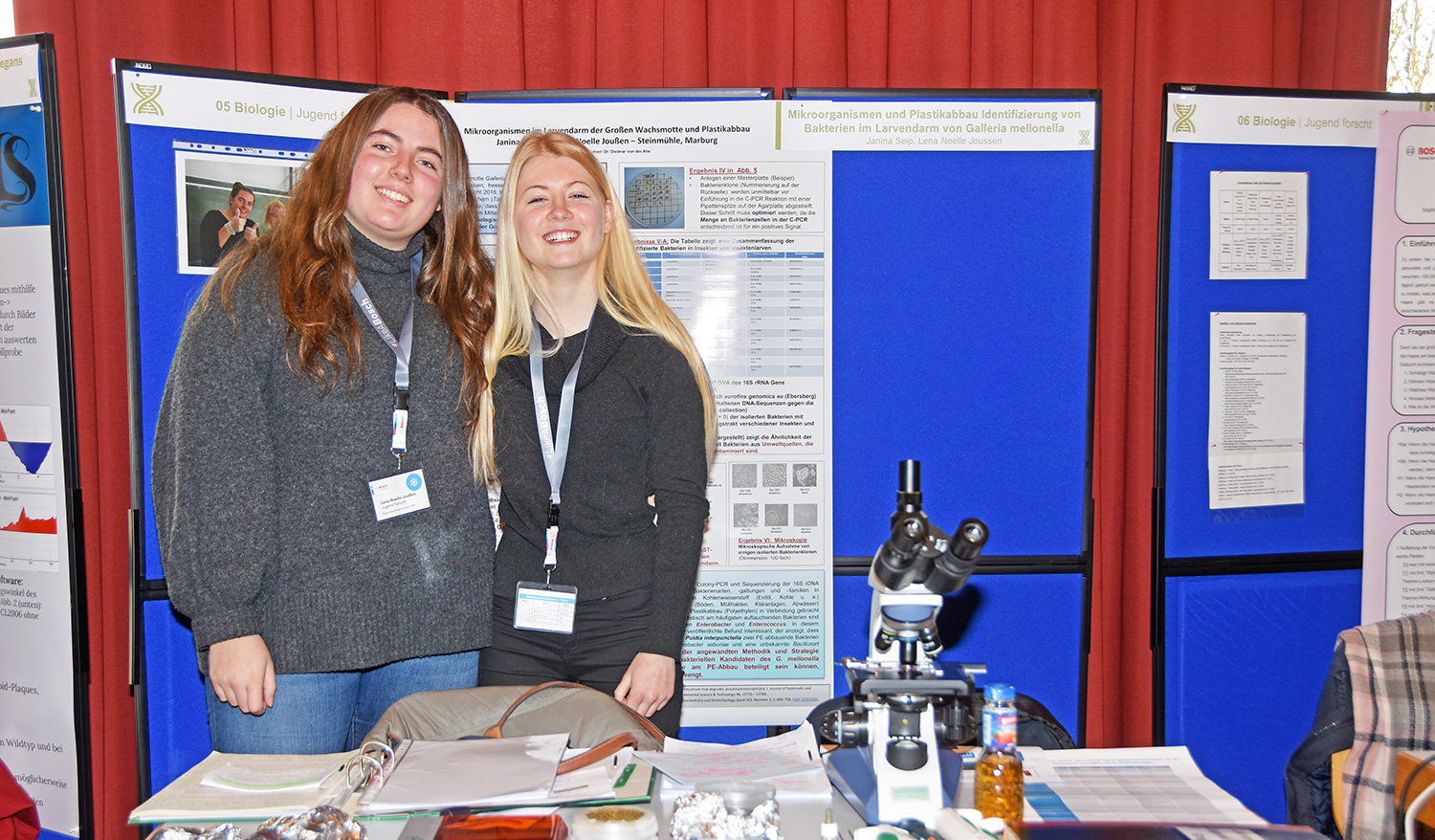


The Steinmühle team won three awards at once
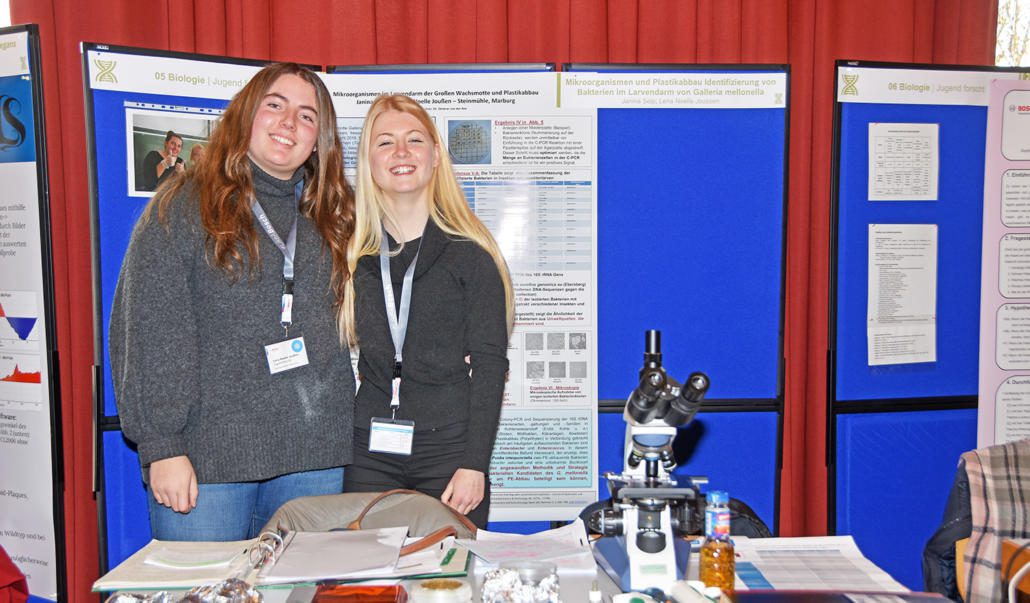
Lena Joußen and Janina Seip, along with their advisor Dr. Dietmar von der Ahe, won the “Jugend Forscht” competition
Things couldn’t have gone better at the “Jugend Forscht” regional competition for Central Hesse, held at the Klein-Linden Community Center, as Steinmühle’s participation resulted in three awards: Students Lena Noelle Joußen and Janina Seip, together with their teacher Dr. Dietmar von der Ahe, won the Project Prize, the Environmental Prize, and the Advisor Prize.
“Keep going, make the most of this project’s potential, and enter the competition again.” That was the jury’s advice exactly one year ago, when the then-11th-grade students first presented their hypothesis to the panel of experts at the “Jugend Forscht” competition. They suggested that the wax moth (Galleria mellonella) might offer a solution to the plastic pollution problem. For the experiment, honeycombs infested with wax moth larvae had been placed in plastic bags. Just a short time later, the plastic was riddled with holes and crumbled. Laboratory tests confirmed that the larvae do indeed break down polyethylene (PE).
In Search of the Right Enzyme
To delve deeper into the topic, Lena and Janina set out to investigate whether the larvae of the greater wax moth harbor so-called symbionts in their intestines—that is, microorganisms that help break down plastic. Their work on the freshly deceased insect—including isolating the bacteria into a culture medium, allowing the bacteria to grow, creating bacterial clones, and performing the polymerase chain reaction (PCR)—revealed that a specific gene from the bacteria was amplifying —and at the same time raised the question of whether this gene exists in nature as part of a similar enzyme that may already be known, and whether this enzyme, through its ability to break down carbon compounds, can make a decisive contribution to plastic degradation.
“We’ve taken a decisive step closer to the result,” reports biology teacher Dr. Dietmar von der Ahe. “It’s not just one bacterium. We’ve narrowed down the list of bacterial candidates to about two dozen,” says the expert. Conducting further research in this area is a matter of time and, above all, cost.
wasn’t discouraged by setbacks. According to the biologist, who holds a Ph.D., it looked as though the research wouldn’t work out until November. The twelfth-grade students carried out over 200 PCR reactions and ultimately refused to let themselves be discouraged. Thanks to plenty of words of encouragement, effective coordination, and a well-thought-out project strategy, Steinmühle also won the Advisor’s Award. The timely and pressing topic of “plastic” was a fitting focus for the environmental award. The competition’s Sponsorenpool Hessen awarded the 1,600-euro project prize in recognition of the students’ persistent, precise, and determined work.
Prerequisites Provided by the Steinmühle Student Lab
The Steinmühle student lab, equipped by the Friends of Steinmühle Association, is an essential prerequisite for the work of the young Steinmühle researchers. Jasmine Weidenbach, chairwoman of the Friends of Steinmühle, had applied for funding (5,100 euros) from Roche Germany as the main sponsor in June 2014. Headquarters approved the application a month later, and the lab was set up in the fall of 2014. The official opening of the lab took place in February 2015.
The national “Jugend Forscht” competition is organized by the foundation of the same name. Its goal is to inspire young researchers to pursue mathematics, computer science, the natural sciences, and technology, and to foster interest in these career fields.