

A Visit from a Successful Actor—or: A Look Behind the Scenes
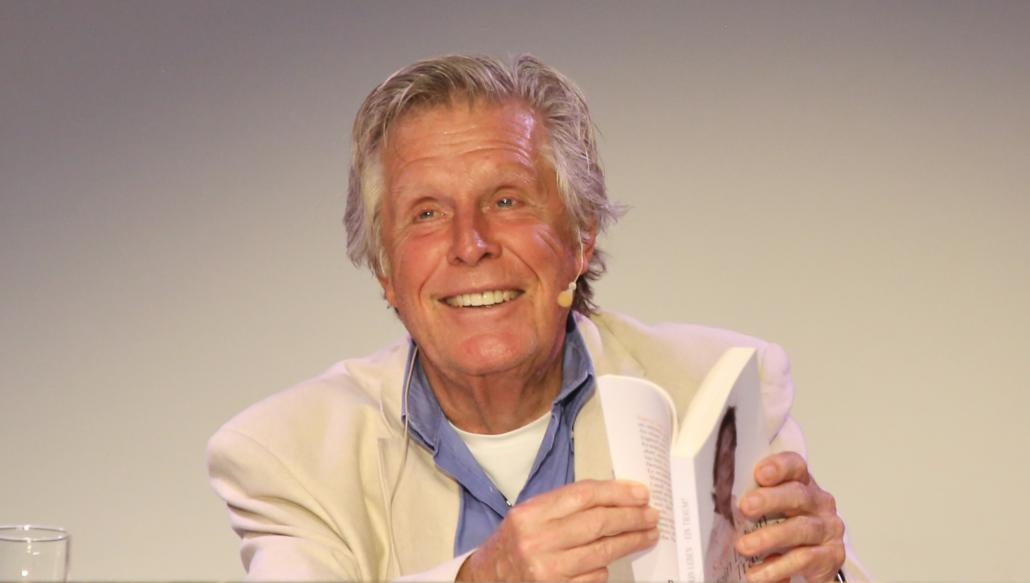
Sigmar Solbach is coming. A former student of the Steinmühle boarding school. Someone who became an actor, a TV series star, and a heartthrob. — What can you expect? A lot of self-importance, a lot of reminiscing about his own glory days, and, on the spot, a good dose of showmanship as he reads from his memoirs.
In the end, people were all the more surprised to realize: He wasn’t a show-off at all. Here was an authentic guest who self-critically looked back on his successful life, yet didn’t shy away from acknowledging dark moments and difficult times. On top of that, he conveyed what is essential for anyone who wants to be successful: overcoming obstacles, pushing past one’s limits, stepping outside one’s comfort zone—and always keeping one’s goal in sight.
Boarding school was his own choice
Sigmar Solbach enrolled in the upper school at Steinmühle Boarding School in 1963 because he wanted to do better in his studies. He did so of his own accord. His parents were separated, and his mother had a new partner. — From his perspective, this was not a foundation for a successful academic career.
The young man from the village of Rothemühle in South Westphalia already knew what he wanted to be when he arrived: an actor. The theater production at the Steinmühle got off to a flying start shortly thereafter. The driving force behind it all: Sigmar Solbach.
“A largely carefree time”
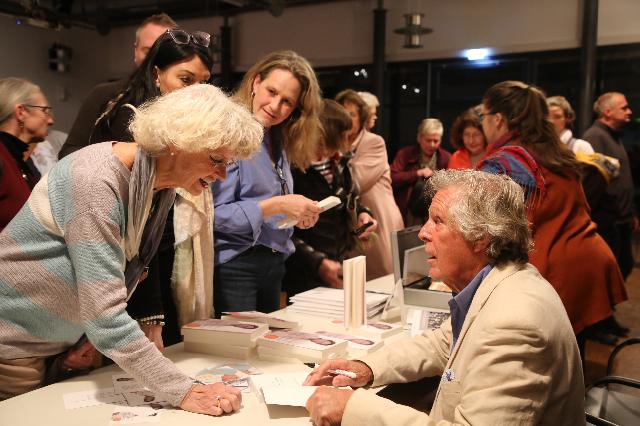
It turned out to be a largely cheerful look back—before, during, and after the reading. Several classmates from back then gathered at the Steinmühlenforum, and more than once someone would say, “Do you remember…?”—They looked at old photos and shared anecdotes. – That’s exactly how you’d imagine a class reunion after 60 years.
“It was a happy and mostly carefree time,” the actor recalls of his years at Steinmühle Boarding School.
Solbach was one of 500—and he played Faust
When Solbach had “a decent high school diploma” under his belt in 1966 and his dream of becoming an actor was still very much alive, his stepfather remained skeptical. “He was willing to support just one attempt at a drama school.” This narrow path and the enormous pressure of auditioning as one of 500 applicants at the Westfälische Schauspielschule in Bochum apparently unleashed every conceivable ounce of energy in Sigmar Solbach. He received the only acceptance—because he performed well in a role that no one had dared to take on before: Faust.
Respect for High Standards
Sigmar Solbach felt a sense of relief. He was able to put his career Plan B—becoming a goalkeeper on the national soccer team—aside.
Solbach’s acting solved some problems, but it also created new challenges. In the eyes of his stepfather, he went from being a “good-for-nothing” to someone who was slowly making something of himself.
What no one saw: The hardships on the way to the top, financial struggles, and the student dorm without a shower; the need to earn money temporarily as a cosmetics sales representative; the poor credit rating as a freelancer; the respect for one or another great director and the expectations that came with it. For example, “…in front of the great Fritz Umgelter”:
“First I was afraid of horses—then I rode like the devil”
He was told to get crowns on his healthy incisors because they were just a tiny bit crooked. And he had to learn to ride—that was the condition for the role he was being considered for. Against his better judgment, he went to the dentist; despite his fear of horses, he took riding lessons. “And you won’t believe it—neither did I—but in the end, I was riding like the devil.”
Hamlet as a Mark of Distinction
The recurring question he asked himself—“Will I be up to the task?”—was a recurring theme not only at the start of Solbach’s career. Later, when the man with a penchant for theatrical roles was appearing primarily in television series, Solbach defined his own personal challenges. After portraying Hamlet—”arguably the most difficult theater role”—he undertook three successful transatlantic crossings on a sailing yacht, which took their toll: little sleep, a great deal of skill, and complete concentration.
Proving himself, pushing himself to the limit, testing his boundaries, and seeing things through to the end—that’s what Sigmar Solbach stands for above all else. How insignificant, then, are the kissing and bedroom scenes from TV series for which—according to his wife’s standard response—“he was, in any case, well paid.”
No, he doesn’t take the characters he plays home with him, Solbach explained during a Q&A session following his reading. And he admits, “…that a successful career depends on many pieces of the puzzle.” He also says he’s been lucky. Judging by everything he’s said, however, that luck seems to have been rather limited. Angela Heinemann
The Oberhessische Presse filmed parts of the evening:
https://www.instagram.com/reel/DQwmHDkDHBf/?igsh=aGJlaTl2M3I3Y3Fi