


“We are currently defending our democracy”
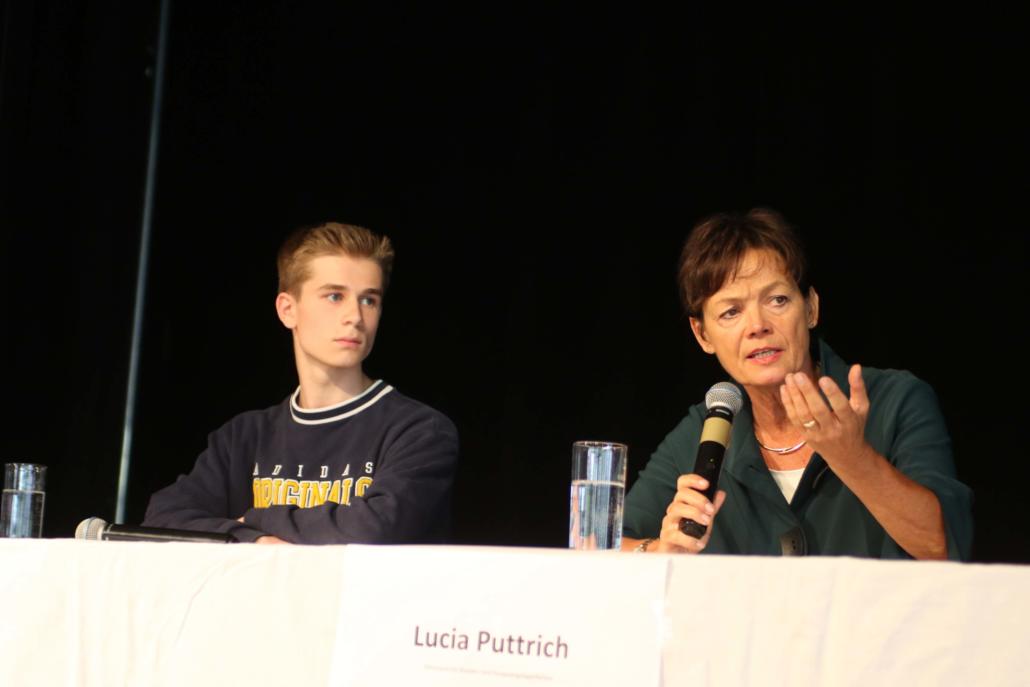
Spotlight on Ukraine: Lucia Puttrich, Hesse’s Minister for Federal and European Affairs, visited the Steinmühle
Don’t talk about politicians—talk with them. That is the goal of Steinmühle High School, and it is also why the school always welcomes visits from members of parliament and ministers. Through local state parliament member Dirk Bamberger (CDU), Steinmühle established contact with Lucia Puttrich. She is not only Bamberger’s colleague in the Hessian State Parliament, but also Hessian Minister for Federal and European Affairs and Plenipotentiary of the State of Hesse. She recently joined Dirk Bamberger and Horst Falk—also a member of the state parliament and the education policy spokesperson for the CDU parliamentary group—on the panel at the Steinmühlenforum event: “Students Ask—Politicians Answer.”
A ministerial visit in the midst of the war in Ukraine—this was a good opportunity for the 11th and 12th graders at Steinmühle to raise issues that were on their minds. It’s no surprise that this topic was the main concern for the Steinmühle students. It was a serious event featuring in-depth questions and well-considered answers from the minister. And her answers didn’t always dispel concerns or alleviate fears. Informative, but not sugarcoated.
“A War Against NATO and the EU”
“Ukraine is defending its sovereignty, and virtually every Ukrainian has a weapon,” said Lucia Puttrich as she began her description of the situation in the country that is currently the focus of attention in Europe and around the world. However, the minister was also keen to make it clear that the conflict does not stop at territorial borders but is imperialist in nature: “Putin wants his old empire back. It is a war against NATO and the EU. And Putin is fundamentally unwilling to change the course of the war before achieving these goals.” In response to the frequently asked question of whether Putin’s absence from the scene would improve the situation, the minister offered no positive outlook: “It’s not about the person; it’s the system behind him.”
What is at stake in the war in Ukraine? What are we defending? What will happen if Russia cuts off the gas supply? — Questions from the minister to ponder, and questions from the students. “We’re defending democracy,” said Puttrich, “and rising prices and economic downturns are currently the price we’re paying for that.” It’s about our stance, about realizing that we shouldn’t take anything for granted. “We have a responsibility toward Ukraine,” Lucia Puttrich stated, and continued: “And we also have a responsibility toward Russia. But that cannot mean condoning a war of annihilation.”
“A Time of Escalation”
The minister described NATO’s foundation as a defense pact with a mutual assistance obligation. She noted that there are currently security threats in the Baltic states and in Poland. This situation means that certain events are interconnected: “If Ukraine falls, we’ll see a domino effect.” She noted that the current situation is fundamentally at odds with the formal realities. Puttrich: “Ukraine is a sovereign state, recognized even by Russia.” This fact alone demonstrates a certain unpredictability: “If Putin wants World War III, then that’s what he wants—it’s not up to us to decide. And war is most likely to be avoided if it is unwinnable for Russia.” In fact, according to the visitor from Wiesbaden, we must probably brace ourselves for a long conflict: “A ceasefire would already be a good thing.” It takes a long time for sanctions to take effect. The minister considers it a mistake to dismiss the Russian president’s behavior as mere caprice: “Putin is serious about these matters. We are living in a time of escalation.”
“We must learn from history—anything is possible,” said State Parliament Representative Horst Falk, concluding the overall discussion between the panel of politicians and the student body. The event—prepared by Steinmühlen teachers Bernd Hülsbeck and Erno Menzel and moderated by Tilmann Molzberger from the Q2 Political Science Honors Class—did not end on a reassuring note, particularly given the minister’s use of sources of information that were, in some cases, exclusive. Principal Björn Gemmer expressed his gratitude for arranging the event, for the attendance and active participation of everyone present, and for their willingness to take the time to engage in dialogue with young people.
When the event came to an end, the audience could have continued the discussion. This was certainly a sign that the topic was thought-provoking, but also that the exchange had been fruitful.


