


“Youth Research”: On the winners’ podium even at the state competition
“Jugend Forscht”: Steinmühlen Teams Win Additional Special Prize
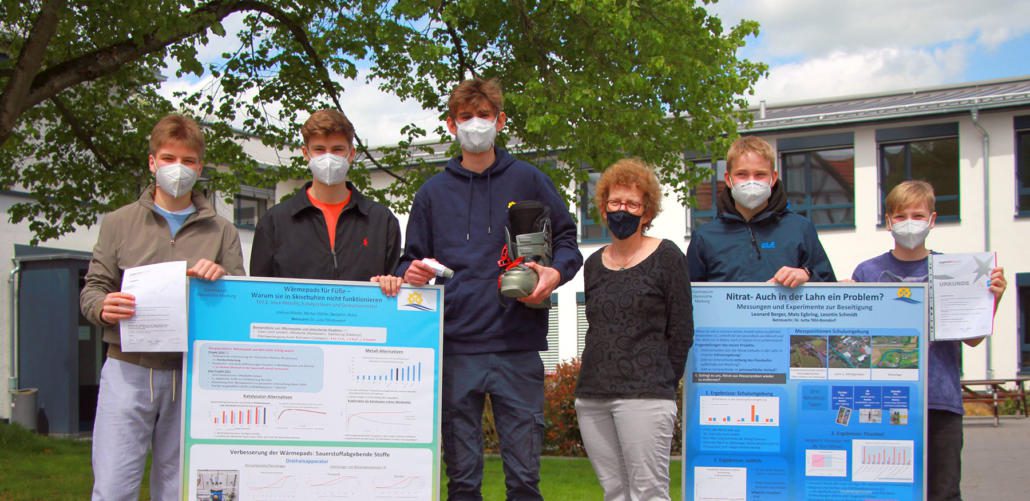
Another success for Steinmühlen High School students Joshua Wieder (15), Morten Köhler (15), and Benjamin Schul (16): After the successful trio won the regional “Jugend Forscht” competition, the three students went on to take second place in the state competition. What’s more, they also won the special “JugendUnternimmt summer school” prize for their chemistry project. Held in Erfurt from July 30 to August 5, this seminar teaches entrepreneurial thinking with a focus on the potential commercialization of one’s own business idea. Their younger classmates Leonard Berger (13), Mats Egbring (12), and Leontin Schmidt (13) were also successful at the state-level “Schüler experimentieren” competition in Kassel, as they had likewise qualified for the next round. At the competition, which took place at the University of Kassel’s Department of Electrical Engineering & Computer Science, they took third place and also received the Special Prize for Environmental Technology from the Federal Foundation for the Environment.
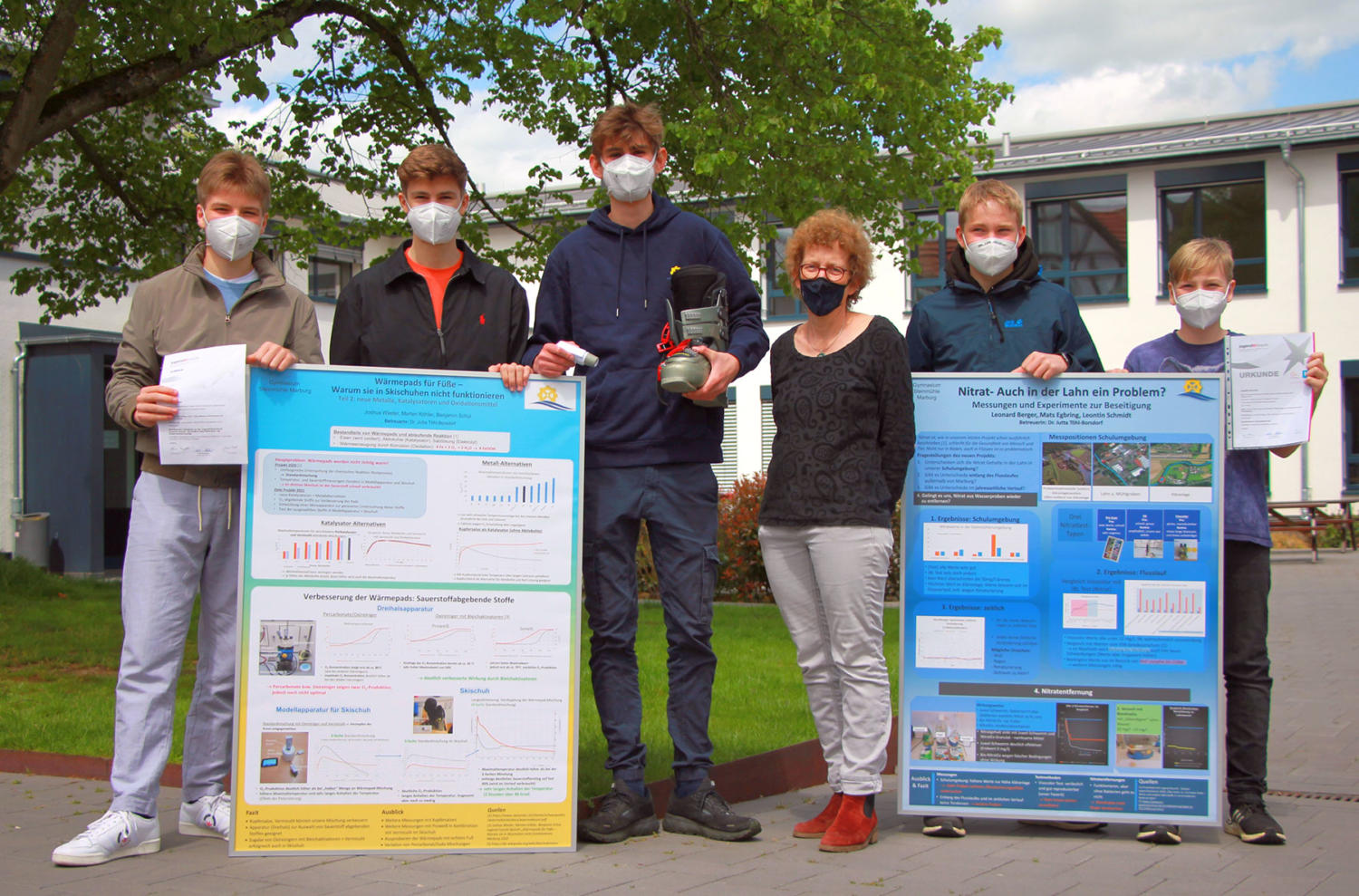
From left: Morten Köhler, Benjamin Schul, Dr. Jutta Töhl-Borsdorf, Mats Egbring, Leontin Schmidt (not pictured: Leonard Berger)
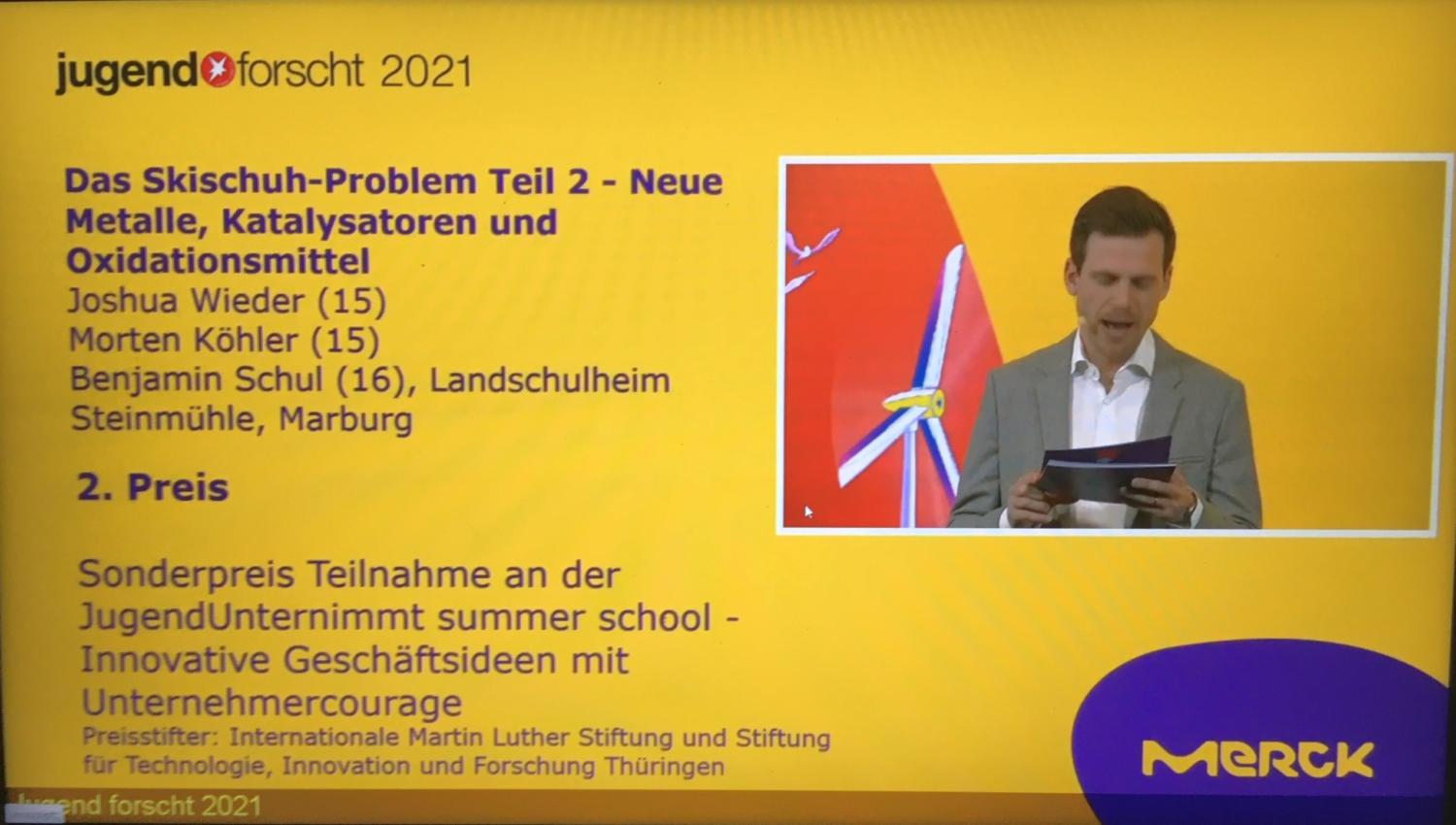
Why conventional heating pads don’t work in ski boots—the questions the project posed to the older students have been persistently explored by Joshua, Morten, and Benjamin since last year, as they’ve come up with new ideas. They continued their research and attempted to conduct the experiment using new metals, catalysts, and oxidizing agents to optimize the heating pad system for ski boots. At the awards ceremony, which took place at Merck in Darmstadt, the expert jury praised them, saying: “You presented everything clearly and effectively, improved the analytical methods, and developed a redox system that works experimentally and is suitable for creating a prototype.”
In last year’s project, the trio of researchers was already able to demonstrate that oxygen is consumed very quickly in a snugly fitting ski boot and that the reaction leading to heat production quickly comes to a halt. Now they have found a solution to this problem; they tested various oxygen-releasing substances and ultimately succeeded with oxygen-based detergents. When heated, these substances—used as detergent additives—release large amounts of oxygen.
How to Develop a Business Plan
The “JugendUnternimmt Summer School,” which Joshua, Morten, and Benjamin are now attending, aims to empower young people to develop their ideas and innovations into viable business concepts and present them, as well as to give them an understanding of the social and societal responsibilities that entrepreneurs bear.
– Just imagine if the experiment by the three chemistry whizzes actually made it to market one day!
Now, of course, the trio is hoping that this seminar in Thuringia—which was offered as a prize by the International Martin Luther Foundation and the Thuringia Foundation for Technology, Innovation, and Research—will even be able to take place at all, given the pandemic. It will only be held in person—or it will be canceled. Unfortunately, there are no plans for an online option.
The figure on the right summarizes the project’s topic and its performance in the competition.
Nitrate in the Lahn River: Experiments on Removal
Leonard Berger, Mats Egbring, and Leontin Schmidt had also participated in the “Jugend Forscht” competition last year, focusing on the issue of nitrate. Back then, their work involved soil analyses; this time, the focus was on measurements in water bodies—specifically, in the nearby Lahn River. This is because nitrate is also dangerous in water bodies, as it can seep into groundwater and drinking water and is harmful to the body. The trio of researchers was particularly interested in the changes that occur in different seasons and at different locations along the Lahn as a result of fertilization and harvesting. The young researchers also wanted to find out whether nitrate can be removed from the water. To this end, they closely examined chemical and biological products available in the aquarium trade to test their effectiveness.
The expert jury also praised these projects highly and awarded them third place in the state-wide competition.
The Steinmühle congratulates you all on these achievements! You can be proud—we certainly are!


