


“This is the end of a dream”
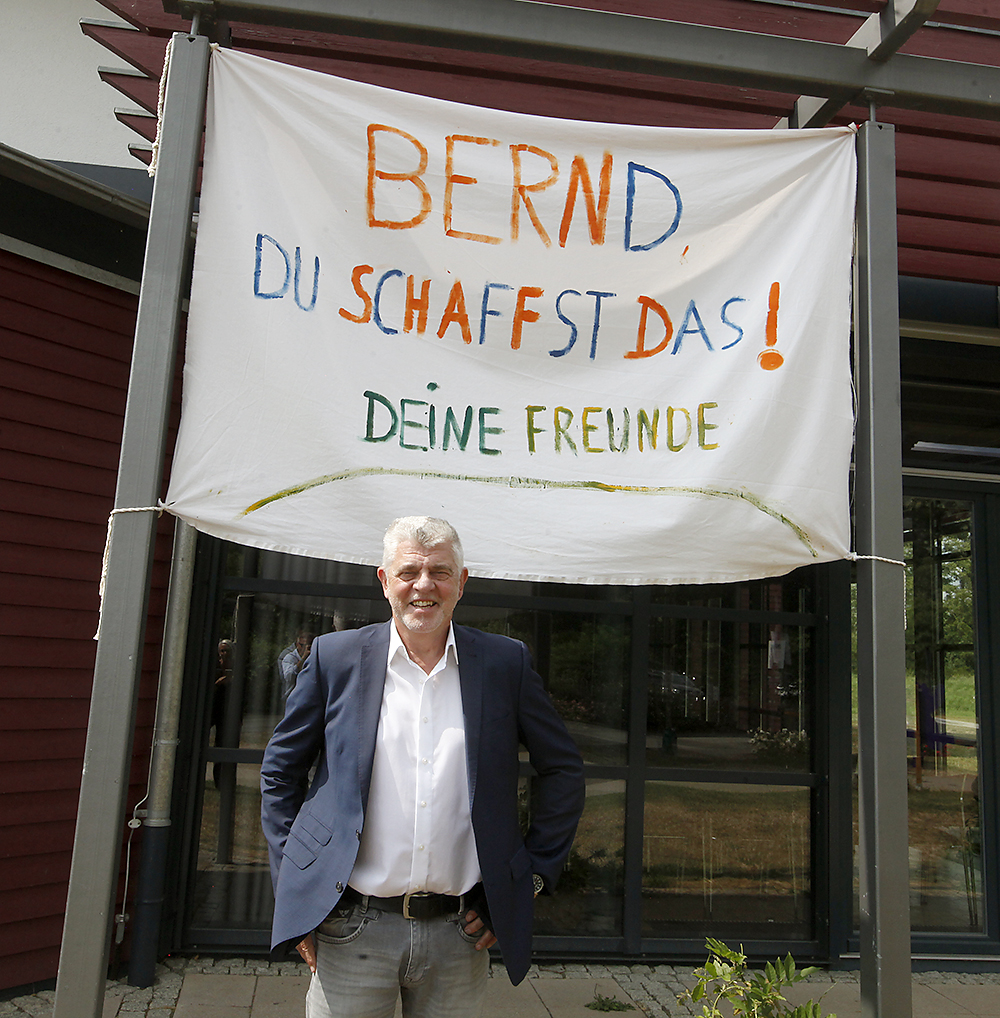
An interview with Principal Bernd Holly on the occasion of his retirement: “Looking forward to life beyond the school gates”
The end of July 2023 is drawing inexorably closer. It is the date on the certificate issued by the Minister of Education that signals Principal Bernd Holly’s retirement from the teaching profession. He has reached the mandatory retirement age. Retirement after 22 years at Steinmühle, after nearly 40 years in his dream job as a teacher. And now? Angela Heinemann spoke with Bernd Holly about defining moments in his life and his current thoughts.
It’s hard to even bring myself to ask. How are you doing right now?
Holly: It is a little awful. Who would willingly leave a place like this? It’s like saying goodbye to a dream. Right now, I’m really aware of what I’m losing. And I’m having so many very emotional goodbyes.
Until now, it’s been a heavy workload—but now there’s time to travel and spend time with the two grandchildren. Isn’t that something to look forward to?
Holly: Oh, absolutely. They’re looking forward to having Grandpa around more often soon. I also love the idea of traveling through Europe in a RV. Or maybe even visiting Ireland sometime. I have an Irish grandfather—that’s where my last name comes from. But I’m being honest with myself: going from endless work hours—a 60-hour week—down to zero is quite something. First, I need to figure out how I’ll define myself now—just through the Steinmühle, or as my own person. I’m curious to see what life will be like in front of the bollard.
Retirees often fall into a slump…
Holly: Not really. I have a wonderful social circle, a great family, and I’m privileged when it comes to the people around me. I’ve also had some very lucrative job offers, but I’m not accepting them. I’ll only be volunteering at the Marburg Food Bank, and I’ll be encouraging people to plant trees.
We know that social involvement was important to you during your time at Steinmühle. So that hasn’t changed?
Holly: I come from a very humble background, from a small village in the Westerwald. My father was a railroad crossing guard, and my mother was a seamstress. They were wonderful parents! In our family of five, there was no money for extras. Whenever I needed money or wanted to buy something, I’d get a part-time job—as a construction laborer, a mail carrier, or an industrial diver. The latter was really risky, but it paid well.
Is that why you’re committed to helping the socially disadvantaged?
Holly: The term “socially disadvantaged” is incorrect and derogatory. People labeled that way aren’t socially disadvantaged—they just don’t have money. I know some people who are very wealthy but are truly socially disadvantaged. The problem isn’t in their wallets—it’s somewhere else.
And you don’t have much trouble expressing that? Social skills are important to you…
Holly: I’ve always been straightforward, which didn’t always sit well with my own teachers. Although I was an A student, I often rubbed people the wrong way. I was excused from the graduation ceremony and wasn’t allowed to give the student speech, even though that’s what my classmates had actually wanted. The school’s reasoning: “General insubordination and insistence on my own opinion.”
Is that something you wanted to do differently as a teacher?
Holly: Actually, I always wanted to be a teacher—both because of good role models and because of bad ones. Even though I got straight A’s on my exams, I couldn’t find a job at first; as we all know, the job market for teachers has been crazy for decades. Sometimes there are too many teachers, sometimes too few. Then it finally worked out.
After stops in Frankfurt and Giessen, you ended up at the Steinmühle…
Holly: I came from the Willy-Brandt-Schule in Gießen. It’s a vocational school, and to some extent, a school in a high-risk neighborhood. As the youngest staff member, I quickly became a department head and “supervisor” for more than 50 colleagues. That’s where I got to know all the different aspects of the job. At the time, many people didn’t understand my application to Steinmühle because it didn’t seem to fit at all. I even heard comments like, “You’re usually a decent person. What do you want at this school?”
In 2001, the Steinmühle was facing a crisis that threatened its very existence…
Holly: The school had only 445 students, was in a precarious financial situation, and, for various reasons, had a very poor reputation. As a team, we managed to turn the school around back then and, over time, turn it into a sought-after educational institution. This approach—combined with having the right people in various key positions—has made Steinmühle what it is today. I’ve put a lot of my heart and soul into it.
Is the stone mill facing challenges today as well?
Holly: Steinmühle faces the challenge of finding teachers. Teaching is a highly complex profession; more needs to be invested in building relationships. At Steinmühle, this is even more difficult because teachers are expected to be more present than at public schools. Presence in more ways than one. And we don’t have tenured positions. Then there’s the power of “anti-social” media and a culture of debate that needs to be nurtured. But the last two points apply to all schools.
And at a time like that, Holly’s leaving?
Holly: Well, I’m not going willingly. And I’m not dead, after all. I’ll join the school association and stay on top of things.
So many people are sad to see you go and have expressed their feelings. Something in particular touched you…
Holly: Every day, two girls from elementary school bring me an apple or some other piece of fruit. They want me to stay healthy. They want me to live to a ripe old age—at least until they graduate from high school. Unfortunately, I can’t grant that second wish…


