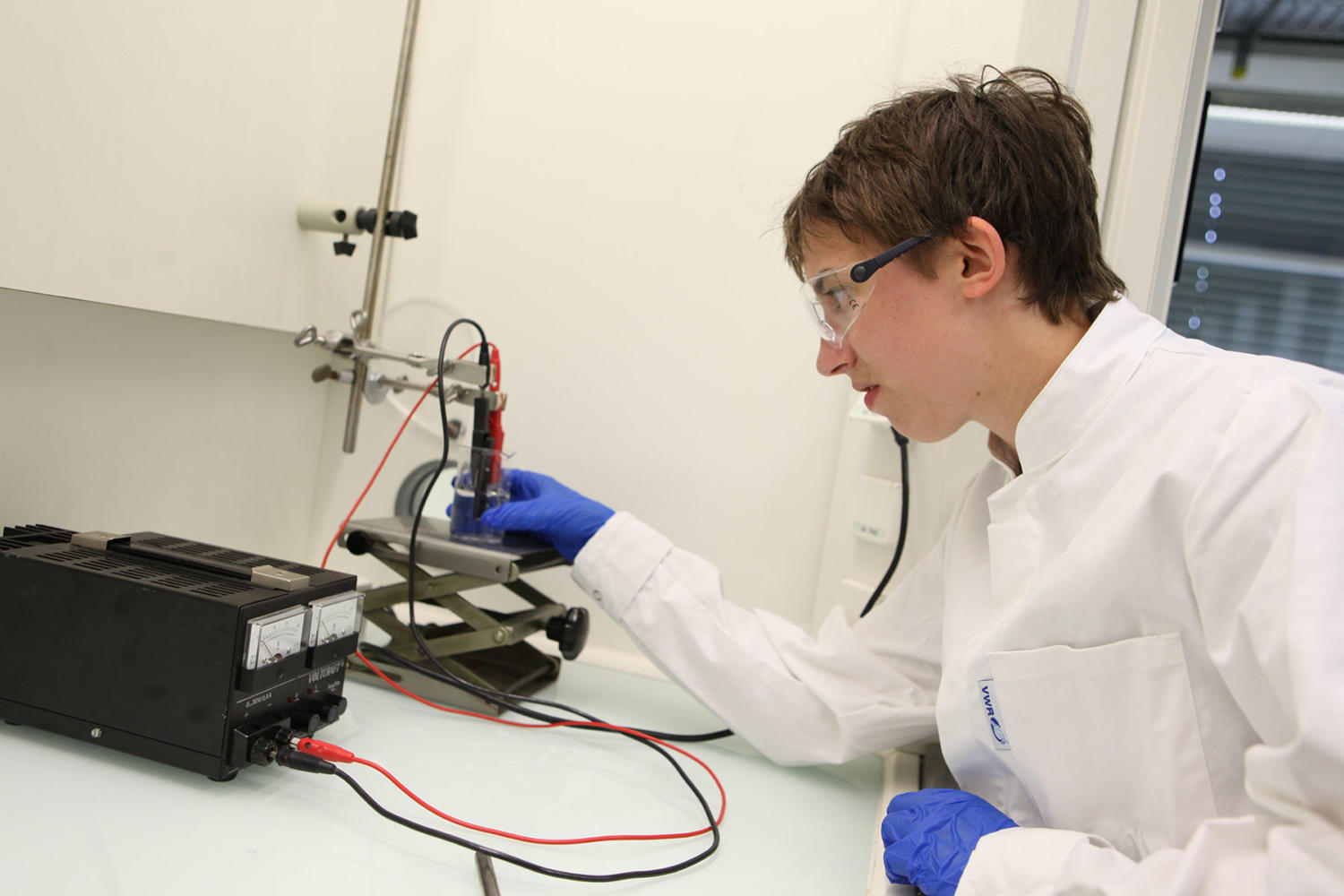
On a regular basis, exceptionally talented students from schools in Hesse present their research findings on specific topics at the Center for Chemistry’s (ZFC) MINT Inventor Lab. This year, our plusMINT student Clara Steiner was among the group of 16 students who were selected from a total of 237 applicants. Clara, a student at the plus-MINT Steinmühle Boarding School and already a college student majoring in mathematics, spent a week working on the production and analysis of photocatalytically active titanium dioxide layers. According to her, the experience gave her “insights into real research.”
For Clara, the journey to this year’s venue for the 35th Inventors’ Lab wasn’t very far: It took place in cooperation between ZFC and Philipps University in the departments of chemistry and physics on the Lahnberge in Marburg. Four groups of four each focused on different research topics, and Clara was especially looking forward to getting to know her three teammates so she could work with them as a team.
Titanium Dioxide: The All-Purpose Solution of the Future?
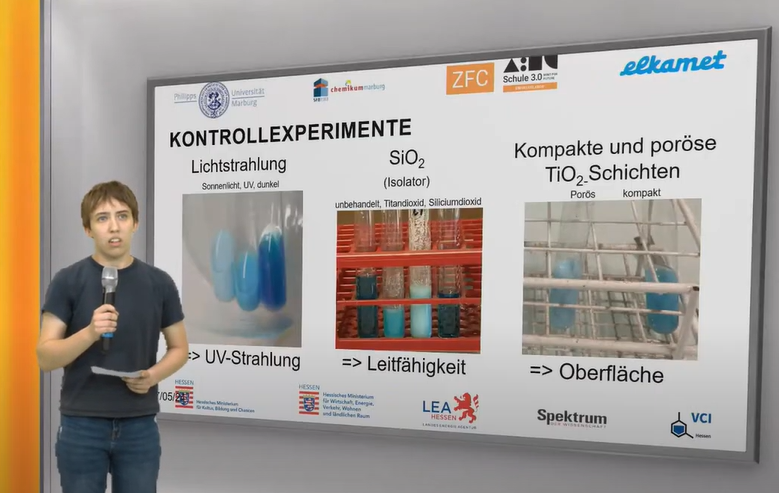
The quartet began their presentation of the research project to a predominantly virtual audience with a question: What do sunscreen, wall paint, and solar panels have in common? The answer led to the substance that was the subject of their joint study: titanium dioxide, TiO₂.
The goal was to determine whether this substance might be the “jack-of-all-trades” of the future: a versatile material that is thermally stable, has high coloring and opacity, is lightfast, and is practically insoluble in water. Of these, photocatalysis is arguably the most important property—that is, the ability to trigger chemical reactions through light. All of this explains the use of titanium dioxide in the aforementioned areas. Titanium dioxide is produced by electrolysis, is inexpensive, and is the most important white pigment. The young researchers examined the substance under a scanning electron microscope and focused on the production and analysis of photocatalytically active titanium dioxide layers. Thanks to its properties, the material could potentially contribute to the development of more efficient methods of energy conversion. However, according to Clara and her colleagues, a great deal of research is still needed before that can happen.
“Directly relevant to science”
The event was broadcast on multiple screens. Not only did the team from Steinmühle, led by supervisor Dr. Jutta Töhl-Borsdorf, follow the presentations, but Minister of Culture Armin Schwarz also joined virtually. He praised the participants’ outstanding achievements and described the topics covered in the Inventors’ Lab as “directly relevant to the state’s scientific and economic development.” The minister provided feedback to one of the four groups. The feedback for Clara and her team came from Michael Schmidt (Elkamet Kunststofftechnik). He emphasized that the presentation had excellently illustrated the wide range of applications for titanium dioxide and had also shown just how much fun and enjoyment the group had while conducting their research.
In addition to the technical presentations, the scientific event also offered plenty of entertainment. It wasn’t just the pedal boat ride on the Lahn River—which participants enjoyed during their free time at the research retreat—that was well received. In keeping with the overall theme, during the live broadcast, hosts Joelina Gärtner and Pablo del Rio—both MINTIES themselves—welcomed chemist and science slammer Arne Nisters from TU Darmstadt.
Opening remarks were delivered by Prof. Dr. Sabine Pankuweit, Vice President for Equal Opportunity and Career Development at Philipps University of Marburg; Dr. Thomas Schneidermeier from the event organizer, the Center for Chemistry (ZFC); and Julia Woth from the State Energy Agency (LEA) of Hesse. Videos and Reels were also used to explain how MINTIES work at the ZFC and what they hope to achieve.
Goal: STEM Assessment Competence
ZFC Board Member Dr. Thomas Schneidermeier emphasized how important it is to equip young people with STEM critical thinking skills so they can contextualize media headlines in the context of new technologies. For him and ZFC Project Manager Magdalena Schmitt, it is important to collaborate with schools, universities, companies, associations, foundations, and ministries on STEM projects for students, linking traditional classroom content with career fields in the STEM sector in everyday life. In this way, the ZFC association aims to help ensure a sufficient supply of STEM professionals.



Research on Climate Neutrality: Clara Steiner from Steinmühle Boarding School Succeeds at the 35th MINT Inventors’ Lab
Contests & Awards, Ecology and Sustainability, Life at Boarding School, News, STEM, Talent DevelopmentOn a regular basis, exceptionally talented students from schools in Hesse present their research findings on specific topics at the Center for Chemistry’s (ZFC) MINT Inventor Lab. This year, our plusMINT student Clara Steiner was among the group of 16 students who were selected from a total of 237 applicants. Clara, a student at the plus-MINT Steinmühle Boarding School and already a college student majoring in mathematics, spent a week working on the production and analysis of photocatalytically active titanium dioxide layers. According to her, the experience gave her “insights into real research.”
For Clara, the journey to this year’s venue for the 35th Inventors’ Lab wasn’t very far: It took place in cooperation between ZFC and Philipps University in the departments of chemistry and physics on the Lahnberge in Marburg. Four groups of four each focused on different research topics, and Clara was especially looking forward to getting to know her three teammates so she could work with them as a team.
Titanium Dioxide: The All-Purpose Solution of the Future?
The quartet began their presentation of the research project to a predominantly virtual audience with a question: What do sunscreen, wall paint, and solar panels have in common? The answer led to the substance that was the subject of their joint study: titanium dioxide, TiO₂.
The goal was to determine whether this substance might be the “jack-of-all-trades” of the future: a versatile material that is thermally stable, has high coloring and opacity, is lightfast, and is practically insoluble in water. Of these, photocatalysis is arguably the most important property—that is, the ability to trigger chemical reactions through light. All of this explains the use of titanium dioxide in the aforementioned areas. Titanium dioxide is produced by electrolysis, is inexpensive, and is the most important white pigment. The young researchers examined the substance under a scanning electron microscope and focused on the production and analysis of photocatalytically active titanium dioxide layers. Thanks to its properties, the material could potentially contribute to the development of more efficient methods of energy conversion. However, according to Clara and her colleagues, a great deal of research is still needed before that can happen.
“Directly relevant to science”
The event was broadcast on multiple screens. Not only did the team from Steinmühle, led by supervisor Dr. Jutta Töhl-Borsdorf, follow the presentations, but Minister of Culture Armin Schwarz also joined virtually. He praised the participants’ outstanding achievements and described the topics covered in the Inventors’ Lab as “directly relevant to the state’s scientific and economic development.” The minister provided feedback to one of the four groups. The feedback for Clara and her team came from Michael Schmidt (Elkamet Kunststofftechnik). He emphasized that the presentation had excellently illustrated the wide range of applications for titanium dioxide and had also shown just how much fun and enjoyment the group had while conducting their research.
In addition to the technical presentations, the scientific event also offered plenty of entertainment. It wasn’t just the pedal boat ride on the Lahn River—which participants enjoyed during their free time at the research retreat—that was well received. In keeping with the overall theme, during the live broadcast, hosts Joelina Gärtner and Pablo del Rio—both MINTIES themselves—welcomed chemist and science slammer Arne Nisters from TU Darmstadt.
Opening remarks were delivered by Prof. Dr. Sabine Pankuweit, Vice President for Equal Opportunity and Career Development at Philipps University of Marburg; Dr. Thomas Schneidermeier from the event organizer, the Center for Chemistry (ZFC); and Julia Woth from the State Energy Agency (LEA) of Hesse. Videos and Reels were also used to explain how MINTIES work at the ZFC and what they hope to achieve.
Goal: STEM Assessment Competence
ZFC Board Member Dr. Thomas Schneidermeier emphasized how important it is to equip young people with STEM critical thinking skills so they can contextualize media headlines in the context of new technologies. For him and ZFC Project Manager Magdalena Schmitt, it is important to collaborate with schools, universities, companies, associations, foundations, and ministries on STEM projects for students, linking traditional classroom content with career fields in the STEM sector in everyday life. In this way, the ZFC association aims to help ensure a sufficient supply of STEM professionals.