

The World’s Happiest People: How Finland Does It
The Finnish education system is considered a model for Europe. Furthermore, the latest “World Happiness Report” recently revealed that the happiest people in the world live in Finland. After all, the report analyzed data from 156 countries!
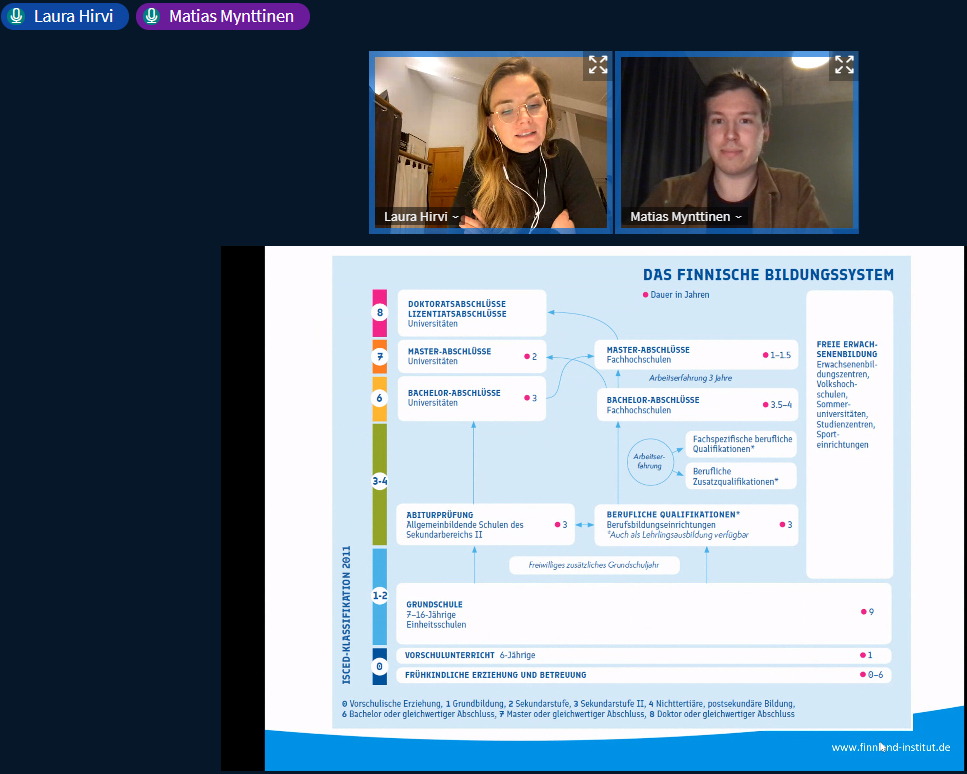
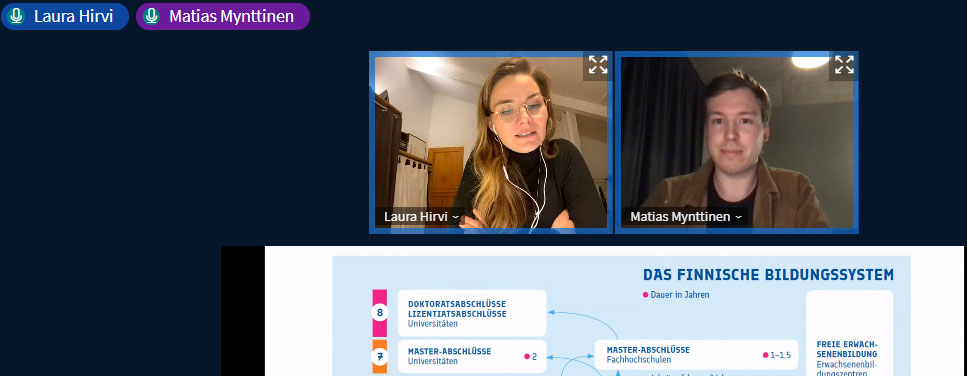
So what is the Finnish education system all about, given that it sets the course for the lives of young people in Finland? Using Big Blue Button, the Steinmühlen teachers recently attended a presentation by Dr. Laura Hirvi. The director of the Finland Institute in Berlin spoke about the Finnish education system.
Home learning is possible
There are fundamental differences between the Finnish and German school systems: For example, there is no compulsory education. But anyone who thinks this means students aren’t learning is sorely mistaken: “The Finns,” says Dr. Laura Hirvi, “actually learn throughout their lives.” In Finland, the obligation to learn can also be fulfilled at home. Anyone who wishes to do so can apply for home schooling. The acquisition of knowledge actually begins even before school. The country, with its 5.5 million people, already invests heavily in its preschools, which also teach through play.
Comprehensive School Through Age 16
The comprehensive school system for all students between the ages of 7 and 16 is based on a different concept than the one in this country. The goal is to spare young people from having to make early decisions, which is believed to promote equal opportunity. However, this does not prevent students from competing for high Abitur scores. “It is,” says Dr. Laura Hirvi, “a major competition in the upper secondary school.” Meanwhile, digital high school graduation exams are standard in Finland. A 10-week summer break allows for a long respite from the curriculum.
And what about the people in the school community? Dr. Laura Hirvi reports that teachers enjoy a fairly high status. They are held in high regard, their working hours are usually clearly defined, and many are civil servants. However, there is no evidence that students are subject to strict rules. On the contrary, they are encouraged to make their own decisions. And in fact, children in Finland often become independent at an earlier age.
However, there is at least one rule that is simply “set in stone”: From 8 a.m. to 4 p.m., all students are provided for, and the shared meal is part of the curriculum. That’s just the way it is. And it cannot be changed by any other decision, such as one made by the parents.
Dr. Laura Hirvi’s presentation took place as part of an Erasmus project on the individualization of learning and development processes, in which Steinmühle is participating together with the teacher training college and the Europaschule Gladenbach.