

“Youth Researches”: Steinmühlen Students Impress at the Regional Competition in Northern and Central Hesse
This year, our “Jugend Forscht” teams had to compete at two different locations.
What is the condition of the soil in our area?
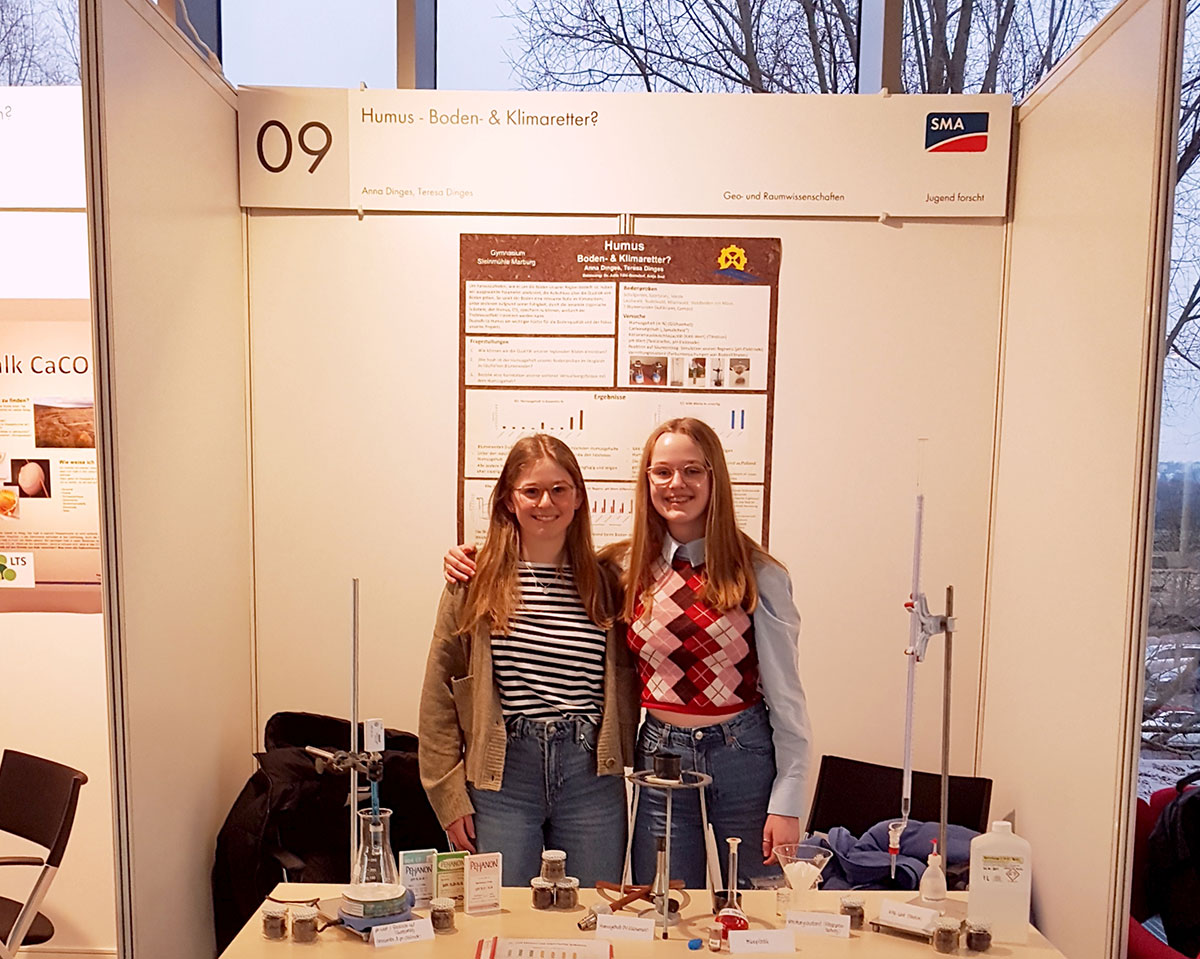
Sisters Anna Dinges (12th grade) and Teresa Dinges (9th grade) traveled to Kassel on Saturday, February 11, with their project “Humus: Savior of the Soil and Climate?” on Saturday, February 11, along with their advisors Antje Seel and Dr. Jutta Töhl-Borsdorf. The North Hesse regional competition was held at SMA in Kassel-Niestetal.
Soils play a major role in the climate system because humus is capableof storing large amounts ofCO2 . Anna and Teresa wondered about the condition of the soils in the areas where they live and go to school. In addition to measuring humus content, pH, and KAK values (a measure of soil fertility), they also investigated how soils react to acid rain. They compared the measurements from the soil samples they collected with those from commercially available potting soils and found that the latter actually had higher humus and KAK values. However, a coniferous forest soil also performed impressively overall. The jury particularly praised the outstanding laboratory work, which was conducted at a high level and with great precision, the rigorous scientific approach, and the in-depth examination of sustainability issues at the local level.
With their project, they won second place in the “Geosciences and Spatial Sciences” category and a special prize consisting of a one-year subscription to the science magazine “natur.”

Rainwater and Natural Adhesives
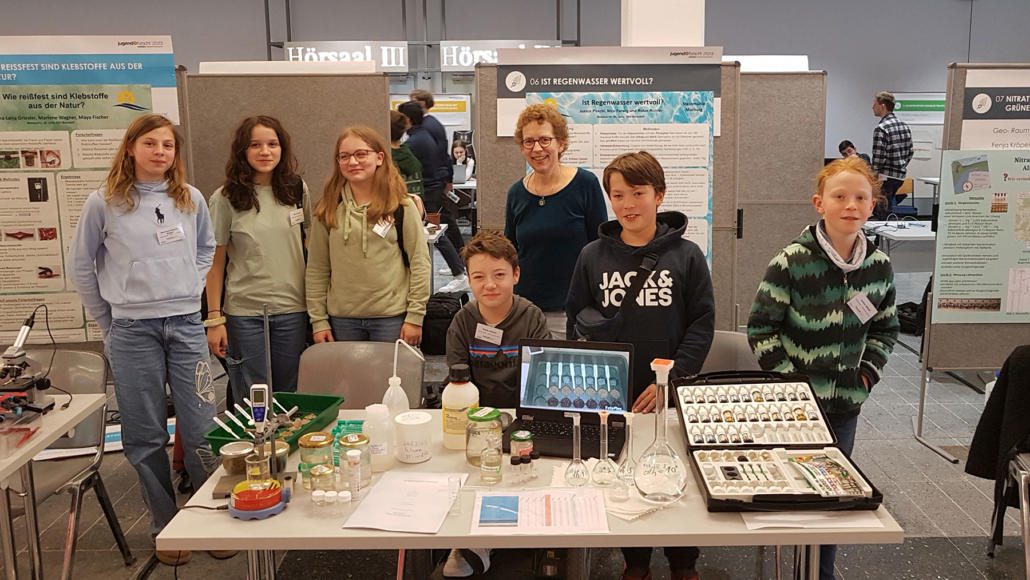
OnFriday, February 24, a large group set out for the University of Giessen to present their projects at the competition in Central Hesse. Anna-Lena Griesler, Maya Fischer, Marlene Wagner, Nico Farwig, Justus Pöschl, and Robin Richter—all from the 6th-grade GuFi lab groups—took on the challenge in the “Students Experiment” category.
The Steinmühlen bus was fully occupied with the six children, their supervisor Dr. Jutta Töhl-Borsdorf, STEM teacher Dr. Patrick Szabo, and participation assistant Steven Müller.
They set off at 7:45 a.m., and the morning was well filled with jury interviews and interesting lab tours. In the afternoon, the presentation booths were open to the general public. Many parents, grandparents, and friends took the opportunity to have the young researchers explain their projects to them. By around 5:00 p.m., everyone was tired but full of new impressions as they returned to the Steinmühle.
This year’s awards ceremony took place online on Saturday afternoon. To mark the occasion, all the students gathered at the Steinmühle for pizza. And finally, there was something to celebrate.
The group of three boys who asked themselves, “Is rainwater valuable?” won over the jury, taking second place in the “Geosciences and Spatial Sciences” category and a special prize of a one-year subscription to the magazine Geolino.
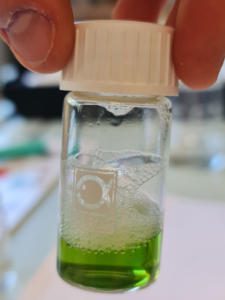
Justus, Nico, and Robin analyzed rainwater for various components, developed a water hardness test using soapy water, and found that cress grows better with rainwater than with tap water. The jury praised their clear methodology, the neat presentation of the measurement results, the visualization of the cress growth, and their broad knowledge.
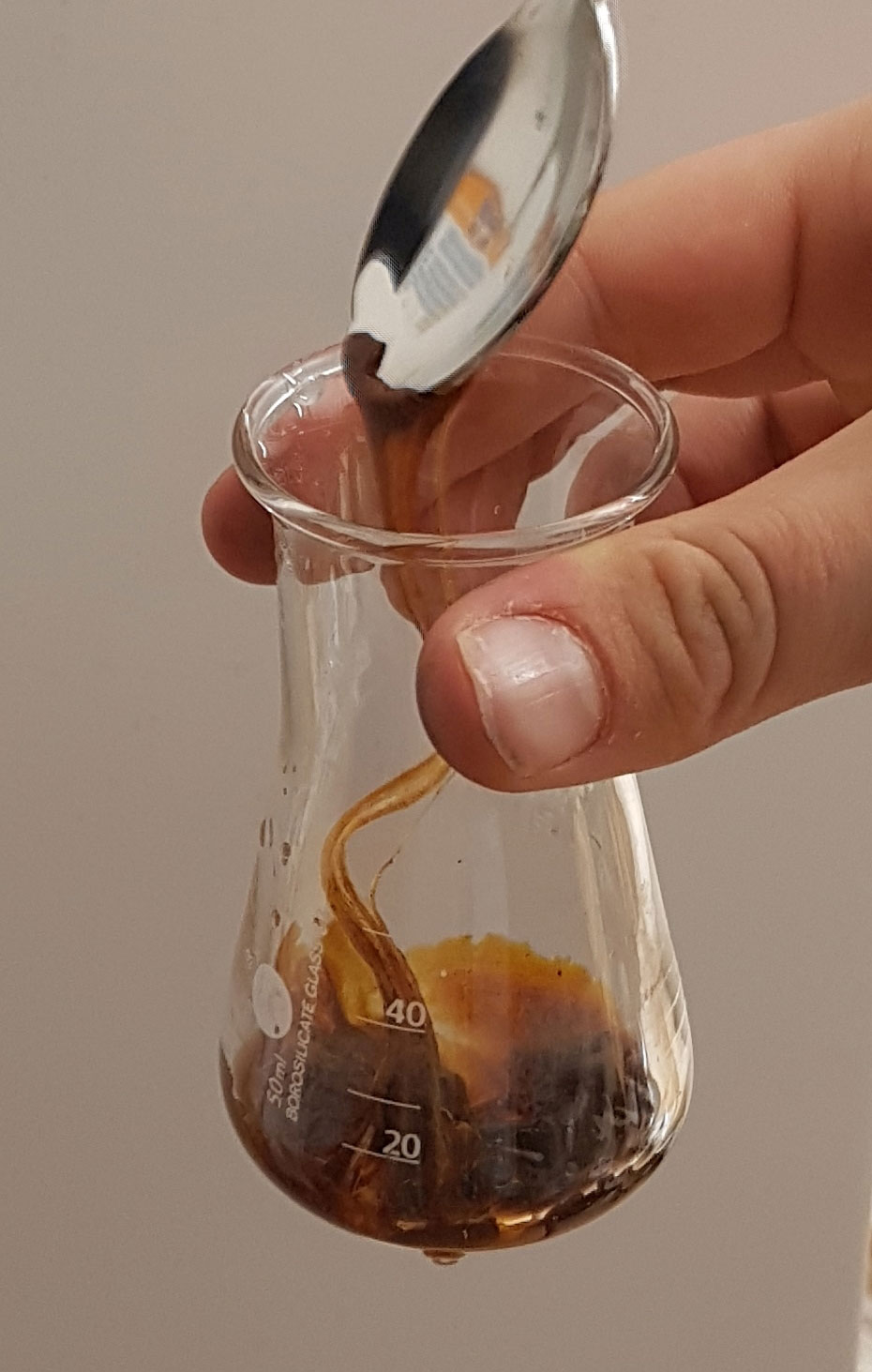
Anna-Lena, Maya, and Marlene securedfirst place in the chemistry category—and with it, a spot in the state competition at the University of Kassel—with their project “How Tear-Resistant Are Natural Adhesives?” They made many adhesives themselves—for example, from food—and tested other natural substances, such as spruce resin, shellac, and snail slime, for their adhesive properties. The team also succeeded in developing a device to measure the adhesive strength of the substances on paper.
The jury was particularly impressed by how these very young students continuously refined and adapted their experimental setup. They paid close attention to accuracy and critically evaluated their approach in each phase of the experiment. Their strong problem-solving skills were evident.
The team also won the plusMint Special Prize for interdisciplinary projects.
If you’re interested in starting your own research project, just stop by the “Open Lab” at the Steinmühle—it’s open every Tuesday and Friday starting at 2 p.m. (Room 127).