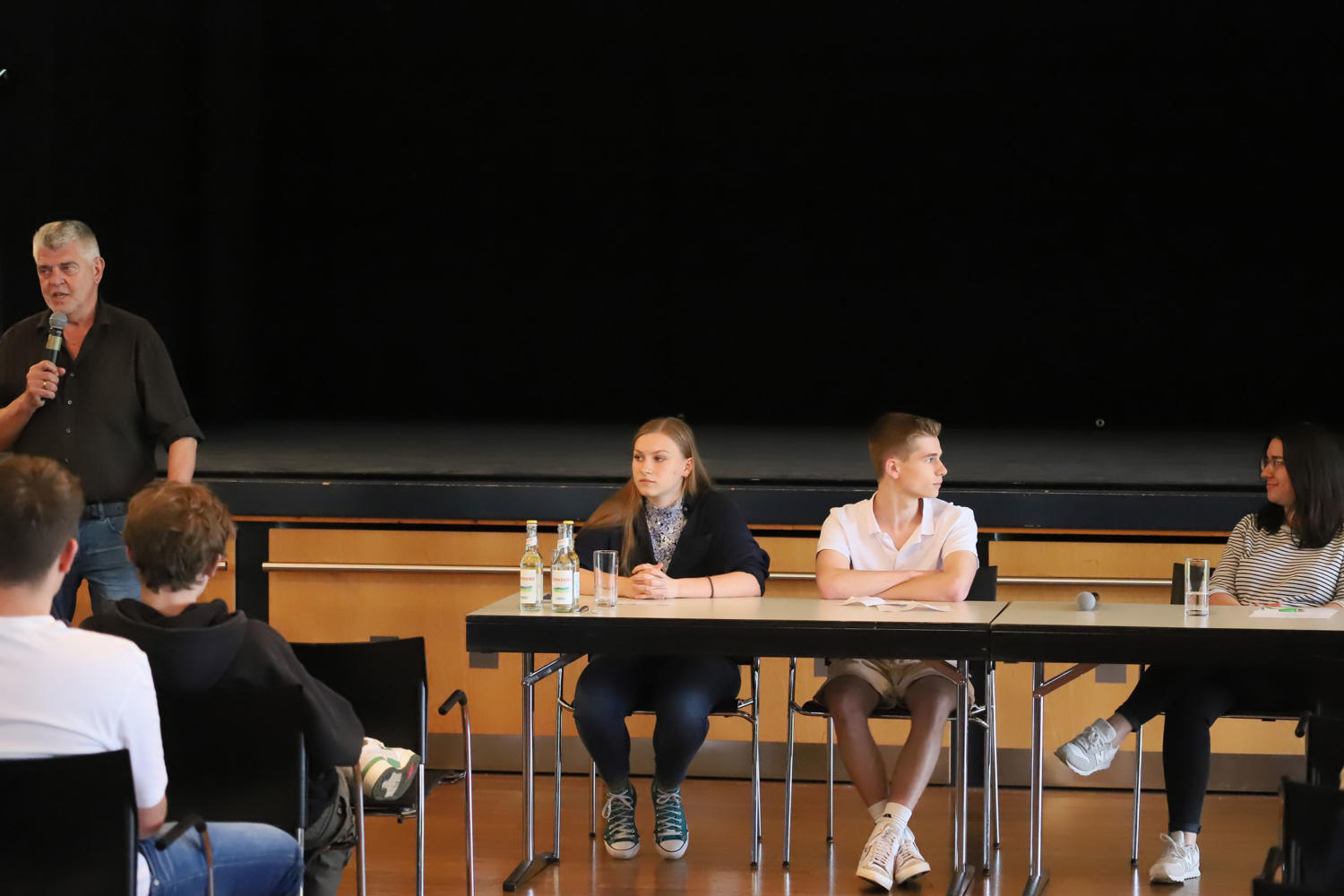
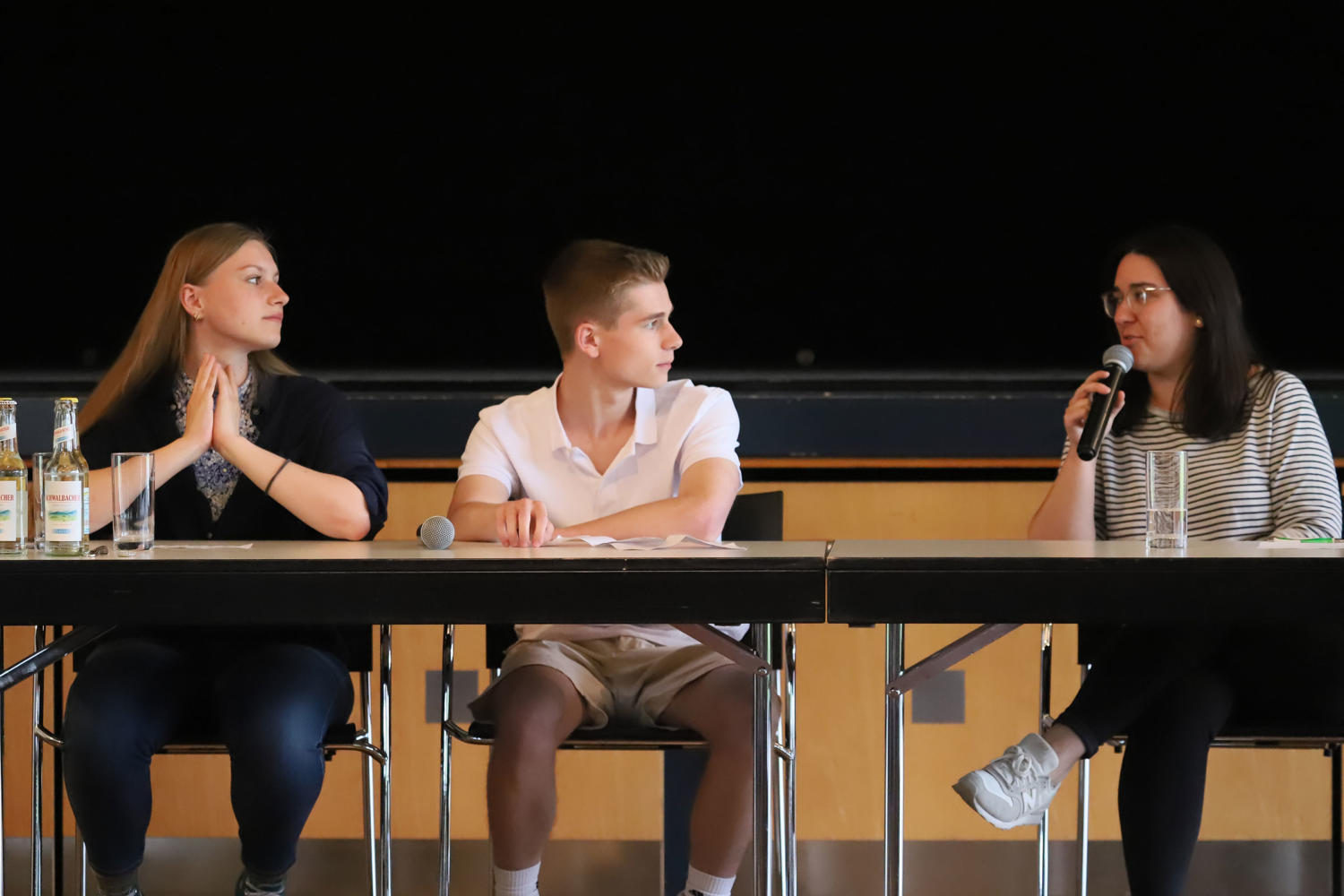
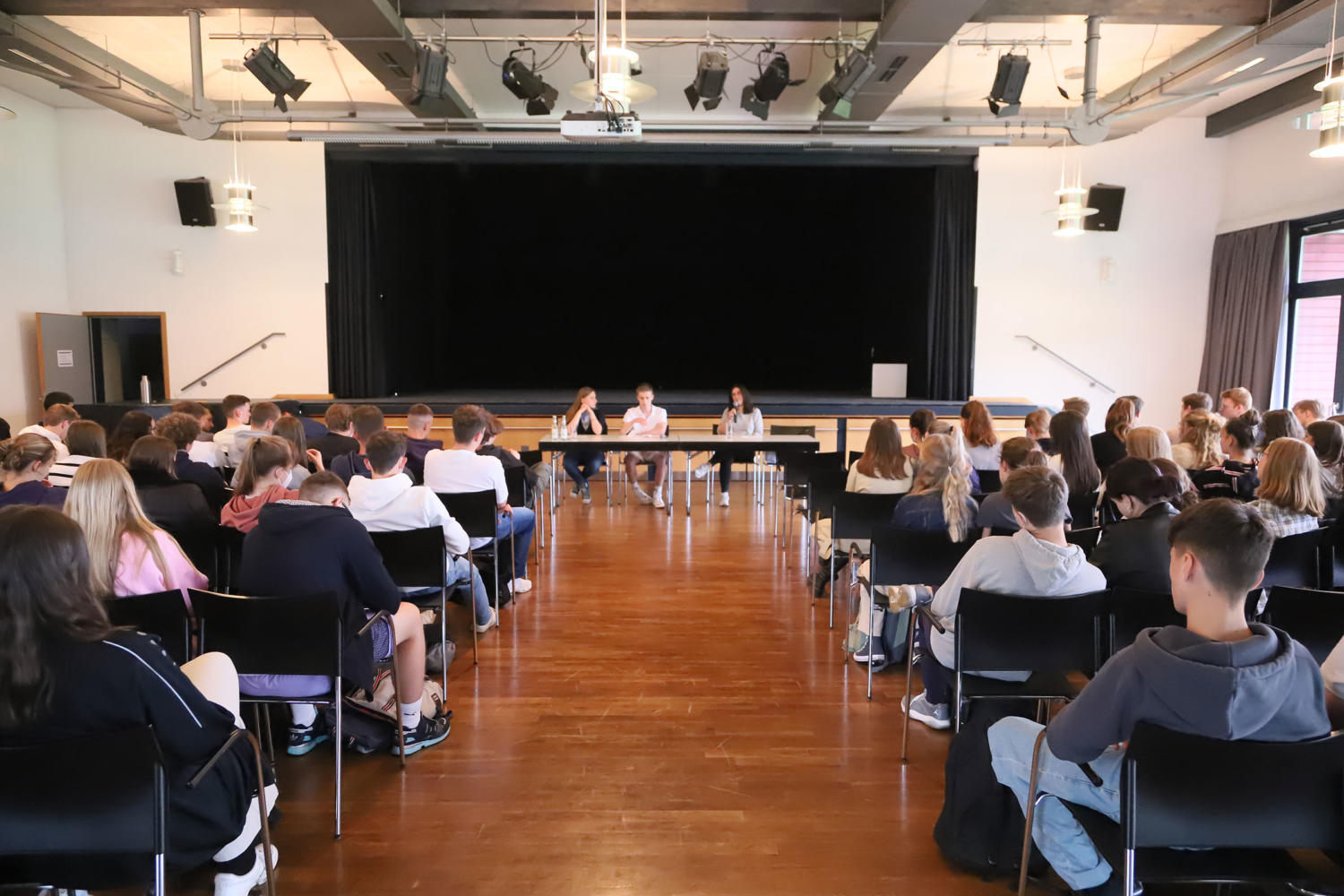
Whenever there’s an opportunity to engage with politicians, the high school students at Steinmühle are eager to participate. They value the chance to discuss current issues, hear different perspectives, and ask questions about topics that are on their minds. This was also the case during the visit by State Parliament Representative Nina Eisenhard. The 32-year-old has been a member of the Hessian State Parliament since 2019 and serves as the higher education policy spokesperson for the Green Party’s state parliamentary caucus.
The visit, organized by Erno Menzel and Bernd Hülsbeck with the support of their colleagues in the Politics and Economics department, had been prepared in class. Participants included the 12th-grade class and the future 11th-grade Politics and Economics honors class. However, some questions also arose spontaneously, partly prompted by the conflict in Ukraine. The discussion centered on defense spending, the question of how the Green Party, as a coalition partner, could possibly support certain decisions in substance, and the fact that digitization is progressing so terribly slowly, especially in higher education.
Despite her young age, Nina Eisenhardt was able to draw on her own personal experience. She didn’t go straight from the classroom to a seat in parliament. The politician spoke about her experience as a self-employed entrepreneur running a web development company. “This has significantly improved my understanding of these issues,” she said. According to Nina Eisenhardt, the slow pace of digitization in the education sector isn’t due to a lack of available hardware: “That’s already in place.” Rather, there is a lack of staff for maintenance and long-term oversight. “It’s simply a matter of jobs.”
The students, led by the moderator team of Tilmann Molzberger and Mara Mensing, asked whether she found the decisions being made within the coalition unsatisfactory in terms of their substance. The member of parliament described the coalition compromises as side effects of a “temporary alliance of convenience.” She noted that if one wants to be part of the process and play a fundamental role in shaping it, there will inevitably be decisions that run counter to one’s personal views.
The questioners—all of whom were men—were also interested in the visitor’s views on a possible lowering of the voting age.
According to Nina Eisenhardt, voting is a right that requires no qualifications. You don’t have to explain why you want to vote. There is no reason to deny the right to vote to those under 18. The representative continued: “I’m in favor of lowering the voting age to 14. From that age on, you can work, earn a salary, and are required to pay taxes.” Nina Eisenhardt concluded: “Voting starting at age 14—that would be a huge opportunity.”





State Representative Nina Eisenhardt (Alliance 90/The Greens) Visits the Steinmühle
Ecology and Sustainability, News, Politics, Business & ResponsibilityWhenever there’s an opportunity to engage with politicians, the high school students at Steinmühle are eager to participate. They value the chance to discuss current issues, hear different perspectives, and ask questions about topics that are on their minds. This was also the case during the visit by State Parliament Representative Nina Eisenhard. The 32-year-old has been a member of the Hessian State Parliament since 2019 and serves as the higher education policy spokesperson for the Green Party’s state parliamentary caucus.
The visit, organized by Erno Menzel and Bernd Hülsbeck with the support of their colleagues in the Politics and Economics department, had been prepared in class. Participants included the 12th-grade class and the future 11th-grade Politics and Economics honors class. However, some questions also arose spontaneously, partly prompted by the conflict in Ukraine. The discussion centered on defense spending, the question of how the Green Party, as a coalition partner, could possibly support certain decisions in substance, and the fact that digitization is progressing so terribly slowly, especially in higher education.
Despite her young age, Nina Eisenhardt was able to draw on her own personal experience. She didn’t go straight from the classroom to a seat in parliament. The politician spoke about her experience as a self-employed entrepreneur running a web development company. “This has significantly improved my understanding of these issues,” she said. According to Nina Eisenhardt, the slow pace of digitization in the education sector isn’t due to a lack of available hardware: “That’s already in place.” Rather, there is a lack of staff for maintenance and long-term oversight. “It’s simply a matter of jobs.”
The students, led by the moderator team of Tilmann Molzberger and Mara Mensing, asked whether she found the decisions being made within the coalition unsatisfactory in terms of their substance. The member of parliament described the coalition compromises as side effects of a “temporary alliance of convenience.” She noted that if one wants to be part of the process and play a fundamental role in shaping it, there will inevitably be decisions that run counter to one’s personal views.
The questioners—all of whom were men—were also interested in the visitor’s views on a possible lowering of the voting age.
According to Nina Eisenhardt, voting is a right that requires no qualifications. You don’t have to explain why you want to vote. There is no reason to deny the right to vote to those under 18. The representative continued: “I’m in favor of lowering the voting age to 14. From that age on, you can work, earn a salary, and are required to pay taxes.” Nina Eisenhardt concluded: “Voting starting at age 14—that would be a huge opportunity.”