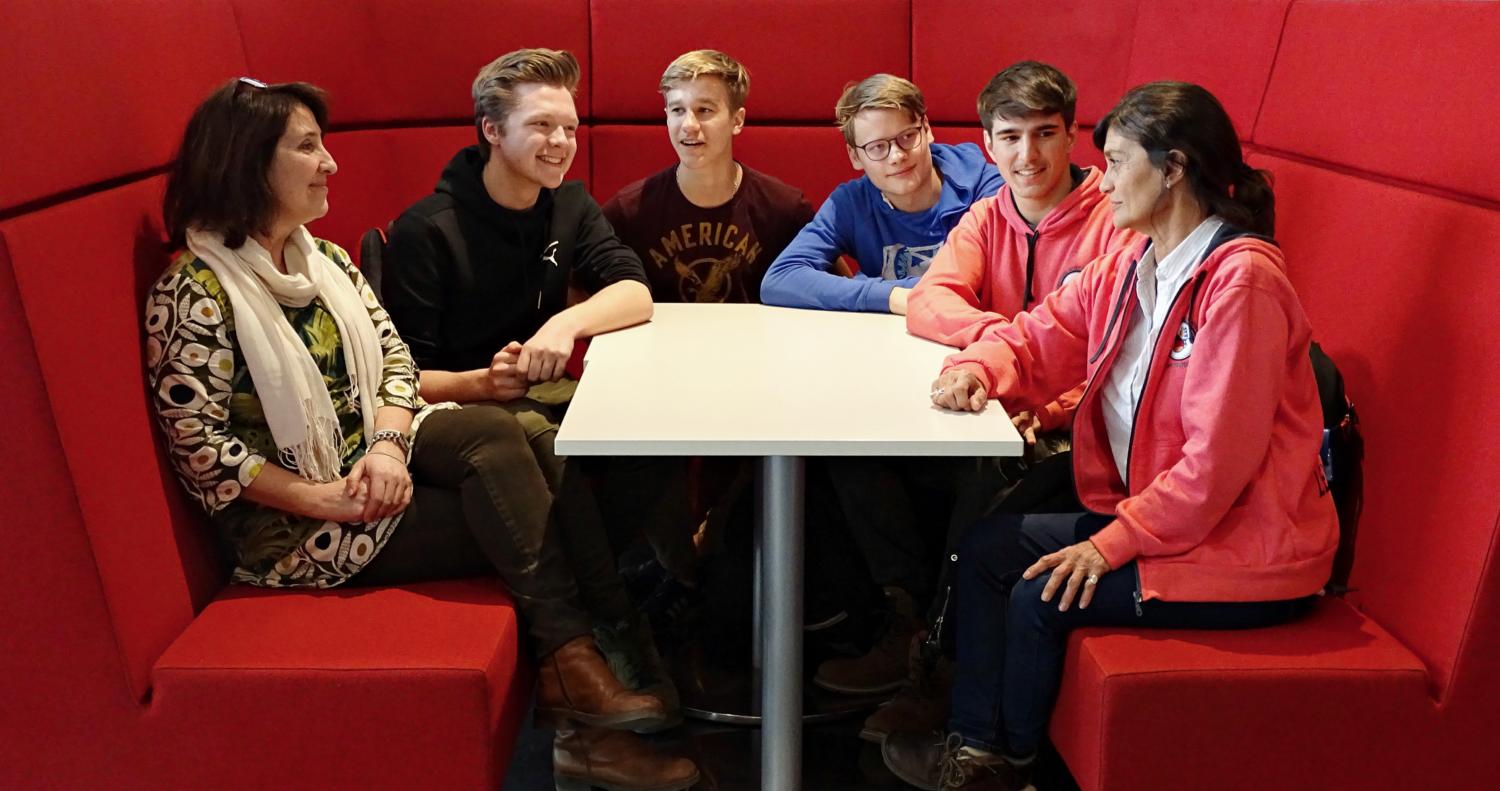
Exchange students Francisco Bayce and Juan Ignacio Cambon from Montevideo have only a few days left at Steinmühle before they return to their home country of Uruguay. Their partner students, Lars Froemel and Julius Hamel, will make a return visit in a few weeks. After all, the best way to learn a language is in the country where it’s spoken. Both students want to improve their Spanish.
The visiting students answer questions in surprisingly good German. In Montevideo, a city of over a million people, they are attending the German school. At the DSM, the German School of Montevideo, they experience school life a little differently than at Steinmühle. With 1,200 students, the enrollment there is almost exactly double.
Otherwise, they see some similarities: Bilingual instruction—Spanish/German or Spanish/English—also helps young people develop their language skills at the DSM in Uruguay. Chaperone Laura Bergues can confirm this. She is their English teacher.
The biggest difference the teenagers noticed was that cell phones play a bigger role in classes back home. “We’re allowed to use them more than we do here,” Francisco reports. He says the internet connections are worse in Germany, but he did notice something else positive: “You definitely have the nicer soccer stadiums,” he says with a laugh.
Francisco and Juan Ignacio noticed something else: “We eat a lot more meat at home.” A few figures make it clear what the dietary situation is like in this South American country: Uruguay has 15 million cows and 13 million sheep for its 3.5 million residents.
“Every country has a different concept of politeness.”
Meanwhile, Lars Froemel, a 10th grader, and Julius Hamel, an 11th grader, are looking forward to their upcoming stay in Montevideo. They’re excited to see their two exchange partners again—people they’ve already gotten along with so well. All four boys agree: It was a great fit!
The teenagers from Uruguay would like to say thank you: “Thank you to the Steinmühle and to our host families. We had a great time.”
María Ramos, Lars and Julius’s Spanish teacher, is glad that the Uruguay exchange program is thriving at Steinmühle. “We started it a few years ago and have now expanded the program.” The linguistic nuances of Spanish in Uruguay, as well as in Argentina, are minor variations and by no means a dialect. “The intonation is a bit like that of Italian.”
Otherwise, she and her colleague from Uruguay give the young people tips on how best to behave in everyday situations in Uruguay. “Every country,” she says, “has a different concept of politeness.”
“In our country,” the guests from Uruguay emphasize, “you’re always warmly welcomed and in good hands. It’s the safest country in Latin America.”



Learning Spanish Abroad: Lars Froemel and Julius Hamel Begin Their Exchange Program in Uruguay
Languages & International Affairs, News, Steinmühle on the RoadExchange students Francisco Bayce and Juan Ignacio Cambon from Montevideo have only a few days left at Steinmühle before they return to their home country of Uruguay. Their partner students, Lars Froemel and Julius Hamel, will make a return visit in a few weeks. After all, the best way to learn a language is in the country where it’s spoken. Both students want to improve their Spanish.
The visiting students answer questions in surprisingly good German. In Montevideo, a city of over a million people, they are attending the German school. At the DSM, the German School of Montevideo, they experience school life a little differently than at Steinmühle. With 1,200 students, the enrollment there is almost exactly double.
Otherwise, they see some similarities: Bilingual instruction—Spanish/German or Spanish/English—also helps young people develop their language skills at the DSM in Uruguay. Chaperone Laura Bergues can confirm this. She is their English teacher.
The biggest difference the teenagers noticed was that cell phones play a bigger role in classes back home. “We’re allowed to use them more than we do here,” Francisco reports. He says the internet connections are worse in Germany, but he did notice something else positive: “You definitely have the nicer soccer stadiums,” he says with a laugh.
Francisco and Juan Ignacio noticed something else: “We eat a lot more meat at home.” A few figures make it clear what the dietary situation is like in this South American country: Uruguay has 15 million cows and 13 million sheep for its 3.5 million residents.
“Every country has a different concept of politeness.”
Meanwhile, Lars Froemel, a 10th grader, and Julius Hamel, an 11th grader, are looking forward to their upcoming stay in Montevideo. They’re excited to see their two exchange partners again—people they’ve already gotten along with so well. All four boys agree: It was a great fit!
The teenagers from Uruguay would like to say thank you: “Thank you to the Steinmühle and to our host families. We had a great time.”
María Ramos, Lars and Julius’s Spanish teacher, is glad that the Uruguay exchange program is thriving at Steinmühle. “We started it a few years ago and have now expanded the program.” The linguistic nuances of Spanish in Uruguay, as well as in Argentina, are minor variations and by no means a dialect. “The intonation is a bit like that of Italian.”
Otherwise, she and her colleague from Uruguay give the young people tips on how best to behave in everyday situations in Uruguay. “Every country,” she says, “has a different concept of politeness.”
“In our country,” the guests from Uruguay emphasize, “you’re always warmly welcomed and in good hands. It’s the safest country in Latin America.”