


“Youth Researches”: Young researchers from Steinmühlen took home plenty of awards
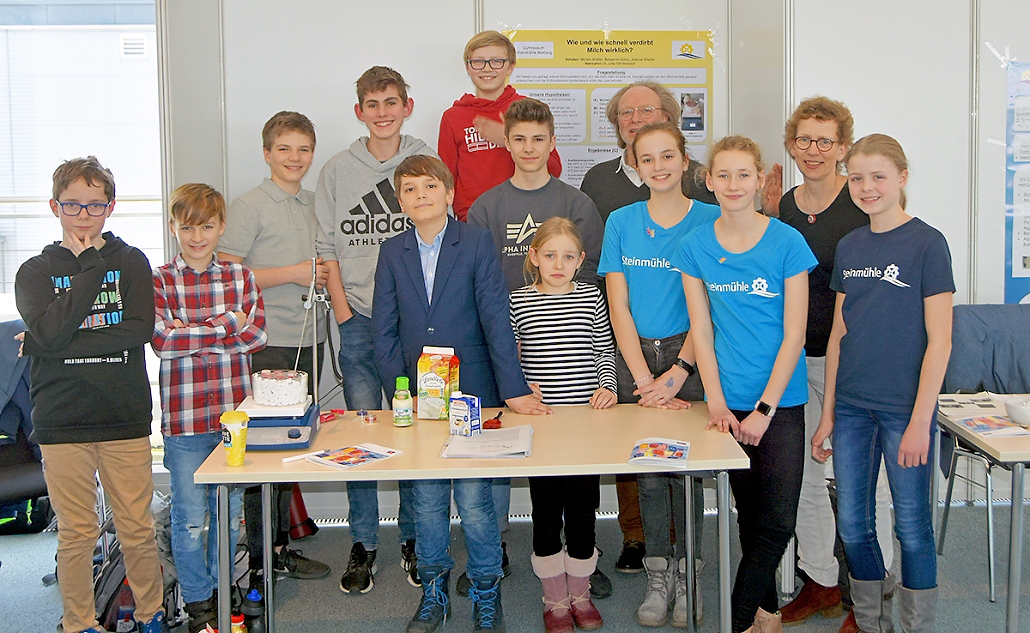
Of the 15 students, 13 qualified for their respective state competitions
Steinmühlen students explored interesting everyday questions related to nutrition and nature in the “Schüler experimentieren” competition. Under this competition title—the “Jugend Forscht” category for lower and middle school students (up to age 14)—the youngest Steinmühlen students won numerous prizes: They were able to prevail against mostly older competitors. They took first place five times and second place once. The early-intervention program—featuring the so-called “GuFi Lab,” where both basic and advanced work is conducted—has thus proven its worth in an impressive way.
Phosphate in Food—How Delicious Food Can Be Dangerous
Under this title, students Mats Böhmer, Marvin Preis, and Joel Rucker, along with their advisor Dr. Jutta Töhl-Borsdorf, entered the competition in the field of chemistry.
Excessively high phosphate levels in the blood can lead to cardiovascular disease and osteoporosis. The group of students developed testing methods to analyze the phosphate content of various foods, such as döner, bratwurst, and cola. In the process, they discovered that you consume far less phosphate from the much-criticized doner than from a cola. The project was awarded first prize and will compete in the state competition in April.
Does Diet Coke Make You Fat? – A Study of Blood Sugar Levels
In their biology class, students Rebecca Zenker and Hanna Schmidt-Dege studied blood sugar levels after consuming various sweeteners, as well as cola, Diet Coke, and potatoes.
Based on their findings, they concluded that it is best not to consume artificial sweeteners at the same time as sugar, and that potatoes do not cause blood sugar levels to rise as sharply if they are allowed to cool beforehand. The project, conducted in the Biology department under the supervision of Dr. Jutta Töhl-Borsdorf, won second place.
How and how quickly does milk really go bad?
In search of an answer to this question, students Joshua Wieder, Morten Köhler, and Benjamin Schul conducted research in the Department of Chemistry. The team investigated how different types of milk spoil under various conditions. To do this, they built a temperature-control apparatus, determined the timing of curdling, and took bacterial swabs. Among other things, they found that added sugar accelerates spoilage, while longer shelf lives—even at room temperature—can be achieved by adding the sugar alcohol xylitol and by introducing air. The judges awarded first place in the same age group to the project, which was supervised by Dr. Jutta Töhl-Borsdorf. The team will now compete in the state competition.
Sunscreen for Trees
Once again in the field of chemistry, fifth-graders Mats Egbring and Leonard Berger entered the competition under the guidance of their teacher, Dr. Dietmar von der Ahe. Because his partner was unable to attend on the day of the competition, Leonard Berger presented the results. The two students isolated the leaf pigments from various colored autumn leaves and plotted them on a chromatogram. They used the leaf pigments—green, red, yellow, and brown-yellow—in solution as “sunscreen protection” against UV radiation, which simulates sunlight, on agar plates containing oral bacteria. Without color filters, bacterial growth is inhibited. The protective effect of the pigment filters ranges from 30% to 80%. The red filter provides the strongest protection against UV light. Leonard Berger received a special interdisciplinary award (equivalent to first prize) for his presentation and has been admitted to the state competition “Schüler experimentieren.”
Herbs, Tea, and More to Fight Bacteria
In their biology experiments, students Teresa Dinges, Neyla Fritz, and Sophia Rogosch (all in 5th grade), under the guidance of their teacher Dr. Dietmar von der Ahe, investigated the effect of various types of tea, herbal infusions, and food-based beverages on bacterial growth. The various solutions were mixed into liquid agar, poured into Petri dishes, and oral bacteria were spread onto them. By counting the bacterial colonies, the students were able to test the inhibitory effect of the herbal, tea, and food solutions on bacterial growth. Peppermint tea and ginger tea inhibit bacterial growth the most. The project was presented by Neyla Fritz and Sophia Rogosch (Teresa Dinges was unable to attend due to her participation in the Math Olympiad). The project won first place and has thus qualified for the state competition.
The young researchers (Schüler experimentieren) in Kassel with their mentors:
From left to right: Mats Böhmer, Joel Rucker, Morten Köhler, Joshua Wieder, Leonard Berger, Marvin Preis, Benjamin Schul, Neyla Fritz, Dr. Dietmar von der Ahe, Rebecca Zenker, Hanna
Schmidt-Dege, Dr. Jutta Töhl-Borsdorf, Sophia Rogosch. Not pictured are participants Teresa Dinges and Mats Egbring.


