


“People make life easy for cybercriminals”
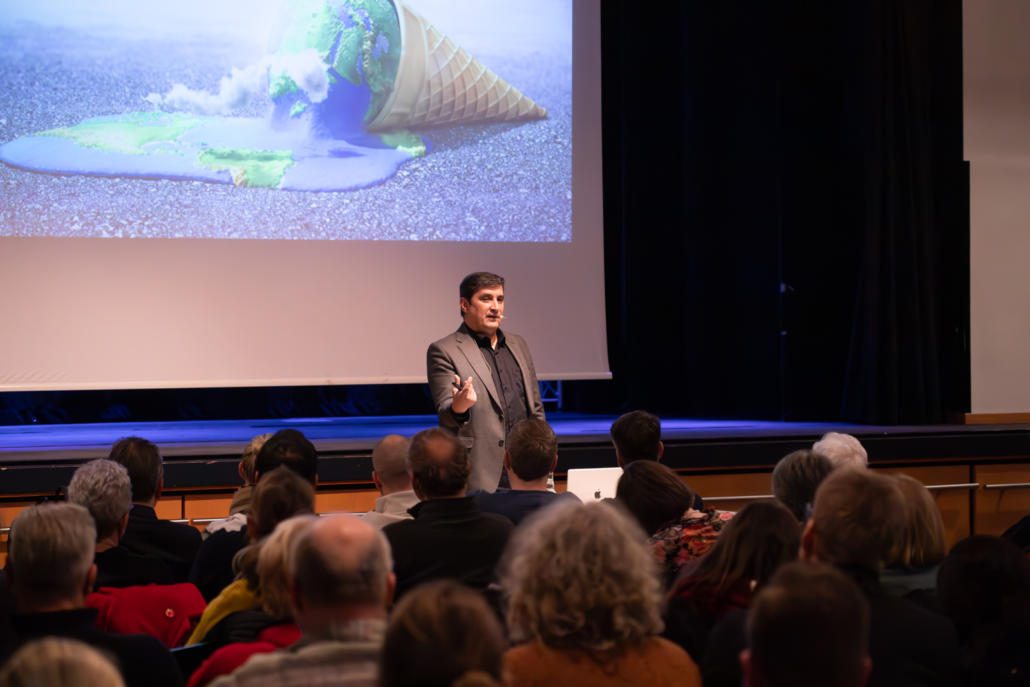
On “data condoms,” whistles, and loss of control: Cem Karakaya, who has specialized in cybercrime and prevention since 2008, spoke to teachers, parents, and alumni of Steinmühle about cybercrime and media literacy. The following day, the former Interpol employee returned to Steinmühle to speak to students in grades 7 through 10—offering plenty of tips on the topic.

He’s not on Facebook. Nor is he on Instagram or TikTok. You’ll also search in vain for Cem Karakaya on the professional network LinkedIn. Instead of WhatsApp messages, he sends good old-fashioned text messages—because of the terms and conditions under German law. And that’s where he catches the audience off guard for the first time: “You always just check the ‘I’ve read this’ box on every set of terms and conditions. Right?”
Well. Who actually reads everything carefully? And who worries about the digital footprint they leave behind? Cem Karakaya holds up a mirror to the audience at the Steinmühle Forum: Be sure to provide your date of birth—and, ideally, your city and street address, too. Email address, of course, and phone number too. Photos of yourself, and of your family as well. The stage is set for identity theft.
Don’t post photos of children online!
“Please, please, don’t post photos of your children online,” warns the Turkish-born trained police officer, former Interpol employee, cybercrime expert, and founder of blackstone 432, a company with 198 employees. Why do you think Mark Zuckerberg covered his children’s faces with emojis online? The internet is not a lawless space; the right to one’s own image and copyrights apply just as they do elsewhere. The only question is: Who actually follows the rules?
Most attacks begin with phishing emails
Karakaya laments the German police’s frequent lack of recourse and shares stories—stories that, unfortunately, are true. How quickly passwords can be cracked (“please make it 13 characters long and include only special characters”), how incredibly easy it is to gain access to other people’s devices via a hotel Wi-Fi network, how easily you can occasionally read the emails of the person sitting next to you on the train or the messages of the passenger two seats away on a plane. That charging your phone on a public Wi-Fi network can expose your data; that an email purporting to be from the “bank” often isn’t actually from the bank; or that it’s not the package delivery service asking you to open its email attachment. Please—don’t! “80 percent of all attacks start with phishing emails.”
Clip made from two photos and AI
Cem Karakaya focuses on education so that people can understand how these mechanisms work, thereby preventing damage to computers and harm to their owners. “Did you know that two portrait photos online are enough to create a video of you speaking every language in the world, with perfect lip-syncing?” The speaker demonstrates this in his presentation: Cem Karakaya suddenly starts speaking French. AI makes it possible.
“They don’t have an awesome life”
In his presentation, the speaker touches on numerous topics. Artificial intelligence—also an issue among influencers who “enhance” their appearance and fake their vacation backgrounds. Cem Karakaya: “In reality, they often don’t have such an amazing life.” There are small details that usually only insiders notice, revealing that it’s not actually a South Sea beach: a repetitive cloud pattern, incongruous vegetation, and more.
“People can swipe and click—that’s all”
Cem Karakaya doesn’t demonize technology. “It’s not the computer itself that’s bad—it’s people.” In addition to data that people enter about themselves online, their behavior on the Internet is also analyzed. Big Data. “Search engines are the biggest source of user identities. Even the way you type on the keyboard helps form a user profile.” Online relationships do the rest. “People make life easy for criminals—whether out of negligence or ignorance.” Karakaya’s take: “People can swipe; people can click. That’s all.”
The speaker sheds light on even more. “Quishing,” for example—the attempt to redirect recipients to a specific page via a QR code in a snail mail letter. It looks legitimate—but it isn’t. “That’s a reason to double-check the sender,” says Cem Karakaya.
Warning sign: Lots of small red numbers on your phone’s home screen
The speaker also throws in a few more tips and suggestions during the presentation. It doesn’t hurt to give them some thought:
– Delete unnecessary files and emails—mail servers consume a lot of electricity, generate heat, and require cooling. “A lot of little red numbers on your phone’s home screen mean you’ve lost control.”
– No backup—no sympathy
– Hacker attacks usually occur on weekends or holidays
– Take a close look first, then react. If an email sender seems suspicious to you, hover your cursor over the name for a few seconds. In such cases, the “real” sender will appear next to it after a while.
– A data blocker (“data condom”) prevents data transfer while charging
– Don’t choose a password that’s too short. It takes 11 hours to crack an eight-character password, and a whopping 47 years to crack a thirteen-character one
– Do not reuse passwords
– If you receive so-called “support calls” from Microsoft, Amazon, PayPal, or Europol/Interpol, blow the whistle
– Watch out for typos in email addresses (O instead of zero, capital “I” instead of “l,” etc.)
– Keep data minimization in mind: Rental cars may, in some cases, access a smartphone’s entire address book
– Set up a guest Wi-Fi network for visitors at home or in the office
– The laws of the location where the server facilities are located always apply
“Media education is the parents’ responsibility”
Cem Karakaya, a Spiegel bestselling author, bids his audience farewell with humor, but not without urging them to reflect: “Media education is the school’s responsibility. Media training is the parents’ responsibility. Every adult serves as a role model. Everyone decides for themselves when to turn it on and when to turn it off.”
Perhaps one or two members of the audience went home feeling uneasy. Steinmühle School also raises its students’ awareness about using the internet cautiously on many occasions, but here the information came in a concentrated dose. The many statistics presented were also impressive—for example, the fact that three years of Facebook membership amounts to 1,200 pages of personal information.
– Don’t have any plans for the weekend yet? We have an idea: Delete any unnecessary information online and check the security settings on your phone. Angela Heinemann
More information on this topic can be found in Cem Karakaya’s two books (“The Cyber Pros” and “Click Here”) as well as on his company’s website, blackstone432.