


Music and Art: A Fruitful Exchange Between Two Disciplines
Art teacher Ines Vielhaben reports on the interdisciplinary Impressionism project in the introductory phase at Steinmühle:
Impressionism was a politically and culturally turbulent period in which rigid forms in music and art were replaced by evocative snapshots. For the composer Debussy, music is “the art of sound and color.” Thus, as the 19th century drew to a close, music and art were, at least linguistically, very closely related.
Students in the art and music classes of the introductory phase were to explore the themes of mutual inspiration and dialogue between the arts in a joint lesson. Through not only theory but also the use of brushes, clay, and instruments, the classes taught by Ulrike Wilmsmeyer and Ines Vielhaben explored the Impressionist era.
In one workshop, for example, the musicians and artists listened together to Ravel’s famous *Boléro* and allowed the music to evoke moods and associations. The artist then distilled these into a landscape motif, which she rendered on paper with broad brushstrokes, while the musicians practiced the underlying rhythm and the main melody in their various keys for the presentations.

Marie Sans performs Claude Debussy’s “La cathédrale engloutie” to open the presentations, while images of Claude Monet’s “Rouen Cathedral, 1893” are projected and artwork by students Hannah and Sarah is on display.
During the presentation, the mosaic of different thematic focuses coalesced into a broad tapestry, which was further enriched by insights into contemporary history provided in the presentations by students Julia, Lina, and Fynn.
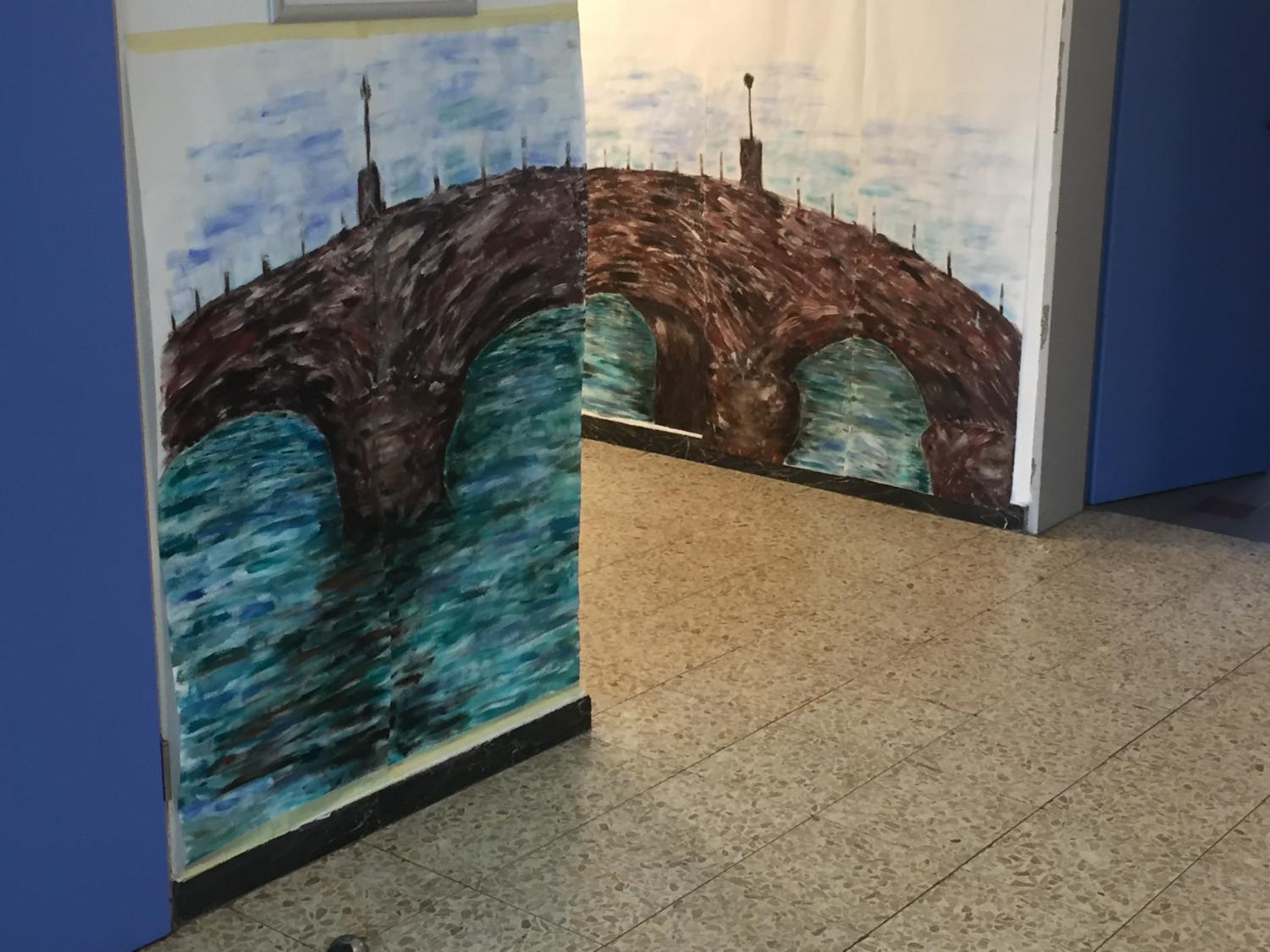

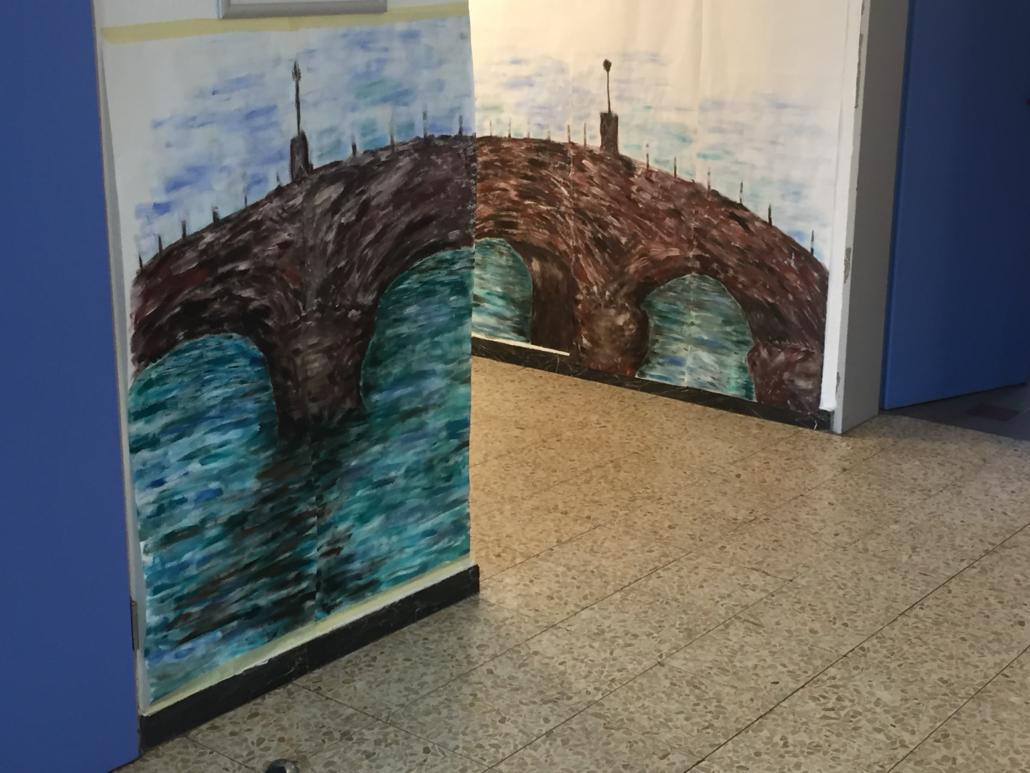
The Weidenhäuser Bridge: From a certain vantage point in the hallway of the Hessenhaus, the bridge appears to be connected, but in reality, the two parts were painted separately on wallpaper by students Chiara and Jana using their characteristic broad brushstrokes.
The highlight of the lesson was the reflection session following the presentations, during which all participants—still filled with impressionistic melodies and impressions of the visual arts—discussed the parallels and differences. In the process, connections were drawn between the dissolution of forms and contours in art and unresolved harmonies in music. It was concluded that, thematically, both disciplines have used atmospheres and moods as inspiration for their works.
It is impressive how fruitful the exchange between the arts—which are always kept separate in school curricula—can be, and how the spirit of an era can be conveyed much more comprehensively than a single subject can achieve.


