Languages & Internationalism at the Steinmühle

At Home in the World

Given Europe’s role as a cultural and economic region and the increasing pace of globalization, learning foreign languages continues to grow in importance. The internationalization of personal and professional relationships requires comprehensive communication skills in various foreign languages as well as intercultural competence. Against this backdrop, foreign language instruction at Steinmühle makes a fundamental contribution to the high school’s educational goals and imparts the linguistic and communicative skills necessary for higher education, vocational training, and professional success.

Language Offerings and Sequence of Languages

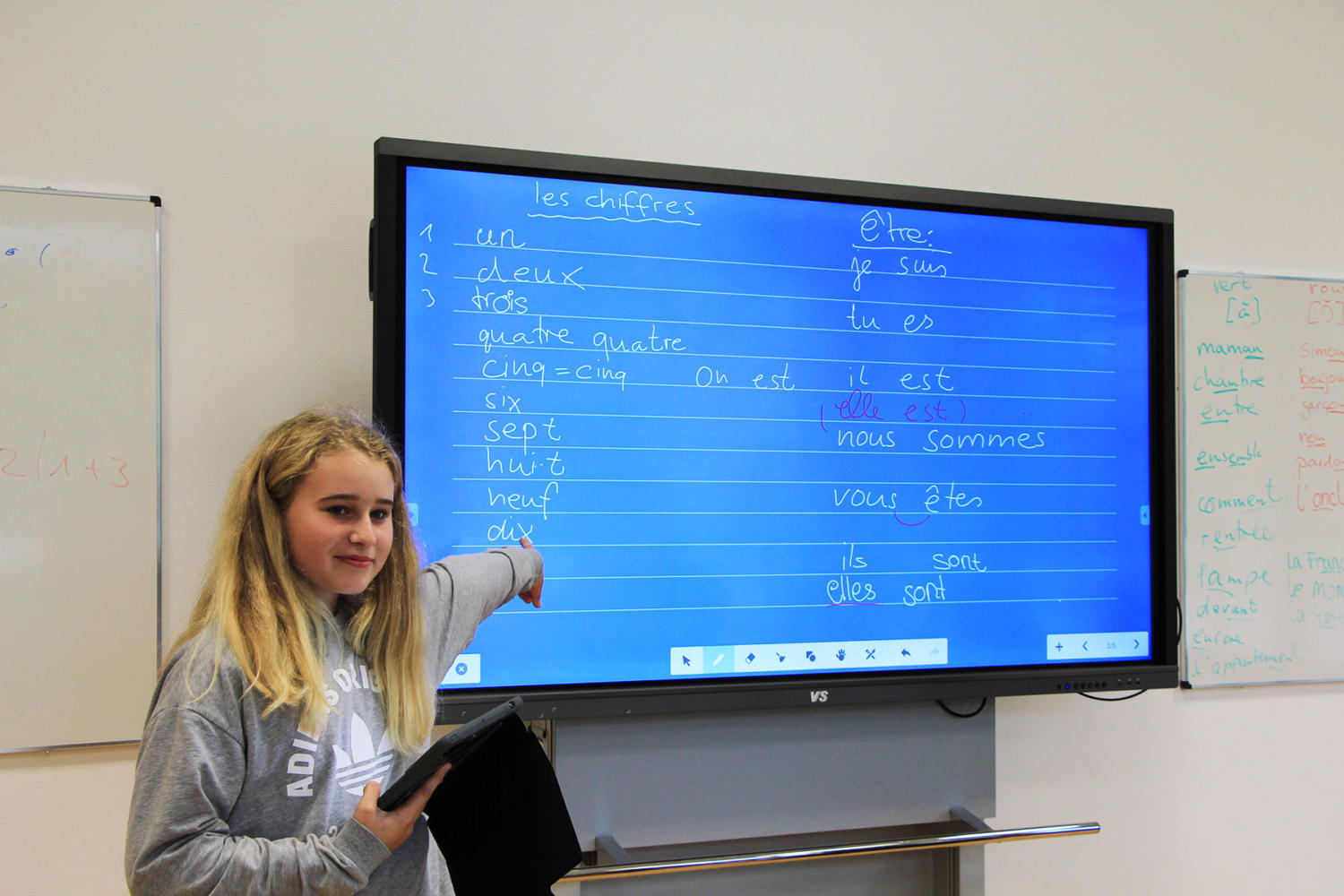
All students begin learning English as their first foreign language in 5th grade. A special program is offered in 6th grade: As part of a one-hour “Fra-La-Spa” class, students can gain their first exposure to French, Latin, and Spanish.
Starting in 7th grade, students must choose one of the three languages mentioned as a second foreign language. An additional foreign language can be taken upon entering the upper secondary level: Spanish or Italian (Russian in cooperation with the other high schools in Marburg).

Language
, Class
Order of Foreign Languages 5 6 7 8 9 10 11 12 13
English 1. FS x x x x x x x x X
French 2nd FS x x x x x x x
Latin 2nd FS x x x x x x x
Spanish 2nd FS x x x x x x x
Spanish Newly started 2nd FS x x x
Italian Newly started 2nd FS x x x
Russian (at MLS) Newly started 2nd FS x x x

Bilingual Instruction

Steinmühle has offered a bilingual program since the 2001–2002 school year. Bilingual instruction means that students learn the standard curriculum for a subject, but in two languages (at Steinmühle: English and German). The primary language of instruction is English, though key terminology is taught in both languages.
Students have the opportunity to take Geography (Grade 7), History (Grades 8 and 9), and Politics and Economics (Grade 10) in English. In addition, students in the upper school can take Mathematics as a bilingual course.
English is a means to an end; in other words, the focus is on communication, not necessarily on linguistic correctness. This allows students to use the foreign language in a relaxed manner.
After just a short time, it becomes apparent that the students have expanded their vocabulary and are able to use the foreign language flexibly.

Elective Courses (WU) for the Cambridge Certificate

To demonstrate English proficiency or to study abroad, proof of language proficiency is often required. Sometimes, a standard grade on a report card is not enough for employers or universities. The Cambridge Certificate is recognized worldwide and is accepted by many universities and employers as proof of language proficiency. What makes the Cambridge Certificates special is that they are valid for life and do not—unlike other certificates—expire after two years.

In this course, which takes place at the beginning of high school, students are prepared for the exam. This means we practice the test formats required for the FCE (First Certificate of English—Level B2 of the Common European Framework of Reference for Languages), both for the written section (Listening, Reading, Writing, and Usage of English) and for the oral section (Speaking). The exams take place at the end of the year at Steinmühle on two separate dates and are subject to a fee. The oral exams are administered by an external member of the FCE examination board.

Elective Courses (WU) for the Cambridge Certificate

To demonstrate English proficiency or to study abroad, proof of language proficiency is often required. Sometimes, a standard grade on a report card is not enough for employers or universities. The Cambridge Certificate is recognized worldwide and is accepted by many universities and employers as proof of language proficiency. What makes the Cambridge Certificates special is that they are valid for life and do not—unlike other certificates—expire after two years.

In this course, which takes place at the beginning of high school, students are prepared for the exam. This means we practice the test formats required for the FCE (First Certificate of English—Level B2 of the Common European Framework of Reference for Languages), both for the written section (Listening, Reading, Writing, and Usage of English) and for the oral section (Speaking). The exams take place at the end of the year at Steinmühle on two separate dates and are subject to a fee. The oral exams are administered by an external member of the FCE examination board.

Round Square

As part of the international school network Round Square, Steinmühle offers its students new and additional opportunities for personal development as well as for education both inside and outside of school. Round Square promotes intercultural learning and provides our students with wonderful opportunities to engage with young people around the world.
Round Square’s approximately 260 select member schools worldwide form an international network committed to shared educational goals and values. Round Square sees itself as a pioneer in tolerance, community, and global learning. Member schools of the network are required to incorporate the 6 IDEALS (Internationalism, Democracy, Environmentalism, Adventure, Leadership, Service)—which guide the network’s collective actions—into their school programs.

Students in 8th grade and above are eligible to participate in a Round Square exchange. It is important to note that anyone interested must also host an exchange partner—usually for the same length of time that they themselves were allowed to spend abroad.

Round Square

As part of the international school network Round Square, Steinmühle offers its students new and additional opportunities for personal development as well as for education both inside and outside of school. Round Square promotes intercultural learning and provides our students with wonderful opportunities to engage with young people around the world.
Round Square’s approximately 260 select member schools worldwide form an international network committed to shared educational goals and values. Round Square sees itself as a pioneer in tolerance, community, and global learning. Member schools of the network are required to incorporate the 6 IDEALS (Internationalism, Democracy, Environmentalism, Adventure, Leadership, Service)—which guide the network’s collective actions—into their school programs.

Students in 8th grade and above are eligible to participate in a Round Square exchange. It is important to note that anyone interested must also host an exchange partner—usually for the same length of time that they themselves were allowed to spend abroad.

Those who learn foreign languages hold the key to a bright future. Especially when it comes to proving oneself on an international level, it makes sense to take an internationally recognized exam that can provide more detailed information than a school grade. For these reasons, Steinmühle has been involved for many years in administering the DELF exam (Diplôme d’Études en Langue Française). This external French language exam—administered by the “Institut français” in Mainz—certifies proficiency in speaking, listening, reading, and writing at levels A1, A2, B1, and B2. For the participating students, the exam serves as a special source of motivation, as they are rewarded with the DELF diploma upon completion.

Students at the A1 and A2 levels (appropriate for grades 8 through 10) are prepared for the exam through their regular language classes. Students in the higher levels (B1 and B2) receive targeted preparation in small, individual groups alongside their regular classes. Registration for the exam usually takes place in November, and the exam itself is administered in February and March. The written exam is administered at the school, while the oral portion takes place in Giessen.
The DELE (Diploma de Español como Lengua Extranjera) exam is an internationally recognized language certificate and represents a valuable additional qualification for college, vocational training, and careers. The foundation for the DELE exam is laid at our school in 10th grade. In class, students are specifically prepared for the various sections of the exam—reading comprehension, listening comprehension, written expression, and the oral exam. They practice typical question formats and reinforce key language skills.

Registration for the exam usually takes place in March, and the exam itself is held in April or May. The official exam is usually held in Frankfurt at the Instituto Cervantes. This is the globally recognized institution responsible for administering the DELE exams. If there are enough registrations, it may be possible to hold the exam directly at our school.

The abbreviation DaF stands for German as a Foreign Language, and DaZ stands for German as a Second Language. Both terms refer to the learning of the German language by people whose native language is not German.

Our program for 10th and 11th graders: Weekly support for students learning German as a foreign language (DaF) or as a second language (DaZ) in the areas of reading comprehension and writing. The goal is to prepare students for upper secondary school or the qualification phase. Work is conducted on an individual basis, tailored to the students’ language proficiency and the content of their respective subjects. This is based on collaboration with the respective subject teachers.
Our program for exchange students in grades 10 and 11: Weekly oral and written language support (grammar, vocabulary, linguistic expression) to improve general language proficiency.
Individual support for DaF/DaZ students in middle school is provided through exercises tailored to their respective language proficiency levels.