


Renovation of the boarding school buildings continues
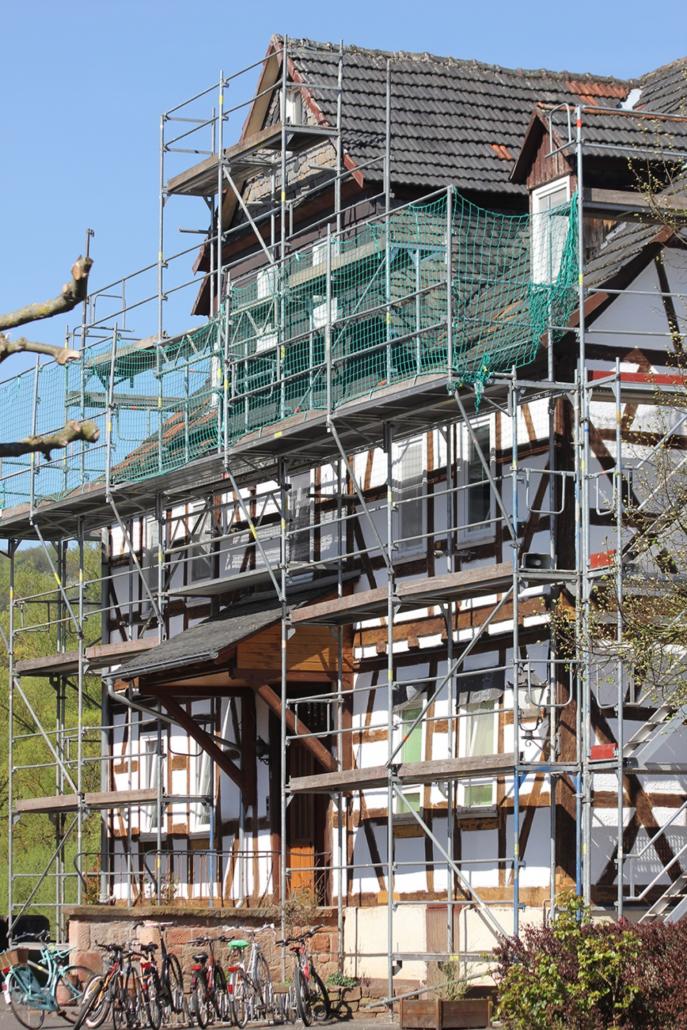
Extensive Renovations Underway at the Main Building / New Interior Design Creates a Comfortable Atmosphere
It’s no secret that a comfortable atmosphere is key to a good learning environment. It’s simply easier to live and learn in a pleasant setting! The main building of the Steinmühle Boarding School is therefore currently undergoing extensive renovations. Other buildings are set to follow. For the historic buildings—namely the main building, the mill, and the administration building—Steinmühle Boarding School is coordinating closely with the authorities. A restoration faithful to the original design is not only a requirement but also a matter close to the client’s heart.
Both inside and out, experts are restoring the main building—which first appears in the Steinmühlen Chronicle in 1794—to its former glory. The renovation of the half-timbered structure is in professional hands. As for the facade, the half-timbered structure is being repainted. The new roof is thermally insulated, thereby addressing energy efficiency considerations. The stairwell is being redesigned to match the building’s style and layout.
Life at the Steinmühle Boarding School: It all started with a model room
To create a cozy atmosphere with a modern touch, the students’ rooms were also spruced up. It was time for new furniture!
“It’s very important to us that our students feel comfortable in their rooms and see them as a place of retreat and relaxation,” say the boarding school’s administration and management. Naturally, the furnishings and atmosphere play a key role in this.
When considering what the students like, the school simply asked the students themselves. It seems that the interior design trend among the students is moving away from the classic wardrobe toward dressers or clothes racks.
Last year, the boarding school council—which serves as the representative body for the boarding school community and consists of members from each residential group—formed a small project group on this topic called the “Steinmühlen Showroom.” The team visited a well-known furniture store together, selected furniture, and calculated costs. A model room was then ordered, furnished, and tested. Following the test phase, the main building—as the first residential group—has now been completely furnished in this style and is already occupied.
The students were allowed to choose for themselves
“I really liked that. It was really cool that we got to choose and plan things ourselves,” says Leon Sauer. The 19-year-old student, who is currently in his senior year, had been living at the Steinmühle boarding school for seven years, served on the boarding school council in 2016–17, and participated in the “Model Room” project. For the past two months, he has been living in one of the newly furnished rooms in the main building, and he’s been delighted with the improved atmosphere, more storage space, and greater design flexibility. At the end of the school year, Leon will leave Steinmühle for Hamburg, where he’ll begin an apprenticeship at BMW—his dream job.
He’s happy for the students coming after him that the modern furniture has arrived: “A lovely living atmosphere has been created here. It’s really great.”
Further Renovations to Be Completed by the End of 2019
For the Steinmühle Boarding School, renovation work on the expansive, nature-rich grounds—as part of the “Stammhaus” project—is far from complete.
Last year, the boarding school administration office and the infirmary were renovated, and the roof of the mill was replaced.
Further renovation work inside and on the boarding school buildings will continue through the end of 2019: the Westfalenhaus, Hessenhaus, administration building, Bremerhaus, and Biohaus are on the schedule.
The Main Building of the Steinmühle Boarding School—Its History
The history of the main house dates back to the Middle Ages. As a residence and part of a complex consisting of a mill, stables, and farm buildings, it first appears in the chronicle of the Steinmühle in 1794 with an entry describing the condition of the residence: “[…] the stone miller Johann Carlé reports that there is reason to fear the collapse of the residence due to rot in the wood. […]. As a result, oak trees from the Marburg Forest and fir trees from the Wildersdorf Forest were provided, and orders were given to construct a new building.” The new building was presumably erected on the old foundation walls.
After passing through the hands of many tenants and owners, the stone mill—along with its residential building, stables, barn, and farmstead—lay abandoned from 1935 onward, and the buildings fell into disrepair.
Residence for the first 17 boarding students
In the place where the Müllers lived for centuries next to the new stone mill (built between 1494 and 1526), it has been our main building since 1949—the first home for the founding Buurman family and the first seventeen boarding students who arrived in October of that same year.
Previously, the building had been expanded toward the Lahn River to include a boarding school kitchen and a dining hall, as well as a central heating system and a washroom with a toilet and shower. The kitchen was located on the lowest floor, which is now the workshop; meals were transported to the upper dining hall via a food elevator: “A terrible contraption, since people were constantly getting injured there” (Buurman Sr.).
In 1961, the kitchen and dining hall were moved to the newly constructed building on Mühlgraben. The vacated dining hall was converted into living quarters, and the kitchen was turned into a classroom.
From 1969 to 1978, this building served as a kindergarten for employees’ children, and the Lahn grounds were fenced off and used as a playground with a sandbox and a swing set. The children and their teacher had to climb out through the windows using a small staircase to get outside. As the group grew smaller and the number of new children declined (due to the “birth control pill slump”), the kindergarten project was discontinued, and this lowest floor of the main building was converted into a workshop with a pottery studio and bicycle repair shop.
Educational Focus on intensive academic support
The two upper floors of the main building and the annex have since been occupied by middle and high school boarding students. The boarding school administration and the health care staff are now located on the lower level.
The old half-timbered house, which is currently being renovated—with a garden, a beach volleyball court, and a swimming dock right on the Lahn River, as well as spacious rooms and common areas—offers a cozy atmosphere where residents can feel at home. The educational focus of this residential group is on intensive academic support.


